RAF Typhoon and Mustang Losses Over Normandy (1 Viewer)

Ad: This forum contains affiliate links to products on Amazon and eBay. More information in Terms and rules

MIflyer

Captain
8,947
20,223
May 30, 2011
Cape Canaveral
Ran across an article by Barrett Tillman that says that 38% of the Typhoons used by the RAF to support Operation Overlord were lost, either as a result of going down or returning but being too badly damaged to repair.

That sounds horrible but it turns out that 44% of the RAF Mustangs employed suffered the same fate.

Of course, those RAF Mustangs would have included MkI, IA, and II Allison engined models performing "Army Co-Operation" missions as well as Mustang III/P-51B models doing fighter bomber duties. Westland Whirlwinds were replaced by Mustang III before D-Day.

So both the Tiffies doing ground attack and the Mustangs were in the thick of it, down low. The Typhoon was a big, tough aircraft if you don't count the tail falling off in the earlier models and the Sabre engine was not renowned for reliability. Being shot at could not have improved that situation. The Mustang's vulnerability to ground fire is well known. Neither airplane was known for its pleasant ditching characteristics, the Typhoon being so bad that it was considered to be a virtual death sentence. In contrast, the Tempest ditched nicely.

I wonder how many of the Mustang losses were the Allison engined versions. Of course they were mainly doing recon, a key feature of which was coming back with the pictures, so strafing targets of opportunity woud not have been encouraged and they were not carrying bombs.
 
I would think that in British service most Mustangs were engined with Allisons. The apparent conclusion would be that most shot down also had Allisons. I don't have numbers and so cannot answer your question directly. How many Merlin Mustangs did the Brits actually buy?
 
I would think that in British service most Mustangs were engined with Allisons. The apparent conclusion would be that most shot down also had Allisons. I don't have numbers and so cannot answer your question directly. How many Merlin Mustangs did the Brits actually buy?
2607 P-51 Mustang Production - MustangsMustangs.com

A-36NA-97EW998-1
Mustang INA-73AG345AG664320
Mustang INA-83AL958AL99942
Mustang INA-83AM100AM257158
Mustang INA-83AP164AP263100
Mustang IANA-91FD418FD44932
Mustang IANA-91FD520FD56748
Mustang IANA-91FD451FD51868
Mustang IINA-99FR890FR93950
Mustang IIIP-51B/CFB100FB12425
Mustang IIIP-51B/CFB135FB399265
Mustang IIIP-51B/CFR411-1
Mustang IIIP-51B/CFX848FX999152
Mustang IIIP-51B/CFZ100FZ10910
Mustang IIIP-51B/CHB821HB962142
Mustang IIIP-51B/CHK944HK9474
Mustang IIIP-51B/CHK955HK9562
Mustang IIIP-51B/CKH421KH640220
Mustang IIIP-51B/CSR406SR43833
Mustang IIIP-51B/CSR440-1
Mustang IVP-51DKH641KH67030
Mustang IVP-51KKH671KH870200
Mustang IVP-51KKM100KM492393
Mustang IVP-51DKM493KM743251
Mustang IVP-51D/KTK586-1
Mustang IVP-51D/KTK589-1
Mustang IVP-51D/KKM744KM79956
P-51HNA-126KN987-1
RAF Mustangs 2607
 
2607 P-51 Mustang Production - MustangsMustangs.com

A-36NA-97EW998-1
Mustang INA-73AG345AG664320
Mustang INA-83AL958AL99942
Mustang INA-83AM100AM257158
Mustang INA-83AP164AP263100
Mustang IANA-91FD418FD44932
Mustang IANA-91FD520FD56748
Mustang IANA-91FD451FD51868
Mustang IINA-99FR890FR93950
Mustang IIIP-51B/CFB100FB12425
Mustang IIIP-51B/CFB135FB399265
Mustang IIIP-51B/CFR411-1
Mustang IIIP-51B/CFX848FX999152
Mustang IIIP-51B/CFZ100FZ10910
Mustang IIIP-51B/CHB821HB962142
Mustang IIIP-51B/CHK944HK9474
Mustang IIIP-51B/CHK955HK9562
Mustang IIIP-51B/CKH421KH640220
Mustang IIIP-51B/CSR406SR43833
Mustang IIIP-51B/CSR440-1
Mustang IVP-51DKH641KH67030
Mustang IVP-51KKH671KH870200
Mustang IVP-51KKM100KM492393
Mustang IVP-51DKM493KM743251
Mustang IVP-51D/KTK586-1
Mustang IVP-51D/KTK589-1
Mustang IVP-51D/KKM744KM79956
P-51HNA-126KN987-1
RAF Mustangs2607

I hadn't realized the disproportion of Merlin Mustangs in the RAF, thanks for the info.
 
The RAF Squadrons that had operated the Westland Whirlwind as 'Whirlibombers' had transferred over to Hawker Typhoons.

44% of RAF Mustangs in same timeframe, what exact timeframe is he using? What is the base line in terms of the effective available airframes that he is working from, and what is he basing his figures on?

Certainly, the planners predictions pre the commencement for Operation Overlord for the potential losses of most RAF front line types in the worst case scenario if the Germans were to put up a particularly stiff defence, with a massive movement of Luftwaffe fighters from the Eastern Front, MTO and Germany in response to the Allied landings in Normandy. Looking through the Air Ministry and SHAEF files, as well as talking to some of those who were involved in the planning at relatively high levels - they were BIGOT'ed - cleared and restricted from operations as they knew the intended landing zones and approximate dates - there were contingencies for up to 50% losses of RAF fighter reconnaissance aircraft, primarily the Allison engine Mustangs in the first month of the invasion operation. But it came no where near that.

As an example, one RAF Squadron operating Mustang IA, that was particularly active, covering period from D-Day to end of August 1944, out of initial strength of 18 aircraft and 24 pilots:
5 missing at time (mixture of shot down by enemy fighter or flak: 3 x MIA, 1 x PoW, 1 x evaded);
4 damaged (3 x flak, 1 x fighters), repaired and returned to service with unit;
4 written off - 2 x damaged in action; 2 x accident (1 x accident UK airfield, 1 x accident ALG France) - pilots all 4 safe.

But, those aircraft lost or damaged, replacement aircraft issued from Group Support Unit in some cases same day or usually next day, with in the cases of lost or injured pilots, a replacement pilot posted in within 48 hours and most of the replacements were experienced pilots notionally 'on rest' or held in a reserve pool at the GSU. So the number of effective available aircraft remained close to the establised 18 for that 3 month period, there was no issues with replacements at the time.

In that timeframe some of the other Tac/R Mustang units fared better with lower losses.

That period where the majority of the missing and damaged were incurred, was when the period when the Luftwaffe units did arrive in France and they particularly went hunting for the Tac/R aircraft. That in turn led to the Tac/R aircraft being given a 'loose' escort of Spitfires flying in the same area and above them to provide some protection. Montgomery did issue a directive, from memory late June, which was endorsed by 2TAf that the pilots of the Tac/R Mustangs were not to engage in strafing or attacking targets of opportunity. Their primary focus was to come back with their photos and visual observations. With advanced controllers in France, they could also report urgent sightings and other aircraft could be directed onto what were considered high priority 'fleeting' targets. The restrictions were not removed until late August to early September after the breakout and pursuit of the retreating German Armies from France had begun in earnest.

In relation to the RAF Merlin engine Mustang units, most of those had converted over from either Spitfire V or Spitfire IX - the units that converted over from Spitfire IX, their aircraft usually went to upgrade a Spitfire V Squadron.

Again would depend on the timeframe and the basis for the statement - on D-Day only six RAF Squadrons had converted over to the Mustang III - No.122 WIng in 83 Group comprising No.s 19, 65 & 122 Squadrons, and No.133 (Polish) Wing in 84 Group comprising No.s 129, 306 (PAF) and 315 (PAF) Squadrons. In June 1944, both WIngs were very active with 'armed reconnaisances', sweeps and bombing sorties - particularly against bridges, transportation hubs, etc. So main losses are to flak, a number of aircraft damaged but later returned to service, and both wings in later June get mixed up in some large dogfights with large formations of Luftwaffe fighters with some losses, but higher scores against the Luftwaffe. Miid July No.133 Wing was moved onto anti-diver patrols based in the UK, so are effectively outside the scope of operations directly associated with the invasion. No.122 Wing stays active and moves to ALGs in France.

What may skew the Mustang III 'loss' figures in that period is the next wave of Squadrons converting over to the Mustang III back in the UK in that period, which does result in a number of aircraft being damaged and lost due to accidents, a large percentage of the damaged are repaired and returned to service.

If you just look at the daily loss summaries as a source, it does paint a worse picture in relation to 'losses' as it is that day's 'snapshot' of what was known on the day in terms of 'losses' and effective aircraft available to each Squadron. There are also in the daily summaries of losses a number of the 'unknowns', aircraft recorded as 'lost' or 'missing' of which a number would later turn up at another airfield having put down due to battle damage or mechanical issues and where information of the aircraft and pilot being 'safe' did not make it back in time for the daily reports.

That's my quick 2 bobs worth.
 
Using Fighter Command Losses series by Norman Franks, which could do with a strong revision, in theory it is combat losses only. Being all war it is a nice single source, showing things like the winter quarters effect.

May to October 1940, losses 391, 93, 95, 357, 327, 126

Losses exceed 100 again in July and August 1941, then in April and August 1942, then September 1943

May 1944 to April 1945, losses 117, 321, 210, 251, 174, 120, 98, 141, 235, 177, 149, 217.

The Luftwaffe definitely tried to intervene in Normandy. In terms of allied fighter kill claims, for the RAF in Britain and France June and July 1944 are the fourth and fifth highest months, after May, August and September 1940. For the USAAF fighters in the European Theater of Operations, June 1944 is sixth and July 1944 tenth in terms of air to air kill claims. The top 5 are, in order, December, May, September, August and November 1944.

Looking at the loss figures the Tillman article defines Overlord as probably June and July 1944.

Aircraft for the Many by Michael Bowyer lists the 1 June 1944 strength in squadrons as 95 Allison and 130 Merlin Mustang, 1,148 Spitfire, 36 Tempest, 376 Typhoon. Lots of Spitfires were guarding Britain as part of ADGB, with some used offensively, 2nd TAF had 546 Spitfires, Tempests soon found themselves on V-1 duty, along with Merlin Mustangs.

Allison Mustang losses, 30 in June and 9 in July, for the two months 46% of starting strength
Merlin Mustang losses, 41 in June and 13 in July, for the two months 41.5% of starting strength (Mustangs total 43%)
Spitfire losses, 142 in June and 87 in July, for the two months 20% of starting strength
Tempest losses, 4 in June and 13 in July, for the two months 47% of starting strength (The low numbers effect)
Typhoon losses, 81 in June and 62 in July, for the two months 38% of starting strength

Sanity Check, RAF Census, all cause losses at home cumulative to end May, end June, no data for July
Allison Mustang 253, 289, difference 36
Merlin Mustang 35, 82, difference 47
Tempest 6, 12, difference 6
Typhoon 881, 963, difference 82 (remembering hundreds were reduced to spares in 1943 due to lack of engine supply)

Day operations, June 1944, 2nd TAF 30,674 sorties, ADGB 17,148 sorties of which 4,905 for UK defence or air sea rescue. July 1933 2nd TAF 40,151 sorties, ADGB 14,701 sorties of which 9,242 for UK defence or air sea rescue.

Williamson Murray notes May and June 1940 cost the Luftwaffe 28& of starting strength (all cause losses) July to September 37%. Also 8th Air force monthly heavy bomber losses January to April 1944 were 20 to 25% a month. It is interesting to note the WWI loss figures during the Fokker Fodder period were considered very bad at the time but were generally lighter than the ones considered acceptable in WWII.

Mustang production spreadsheet attps://ww2aircraft.net/forum/threads/mustang-numbers.61924/
 
Gentlemen

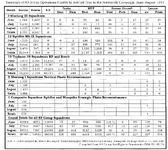
The following data is for 83rd Group, for June through August 1944.

In the context of the table MET stands for Motorized Enemy Transport.

FWIW

Eagledad
 

Attachments

  • 83 group Stats 6-44  8-44.png
    83 group Stats 6-44 8-44.png
    52.5 KB · Views: 41
What is interesting to me is that 10 squadrons of Typhoons was doing 0.0001% air to air work ;)
Which means the Mustang IIIs and the Spitfires were doing the air to air work keeping the Germens off the back of the Typhoons.
It was a coordinated effort. The British had figured out how to escort fighter bombers. The Typhoons were NOT escorting themselves.
 
The Typhoons were NOT escorting themselves.
A good point! I can recall only two cases in which Typhoons were assigned as escorts. One was a B-17 mission and the other was the Mossie raid on the Aimens prison. It was not a high altitude airplane. And I recall a case in which Lancs were hitting the Cherborg area in a daylight raid in June 1944; they used Mossies as escorts.

I still maintain that the P-40N would have been as good a choice as the Typhoon for CAS and a much better choice than the Spitfire.
 
The RAF Mustang IIIs during the invasion period did a mix of tasks. What the 83 Group stats doesn't show is the significant percentage of the tasks flown by the Mustang IIIs that were against fixed targets, such as suspected enemy HQs, supply depots, railway stations/yards where reinforcements and supplies were being brought in, major road junctions and especially bridges, punts and ferries. By the time the Germans were in retreat from Normandy, back across the Seine, the Mustang IIIs were carrying a payload of 2 x 1000lb bombs for attacks on the Seine crossing points and concentrations of German troops, vehicle and armour trying to get back across the Seine. The RAF Mustang III Wings, operated to a large degree as the campaign developed on a 'self escort' basis when operating as fighter bombers. So for example a flight of 4 Mustang IIIs carrying bombs escorted by another flight of 4 Mustang IIIs from the same Squadron, or 2 of the Squadron's in the Wing carrying bombs, escorted by the other Squadron in the Wing.

The RAF Mustang III Wings in 83 and 84 Groups both flew on a couple of occasions in June and July, Wing strength fighter sweeps over particular sectors of the beachead perimeter. These were usually in response to an uptick in Luftwaffe activity in a particular sector and complaints from Army units of being attacked by enemy aircraft. As a result a series of Wing sized sweeps by Spitfires and Mustangs would be performed in the area, which on a number of occasions resulted in some large scale dog fights with larger formations of Luftwaffe fighters.

Thrown into that mix on a couple of occasions were escort tasks by the RAF Mustang IIIs to RAF Medium bombers, including Mosquitos, Bostons and Mitchells and USAAF Marauders.
 
Tomo Pauk,

Sorry, I do not know for certain if they are claims or actual losses. These tables can be found in the paper attached below. My impression (guess) is that they are probably claims. Will gladly accept any corrections.

Eagledad
 

Attachments

  • 83rd Group Normandy Campain.pdf
    8.5 MB · Views: 31
The tables on pages 139-140 are titled "claims".
There are also interesting notes on overclaiming and the number of sorties and rockets per one destroyed (and verified) vehicle, as "roughly 88 rockets and 11 sorties per destroyed vehicle" - page 108.
 
Just to note that the Mustang Production table from the MustangMustangs website has some errors and is incomplete.

As examples:

The 'sole' A-36A shown EW998, after being used by the RAF for trials was returned to the USAAF. It also misses the six A-36A that were provided by USAAF 12th AF in the MTO to the RAF for use by No.1437 Strategic Reconnaissance Flight in 1943, which were issued in-theatre RAF serials in the HK range.

In the NA-91 P-51, it lists nearly all the allocated RAF serials, but misses the RAF serials for the two NA-91 P-51 that were retained by the US and allocated to NAA for the XP-51B program - they did have RAF serials allocated. It also misses the other 56 NA-91 P-51 that were held back by the US from the Lend Lease order and initially allocated to the USAAF. They were allocated RAF serials, but the RAF never got them.

Similar happens a fair bit in the early P-51B/C production where under the proportional arrangements for the production run, a certain percentage were for the USAAF and the remainder were for the RAF. Those originally destined for the RAF were given RAF serials ex the factory. A number of the early P-51B/C that were delivered to the UK for the RAF in RAF c&m and carrying RAF serials ex the NAA factory, were reallocated on arrival in the UK to the USAAF. They were handed over to the USAAF 8th AF for the build up and conversion of USAAF units over to the P-51B/C for use as long range escort fighters. They were supposed to be 'backfilled' with P-51B/C from later deliveries to the UK destined for 8th AF, so there is a range of discrepancies in actual serials and actual numbers delivered and received.

The table also misses the RAF serials allocated for the 'light-weight' P-51s allocated to the RAF, XP-51F and XP-51G from those built, against those that were actually delivered to the UK for testing.


The figures in the table in the 83 Group thesis and articles, are based off the original monthly summaries, which in turn are based off the daily reports and weekly summaries provided by units in 83 Group to 83 Group HQ. So they are figures that represent what was known and claimed at the time. Sometimes in the timeframe between the daily/weekly summaries and the production of the monthly summary, new information had come to light, eg examination of gun camera film, other confirmation such as reports from ground witnesses such as Army units observing action or entering area where attack took place, or similar, then the figure may have been subject to some minor revision at that stage.

To give you an example of how initial reports and later reports may not always match up, two 84 Group pilots I am aware of were reported initially 'missing', but were later updated due ot lack of further information were considered KIA. They were not reported as PoWs, and as aircraft were lost at low altitude chances of survival were considered low. In both instances pilots had successfully survived being shot down and were evading. Both eventually were in areas that were liberated by advance of Allied ground forces, and made their way back to UK - often by means most unusual. Signals were sent to their units, Wing and 84 Group HQ advising of their safe return having successfully evaded. Both appeared in a post-VE-Day 84 Group casualty "Roll of Honour" listing which was drawn up - so again if someone used that original document as a source, it did include errors.
 

Users who are viewing this thread

Back