Required headwind for carrier aircraft launch?

Ad: This forum contains affiliate links to products on Amazon and eBay. More information in Terms and rules

BTW, my ship was one of the last ones to have a C-1 hack permanently assigned to the ship and while they would trap to board, all take offs were a deck run off the angle.
When I got an opportunity to go out and visit an A School classmate who was in charge of the PLAT system on the Lex, I was excited about getting a trap and a cat shot. So I and a bunch of Pensacola instructors are all buttoned up in a stoof (US2B) to head out to the boat when #2 engine can't get its oil pressure up. So the duty SH3 fires up and trundles us out to the boat. Shoot, there goes my trap!
After watching a bunch of Dilberts scare themselves, their instructors, and the LSOs in their T28s, it's time to head back in a heavily loaded C1. I plugged into the intercom (I was in what would have been the plane captain/loadmaster seat), and heard the pilots talking about currency issues. Turns out the SIC (who was pilot flying on this trip) was two days away from being out of currency on deck run takeoffs so the skipper calls ops, cancels the scheduled cat shot and gets clearance for a deck run. Shoot, there goes my cat shot! The deck was bare, so we got clearance for full length. It was an eye opener looking down and watching the left main wheel rolling along about two feet from the deck edge and the catwalks as we taxied back to the rounddown. When we ligned up for takeoff, I swear our tail was hanging out over the ocean.
God, those 1820s are noisy! And they feel like they're shaking themselves to death. Acceleration could best be described as a waddle. If we had thirty knots going by the island, I'd be surprised. Of course I couldn't see forward but it looked like we got airborne in the last 100 feet of deck. Quite an experience for someone in the jet fighter world.
Cheers,
Wes
 
I had an uncle who flew TBMs off ASW jeep carriers in the Atlantic Uboat war. He hated the hydraulic catapults, said they "beat the crap" out of the planes. He was catapult qualled on a CV with steam cats, then his squadron was broken up because the carrier they were destined for was rendered inoperative by battle damage, and the personnel were sent out as individual replacements. He wound up on CVEs doing ASW.
He said the steam cats had a relatively "soft" start with an exponential rate of acceleration, which he likened to a compound bow. The hydraulics, OTOH, he said "snapped" you into motion with the thrust sensation actually dwindling as you approached the forward deck edge, sort of like a straight or recurve bow. He said that if the engine coughed at that point you were about to play submarine and the ship would run right over you. Cheery thought.
Wes
Steam catapults were a post WWII invention.
 
Steam catapults were a post WWII invention.
So all the sources say, but Uncle Ned was a straight arrow, not given to inventing experiences or enhancing the facts. I'm guessing he got to experience a pre-deployment experimental prototype. He didn't stick around after demob, and had had his fill of operational flying, preferring "a nice warm passenger cabin with good food and pretty stews" for the duration of his 30+ years in the foreign service postwar.
He and my Aunt Dorothy raised their two sons all over Asia in such garden spots as Taipei, Kuala Lumpur, Jakarta, Karachi, Madras, and Singapore.
Cheers,
Wes
 
Last edited:
WWII aircraft carriers rarely used their catapults. In fact the Japanese carriers did not have them.
For all their focus on naval aviation the Japanese seem to have neglected much of the essential elements. Catapults are useful on crowded decks or at low wind over deck conditions, but not having radar equipped carriers and radio-equipped fighters seems a deep oversight. Imagine at Midway if the Japanese fleet had 30-45 min warning over the Dauntless dive bombers approaching.
 
Launching CV a/c without wind was demonstrated in the 50s when steam cats replaced hydraulics, tho I would not claim it never happened previously (acknowledging the reference to hangar-deck cats.) But obviously heavier jets needed more end speed than recips, and the procedure became known as "Flanchor Ops" for Flying At Anchor.

In a Midway context, the front-spotted Enterprise SBDs were the CAG section and scouts with 500- v. 1,000-pounders.
 
Steam catapults were a post WWII invention.
So all the sources say, but Uncle Ned was a straight arrow, not given to inventing experiences or enhancing the facts. I'm guessing he got to experience a pre-deployment experimental prototype. He didn't stick around after demob, and had had his fill of operational flying, preferring "a nice warm passenger cabin with good food and pretty stews" for the duration of his 30+ years in the foreign service postwar.
He and my Aunt Dorothy raised their two sons all over Asia in such garden spots as Taipei, Kuala Lumpur, Jakarta, Karachi, Madras, and Singapore.
Cheers,
Wes

The USN was 100% in on hydraulic cats - post-WW2 they developed the stronger H-8, which was installed on the modernized Essex class CVs in the late-1940s/early 1950s (as well in the Midway class in the late 1940s to replace their H-4-1s), and even soldiered on through the early 1970s in Essex-class CVS ASW carriers. They were working on an even more-powerful H-9 for the USS United States in the late 1940s.

The USN's shift to steam catapults in the early-mid-1950s was based on the British steam "slotted cylinder" design - which had started development in 1946, using a modification of a German catapult design for the V-1!

I don't know what the USN might have been using with what your father described - I have never seen anything anywhere saying that the USN ever experimented with steam vs hydraulic/pneumatic or explosive catapult designs (they had fitted flywheel catapults aboard Lexington & Saratoga starting in 1928, but removed them by 1937).
 
Unfortunately the RN had a complex trolley system which resulted in slower cycle times. A Seafire is catapulted off at the 50 sec mark of the following video. You can see the trolley.


The aircraft had to be equipped with spools to hook up to the trolley which had the unfortunate effect of increasing drag. The spools are visible at the 9.50 mark of the following video.


Although such a protuberance wouldn't have much effect on a Walrus, it would on a Seafire.

I found this video of a Firefly also on the trolley.


View: https://m.youtube.com/watch?v=jH2HwUKSwqM&pp=ygURRmxlZXQgYWlyIGFybSB3dzI%3D
 
Try Norman Friedman's U.S. Aircraft Carriers: An Illustrated Design History. He spends time writing about the trades in the 20's and 30's for US carrier design, size, speed. Wasp was considered a marginal design by Adm King, who was chief of BuAer in the late 30's, due to her low speed providing little to help an aircraft take off. She was a compromise for available tonnage , speed and size.

 
Last edited:
As an Amazon Associate we earn from qualifying purchases.
Try Norman Friedman's U.S. Aircraft Carriers: An Illustrated Design History. He spends time writing about the trades in the 20's and 30's for US carrier design, size, speed. Wasp was considered a marginal design by Adm King, who was chief of BuAer in the late 30's, due to her low speed providing little to help an aircraft take off. She was a compromise for available tonnage , speed and size.

Wasp was designed to use up the available carrier tonnage left to the USN (after converting Langley CV-1 to a seaplane carrier) under the Treaty system. That led to a number of compromises in the design. But her designed speed (29.5 knots) was more than adequate for the task. It matched Ranger and was only about 3-4 knots less than the other USN carriers built inter-war. Contrary to the popular view, carriers did not need to hare about the oceans at max speed to launch / recover aircraft for the vast majority of their time at sea.

And before it is brought up, Ranger was not sent to be an operational carrier in the Pacific in WW2, not because of her speed or other weaknesses in her design characteristics, but because of other demands placed upon her. Those so called weaknesses were used as excuses to ensure that she remained under USN control in 1942/43. Then after mid-1944, when she was sent to the Pacific, she was too valuable in the training role and full modernisation was deferred due to there being higher priorities.

For a full analysis of the background to her wartime use and the politics around it see:-
 
As an Amazon Associate we earn from qualifying purchases.
Wasp was designed to use up the available carrier tonnage left to the USN (after converting Langley CV-1 to a seaplane carrier) under the Treaty system. That led to a number of compromises in the design. But her designed speed (29.5 knots) was more than adequate for the task. It matched Ranger and was only about 3-4 knots less than the other USN carriers built inter-war. Contrary to the popular view, carriers did not need to hare about the oceans at max speed to launch / recover aircraft for the vast majority of their time at sea.

And before it is brought up, Ranger was not sent to be an operational carrier in the Pacific in WW2, not because of her speed or other weaknesses in her design characteristics, but because of other demands placed upon her. Those so called weaknesses were used as excuses to ensure that she remained under USN control in 1942/43. Then after mid-1944, when she was sent to the Pacific, she was too valuable in the training role and full modernisation was deferred due to there being higher priorities.

For a full analysis of the background to her wartime use and the politics around it see:-
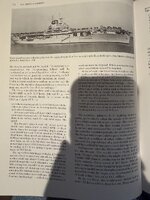
Agreed. Adm King thought 29.5Kts the minimum for carrier operations to provide adequate wind over the deck. Wasp was a compromise to achieve the 29.5 on available treaty tonnage. Another interesting note, the Yorktowns were designed to make 30 kts in reverse, to allow deck operations if the forward flight deck were damaged. Attached is a letter King wrote to the CNO on Ranger's speed. During the War there were studies to bring Ranger up to the 32 kt standard, but new construction was leaving the yards at a pace that it wasn't necessary. The US standard of 32 kts for fast ships was tied to doctrine for flight operations.

Excerpt from Norman Friedman's U.S. Aircraft Carriers, Revised Edition: An Illustrated Design History, Naval Institute Press, Copyright 1983. The book is very good for anyone interested in US carrier development and doctrine.
 

Attachments

  • IMG_8406.jpg
    IMG_8406.jpg
    162 KB · Views: 13
Last edited:

Users who are viewing this thread

Back