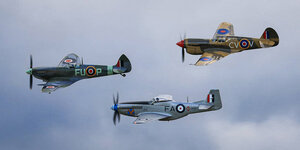
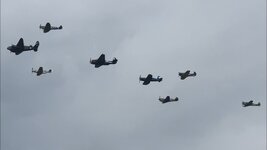
Wherever possible, the aircraft were dispersed around the field, in blast pens if available, in order to mimimise damage or loss should a bombing or strafing attack take place.
However, even with this precaution, a number of aircraft with exactly the same pattern of camouflage would be more noticeable, from the air, than those with alternating patterns, even if the latter application only had marginal effect.
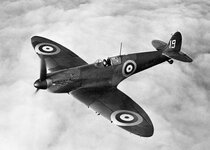
It should also be noted that the RAF camouflage patterns had to try to suit two purposes - disruption of shape on the ground, and in the air.
The "wavey" pattern wasn't just something chosen at random, it was to help break-up a recognisable shape against the irregular background of the British countryside, with its varied shapes of fields, hedges, heathland, woods etc, and help to blend in to this background.
Luftwaffe aircraft of the period had a hard-edged "splinter" pattern of camouflage, designed to fulfil the same requirements, originally over Germany itself, and then later northern Europe, where the terrain looks more "regular", with fields that are more straight-edged, rectangular and distinctive, compared to the apparently haphazard appearance of the British terrain.
Whatever the period or region, the main requirements of camouflage still apply - Shape, Shine, Shadow and Silhouette, with at least three of these requirements being fulfilled, at least to an extent, by the correct use of the required colours, and the use of matt paint.
During the filming of the BoB movie in 1968, it was found that the "Sky" undersides on the Spitfires and Hurricanes blended-in to the background, and the aircraft were difficult to spot and track with the cameras, and wouldn't be very clear on the "big screen", hence the reason the aircraft were re-painted in a light blue underneath !