I'll post again here the Hanseman combat report, so that anyone loosely following here can judge for themselves if the situation Hanseman describes is clear...:
http://www.spitfireperformance.com/mustang/combat-reports/339-hanseman-24may44.jpg
Gaston - use YOUR intellect and quit trying to use someone else's narratives
Fully correlating this are at least 6 other Merlin P-51 combat reports with the exact same 3 downthrottling steps at low speed, including the strange coarser prop pitch at low speeds...
If an airplane is entering a turn at relatively high speed, with an equally performing aircraft in a turn at lower speed - and he wishes to pursue it - then he must reduce his speed to enter the turn. If he doesn't lower his speed he will remain 'faster' but his RATE of turn will be slower (to you that means it will take Longer to complete a 360 degree turn) and his Radius of turn will be greater. If he engages under these circumstances the Other aircraft will eventually end up on His tail.
So, if he wishes to slow down fast he not only reduces throttle (that is reducing power to the prop), but he increases drag by changing pitch from Fine to Coarse-(er). The latter changes the angle of attack to Increase the blade pitch creating more drag on the propeller disk - which slows the airplane down rapidly.
Hence - not 'Strange' if you want to slow down.
Further correlating the use of downthrottling is a FW-190A-8 Western Ace describing using the FW-190A-8 ONLY as a
downthrottled low speed horizontal turn fighter, preparing for the merge with P-51Ds by downthrottling and popping the flaps long before the merge... Doing this "I feared no other aircraft in my FW-190A-8"... And he described the three ailerons type he could choose from, how he chose the widest chord for low speed performance at all costs, and added field-installed hinge "spacers" to widen the aileron chord further to catch better the low speed stall while turning...
He then described how, with the wider wood prop, reduced throttle and wider ailerons he reversed a
tailing P-51D
on the deck in
two 360 turns, the formerly-tailing P-51D almost straining into a stall just before being hit and shot down...
The relative who posted this direct from the pilot's mouth did not say the pilot's name, and this Aces High thread was pulled by "Hitech" after many pages as it wasn't in line with his obviously well-set notions on the issue... (Note Hitech is also a recent P-51D pilot)
But even if you think that this above FW-190A-8 ace thing was all a fraud, including all that business about spacers on the aileron hinges

, you still have a third aircraft type to deal with, along with another multiple ace pilot singing the praises of downthrottling...:
virtualpilots.fi: 109myths
Quote:
"I learned to fly with the "Cannon-Mersu" (MT-461). I found that when fighter pilots got in a battle, they
usually applied full power and
then began to turn. In the
same situation I used to
decrease power, and with lower speed was able to turn equally well. I shot down at least one Mustang (on 4th July 1944) in turning fight. I was hanging behind one, but I could not get enough deflection. Then the pilot made an error: he pulled too much, and stalling, had to loosen his turn. That gave me the chance of getting deflection and shooting him down. It was not impossible to dogfight flying a three-cannon Messerschmitt."
"
When the enemy decreased power, I used to throttle back even more. In a high speed the turning radius is wider, using less speed I was able to out-turn him having a shorter turning radius. Then you got the deflection, unless the adversary did not spot me in time and for example banked below me.
250kmh seemed to be the optimal speed."
- Kyösti Karhila, Finnish fighter ace. 32 victories.
Notice the extraordinary quoted "optimal sustained turn speed" for the Me-109G-6: A measly 160 MPH (250 km/h) or barely 60 MPH above stall was
optimal...
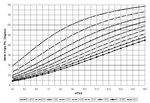
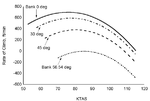
 Ah Grasshopper, stall speed for a banked turn is much higher than for level flight. 160mph is also the approximate stall speed for a P-51D at 9800 pounds, 1600 hp, 3000 rpm, 3g turn... whereas the stall speed for the same P-51D in level flight is approximately 94mph. Your would not be so great if you understood trig, and the relationship between CLmax and stall, and further understood that in a turn the airplane increase relative angle of attack as the bank angle increases..I will post a few images below to help you work throught these concepts visually.
Now downthrottling, in the sadly confused currently accepted theory sense, should apply only if you are above "Corner Speed"... Below that it makes no sense to downthrottle for the highest turn rate...
Ah, Grasshopper - 'Corner Speed' is a very meaningful term describing the maximum G versus velocity which the airplane is intended to remain 'intact' - that speed may be reached in a near terminal dive and pullout for WWII fighters (i.e' 'vertical turn for you)... but no WWII fighter had the thrust to sustain a 360 degree turn at much more than 2.8 to 3.1 G - and the velocity in that turn (just before stall) would be ~150 to 170 mph. An F-16? different story.
In your spare time look up V-n Diagram to further explain Corner speeds (two) for positive and negative design limits for each airframe/engine combination.
Simply, exceed Corner Speed at your own risk sayeth the manufacturer, for to exceed such risketh loss of critical components of your metal steed - like your wing...
When you wish to dabble in the arcane art of science and math, and begin to understand the relationships between Weight, Lift, Wing Area and Density of air, you may find pearls of wisdom to bridge ignorance of the laws of the universe (Newtons laws at least)
V*=Sqrt [2*nmax*(W/S)/({Rho@Sl*CLmax)] at sea Level
Where V*=corner Speed
nmax = airframe mfr Limit Load factor (positive and negative)
CLmax = maximum Lift Coefficient (stall break point)
W= weight
S= wing area
rho@SL=density of air at seal level
"Corner Speed", the lowest speed at which a given amount of Gs can be reached,
reached, ie: regardless of sustainability, is for WWII aircrafts usually given for 6 Gs, since that is pretty much the pilot's practical limit without G suit...
Correct, as noted above - and has nothing to do with any WWII aircraft in a sustained 360 degree turn.
For most if not all prop WWII fighters, the 6 G "Corner Speed" is
calculated to be between 220 MPH and 280 MPH: They almost all fall, according to aeronautic engineer math

, in between these two values... Sort of a high mid-range of speeds: Makes sense intuitively...
So 220-280 MPH is the range of the lowest speed to reach 6G...
So V*= Sqrt {[2*6.83/(.0023769*1.72)]*(W/S)} for SL in feet per sec. Remember to divide the final answer by 1.467fps/mph toget speed in miles per hour.
For a P51D at 9800 pounds, in a 6.83 G (Limit Load for a D at 9800lbs), CLmax=1.72, Wing Area at 233.2 sq ft, sea level density = .0023769 slugs
V*=Sqrt(140413) = 374.71fps = 255mph for the P-51D for limit load and 312mph for ultimate load at sea level. At 15000 ft the corner velocity = 322 mph for limit load and 394 mph for ultimate load.
At 10,000 feet, 6g (NOT G limit load for P-51D at 9800 pounds GW), the same velocity calculates to 278.6 mph - note, increasing the 'n' to 6.83 G Limit load for same GW, the CORNER Speed then is 297.2 mph.
You are parroting what you think you learned on the other threads but that is the math behind the discussion. Incidently the P-51A had a higher Corner Speed because it was lighter and had the same CLmax and wing area. The original design limit load by NAA was based on 8G at 8000 pounds gross weight
Does anyone know how well the aeronautic engineer math

did when that value was actually looked for and tested in flight for the P-51D, FG-1, F6F-5, P-47D?
I await the answer I am sure someone has out there... Hint: The aeronautic engineer math didn't do too well...
Gaston





 ...
...


