No information on pre war US aircraft bombs beyond there would have been trials with AP and SAP versions.
British Statistical Digest, filled weight of bombs by year, 1940 to 1944, short tons, 51,093 plus an unknown amount of incendiary and smoke bombs, 147,848, 211,048, 223,807, 309,246, the first 9 months of 1945 it was 244,498 tons (all including incendiaries and smoke). Unfortunately it counts AP and anti submarine bombs together.
The Ministry of Aircraft Production goes with weekly averages and the monthly figures jump around a lot. There were 2,000 pound AP and 250 and 500 pound SAP bombs in production in January 1941, in that month the average number per week were 9, 832 and 236 respectively, January 1942 it was 33, 723, 909, January 1943 112, 720, 1,960, the 250 pound went out of production in May 1943, the 500 pound in December, while production of the 2,000 pound AP was paused August to October 1943 before ending in July 1944.
MAP reports Anti Submarine bombs ended production in October 1941. Assuming that is correct than British AP and probably SAP bomb production per the Statistical Digest 1942 to 1944 was 26,798, 19,061, 1,788 tons but as a warning also says 80 tons of AP and AS bombs Q1 to 3/1945.
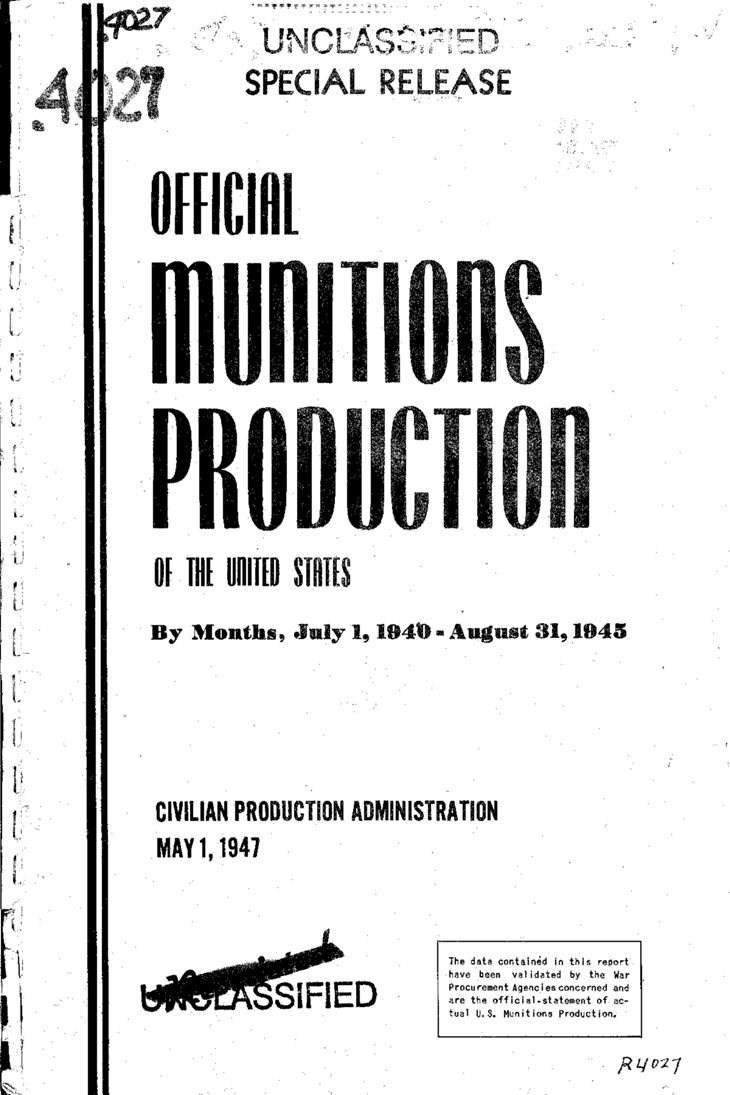
The useful bomb production figures Ewen is quoting come from the War Production Board Report, available at
Contains data on actual production by months from July 1, 1940 at the beginning of the War Program, through August 31, 1945, the last month of actual fighting against Japan. Covers aircraft, ships, ordnance and automotive vehicles (guns and small arms, ammunition and bombs, combat and motor...

cgsc.contentdm.oclc.org
Section III pages 217 to 224
In Summary around 2,000 tons of bombs in the second half of 1940, then 40,000, 493,000, 1,005,000 and 956,000 tons 1941 to 1944 then 1,130,000 tons January to August 1945. This hides a major drop in production from 114,000 tons in September 1943 to 45,000 tons in January 1944, then back to 116,000 tons in December, it made the top 7 months of production January to July 1945. The drop is probably due to consumption reports for the North African fighting in particular as well as world wide numbers.
The AP/SAP bomb program started in January 1942 and was wound down to zero for a time in early 1944, by year 52,400, 175,200, 36,500 tons and 29,500 tons January to August 1945. With a 2,000 pound AP SAP bomb produced in 1945. Apart from the small runs the "standard" 1,600 pound AP, 1,000 pound AP, 1,000 pound SAP and 500 pound SAP went in and out of production at least once. The odd weight one offs tended to be repurposed USN shells.
The USAAF Statistical digest reports no usage of AP or SAP bombs in 1943, in Europe it was 1,122x1600 AP, 11,633x1000 SAP and 20,934x500 pound SAP in 1944, 4x1600 AP, 4,587x1000 SAP and 9,981x500 pound SAP in 1945, against Japan again nothing in 1943, 633x1000 SAP in 1944 and 5,675x1000 SAP and 78x500 pound SAP in 1945 (also add 31 torpedoes in 1945)
When it comes to the USN the pre war treaty limits gave it a comfortable superiority in battleships, add the low load carrying capacity of the aircraft but their usefulness as spotters meant the USN carriers were orientated towards destroying enemy air power with a bonus of inflicting damage on enemy lighter warships. Reinforced by the way the IJN was matching USN carrier numbers. From 1935 to 1039 the USN built BG-1, SBU, SBC, SB2U, BT-1 dive bombers and the TBD Devastator torpedo bomber, the RN was the reverse, emphasising torpedo bombers. Early in WWII the submarine threat was upgraded.
Paraphrased from Friedman, US Aircraft Carriers, representative magazine loads. There is a suspicion some of the entries are typos, repeating the previous line The load of course varied according to what sort of opposition the carrier was expecting to face.
| Ship | Lexington | Ranger | Essex | Essex | Essex | Essex | Essex | Midway | Midway | CVL | CVL | CVE | CVE | CVE |
| year | 1936 | 1941 | 1939 | 1940 | 1942 | 1944 | 1945 | 1942 | 1945 | 1942 | 1947 | 1942 | 1943 | 1944 |
| 100 GP | 804 | 600 | 288 | 522 | 504 | 508 | 300 | 552 | 828 | 162 | 240 | 150 | 240 | 180 |
| 500 GP | 391 | 515 | 246 | 450 | 296 | 292 | 400 | 480 | 470 | 72 | 72 | 85 | 72 | 120 |
| 500 SAP | | | | | | 292 | 60 | | | | | | | |
| 1,000 GP | 240 | 177 | 108 | 148 | 146 | 147 | 75 | 216 | 324 | 36 | 18 | 40 | 18 | 30 |
| 1,000 SAP | | | | | 129 | 128 | | 204 | 306 | 36 | 27 | 40 | 27 | 45 |
| 1,000 AP | | | | | 110 | 110 | | | | 36 | 18 | | 18 | 30 |
| 1,600 AP | | | | | 19 | 18 | | 120 | 180 | | 9 | 24 | 9 | 15 |
| 2,000 GP | | | | | 19 | 18 | 15 | | | | 9 | | 9 | 15 |
| 325 DB | | 200 | | | 296 | 292 | 48 | 480 | 720 | 36 | 72 | 110 | 72 | 120 |
| 100 INC | | | | | 296 | 292 | 240 | 480 | 720 | 180 | 72 | 175 | 72 | 121 |
| Torpedo | 36 | 0 | 36 | 36 | 36 | 50 | 0 | 168 | 96 | 24 | 36 | 46 | 36 | 9 |
| 3.5 AR | | | | | | 366 | 300 | | 486 | | | | 132 | 132 |
| 5.0 HVAR | | | | | | 4,006 | 1,700 | | 5,324 | | 1,500 | | 1,452 | 1,188 |
| 11.72 AR | | | | | | | 108 | | 250 | | | | | |
The 1945 Essex also carried 50x250 pound bombs and 300x220 pound F bombs.