Take off distance CV vs Land

Ad: This forum contains affiliate links to products on Amazon and eBay. More information in Terms and rules

There were 500lb and 1000lb SAP bombs at some point in 1942.
Ok, so at Midway and Coral Sea, no SAP bombs either presumably?

Or was the thinking that the HE bombs were simply better for CV's?

Do we know if they used SAP or HE at Eastern Solomons and Santa Cruz?

I hate to press for a date, but do you know when the 500 and 1000 pound SAP bombs became available in 42?
 
Last edited:
In all of this the USN fully understood that if it didn't find an enemy's carriers and get its strike away first, its own carriers could be hit first and have their decks damaged so might not be able to launch a retaliatory strike. To get round the potential problem they equipped their carriers with hangar deck catapults. They were cancelled for Ranger as a cost saving measure. They were then fitted to the Yorktowns, Wasp and a few of the early Essex.
I have read of these, but I don't know that any were used operationally?

I have seen pictures of planes on them though.
 
I have read of these, but I don't know that any were used operationally?

I have seen pictures of planes on them though.
Never heard of there being any operational use of the hangar deck catapults. Hence their deletion from the Essex class after about 5 ships (and the addition of a second flight deck cat) and removal from surviving ships that were fitted.
 
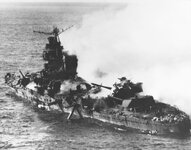
Mikuma

Presumably the lack of AP or SAP bombs is why she absorbed so many bomb hits?

aOhx1FH.jpeg
 

Attachments

  • Japanese_heavy_cruiser_Mikuma_sinking_on_6_June_1942_(80-G-414422).jpgkhu.jpg
    Japanese_heavy_cruiser_Mikuma_sinking_on_6_June_1942_(80-G-414422).jpgkhu.jpg
    1.4 MB · Views: 17
Mikuma

Presumably the lack of AP or SAP bombs is why she absorbed so many bomb hits?
Maybe, maybe not.

AP bombs are tricky to use. They are rather hard to hit with if you want them to penetrate armor.
The US 1000lb AP would penetrate 5in of armor if dropped from 10,000ft from a horizontal bomber or if dropped at 6500ft in a 60 degree dive in a 300kt (not mph) dive.
Dropping from lower altitudes (or less speed) meant less penetration. But the altitudes given meant a very small chance of a hit.
The 1000lb AP bomb held about 15% explosive.
A 500lb SAP bomb held about 30% explosive or about the same as the 1000lb AP and both did not work well with a near miss.
A 1000lb GP held about 53-59% HE is depending on type of HE and a near miss could cave in hull plating. A 1000lb GP that had a functioning fuse could wreck a lot of superstructure, upper deck work, fire control equipment or even knock main cruiser turrets out of action (Japanese heavy cruisers used thin armor on their 8in turrets).
A problem with penetration is that a 1000lb GP bomb was trying to punch an almost 19in hole through the deck/s.
The 1000lb AP bomb was trying to punch a 12in hole in the deck/s.
A 500lb SAP was trying to punch an 11.83in hole (let's just say 12in) and do it with a bomb that dropped from the same height and speed had 1/2 the energy of the 1000lb AP bomb.
The SAP bombs did not penetrate much armor if dropped at low altitudes.

The 3 different bombs needed different attack profiles (drop heights) to get the best results and counter intuitively, as out lined above, AP bombs needed to be dropped from higher altitudes which decreased the chances of hitting.

Now for most or all of the war, the Americans and British did not know exactly the thickness of the Japanese cruiser armor (or the carrier deck armor).
 
To understand the lack of AP bombs in the USN until 1942 you need to go back to the role of the carrier inter war in the eyes of the USN. It WAS NOT to sink battleships. That was the role of the USN's own battleships. It WAS to locate and put out of action the carriers of an enemy navy. But to put a carrier out of action it did not need to be sunk. Once its flight deck was torn up it was hors de combat (mission killed in today's terms). With the size of aircraft being what they were, 500lb was about the max that could be carried. Even 100lb bombs could knock holes in a wooden carrier deck.

By the mid-1930s the USN realised not enough bombs might hit. So bigger bombs were required so that near misses might cause underwater damage. Hence the introduction of the 1,000lb HE bomb. And with it came a new generation of dive bombers to carry them. The Vought SB2U Vindicator (service entry Dec 1937), the Northrop BT-1 (immediate predecessor of the SBD with service entry in 1938) and the Curtiss SBC-4 Helldiver (earlier versions could only carry 500lb weapons. Ordered Jan 1938 with service entry March 1939).

The USN did not favour the use of the torpedo inter war. At one point in the early 1930s there was just one squadron. Ranger was completed without any facilities for torpedoes and their carrier aircraft. She only received modification to carry them in early 1942.

In all of this the USN fully understood that if it didn't find an enemy's carriers and get its strike away first, its own carriers could be hit first and have their decks damaged so might not be able to launch a retaliatory strike. To get round the potential problem they equipped their carriers with hangar deck catapults. They were cancelled for Ranger as a cost saving measure. They were then fitted to the Yorktowns, Wasp and a few of the early Essex.

"to put a carrier out of action it did not need to be sunk. Once its flight deck was torn up it was hors de combat"

I read that one carrier admiral stated (just before the war) that "an aircraft carrier is like a boxer with a powerful punch, while at the same time having a fragile glass chin." (I couldn't find which book of mine had the quote in it.)
 
AP bombs and dive-bombers didn't work well together. A dive-bomber relied upon low release-altitude for accuracy, but an AP bomb relied upon gravity (32ft/sec/sec) to attain enough speed to punch through. Drop that 1600-lb bomb at 2,000 ft, and even if it hits it may just be too slow to punch through, and near-misses won't have the same mining effect because the explosive load is that much lower.

I think that's why USN didn't rely upon them. If you want to sink a BB, scour the decks with shrapnel and put holes in the hull with torps ... once you get the torps to work.

If you want to knock out carriers, a 1000-lb SAP is a perfectly fine animal.
 
AP bombs and dive-bombers didn't work well together. A dive-bomber relied upon low release-altitude for accuracy, but an AP bomb relied upon gravity (32ft/sec/sec) to attain enough speed to punch through. Drop that 1600-lb bomb at 2,000 ft, and even if it hits it may just be too slow to punch through, and near-misses won't have the same mining effect because the explosive load is that much lower.

I think that's why USN didn't rely upon them. If you want to sink a BB, scour the decks with shrapnel and put holes in the hull with torps ... once you get the torps to work.

If you want to knock out carriers, a 1000-lb SAP is a perfectly fine animal.
Depends on who you are I suppose, Thew Japanese did very well with their SAP 250 kg bombs from there D3A1's. But they did frequently carry some HE bombs to suppress AA.
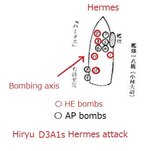
Hermes attack on 9 April 1942
Hiryu, therefore, equipped six D3M1s (the 1st and 4th Shotai) with HE bombs to suppress anti-aircraft gunfire. This idea was LT Kobayashi's personal one.
Hiru: 6 x 250kg HE + 12 x 250kg AP
Akagi: 2 x 250kg AP
Shokaku: 18 x 250kg AP
Zuikaku: 14 x 250kg AP
Because Hermes carried no aircraft, its hit rate was astounding without fighter interception.
Akagi Squadron: 100% (2 hits/2 released)
Hiryu Squadron: 82% (9 hits/11 released)
Zuikaku Squadron: 93% (13 hits/14 released)
Shokaku Squadron: 72% (8 hits/13 released)
The image below shows the damage sustained by Hermes from the Hiryu Squadron. Hermes had four 10.2cm single-barreled anti-aircraft guns, two fore and two aft, of the bridge structure. The First Shotai (Nos. 1-3) targeted these, neutralizing them with direct hits or shrapnel.
..........................
Yorktown attack on 5 Juna 1942
In the Battle of Midway, the IJN lost three aircraft carriers due to numerous blunders, and the remaining Hiryu counterattacked with 10 torpedo-armed B5Ns commanded by LT Tomonaga Joiti and 18 D3As commanded by LT Kobayashi. LT Kobayashi was killed in the attack.
The B3As' bombs were:
6 x 250kg HE + 12 x 250kg AP.

.......................


Battle of the Eastern Solomons on 24 August 1942
1st wave attack
Shokaku: 8 x 250kg HE + 10 x 250kg AP
Zuikaku: 9 x 250kg AP
2nd wave attack (not contacted with the targets)
Shokaku: 3 x 250kg HE + 6 x 250kg AP
Zuikaku: 8 x 250kg AP
US Convoy attack on 15 October 1942
Shokaku: 3 x 250kg HE + 18 x 250kg AP
Battle of the Santa Cruz Islands on 26 October 1942
1st wave attack
Zuikaku: 21 x 250kg AP
2nd wave attack
Shokaku: 3 x 250kg HE + 16 x 250kg AP
3rd wave attack
Shokaku + Zuikaku: 2 x 250kg AP

..................

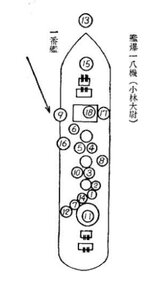
HMS Cornwall off Ceylon as an example. At this time, Val companies of Akagi, Soryu, and Hiryu were dispatched, and got a bomb hit rate of 15 / 16, 14 / 18, and 17 / 18, respectively. Figure 2 shows Hiryu company's hit points. What should be noted is that Val's path was not along the target's axis, where a high hit rate could be expected. It was oblique to the target. This period was the peak of Val's glory.

Above: fontessa
 

Attachments

  • ハーミス攻撃.jpgx.jpg
    ハーミス攻撃.jpgx.jpg
    29.4 KB · Views: 15
  • Cornwall.jpg
    Cornwall.jpg
    24.8 KB · Views: 15
Maybe, maybe not.

AP bombs are tricky to use. They are rather hard to hit with if you want them to penetrate armor.
The US 1000lb AP would penetrate 5in of armor if dropped from 10,000ft from a horizontal bomber or if dropped at 6500ft in a 60 degree dive in a 300kt (not mph) dive.
Dropping from lower altitudes (or less speed) meant less penetration. But the altitudes given meant a very small chance of a hit.
The 1000lb AP bomb held about 15% explosive.
A 500lb SAP bomb held about 30% explosive or about the same as the 1000lb AP and both did not work well with a near miss.
A 1000lb GP held about 53-59% HE is depending on type of HE and a near miss could cave in hull plating. A 1000lb GP that had a functioning fuse could wreck a lot of superstructure, upper deck work, fire control equipment or even knock main cruiser turrets out of action (Japanese heavy cruisers used thin armor on their 8in turrets).
A problem with penetration is that a 1000lb GP bomb was trying to punch an almost 19in hole through the deck/s.
The 1000lb AP bomb was trying to punch a 12in hole in the deck/s.
A 500lb SAP was trying to punch an 11.83in hole (let's just say 12in) and do it with a bomb that dropped from the same height and speed had 1/2 the energy of the 1000lb AP bomb.
The SAP bombs did not penetrate much armor if dropped at low altitudes.

The 3 different bombs needed different attack profiles (drop heights) to get the best results and counter intuitively, as out lined above, AP bombs needed to be dropped from higher altitudes which decreased the chances of hitting.

Now for most or all of the war, the Americans and British did not know exactly the thickness of the Japanese cruiser armor (or the carrier deck armor).
With everybody's help I am beginning to fully appreciate the logic that the USN was using with the 1000-pound high explosive bomb especially against the Japanese carriers. The crews didn't need to be as good / accurate with dive bombing because even a few hits could achieve a significant effect on target.

I very much do appreciate listing the charge to weight ratios of the various bombs That was something I was really curious about, I think especially surprising was the 15% explosive on the AP bomb I didn't know it was going to be that low but I suppose another way to look at an AP bomb is a way to package that explosive so it will survive long enough to do what it needs to do inside of the ship

I am really curious though what bombs the US used during its attacks on the Japanese carriers at Eastern Solomons and Santa Cruz. I think at this point I would have been surprised if they used anything other than1000 pound high explosive given they had proven to be so successful earlier in the year.
 
The Charge top weight ratios of the Japanese bombs are interesting to compare

No 6 Land bomb ~ 40% (HE)
No 6 Ordinary ~46% (SAP)

No 25 Land bomb ~ 60% Explosive (HE)
No 80 Land bomb ~ 48% Explosive (HE)

No 25 Ordinary ~ 24% Explosive (SAP)
No 80 Ordinary ~ 42% Explosive (SAP)


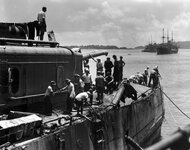
USS Marblehead and USS Chester both hit by 60 kg SAP (No. 6 Ordinary)
 

Attachments

  • Bomb_damage_to_USS_Marblehead_(CL-12)_following_the_Battle_of_Makassar_Strait,_February_1942_(...jpg
    Bomb_damage_to_USS_Marblehead_(CL-12)_following_the_Battle_of_Makassar_Strait,_February_1942_(...jpg
    382.3 KB · Views: 16
  • chester 60 kg bomb hit.jpg
    chester 60 kg bomb hit.jpg
    81.7 KB · Views: 18
Last edited:
Mikuma

Presumably the lack of AP or SAP bombs is why she absorbed so many bomb hits?
She didn't absorb that many bomb hits. The photo shows the accumulated damage from the bomb hits and from other damage.

Mogami collided with Mikuma on the evening of 5th June at 28knots. The former saw her bow crumpled back to No 1 turret leaving the ship some 40ft shorter. Mikuma was luckier as it was more of a glancing blow for her. But it left her with stove in plating mostly above the waterline port side and a leaking oil tank abreast No 4 engine room due to a 20m long, 6m wide gash.

On 6th June the pair and their 3 escorting destroyers were discovered by the USN and strikes organised:-

0800 Hornet launched 25 SBD (8 with 500lb & 17 with 1,000lb) and 8 F4F Wildcats. 2 aircraft lost to AA. Results were one near miss on Mikuma and 2 hits on Mogami (one hit No 5 turret destroying it and the other smashed through the aircraft deck and started fires on the torpedo deck under it. Fires were out in 1 hour).

About 1045 Enterprise launched a strike of 31 SBD and 12 F4F Wildcats with 3 TBD Devastators being added at the last minute (which were ordered not to attack if AA fire was too heavy and so didn't). Results were:-

2 hits on Mogami - one on the aircraft deck and one forward of the bridge inflicted medium damage.
1 hit on Mikuma No 3 turret destroying it.
2 more bombs hit Mikuma's aircraft deck and tore down into the port aft engine room (it later became apparent her hull bottom was holed in this area) and started a huge fire in the area of the torpedo tubes.
At this point she also suffered another 2 hits and at least 2 near misses and was slowed to a standstill.

Nearly two hours after the attackers left, the fires amidships on Mikuma reached her torpedoes, a number of which exploded. She carried 12 of the 24in Long Lance Type 93 torpedoes each with a warhead containing 1,080lb of explosive (that is nearly double the explosive charge of the 1,000lb HE bombs used on her). Her entire upperworks from the funnel to the No4 turret were reduced to a pile of tangled metal by this explosion, which also felled her mainmast. In the photo you can see the torpedo tubes themselves hanging out of the hull due to the force of the explosion. Until that point the captain of Mogami believed that Mikuma might be salvageable if he could get a towline aboard.

At 1345 Hornet launched another strike of 23 SBD with 1,000lb bombs. They reached the IJN ships around 1500 and achieved just 3 hits. One on Mikuma, one on Mogami & one on the escorting destroyer Arashio.

The hit on Mogami was again on the aircraft deck that was already damaged by earlier hits and started a horrendous fire and caused difficult decisions to be made to stop it spreading and let damage control get a grip on it.

Not sure where that final hit was on Mikuma. Somewhere down the line damage caused an internal explosion in No 2 turret, blowing its roof off. But she lingered on the surface until finally sinking around 1930, some four and a half hours after the last attack.

The photo you posted was one a a very famous sequence taken by two SBD crews from the Enterprise sent to settle the issue of whether it had been two cruisers the USN had been attacking or a cruiser and a battleship. I suspect that with her damaged bow pushing a huge bow wave, it would have been easy to mis-identify Mogami for a much larger vessel. Unfortunately aviators of all nations have never proved to be much good at ship identification!

So overall with most probably being 1,000lb
Mogami - 5 hits
Mikuma - 6 hits
Plus of course the near misses on both vessels.

But ultimately,as has been pointed out, ships sink when water gets into the hull. Most of the damage to both Mikuma & Mogami was above the waterline. What underwater damage there was to Mikuma was only allowing the relatively slow ingress of water so she stayed afloat for a long time.
 
Neither the Japanese or the Americans had any real experience with large bombs against ships of any size.
The British, Germans and Italians did in 1940-41 but how much information was getting out to allies is a bit questionable and both the British and Italians were using small (or smallish) bombs themselves or were on the receiving end.
British bombs were particularly low in HE content and the light German cruiser sunk in Norway had some problems that complicated analysis. Very thin armor and a hull that had problems completing round the world training cruises in peacetime. Previous damage from shore batteries meant she was compromised to being with. A tremendous feat of arms but perhaps not one you want to base your future ship construction and future weapons types/procurement on?
Most navies tended to gloss over damage control or overestimated their own capabilities.

WW I experience against naval shells was not very useful.
Japanese 8in cruiser guns (new) that weighed 126kg only held 3.1kg of HE in the AP shell and 8.2kg in the common shell.
The 14 in guns in the Kongos and 4 twelve gun battleships held 11.5kg of HE in the AP and about 29.5kg in the common (HE) shells.
Again an American 500lb GP bomb held 116-117kg of Amatol. A single 500lb bomb held 4 times the explosive a 14in HE naval shell.
There is a square law about effect of the blast but the amount of damage seems to have been underestimated and the ability of ships to repair damage seems to have been over estimated. This is ships in general and carriers had problems of their own what with the gasoline and gasoline fumes.
 
Depends on who you are I suppose, Thew Japanese did very well with their SAP 250 kg bombs from there D3A1's. But they did frequently carry some HE bombs to suppress AA.
Hermes attack on 9 April 1942
Hiryu, therefore, equipped six D3M1s (the 1st and 4th Shotai) with HE bombs to suppress anti-aircraft gunfire. This idea was LT Kobayashi's personal one.
Hiru: 6 x 250kg HE + 12 x 250kg AP
Akagi: 2 x 250kg AP
Shokaku: 18 x 250kg AP
Zuikaku: 14 x 250kg AP
Because Hermes carried no aircraft, its hit rate was astounding without fighter interception.
Akagi Squadron: 100% (2 hits/2 released)
Hiryu Squadron: 82% (9 hits/11 released)
Zuikaku Squadron: 93% (13 hits/14 released)
Shokaku Squadron: 72% (8 hits/13 released)
The image below shows the damage sustained by Hermes from the Hiryu Squadron. Hermes had four 10.2cm single-barreled anti-aircraft guns, two fore and two aft, of the bridge structure. The First Shotai (Nos. 1-3) targeted these, neutralizing them with direct hits or shrapnel.
..........................
Yorktown attack on 5 Juna 1942
In the Battle of Midway, the IJN lost three aircraft carriers due to numerous blunders, and the remaining Hiryu counterattacked with 10 torpedo-armed B5Ns commanded by LT Tomonaga Joiti and 18 D3As commanded by LT Kobayashi. LT Kobayashi was killed in the attack.
The B3As' bombs were:
6 x 250kg HE + 12 x 250kg AP.

.......................


Battle of the Eastern Solomons on 24 August 1942
1st wave attack
Shokaku: 8 x 250kg HE + 10 x 250kg AP
Zuikaku: 9 x 250kg AP
2nd wave attack (not contacted with the targets)
Shokaku: 3 x 250kg HE + 6 x 250kg AP
Zuikaku: 8 x 250kg AP
US Convoy attack on 15 October 1942
Shokaku: 3 x 250kg HE + 18 x 250kg AP
Battle of the Santa Cruz Islands on 26 October 1942
1st wave attack
Zuikaku: 21 x 250kg AP
2nd wave attack
Shokaku: 3 x 250kg HE + 16 x 250kg AP
3rd wave attack
Shokaku + Zuikaku: 2 x 250kg AP

..................

HMS Cornwall off Ceylon as an example. At this time, Val companies of Akagi, Soryu, and Hiryu were dispatched, and got a bomb hit rate of 15 / 16, 14 / 18, and 17 / 18, respectively. Figure 2 shows Hiryu company's hit points. What should be noted is that Val's path was not along the target's axis, where a high hit rate could be expected. It was oblique to the target. This period was the peak of Val's glory.

Above: fontessa

Right, but I was talking about the 1600-lb AP, not the 250-kg AP. Two very different critters. The 1600-lb bomb has about 215 lb of explosive. My understanding is that the Japanese bomb was semi-AP, and had a fill of 130 lbs. The larger American bomb relied upon the built-up speed to penetrate armor so that the proportionally-smaller charge could be more effective. The HE and SAP bombs used their disproportionate fill-weights to make up for their lesser penetrative power.

Against flattops in the PTO, HE and SAP were great. Against British armored decks, you really wanted SAP or AP and even then the heavier the better.
 
Last edited:
I am really curious though what bombs the US used during its attacks on the Japanese carriers at Eastern Solomons and Santa Cruz. I think at this point I would have been surprised if they used anything other than1000 pound high explosive given they had proven to be so successful earlier in the year.
Not necessarily.

Depends on a number of factors incl wind speed over the deck (natural + ship speed), how many aircraft being ranged for a strike (how much deck space available for free take offs).

It was quite common for the foremost aircraft in a strike to be given smaller loads (500lb bombs in the case of the SBD) with later aircraft receiving heavier loads (1,000lb).

Before anyone mentions catapults, Saratoga didn't have any in 1942, while Enterprise, Hornet & Wasp had the H-2 catapult. The H-2 in its upgraded form from 1941 was only capable of launching 7,000lb with a catapult end speed of 70 knots in zero wind conditions. Catapult was only about 55ft long. It was in her 1943 refit that Enterprise received the more capable H-2-1 catapult capable of launching 11,000lb at 70mph over a length of 73ft.

Flight deck lengths - Saratoga 866ft, Enterprise 802ft, Hornet 814ft & Wasp 727ft
 
Depends on a number of factors incl wind speed over the deck (natural + ship speed), how many aircraft being ranged for a strike (how much deck space available for free take offs).

It was quite common for the foremost aircraft in a strike to be given smaller loads (500lb bombs in the case of the SBD) with later aircraft receiving heavier loads (1,000lb).

Mission also mattered. SBDs on scouting missions were normally loaded with 500-lb HE because the lighter weight allowed for longer range.
 
Right, but I was talking about the 1600-lb AP, not the 250-kg AP. Two very different critters. The 1600-lb bomb has about 215 lb of explosive. My understanding is that the Japanese bomb was semi-AP, and had a fill of 130 lbs. The larger American bomb relied upon the built-up speed to penetrate armor so that the proportionally-smaller charge could be more effective. The HE and SAP bombs used their disproportionate fill-weights to make up for their lesser penetrative power.

Against flattops in the PTO, HE and SAP were great. Against British armored decks, you really wanted SAP or AP and even then the heavier the better.
The Japanese 800 kg weapons had different charge to weight ratios, the SAP(Ordinary) was ~ 40% *

The AP bombs:

Type 99 No.80 Mk 5 had just 30kg (Pearl Harbor Modified 40cm AP Shell)

Type 2 No.80 Mk 5 had 100 kg (Introduced in 42) *

* I am fairly certain is was one of these types that Hit Hornet at Santa Cruz
 
Not necessarily.

Depends on a number of factors incl wind speed over the deck (natural + ship speed), how many aircraft being ranged for a strike (how much deck space available for free take offs).

It was quite common for the foremost aircraft in a strike to be given smaller loads (500lb bombs in the case of the SBD) with later aircraft receiving heavier loads (1,000lb).

Before anyone mentions catapults, Saratoga didn't have any in 1942, while Enterprise, Hornet & Wasp had the H-2 catapult. The H-2 in its upgraded form from 1941 was only capable of launching 7,000lb with a catapult end speed of 70 knots in zero wind conditions. Catapult was only about 55ft long. It was in her 1943 refit that Enterprise received the more capable H-2-1 catapult capable of launching 11,000lb at 70mph over a length of 73ft.

Flight deck lengths - Saratoga 866ft, Enterprise 802ft, Hornet 814ft & Wasp 727ft

Ok, this explains why we see the 500-pound bombs in the strikes along with the 1000's.

So in 42 the catapults were not really all that useful most of the time?
 
So in 42 the catapults were not really all that useful most of the time?
For the USN yes.

For the RN the accelerators were much more capable. By comparison the British BH.I started at 8000lb at 56 knots in 1935 and had risen to 12,000lb at 56 knots in 1938. The BH.III started at 11,000lb at 66 knots in 1940 and was upgraded over the wartime years to 16,000lb at 66 knots using the trolley or in modified form to use the bridle to 20,000lb at 56 knots.

But the RN preference was still for free take offs to reduce overall launch time.

Note for the RN the assisted launch equipment was called an "accelerator" on a carrier and a "catapult" on other vessels. For the USN they were all catapults.
 
Notes from: The Miraculous Torpedo Squad by Juzo Mori (B5N2 pilot) Sõryū

Under normal operations as soon as a plane landed it would be lowered to the hangar deck, and it would take about two minutes before the next plane could land. However, during fast-recovery operations this interval was reduced to only twenty-five seconds. This meant that nine planes could be recovered in about four minutes. Of course, this operation required precise orchestration on the part of the deck crew.
 
The Japanese 800 kg weapons had different charge to weight ratios, the SAP(Ordinary) was ~ 40% *

The AP bombs:

Type 99 No.80 Mk 5 had just 30kg (Pearl Harbor Modified 40cm AP Shell)

Type 2 No.80 Mk 5 had 100 kg (Introduced in 42) *

* I am fairly certain is was one of these types that Hit Hornet at Santa Cruz

These weapons could only be carried by the B5N2 Kate used as a level bomber. Too heavy for the D3A Val dive bomber. The one such attack on Hornet was by 6 level bombers in the afternoon. Result 5 near misses and a single hit on the aft starboard quarter of the flight deck and passed through to explode in the water. The following is from her damage report.

I. Probable Damage Caused by Bomb Hit, After Starboard Corner of Flight Deck and Near-Misses

46. Since HORNET was being abandoned at the time of the high level attack, the structural damage as a result of the near-misses and the bomb aft is unknown. These bombs were probably S.A.P. inasmuch as they detonated after traveling underwater and produced an effect similar to that of a mine explosion. If this assumption is correct, then the bomb hit on the after starboard corner of the flight deck must have passed through the flight deck, leaving a small hole, and detonated underwater with the other near-misses. The skin was probably dished in the general area of the explosion. Possibly the hull was ruptured, permitting flooding in some of the after compartments on the second platform or hold.


49. The bombs used by the enemy in the afternoon high-level bombing attack were probably at least 250 Kg. S.A.P. bombs inasmuch as reference (a) reports that the detonation occurred underwater. The cumulative effect of the detonation of the six near-misses was that of a mine explosion. It also appears doubtful that high level bombers would carry bombs of a smaller size than 250 Kg.


Note the hit is described on the diagram as being from a "small" bomb.

Full report is here
 

Users who are viewing this thread

Back