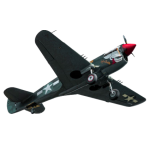
The Oscar at the Canal

Ad: This forum contains affiliate links to products on Amazon and eBay. More information in Terms and rules

MIflyer

Captain
8,969
20,274
May 30, 2011
Cape Canaveral
Reading about the air combats associated with Guadalcanal would lead you to think all the Japanese fighters were Zeros, and that was true in the early days when the issue was in doubt. But after the Japanese decided that "Death Island" was a lost cause and their main concern was rescuing the10,000+ troops that were suffering through existence on that delightful tropical resort, the IJN decided the Japanese Army needed to help. So the Army sent Oscar fighters and Lilly bombers to help cover the evacuations and try to suppress the Cactus Air Force in January 1943.

The book Operation KE describes the battles that took place during the evacuations. In the old Len Morgan book on the P-40 it is said that the Oscar did not have enough armament to prove to be deadly to the Warhawk, but trying to maneuver with it could send the P-40 pilot home talking to himself. I though that was funny but inaccurate but it turns out to be pretty much right on the money. The Oscar had one 7.7 MM machine gun and one 12.7MM machine gun, both limited by the engine synchronization, which reduced the firing rate. Of course that was same as the standard armament of US fighters back in the 1930's, so we know here the Japanese Army got the idea that would be adequate.

Operation KE describes many instances in which US fighters, F4F, P-40, and P-39 were peppered extensively by Oscars, full of even hundreds of bullet holes, but still got away. One F4F pilot reported being shocked by how far away an Oscar hit him in the engine and put him out of the fight, but that was no doubt the 12.7MM at work. The US fighters did not have a whole lot of that caliber being shot at them.

In contrast, when a US fighter got the bead on an Oscar it seems that it basically disintegrated right away.

The authors of the book point out that Oscars were usually identified as Zeros, even by coast watchers, but given the fighter's rather late introduction to the Canal that is not surprising. They really do look a whole lot alike. For that matter the Lillys were sometimes identified as cargo planes.
 
While it seems that most, if not all, of the Ki-43-I Oscars that went to the South East Area (New Guinea & the Solomons) in late 1942 had the mixed armament, there were other armament fits on that version (2 × 7.7mm or 2 x 12.7mm). From the j-aircraft site.

The Ki-43-II that was produced from Nov 1942 and started to reach the front line from about 1943Jan / Feb 1943 had an armament of 2 x 12.7mm.
 
Bailing out the navy did not seem a high priority.
And the IJN was bailing out the Army! Yamamoto's opinion was that the IJN was going to get its butt shot off to save the Army and it probably was not worth doing. He figured they could lose 20 destroyers in the process and they could not afford that. And of course it was the Japanese Army that had suggested before the war that if the Admiral did not take a hard enough line with the Americans that he might be retired with extreme prejudice.

In reality while the IJN did lose some ships the USN lost the USS Chicago and a destroyer, partially because of the Cactus Air Force control center Keystone Cops-style response to the Japanese air attacks on both Henderson Field and US ships that day.

On the other hand, the Japanese built a new airfield on Munda and as a result basically found out what Henderson Field went through in the earlier days, including incessant bombing and strafing as well as actual shelling from USN warships. If the Cactus folks went out and could not find the IJN ships they were looking for they dumped their bombs on Munda, in addition to planned attacks, including by B-26's.
 
And the IJN was bailing out the Army! Yamamoto's opinion was that the IJN was going to get its butt shot off to save the Army and it probably was not worth doing. He figured they could lose 20 destroyers in the process and they could not afford that. And of course it was the Japanese Army that had suggested before the war that if the Admiral did not take a hard enough line with the Americans that he might be retired with extreme prejudice.

In reality while the IJN did lose some ships the USN lost the USS Chicago and a destroyer, partially because of the Cactus Air Force control center Keystone Cops-style response to the Japanese air attacks on both Henderson Field and US ships that day.

On the other hand, the Japanese built a new airfield on Munda and as a result basically found out what Henderson Field went through in the earlier days, including incessant bombing and strafing as well as actual shelling from USN warships. If the Cactus folks went out and could not find the IJN ships they were looking for they dumped their bombs on Munda, in addition to planned attacks, including by B-26's.
Yes. 252nd Kokutai was chased out after just a few weeks.
 
Reading about the air combats associated with Guadalcanal would lead you to think all the Japanese fighters were Zeros, and that was true in the early days when the issue was in doubt. But after the Japanese decided that "Death Island" was a lost cause and their main concern was rescuing the10,000+ troops that were suffering through existence on that delightful tropical resort, the IJN decided the Japanese Army needed to help. So the Army sent Oscar fighters and Lilly bombers to help cover the evacuations and try to suppress the Cactus Air Force in January 1943.

The book Operation KE describes the battles that took place during the evacuations. In the old Len Morgan book on the P-40 it is said that the Oscar did not have enough armament to prove to be deadly to the Warhawk, but trying to maneuver with it could send the P-40 pilot home talking to himself. I though that was funny but inaccurate but it turns out to be pretty much right on the money. The Oscar had one 7.7 MM machine gun and one 12.7MM machine gun, both limited by the engine synchronization, which reduced the firing rate. Of course that was same as the standard armament of US fighters back in the 1930's, so we know here the Japanese Army got the idea that would be adequate.

Operation KE describes many instances in which US fighters, F4F, P-40, and P-39 were peppered extensively by Oscars, full of even hundreds of bullet holes, but still got away. One F4F pilot reported being shocked by how far away an Oscar hit him in the engine and put him out of the fight, but that was no doubt the 12.7MM at work. The US fighters did not have a whole lot of that caliber being shot at them.

In contrast, when a US fighter got the bead on an Oscar it seems that it basically disintegrated right away.

The authors of the book point out that Oscars were usually identified as Zeros, even by coast watchers, but given the fighter's rather late introduction to the Canal that is not surprising. They really do look a whole lot alike. For that matter the Lillys were sometimes identified as cargo planes.

Are you referring to this book?


It's also interesting because Christopher Shores day by day account of the fighting in Burma shows Ki-43s holding their own very well against Allied fighters like P-38s, Hurricanes, and P-51As, and even shooting down a fairly large number of B-24 bombers, as well as lots of Blenheims and other types.

P-40s did seem to do a little bit better than the other Allied typs, and most of the combat in the book I have, Volume III of Bloody Shambles, takes place with the JAAF using the slightly more heavily armed (and better performing) Ki-43-II which usually had two 12.7mm guns.

I think a fair number of the Ki-43-Is only had two 7.7mm guns because they were having a lot of problems with the 12.7mm and the special ammunition they used with it.

Christopher Shores has a series of books covering fighting in the Solomons and around New Guinea, which like Shores works also refer to the Japanese records and the results look a lot more even, and the Oscar quite deadly. At least on par with the A6M.
 
As an Amazon Associate we earn from qualifying purchases.
For those interested, I picked up this brand-new release yesterday. Guadalcanal is covered in two chapters.
9781764193788.jpg
 
I have that on pre-order, but I thought it wasn't coming out until August? Maybe earlier in Oz?
 
Well, whose numbers are they using? For example, at Bismarck Sea, the P-38's claimed they shot down 26 Japanese fighters while the bombers claimed another 7. No doubt that was overclaiming.

The Japanese claimed they shot down 9 P-38's, 6 B-25's and 3 B-17's.

In reality the US lost 3 P-38's and 1 B-17, with the P-38's being lost while trying to stop the Zeros from strafing the B-17 crew in their chutes.

And even more importantly NONE of the low altitude attacking B-25's, A-20's and Beaufighters were shot down! One B-25 and one Beaufighter made it home but were so shot up that they had to be scrapped. Most of the low altitude attacking aircraft were not even seriously damaged.

Interesting thing was that when the attacking aircraft approached at low altitude the Japanese assumed that they were going to launch torpedoes and turned into the attack so to minimize the area vulnerable to being hit by the torps. But this meant that the ships could only fire their forward guns at the aircraft while the strafers could hit the entire length of the ships. Normally you are told to NOT strafe the length of a convoy of vehicles, since that gives everyone in the target area a change to shoot at you. But in this case it actually had the opposite effect.

So they sank all 8 of the cargo ships and four of the eight destroyers. By the way, while they went back to strafe the survivors in the water, neither MacArthur nor Kenny ordered them to do that. After seeing what the Japanese did to the B-17 crewmen, revenge was sought, as well as making sure the ground troops did not have to fight the surviving troops.

As for the US Navy, when told of the success of the air attacks they scoffed, saying it was just the usual USAAF propaganda.
 
Ah, I don't know how I missed this earlier, sorry I didn't reply sooner.

Bismarck Sea was no doubt a triumph, but the Japanese losses were nowhere near the claims, I posted a thread on the real claims and losses a while back, based on Claringboulds books. I'll post some numbers tomorrow.
 
It's also interesting because Christopher Shores day by day account of the fighting in Burma shows Ki-43s holding their own very well against Allied fighters like P-38s, Hurricanes, and P-51As, and even shooting down a fairly large number of B-24 bombers, as well as lots of Blenheims and other types.
Below 15,000ft the Ki 43's totally dominated the MkV's we had over Darwin, the Merlin 46's were limited to 9psi boost so they couldn't climb turn or run away, it was only above 20,000ft that the Spitfires had an advantage.
 
Below 15,000ft the Ki 43's totally dominated the MkV's we had over Darwin, the Merlin 46's were limited to 9psi boost so they couldn't climb turn or run away, it was only above 20,000ft that the Spitfires had an advantage.


1787413294319.png

They were a major problem in Burma against the far more hapless Hurricane I and IIs, which got the worst of almost every engagement. The Mohawk IVs surprisingly did a bit better, (roughly even) which is why they were kept in the breach for so long. By the time Spit Vs showed up (fall 1943) I think they may have had the better engine, anyway they did much better than the Hurris, and again, did about even I'd say based on Shores research. But the limited range was a problem so they started sending a lot of Spit VIIIs, which had an edge over the -43s in combat and had much better range than the Hurris or the Spit Vs, but were still challenged and by no means assured of a victory.


1787413489434.png


1787413380918.png


The Ki-43-IIs which showed up in mid 1943 had much better altitude performance than the Ki-43-Is. The Ki-43-I had a two blade propeller, periscope gunsight, often just one heavy machine gun and one 7.7mm, and a single speed, single stage supercharger. The Ki-43-II had 150 more horsepower and a two stage supercharger, a bit more armor, two 12.7 mm machine guns, and a reflector gunsight. Should have arrived a year earlier but they were a big improvement. Luckily for us the Ki-43-III was even later to the party, really too late by then.

1787413262429.png


1787413277804.png


Summer of 1943 was a difficult period for the Allies in the SEAC / CBI. Units like the 64th Sentai racked up large numbers of victories against Hurricanes and British bombers. The US P-51As and P-38s didn't do that well in Theater either, and even heavy bombers like the B-24 were getting shot down in appalling numbers only the P-40s held their own until the Spit VIII and P-51B/C arrived. Later on (starting in late 1944) the British also got a large number of Thunderbolts which held their own though didn't dominate.

1787413217623.png


I think overall the Ki-43 is one of the most underestimated fighters in WW2
 
Well, whose numbers are they using? For example, at Bismarck Sea, the P-38's claimed they shot down 26 Japanese fighters while the bombers claimed another 7. No doubt that was overclaiming.

The Japanese claimed they shot down 9 P-38's, 6 B-25's and 3 B-17's.

In reality the US lost 3 P-38's and 1 B-17, with the P-38's being lost while trying to stop the Zeros from strafing the B-17 crew in their chutes.

And even more importantly NONE of the low altitude attacking B-25's, A-20's and Beaufighters were shot down! One B-25 and one Beaufighter made it home but were so shot up that they had to be scrapped. Most of the low altitude attacking aircraft were not even seriously damaged.

Interesting thing was that when the attacking aircraft approached at low altitude the Japanese assumed that they were going to launch torpedoes and turned into the attack so to minimize the area vulnerable to being hit by the torps. But this meant that the ships could only fire their forward guns at the aircraft while the strafers could hit the entire length of the ships. Normally you are told to NOT strafe the length of a convoy of vehicles, since that gives everyone in the target area a change to shoot at you. But in this case it actually had the opposite effect.

So they sank all 8 of the cargo ships and four of the eight destroyers. By the way, while they went back to strafe the survivors in the water, neither MacArthur nor Kenny ordered them to do that. After seeing what the Japanese did to the B-17 crewmen, revenge was sought, as well as making sure the ground troops did not have to fight the surviving troops.

As for the US Navy, when told of the success of the air attacks they scoffed, saying it was just the usual USAAF propaganda.

So yeah, I think it is a safe bet they were overclaiming a bit, on both sides naturally.

So the following data is per Shores South Pacific Air War Volume 6

1787413994435.png


During the entire three month period of Jan-March 1943, which includes the Battle of Bismarck Sea, the Japanese lost 62 aircraft. This included 25 x Ki-43-Is (19 in Air Combat) and 21 A6M2 and A6M3s (18 in Air Combat). Of that number, 4 x Ki-43s were shot down by P-38s, 4 by US bombers, and 9 by "other US fighters" (P-40s or P-39s, mainly the former) and 2 to AA. 6 x A6Ms were shot down by P-38s, 5 by US bombers, 3 by 'US fighters' (P-40s and P-39s) and 4 to AA. The rest of the losses were to operational accidents.

In the same period, the US and Australians together lost 97 aircraft, including 11x P-38s, 11 x P-40Es, 10 x P-39s, and 4 x Beaufighters. The rest of the losses were bombers. Of these losses, 6 x P-38s were shot down in air combat (or crash-landed after), 2 x P-40s were shot down. Some of the rest were lost to being destroyed on the ground in bombing raids, but most were mainly to accidents, mishaps, maintenance problems or just getting lost in the fog and running into a mountain or disappearing in the vast Pacific Ocean in that extremely brutal theater of war.

Given that only 4 x Ki-43s and 6 x Zeros were shot down by P-38s in the whole period, the Allies were clearly overclaiming a lot, but you are correct about the Japanese ship losses which was the crucial thing, and the new anti-shipping tactics worked out by General Kenney and the modifications by Pappy Gunn were indeed effective, which was a big change over the many previous attempts by USAAF and Australian units against Japanese shipping to that point, which had been marginal. It represented a real shift.
 
136, 607 & 615 squadrons converted from Hurricane II to Spitfire Vc in Sept / Oct 1943.

The Spitfire VIII arrived in SEAC in Dec 1943 with the transfer of 81 & 152 squadrons from the Med. As more of this mark arrived in India the Vc squadrons converted to the new model from Jan 1944 and more Hurricane squadrons were able to convert. By 1 July 1944 there were 8 Spitfire VIII squadrons plus another in the process of converting from the Mk.Vc.

The first two P-47D Thunderbolts for the RAF arrived in India in Feb 1944 with further deliveries beginning in mid-March and continuing through to June 1945. The first squadron converted in May 1944 followed by two more in June. On completion of conversion, RAF Thunderbolt operations began in Sept 1944. By Dec 1944 there were 9 RAF Thunderbolt squadrons in SEAC.

The USAAF in the CBI also began to receive the P-47D Thunderbolt in early 1944.

33rd FG transferred from the Med in Feb 1944, leaving its P-40 behind and re-equipping with the P-47D on arrival in India. It subsequently spent time both in India and China with 10th & 14th AF before converting to the P-38 between Nov 1944 & Feb 1945.

80th FG was part of the 10th AF in India. It swapped its P-40 for P-47D in June 1944.

81st FG was another unit to transfer from the Med in Feb / March 1944, to re-equip with the P-47D on arrival in India. It joined the 14th AF in China, beginning operations in June 1944. One squadron returned to India in Oct 1944 to provide combat training for the other two squadrons, a role it fulfilled until almost the end of hostilities.

Finally, the 1st Air Commando Group in 10th AF was reorganised in late summer 1944 and its fighter complement increased to two full squadrons which were equipped with brand new P-47D.AF These entered combat in Oct 1944.
 
136, 607 & 615 squadrons converted from Hurricane II to Spitfire Vc in Sept / Oct 1943.

The Spitfire VIII arrived in SEAC in Dec 1943 with the transfer of 81 & 152 squadrons from the Med. As more of this mark arrived in India the Vc squadrons converted to the new model from Jan 1944 and more Hurricane squadrons were able to convert. By 1 July 1944 there were 8 Spitfire VIII squadrons plus another in the process of converting from the Mk.Vc.

The first two P-47D Thunderbolts for the RAF arrived in India in Feb 1944 with further deliveries beginning in mid-March and continuing through to June 1945. The first squadron converted in May 1944 followed by two more in June. On completion of conversion, RAF Thunderbolt operations began in Sept 1944. By Dec 1944 there were 9 RAF Thunderbolt squadrons in SEAC.

The USAAF in the CBI also began to receive the P-47D Thunderbolt in early 1944.

33rd FG transferred from the Med in Feb 1944, leaving its P-40 behind and re-equipping with the P-47D on arrival in India. It subsequently spent time both in India and China with 10th & 14th AF before converting to the P-38 between Nov 1944 & Feb 1945.

80th FG was part of the 10th AF in India. It swapped its P-40 for P-47D in June 1944.

81st FG was another unit to transfer from the Med in Feb / March 1944, to re-equip with the P-47D on arrival in India. It joined the 14th AF in China, beginning operations in June 1944. One squadron returned to India in Oct 1944 to provide combat training for the other two squadrons, a role it fulfilled until almost the end of hostilities.

Finally, the 1st Air Commando Group in 10th AF was reorganised in late summer 1944 and its fighter complement increased to two full squadrons which were equipped with brand new P-47D.AF These entered combat in Oct 1944.

1787424416497.png

Yep, in addition to all this, you had a large US presence in China which was on and off involved with fighting in the Burma / India Theater, including 23rd FG (successor to the AVG) which mostly stayed on the China side (flying mainly P-40s with some P-51A and P-38s, and a few others like P-43s, finally converting to P-51s starting in Nov 1943 and fully converted in late 1944),

1787424383279.png


and the 51st FG (also flying P-40s until converting to P-51s starting in March 1944 and complete by early 1945) which had elements (squadrons or more) fighting from both the Chinese and east India sides of the Theater, sometimes both simultaneously. Both fighter groups fought alongside RAF units during specific campaigns in Burma at various times.

1787424432038.png


US 1st Air Commando group was using P-51A and then P-51B/C starting in April-May 1944, in addition to P-47s, the P-47s being fully replaced by P-51B/C/D by May 1945.

1787424465193.png


1787424491862.png


There was also the independent 449th FS operating in China with P-38s, and the 459th FS flying out of India from Sept 1943 with P-38s.

And finally there were a couple of US recon units, the 118th TRS and 10th PRS both using P-40Ns, which also switched to P-51s in 1945.

1787424562419.png


The British 5th Sqn RAF used Mohawk IVs from March 1942 through June 1943 when they converted to Hurricane IIs due to the declining number of Mohawks, while 155 Sqn RAF used Mohawk IVs from Aug 1942 through January 1944. It's pretty amazing they were able to find enough spares etc. to keep them going that long!

China / Burma / India was of course at the end of an extremely long supply chain and not at the top of Allied priority lists for aircraft, particularly for the British. The Spit VIII was the best fighter in Theater for the British and they kept gradually getting more and more of them, while the P-51 B/C/D was the best for the Americans and they slowly replaced all the other types. P-40 was still clearly useful though the whole time it was in use.
 
Last edited:
It had been planned to assemble the Curtiss Hawk 75A-5assemble (aka the P-36) in China. That evolved into licence production of 48 plus spares for the Indian Govt by Hindustan Aircraft Ltd in Bangalore, India. The first of five aircraft was produced in July 1942. A change of policy ended production with the company switching to assembly of imported aircraft and maintenance.

So the means were available to keep the Mohawks going until Jan 1944.
 
It had been planned to assemble the Curtiss Hawk 75A-5assemble (aka the P-36) in China. That evolved into licence production of 48 plus spares for the Indian Govt by Hindustan Aircraft Ltd in Bangalore, India. The first of five aircraft was produced in July 1942. A change of policy ended production with the company switching to assembly of imported aircraft and maintenance.

So the means were available to keep the Mohawks going until Jan 1944.

Yeah I'm aware of those attempts, though IIRC they basically came to nothing, and I thought the Hindustan effort was about assembling planes shipped as kits, nothing more (correct me if I'm wrong). The Chinese made Hawks were all fixed undercarriage Hawk 75H or M types, and their production ended when the factories were overrun by the IJA. So I think all of the P-36 / Hawk 75 were manufactured in 1940 or prior, or maybe 1941 at the latest if Chinese factories were still making them. And same would apply to any spare parts specifically made for that aircraft, though there was of course overlap with P-40s and other aircraft which used the same engines as the Hawk 75, Wright 1820 Cyclone or P&W R-1830 Twin Wasp depending on type. I think some of the spares and extra airframes that the RAF used came from Iran and other far off places, orphaned shipments that eventually ended up in the UK etc.

Frankly I think if they had managed to keep production going and ramp it up a bit, the IAF could have used some Mohawk IV for a few of their squadrons instead of the Hurricane IIs they ended up flying well into 1945. Spitfires would obviously be much better.
 

Users who are viewing this thread

Back