Hi Clay,
>It seems like this modification added to many existing engines (like the Allison) would have pushed it back into contention with the Merlin and 605. It's an amazing thing to me, a little turbine that gives free power by eating exhaust gas.
"Free" is not entirely correct as the power generation is done at the expense of the exhaust thrust.
For fighters, power recovery turbines were not attractive due to this ... it was simpler to use the exhaust thrust directly.
Power recovery turbines were really good at improving efficiency, but not so good at improving performance.
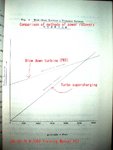
Turbo-supercharging really harnessed the exhaust power in a similar manner as the power recovery turbines did, except that it avoided transmitting power to the engine crankshaft, thus reducing the complexity of the installation. It did free the crankshaft of the work to run a (big) supercharger so it gave more or less the same effect as a recovery turbine installation at full power, but in situations were the waste gate had to be opened, it was less efficient than recovery turbines.
I guess power recovery turbines mainly made sense for commercial and military long-range aircraft as they helped to descrease specific fuel consumption, obviously more so than turbo-superchargers (or they wouldn't have been used at all

Regards,
Henning (HoHun)