
US VASS ASW bombsight

Ad: This forum contains affiliate links to products on Amazon and eBay. More information in Terms and rules

WATU

Airman 1st Class
247
160
Sep 1, 2019
I have a c47 page report from NDRC on the US designed VASS low level bombsight for submarine attacks. It was still in development with just a few prototypes in existence. It is not stabilised and just has a single tube bubble level (similar to the British hand held Mk I but more sophisticated). It is very trigonometry heavy. The report is dated 12 November 1942 and copy was in British hands the following January.
Anyone know the subsequent history of the sight? Was it adopted and used operationally by the US? Britain did not use it.
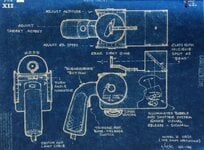
 

Attachments

  • AVIA15-938 Pt2 P VASS BS Drawing.JPG
    AVIA15-938 Pt2 P VASS BS Drawing.JPG
    139.6 KB · Views: 13
VASS (Vosseller Anti-Submarine Sight) aka USN Bomb Sight Mk 20.

In my notes I have it listed as no service during the war, but saw limited service in the late-1940s and Korean War period.
Thanks. I have seen the name Vosseller but had not tied it to VASS. I wonder why it too so long to be developed and deployed?
 
I don't believe in second sight but... The next document I read after ThomasP's answer above, a document already in my possession, was an extract from the US Bureau of Ordnance history. It can be found on Hyperwar at HyperWar: US Navy Bureau of Ordnance in World War II.
Pages 354 onwards give a brief history of US bombsights in WW2 including the VASS and the Mk 23. Helpful and interesting stuff.
 
I don't believe in second sight but... The next document I read after ThomasP's answer above, a document already in my possession, was an extract from the US Bureau of Ordnance history. It can be found on Hyperwar at HyperWar: US Navy Bureau of Ordnance in World War II.
Pages 354 onwards give a brief history of US bombsights in WW2 including the VASS and the Mk 23. Helpful and interesting stuff.
I uploaded the manual for the Bomb Director Mark 1 (Toss Bombing Sight) to this site a few years ago. It is disucssed in the text, above. That it worked well is a testament to the simple fact of physics that the acceleration in one reference frame relative to another reference frame is easier to measure than the relative velocities of those different reference frames. Einstein thought so, too.

Bomb Director Mark 1 - PDF
 
Thanks for that yossie. Any other manuals lurking in your library?
None that aren't available on the web. I found this manual in the U.S. National Archives and had a copy printed and sent to me. Cost me about $50 USD to get the copy. Now it's in the "wild" where it should be. The dangers of dive bombing are the reason the U.S. Army Air Forces was not very interested in dive bombing. The increasing lethality of AA automatic weapons was the main reason the AAF was very leery of dive bombing. The Navy, however, knew that it was the only type of "free fall bombing" that would work against maneuvering ships at sea, and so they developed it and used it all through the war. (Interestingly, it was the Navy that first contracted Norden for a bomb sight that would hopefully get around the problem. It didn't work for that application but the Army "took over" the project, more or less.) The Navy was heavily invested in research during the war on "terminally guided munitions", e.g. radar guided "Bat Bomb" and flying drones, but the electronics of the era were not yet up to the task. The Army concentrated on VB-1 Azon type weapons and they were partially successful in "terminal guidance", in that regard.

The fact that dive bombers can never "aim" directly at the target (ship) but must "lead" it somewhat, due to gravity causing the bomb to strike short of the aiming point, meant that Naval dive bombing required skills that had to be learned from training. They also had to account for the fact that the target can steer left or right during the dive. Naval dive bombing was as much an "art" as it was a trained technique. You can see this in the numerous photos of dive bombing "near misses" around a ship under attack and maneuvering wildly.
 

Users who are viewing this thread

Back