RAF Merlin 45-46's were approved for 16psi @ 3,000rpm in Feb 1942, the RAAF approved 12psi boost for their engines in Feb 1943 when LF MkV's were running at 18, the lack of boost cost the Darwin MkV's when compared to the equivalent models.Neither of those is true.

Navigation
Install the app
How to install the app on iOS
Follow along with the video below to see how to install our site as a web app on your home screen.
Note: This feature may not be available in some browsers.
More options
You are using an out of date browser. It may not display this or other websites correctly.
You should upgrade or use an alternative browser.
You should upgrade or use an alternative browser.
Was the Sea Hurricane a superior naval fighter than the F4F?
- Thread starter Wild_Bill_Kelso
- Start date
More options
Who Replied?Geoffrey Sinclair
Staff Sergeant
- 1,271
- Sep 30, 2021
The reason I gave the data was your messages, #172 about US bomber (and fighter) speeds and #237 about German bomber speeds, they were not F4F economic cruise speeds, I was providing the correct information. I receive an editorial long on how you are right on topics I did not mention, now go away. I work on the principle the more editorial, the less accuracy.Whatever cruise rate they were using,
As for the bombers diving, London to Dover is around 70 miles, the bombers are 3 miles up, work out the slope assuming the bombers are at zero feet at the coast, or the lesser slope assuming they want to stay above light AA range, then work out the actual speed boost.
I suggest you stop developing it and address the problems you are ignoring.Somehow there seems to now be a myth developing that Wildcats were slower than any of these bombers, which is ridiculous.
Actually I read it as you are pretending that is what other people are saying.Everyone else is just kind of trying to pretend that Wildcats can't fly fast or that they suffer problems that a 109s does not.
The ranges the British tests give are economic cruise, not maximum weak mixture cruise. Unlike the data I posted which made clear the speeds involved. Next note the Wildcat II card of 6 February 1944 supersedes the Martlet II card of 22 August 1941, but they are very different aircraft. The Martlet I card is 22 August 1941, the IV is 6 February 1944, the V is 11 November 1944.For example, all of these are British tests by the way.
Martlet I "most economical" 167-175 mph, maximum weak mixture 257 mph. Range 870 miles. (no aux or loiter time indicated)
Martlet II "most economical" 170 mph, maximum weak mixture 260 mph. Range 850 miles (no aux or loiter time indicated)
Wildcat II "most economical" 213 mph, maximum weak mixture 246 mph, loiter 181 mph. Range 795 miles. Loiter 3.95 hours.
Wildcat IV "most economical" speed 213 mph. Maximum weak mixture 238 mph. Loiter 181 mph. Range 695 +452 aux tanks, 3.5 +2.3 hours loiter.
Wildcat V "most economical" speed 218 mph. Maximum weak mixture 262 mph. Loiter 185. Range not given.
The USN says the F4F-3 had an endurance of 1 hour at maximum speed at 19,000 feet, that is around 323 miles, the Bf109E-3 economic cruise was 410 miles. No one is disputing the F4F had a greater range. The advantage decreases with speed, partly as 300 mph is around 91% of the F4F-3 top speed, it is 86% of the Bf109E, and that small percentage does make a difference
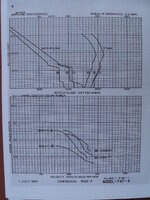
The F4F-3 is quoted as 940 miles at 150 mph at 2,500 feet using 144 gallons of fuel. The F4F-4 drops that to 830 miles at 161 mph at 5,000 feet. The rise in fuel consumption with speed, F4F-4 range/speed curve at 5,000 feet, 144 gallons of fuel.
161 mph, 830 miles
200 mph, 715 miles
220 mph, 625 miles
240 mph, 500 miles
285 mph, 280 miles
See the attached, condition 2 is fighter using normal power, condition 4 is fighter, normal power, 2x58 gallon external fuel tanks. The graph shows the trade off between speed, altitude and longest range.
The USN says at 195 mph the F4F-3 had a range of 930 miles at 19,000 feet, (4.8 hours times 0.6 times 323 mph) at 240 mph 800 miles (3.3 hours times 0.75 times 323 mph), at 323 mph 323 miles (1 hour times 323 mph), yet gives the maximum range as 940 miles at 150 mph at 2,500 feet. Somehow an extra 110 miles range advantage over the F4F-4 at 150-160 mph becomes an extra 235 miles at 200 mph and 250 more miles at 250 mph. Shall we say there is an issue here. Using the F4F-4 curve the F4F-3 would have twice the range of the Bf109E-3 at 200 mph.
The RAF reports the Spitfire I was good for 415 miles at 304 mph, to get the official 575 miles range cruise was 180 to 190 mph. The Hurricane I range around 275 mph was 340 miles, at 180 mph 600 miles.
Assume the B109E-3 range degrades in the same way as the Spitfire, given similar top speeds, 410 miles at 200 mph becomes 295 miles at 300 mph. The F4F-4 range advantage drops from 75% more to actually less. The F4F-3 range advantage drops from around twice as much to still better, given it could do 323 miles at 323 mph if the endurance chart is accurate and remembering it starts with a range advantage over the F4F-4.
Put it another way, flying beside a Do17Z the F4F-4 was good for 760 miles, beside a Ju88A-1 550 miles. At 180 mph the F4F-4 could out range the Hurricane by 200 miles, at 275 mph it had about the same range.
The F4F-4 rate of climb, normal power is 2,200 feet per minute at sea level, down to 2,050 feet per minute at 4,000 feet, holds that to 11,500 feet then it steadily degrades, 1,600 feet per minute at 16,000 feet, 1,200 feet per minute at 20,000 feet, 800 feet per minute at 25,000 feet. It costs the F4F more fuel than the Bf109E to climb given the longer duration, add that the F4F-3 took off at around 7,556 pounds, the Bf109E-3 was 5,875 pounds, raising a ton 5 miles costs, the F4F is almost 30% heavier.
I know you do not see despite so many people trying to explain. And the editorials show you are uninterested. After all I posted the Bf109 and Bf110 ranges noting they were economic cruise now apparently the requirement is 300 mph, an estimate is given above. Now remember, replying your idea is better requires some evidence, not an assertion. Otherwise I do not see any point here. I am sure someone with better knowledge of the DB601 could provide a more accurate idea of fuel consumption at different power levels. I do note Eric Brown quotes the Bf109G-6 range as 350 miles at 330 mph at 19,000 feet, implying the Bf109E range figures are at fast cruise.Unless you can show that the stated range limitation for the Bf 109 and Bf 110 were done at 300 mph, then I don't think there is any point here.
On another point fundamentally for most of the Pacific air war the chances of interception away from a Japanese base were small so allied aircraft cruised at optimum for range and in loose formations.
Attachments

Clayton Magnet
Staff Sergeant
- 914
- Feb 16, 2013
The Darwin Spitfires could have had double the internal fuel, and still struggled.Range was the single biggest issue.
The low boost, Merlin 46, tropical filter, frozen guns, maintenance issues, bad tactics all meant disaster. I wonder how much range the stupid nose scoop and engine problems robbed, it probably wasn't trivial
- Thread starter
- #264

Wild_Bill_Kelso
Senior Master Sergeant
- 3,231
- Mar 18, 2022
To me, it's really simple.
Anything that affects or limits the range of the Bf 109 (or Spitfire, or Hurricane) would also affect the Wildcat and vice versa.
I have yet to see any evidence that the 400 mile range estimate of the 109 was calculated based on flying 300 mph dodging and weaving and engaging in combat.
I believe, in fact, that the range of both Wildcat and Bf 109e were calculated the same way.
So in both cases the range on an actual combat strike would be less than it was in a test flight. But they would both be diminished at the same rate.
Thus the Wildcat would still have roughly twice the range as the 109.
And all these arguments that the Wildcat's range would be much less because it wasn't flying over the Pacific, are, IMO, ridiculous. Yes I dismiss that line of argument.
I am also very well aware that strike range and maximum range as stated on a data sheet are not the same thing, actual strike range is always shorter, for every aircraft. However, I do also believe that range for a strike from a carrier (which could be 175 or 225 miles or whatever) took into consideration finding the ship and waiting to land on a very small space. I believe range was increased somewhat when flying from an airfield.
As I said before, Shortround6 was the only one (IMO) making a coherent argument, namely to imply that the Wildcat somehow burned fuel in combat more than the 109, but I don't think he made the case. There is more to it than the rate at which each engine burns fuel in different settings. There is also drag, lift, energy management, and tactics used by the pilot, among other things. It's possible that the Wildcat did burn more fuel in combat, but we don't know if that would be enough of a difference to drastically affect the existing ratio, i.e. that Wildcat had 200-150% of the range of a 109, depending on the variants.
Anything that affects or limits the range of the Bf 109 (or Spitfire, or Hurricane) would also affect the Wildcat and vice versa.
I have yet to see any evidence that the 400 mile range estimate of the 109 was calculated based on flying 300 mph dodging and weaving and engaging in combat.
I believe, in fact, that the range of both Wildcat and Bf 109e were calculated the same way.
So in both cases the range on an actual combat strike would be less than it was in a test flight. But they would both be diminished at the same rate.
Thus the Wildcat would still have roughly twice the range as the 109.
And all these arguments that the Wildcat's range would be much less because it wasn't flying over the Pacific, are, IMO, ridiculous. Yes I dismiss that line of argument.
I am also very well aware that strike range and maximum range as stated on a data sheet are not the same thing, actual strike range is always shorter, for every aircraft. However, I do also believe that range for a strike from a carrier (which could be 175 or 225 miles or whatever) took into consideration finding the ship and waiting to land on a very small space. I believe range was increased somewhat when flying from an airfield.
As I said before, Shortround6 was the only one (IMO) making a coherent argument, namely to imply that the Wildcat somehow burned fuel in combat more than the 109, but I don't think he made the case. There is more to it than the rate at which each engine burns fuel in different settings. There is also drag, lift, energy management, and tactics used by the pilot, among other things. It's possible that the Wildcat did burn more fuel in combat, but we don't know if that would be enough of a difference to drastically affect the existing ratio, i.e. that Wildcat had 200-150% of the range of a 109, depending on the variants.
- Thread starter
- #265
Wild_Bill_Kelso
Senior Master Sergeant
- 3,231
- Mar 18, 2022
More were probably lost to fuel starvation than mechanical failure, but the point still stands.
Neither of those is true.
Boost only effects speed below critical altitude. RAF testing shows speeds of 354-372 mph at +9 lbs of boost. RAAF testing of their tropicalised Spitfire Mk Vcs shows speeds between 354 and 365 mph at + 9 lbs. Poor condition of the aircraft surfaces, poor engine performance, the tropical filter and a few other issues were what sapped the Darwin Mk Vs of their performance.
RAAF tactical trials of the Mk Vc tropicalised vs an A6M3 specifically state that the Spitfire can loop more tightly than the Zero at high speeds. It recommends loops at high speed as a evasive tactic.
In testing at 17,000 ft the Mk V did have trouble in the loop when initial speed was 220 mph IAS, at which point the Spitfire would stall out at the top of the maneuver. However, it could be easily looped at higher speeds. A 280 mph IAS and 27,000 ft, the Mk V could do three consecutive loops.
RAAF's recommendation was to not loop the Spitfire in combat with the Zero at speeds blow 250 mph IAS.
The thing was, the Spit V's they had seemed to work out fine once they changed their tactics, and obviously did have a speed advantage over the A6M2s and Ki43*s. which is what they exploited going forward.
I agree about all the other things - frozen guns, bad ammunition etc. but obviously range was a major issue. Again also somewhat alleviated when they changed tactics.
Low speed looping was not advised vs. A6M with just about any aircraft. They had a tactic where they could loop inside you and shoot right into your cockpit. The phenomenal agility of the A6M is something we tend to forget about with the distance of time.
(* I can't remember of the Spitfire units faced Ki 43s or not, though I know some were sent on some of the raids to Darwin at some point. So don't crucify me.)
- Thread starter
- #266
Wild_Bill_Kelso
Senior Master Sergeant
- 3,231
- Mar 18, 2022
The reason I gave the data was your messages, #172 about US bomber (and fighter) speeds and #237 about German bomber speeds, they were not F4F economic cruise speeds, I was providing the correct information. I receive an editorial long on how you are right on topics I did not mention, now go away. I work on the principle the more editorial, the less accuracy.
As for the bombers diving, London to Dover is around 70 miles, the bombers are 3 miles up, work out the slope assuming the bombers are at zero feet at the coast, or the lesser slope assuming they want to stay above light AA range, then work out the actual speed boost.
I suggest you stop developing it and address the problems you are ignoring.
Actually I read it as you are pretending that is what other people are saying.
The ranges the British tests give are economic cruise, not maximum weak mixture cruise. Unlike the data I posted which made clear the speeds involved. Next note the Wildcat II card of 6 February 1944 supersedes the Martlet II card of 22 August 1941, but they are very different aircraft. The Martlet I card is 22 August 1941, the IV is 6 February 1944, the V is 11 November 1944.
The USN says the F4F-3 had an endurance of 1 hour at maximum speed at 19,000 feet, that is around 323 miles, the Bf109E-3 economic cruise was 410 miles. No one is disputing the F4F had a greater range. The advantage decreases with speed, partly as 300 mph is around 91% of the F4F-3 top speed, it is 86% of the Bf109E, and that small percentage does make a difference
The F4F-3 is quoted as 940 miles at 150 mph at 2,500 feet using 144 gallons of fuel. The F4F-4 drops that to 830 miles at 161 mph at 5,000 feet. The rise in fuel consumption with speed, F4F-4 range/speed curve at 5,000 feet, 144 gallons of fuel.
161 mph, 830 miles
200 mph, 715 miles
220 mph, 625 miles
240 mph, 500 miles
285 mph, 280 miles
See the attached, condition 2 is fighter using normal power, condition 4 is fighter, normal power, 2x58 gallon external fuel tanks. The graph shows the trade off between speed, altitude and longest range.
The USN says at 195 mph the F4F-3 had a range of 930 miles at 19,000 feet, (4.8 hours times 0.6 times 323 mph) at 240 mph 800 miles (3.3 hours times 0.75 times 323 mph), at 323 mph 323 miles (1 hour times 323 mph), yet gives the maximum range as 940 miles at 150 mph at 2,500 feet. Somehow an extra 110 miles range advantage over the F4F-4 at 150-160 mph becomes an extra 235 miles at 200 mph and 250 more miles at 250 mph. Shall we say there is an issue here. Using the F4F-4 curve the F4F-3 would have twice the range of the Bf109E-3 at 200 mph.
The RAF reports the Spitfire I was good for 415 miles at 304 mph, to get the official 575 miles range cruise was 180 to 190 mph. The Hurricane I range around 275 mph was 340 miles, at 180 mph 600 miles.
Assume the B109E-3 range degrades in the same way as the Spitfire, given similar top speeds, 410 miles at 200 mph becomes 295 miles at 300 mph. The F4F-4 range advantage drops from 75% more to actually less. The F4F-3 range advantage drops from around twice as much to still better, given it could do 323 miles at 323 mph if the endurance chart is accurate and remembering it starts with a range advantage over the F4F-4.
Put it another way, flying beside a Do17Z the F4F-4 was good for 760 miles, beside a Ju88A-1 550 miles. At 180 mph the F4F-4 could out range the Hurricane by 200 miles, at 275 mph it had about the same range.
The F4F-4 rate of climb, normal power is 2,200 feet per minute at sea level, down to 2,050 feet per minute at 4,000 feet, holds that to 11,500 feet then it steadily degrades, 1,600 feet per minute at 16,000 feet, 1,200 feet per minute at 20,000 feet, 800 feet per minute at 25,000 feet. It costs the F4F more fuel than the Bf109E to climb given the longer duration, add that the F4F-3 took off at around 7,556 pounds, the Bf109E-3 was 5,875 pounds, raising a ton 5 miles costs, the F4F is almost 30% heavier.
I know you do not see despite so many people trying to explain. And the editorials show you are uninterested. After all I posted the Bf109 and Bf110 ranges noting they were economic cruise now apparently the requirement is 300 mph, an estimate is given above. Now remember, replying your idea is better requires some evidence, not an assertion. Otherwise I do not see any point here. I am sure someone with better knowledge of the DB601 could provide a more accurate idea of fuel consumption at different power levels. I do note Eric Brown quotes the Bf109G-6 range as 350 miles at 330 mph at 19,000 feet, implying the Bf109E range figures are at fast cruise.
On another point fundamentally for most of the Pacific air war the chances of interception away from a Japanese base were small so allied aircraft cruised at optimum for range and in loose formations.
Well if it's true that a Bf 109 could fly 295 miles at 300 mph I'm pretty impressed, though it seems like F4F-3 still has an advantage. I would think the two stage supercharger on the Wildcat may help with efficiency somewhat at the higher altitudes.
I can't think why you would intentionally use F4F-4 instead of F4F-3 in a land based unit (unless your carrier was sunk and they had nowhere else to go), although the whole thing is a hypothetical just to make a point about range, so it only goes so far.
I also don't see why F4F-4 ranges would be so drastically reduced from -3, I would also be very surprised if it's true that F4F of any type has the same range as a Hurricane at 275 mph, how much of the above is calculated vs. actual reported numbers? If the latter then I concede defeat (and would be very surprised!)

Thumpalumpacus
Colonel
I also don't see why F4F-4 ranges would be so drastically reduced from -3 [...]
Reduced fuel capacity (due to SS tanks) plus increased weight.
And all these arguments that the Wildcat's range would be much less because it wasn't flying over the Pacific, are, IMO, ridiculous. Yes I dismiss that line of argument.
If you're willing to dismiss a valid point without addressing it substantively, what's the point of conversing with you at all? Your mind is made up and there's no give-and-take, no nuance, no interest in looking at any factors which might change your thinking?
That's boring as hell. I'm out too.
Again, go read some Lundstrom, if you dare to challenge your own views.
- Thread starter
- #268
Wild_Bill_Kelso
Senior Master Sergeant
- 3,231
- Mar 18, 2022
I have "First Team", have read it, and have quoted from it extensively in this forum.
I have not dismissed a single valid point in this thread.
I also find certain patterns of discussion in here very boring, and I'll leave it at that.
I have not dismissed a single valid point in this thread.
I also find certain patterns of discussion in here very boring, and I'll leave it at that.

We have been down this road before. Knock it off with the snide comments.
It got old a long time ago.
I don't see anything funny here…
I'm going to leave this here one final time, as I keep getting this nagging feeling I am being ignored. It is especially annoying when that ignoring appears to come from a high horse.
It's a curly hair width away from being old past the point of no return…
- Thread starter
- #271
Wild_Bill_Kelso
Senior Master Sergeant
- 3,231
- Mar 18, 2022
Not on a high horse.
Did not ignore you.
Veered away from replying in kind to the last post.
I am a grown ass man and really don't like being threatened.
So do what you need to do mate.
And since this may very well be my final post, let me say, again, that I see a few trends on this forum which I suspect are related:
There is a lot of knowledge here. I've thought about how to find a constructive way to offload some of it in a more efficient manner so that it will remain available to people who want to know about these things in the future if and when this forum disappears, as sadly so many other wonderful ones have done in the last few years (South Pacific Air War I'm looking at you mate). This is a tricky, though possibly doable mission, though I'm probably not the one to do it.
In the mean time, conversations seem to be winding down around here. I literally made the post (Wildcats had twice the range of a bf 109, which is true) just in an attempt to get some discussion going, I didn't expect it to start a massive argument. There aren't nearly as many forums like this on the interwebs as there once were, and this one seems to be gradually diminishing. I think to keep it going people need to be having conversations.
This is because of people with the knowledge and interest 'aging out' so to speak, but it's also because there is a tendency of many of the forum regulars to gang up on anyone that says anything remotely controversial or even unexpected that might challenge the consensus on something, or annoy a regular. Sometimes people will sit in a bunker and snipe, weaponizing their knowledge as much as they can, then others pile on, until the 'outside agent' is cowed. I think this is contributing to discussions petering out here. As I've mentioned before, I participate in other online spaces populated with people with a lot of specialized expertise. It doesn't have to be this way. It's just as easy to share data, information and analysis, which also happens on here of course, but i see it drowned out more and more with the aggression.
I already alluded to all this on another thread, so I think the point has been made. I don't expect it to be taken to heart necessarily, but felt it needed to be said.
Not everybody is willing to just bow their head and accept a dressing down based on a spurious premise, just because some grouchy old guys are bored and want to pick on a 'newby'. i got a lot of abuse on recent threads and tried to be patient about it, but instead ended up wasting a lot of time. I learned about a great book which I've added to my real life library, so it wasn't completely wasted, but it was quite unpleasant, and more to the point, completely pointless. We could have had 20-30 pages of interesting conversations, instead of blockheaded bickering.
So I've given up being patient with insults and completely unfounded derision. I don't blame the mod for getting fed up with bickering, but I also don't take the blame, and I'm fed up myself. I don't think it's a good prospect to expect people to knuckle under to unfounded insults etc. in order to have discussions on here or become active vs. being lurkers on the forum. Right now your "old guard" is getting pretty crabby, unless conversations remain within quite narrow boundaries. If that is the way you like it, drive on.
Did not ignore you.
Veered away from replying in kind to the last post.
I am a grown ass man and really don't like being threatened.
So do what you need to do mate.
And since this may very well be my final post, let me say, again, that I see a few trends on this forum which I suspect are related:
There is a lot of knowledge here. I've thought about how to find a constructive way to offload some of it in a more efficient manner so that it will remain available to people who want to know about these things in the future if and when this forum disappears, as sadly so many other wonderful ones have done in the last few years (South Pacific Air War I'm looking at you mate). This is a tricky, though possibly doable mission, though I'm probably not the one to do it.
In the mean time, conversations seem to be winding down around here. I literally made the post (Wildcats had twice the range of a bf 109, which is true) just in an attempt to get some discussion going, I didn't expect it to start a massive argument. There aren't nearly as many forums like this on the interwebs as there once were, and this one seems to be gradually diminishing. I think to keep it going people need to be having conversations.
This is because of people with the knowledge and interest 'aging out' so to speak, but it's also because there is a tendency of many of the forum regulars to gang up on anyone that says anything remotely controversial or even unexpected that might challenge the consensus on something, or annoy a regular. Sometimes people will sit in a bunker and snipe, weaponizing their knowledge as much as they can, then others pile on, until the 'outside agent' is cowed. I think this is contributing to discussions petering out here. As I've mentioned before, I participate in other online spaces populated with people with a lot of specialized expertise. It doesn't have to be this way. It's just as easy to share data, information and analysis, which also happens on here of course, but i see it drowned out more and more with the aggression.
I already alluded to all this on another thread, so I think the point has been made. I don't expect it to be taken to heart necessarily, but felt it needed to be said.
Not everybody is willing to just bow their head and accept a dressing down based on a spurious premise, just because some grouchy old guys are bored and want to pick on a 'newby'. i got a lot of abuse on recent threads and tried to be patient about it, but instead ended up wasting a lot of time. I learned about a great book which I've added to my real life library, so it wasn't completely wasted, but it was quite unpleasant, and more to the point, completely pointless. We could have had 20-30 pages of interesting conversations, instead of blockheaded bickering.
So I've given up being patient with insults and completely unfounded derision. I don't blame the mod for getting fed up with bickering, but I also don't take the blame, and I'm fed up myself. I don't think it's a good prospect to expect people to knuckle under to unfounded insults etc. in order to have discussions on here or become active vs. being lurkers on the forum. Right now your "old guard" is getting pretty crabby, unless conversations remain within quite narrow boundaries. If that is the way you like it, drive on.
1. I'm not threatening anyone. I certainly did not threaten you.
2. I'm not singling anyone out either. Did you see me name a particular poster or person? Did I single you out?
- Thread starter
- #273
Wild_Bill_Kelso
Senior Master Sergeant
- 3,231
- Mar 18, 2022
Maybe I'm being paranoid, I'm going to take a break for a while regardless.
I'm going to quote you here…
So do what you need to do mate.
So do what you need to do mate.
Shortround6
Lieutenant General
Yes, to different degrees.Anything that affects or limits the range of the Bf 109 (or Spitfire, or Hurricane) would also affect the Wildcat and vice versa.
What I have is a simply statement of max range of 410 miles, speed and altitude not given from Green. However a (repeat A) range cruise at 3 different altitudes are given. 202mph at 1000 meters, 210mph at 2,000 meters and 236mph at 7,000 meters. Also a max continuous cruising of speed of 300mph at 4000 meters and max speed of 342mph at 13,120ft and 334mph at 6000 meters. The last two are just for reference and are using the DB 601A engine as used in most 109E-1s. Some (all) 109E-3s got DB 610Aa engines so speeds and altitudes are bit off. I doubt very much that the 410 miles was done bobbing and weaving at 300mph. The figures are from am old William Green book and are subject to doubt (he says the 109E-3 had the cannon in the prop hub).I have yet to see any evidence that the 400 mile range estimate of the 109 was calculated based on flying 300 mph dodging and weaving and engaging in combat.
From a data sheet for the 109E-1 and E-3 as printed in "Messerschmitt" Bf 109 A-E" by Willy Radinger & Walter SchickI believe, in fact, that the range of both Wildcat and Bf 109e were calculated the same way.
Range * =* according to L.Dv. ff6/3. Appendix 9 (whatever the heck that is)
RPM...................Altitude.....................flying time..............................distance
2200....................1km............................1 hr 5 min................................430km
1300....................." "...............................2 hr 20 min..............................650km
2200...................3 km............................1 hr.............................................450km
1300....................." " ..............................2 hr 5 min................................660km
2400..................5 km............................55 min.......................................460km
1400...................." "...............................1 hr 50 min..............................665km
2400..................6 km............................1 hr 10 min..............................520km
1600...................." "................................1 hr 40 min..............................635km
Now the next part gives engine performance at ground level.
Power type.................................power/rpm...............................fuel consumption
Short (1 min).............................1175hp/2500.........................433 l/hr
Short (5 min).............................1015hp/2400..........................321 l/hr
Continuous (30 min)...............950hp/2300............................288 l/hr
Continuous (unlimited)..........860hp/2200............................260 l/hr
Next part is engine performance at altitude and it jumps around a bit.
Power type........................................altitude.........................power/rpm...............................fuel consumption
Short (5 min).......................................3.7 km........................1100hp/2400..........................318 l/hr
Continuous (increased)..................4.1 km.........................1050hp/2400..........................297 l/hr
Continuous..........................................4.5 km........................1000hp/2400..........................283 l/hr
Continuous (economic)..................3.85 km.......................975hp/2250...........................269 l/hr
Now it appears to me, given that data, that the German range figures include a reserve or allowance of some short.
2200....................1km............................1 hr 5 min................................430km...Continuous (unlimited)..........860hp/2200............................260 l/hr
2400..................5 km............................55 min.......................................460km...Continuous.....4.5 km........................1000hp/2400...................283 l/hr
yes the altitudes don't line up exactly but there is about/over 25% of the fuel unaccounted for. Anybody that wants to can sort out the speeds in the first part but just at sea level the 109 was doing 289mph at sea level at max cruise.
It may need further research.
Can't find the charts for the F4F-3 but the engines in a C-47 used 114 gallons (431 liters) an hour to make 1050hp at low altitude (below altitude that the aux supercharger engages at.
The 109 can fly faster at max continuous than the F4F-3 can at full power at sea level. I am not getting into the higher altitudes at this point.
Note that the 109 at 1 minute power is using 0.584lbs/hp/hr if I have done the math right and less at lower powers.
Usually under 0.50.
The R-1830 (in the C-47) is using
0.562 to make 790hp.
0.532 to make 700hp.
0.466 to make 630hp
going back up
0.651 to make 1050hp
0.715 to make 1200hp.
The Wildcat will have more endurance and range than the 109, the question is how much.
planespotting
Airman
- 31
- Apr 16, 2023
Outturn, maybe. Outclimb?
As I understand it, the Messerschmitt was good at a steep near-vertical climb or a spiralling ascent, but unable to catch the Spitfire in diagonal "climb away" which adds distance to the equation. But that's just an impression I've picked up from reading stuff unsystematically, and it may not be that accurate...
Geoffrey Sinclair
Staff Sergeant
- 1,271
- Sep 30, 2021
Please read and absorb the information, most importantly the attached documents. Given the original hypothetical idea was to give the Luftwaffe F4F because of its better range my post uses data from the F4F-3 and F4F-4 as the USN sheets have different ways of presenting range information, the F4F-3 has ranges at 19,000 feet for different power settings, the F4F-4 has a proper range curve, both have a low level "maximum range". The F4F-3 has some inconsistencies but states it had a longer range than the F4F-4, how much of that is due to different measuring criteria is unclear. The range curve gives a much better idea in the fall in air miles per gallon as speed goes up. At 180 to 190 mph the RAF reports the Spitfire I could make 575 miles, at 304 mph 415 miles. At 180 mph the USN says the F4F-4 range was around 790 miles, at 280 mph 300 miles, in other words going from around a third better to a third worse than the Spitfire.Well if it's true that a Bf 109 could fly 295 miles at 300 mph I'm pretty impressed, though it seems like F4F-3 still has an advantage. I would think the two stage supercharger on the Wildcat may help with efficiency somewhat at the higher altitudes.
I can't think why you would intentionally use F4F-4 instead of F4F-3 in a land based unit (unless your carrier was sunk and they had nowhere else to go), although the whole thing is a hypothetical just to make a point about range, so it only goes so far.
I also don't see why F4F-4 ranges would be so drastically reduced from -3, I would also be very surprised if it's true that F4F of any type has the same range as a Hurricane at 275 mph, how much of the above is calculated vs. actual reported numbers? If the latter then I concede defeat (and would be very surprised!)
The RAF data comes from Performance Tables of British Service Aircraft, Air Publication 1746, dated August 1939 but data includes 1940/41 aircraft, it also has the Marlet I with the figures I posted earlier. Like the USN they are the numbers the people planning missions were expected to use.
Now for something that has been back of mind for a time, the Bf109E fuel load.
The Spitfire I fuel capacity was 87 gallons, the Bf109E capacity was 400 litres or 88 gallons. The Spitfire ranges are given above while the range with combat allowance was 395 miles, presumably at economic cruise out of combat. The RAF 15 minute allowance for fighters translates to 21.75 gallons for the Spitfire, roughly a quarter of the load, this is the fuel deducted before using the rest for range, allowing for warming up and climbing to operational height. The Luftwaffe tests would have had a similar allowance.
The British tests of the various F4F variants quote 2 cruise speeds but only one range, without specifying which speed. The many Bf109E references give a cruise speed of around 202 mph, with a fast cruise at 300 mph and the reader's assumption the range of 410 miles is at economic cruise, backed up by the Battle of Britain stories. Two possibilities,
1) the Bf109E drag and/or DB601 engine specific fuel consumption was so much worse than the Spitfire I/Merlin combination at 200 mph that the Spitfire had 40% more range on about the same fuel.
2) The Bf109E range is given at fast cruise, in which case at around 300 mph the Bf109E makes 410 miles, the Spitfire I 415 miles, the Spitfire is about 2-3% more fuel efficient, in other words effectively the same. And both well out range the F4F-4 at that speed and probably equal to better the F4F-3 based on the USN performance reports. 640 km = 400 miles, it comes back to what sort of speed the Bf109E obtains running the DB601 at 1,300 to 1,600 RPM.
Spitfire Mk I versus Me 109 E says the DB601 had better fuel consumption.
St Omer to London is 115 miles. So 230 miles round trip, a combat allowance of the same size as the Spitfire would cost around 180 miles, total 410 miles. Either the Bf109E was spending its entire time at its best cruise when flying to London, which made it slower than the He111 and Ju88 at their fast cruise, so the bombers would be doing the weaving to allow the fighters to keep up, not the many reports of the fighters weaving, or the Bf109E 410 miles range is fast cruise. With about the first 40 to 50 miles of the flight from St Omer able to be done at economic cruise to give a small additional fuel allowance.
Cherbourg to Portsmouth is about 84 miles.
Further on this:
Spitfire 1*/ Me109E/ F4F-3/4 (at same weight) ~fuel consumption/min at rated climb power (USG):
~Time to climb to 20K ft
fuel consumption during climb
1.62 / 1.32 / 2usg
8 / 8 / 12.5min** (HH1/HSH1B = ~10min)
12.96/10.56 /25usg (HH1/HSH1B = ~16)
So we can see how repeated rated power climbs would rapidly erode the F4F-3/4 range advantage.
* Hurricane 1/ Sea Hurricane 1B would be very similar.
**Grumman Aircraft Engineering Corporation Report No. 1471C, October 21, 1942.
Spitfire 1*/ Me109E/ F4F-3/4 (at same weight) ~fuel consumption/min at rated climb power (USG):
~Time to climb to 20K ft
fuel consumption during climb
1.62 / 1.32 / 2usg
8 / 8 / 12.5min** (HH1/HSH1B = ~10min)
12.96/10.56 /25usg (HH1/HSH1B = ~16)
So we can see how repeated rated power climbs would rapidly erode the F4F-3/4 range advantage.
* Hurricane 1/ Sea Hurricane 1B would be very similar.
**Grumman Aircraft Engineering Corporation Report No. 1471C, October 21, 1942.
Last edited:
The British tests of the various F4F variants quote 2 cruise speeds but only one range, without specifying which speed. The many Bf109E references give a cruise speed of around 202 mph, with a fast cruise at 300 mph and the reader's assumption the range of 410 miles is at economic cruise, backed up by the Battle of Britain stories. Two possibilities,
The various Martlet and Wildcat data cards state that range is at Most Economical Speed at 15K ft. For the Martlet 1/II/IV the speed given is 167-175/ 170/ 213mph (TAS).
AZRailwhale
Airman
- 19
- May 1, 2023
American pilots were complaining about the performance against the Zero, the Hurrican did no better and was less powerfully armed. The performance of the Wildcat and Sea Hurricane were about the same with either having advantages in certain areas. Both were inferior to Axis aircraft in 19421) So? Those aren't Sea Hurricanes and would need to be converted which costs money vs free FM2s.
2) I looked at the data from PQ18, IRONCLAD, and PEDESTAL and the SH seems to have had the lowest landing accident rate. The data card for the SH1B shows 315mph at 7500ft. The Seafire appeared in late 1942.
3) The early variants of the Martlet had no armour or self sealing tanks and 10% more fuel than the ~SS tank versions and these seem to be the basis for that rumour. The actual data shows the rumours to be unfounded.
4) The Zero had 60 rounds/gun. The SHIIC had 100RPG (Brown: Wings of the Navy).
5) I'm pretty certain that your average F4F-4 Wildcat pilot who was complaining about his aircraft's poor climb rate and manoeuvrability (and whose reports were passed up the line to Nimitz) would be quite happy to fly an aircraft that weighed ~10% less with the same wing area and had ~20% more power... This is hard truth here and we have to recognize it. Yes, the F4F-4 has some superior attributes like folding wings but why then did the FM2 design team spend countless hours and dollars to come up with a lightweight carrier fighter in 1944 that only just matched the mid 1941 SH1B in range and performance?
Users who are viewing this thread
Total: 1 (members: 0, guests: 1)


