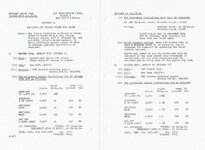
Bad example.
The 35 liter DB engine ran at about 6.1lbs of boost, once they got a few niggling problems solved, like holes appearing in the piston tops. by the time the DB 605 appeared the Merlin was not only cleared for 12lbs of boost but 1942 saw boost cleared to 15lbs and later 18lbs with strengthened supercharger drive. Please note that 15lbs of boost is 2.02 Ata.
Amazing how an extra 42% of intake pressure (which in this case is mass air flow) can equal 30% extra displacement.
You are confusing two different things. A Merlin XX running 12lbs of boost had a temperature rise in the supercharger of 148 degrees C. This was the rise over the temperature of the intake air. The radiators had nothing to do with the temperature of the air in the intake tract, unless there was some sort of intercooler. A Merlin running less pressure would have a lower temperature rise. A Merlin using a lower gear ratio on the supercharger would have less temperature rise but would not have the same pressure available at the same altitudes.
This was why the Merlin VIII engine in the early Fulmars was rated at 1275hp at 9lbs of boost using 87 octane fuel. The low geared supercharger could only hold 9lbs of of boost to a very low altitude. The much slower turning impeller didn't heat the air as much.
The detonation limit in supercharged aircraft engines has very little to do with the detonation limit on non-supercharged cars/motorcycles. In the supercharged engine the intake fuel/air mixture at full throttle is very close to it's ignition temperature. Sometimes the pilot gets a warning in the form of conventional "knocking", which is local (in the cylinder) pre-ignition. Sometimes the entire cylinder flashes at once, instead of a controlled burn taking 30-40 degrees of crankshaft rotation all the burn burns in 0-2 degrees the resulting pressure breaks the piston/s, con rods, etc, In the case of radials it may blow cylinders right off the engine.
This is why the engine makers (and airplane) used intercoolers or water/alcohol injection. To cool the intake charge. Worrying about the engine overheating in 2-5 minutes came after you could get the engine to survive making the high power for even a few seconds.
For some reason the difference in speed between the DH and Rotol props was only a few MPH. There was a difference in
performance. Performance covering all aspects, not just speed. The finer pitch end of the Rotol props gave better take-off performance and perhaps better climb. If you are trying to fly at 350mph you need the prop pitch to be correct for 350mph (or very close) otherwise the efficiency goes to pot real quick. All the engine and propeller people had figured that out (matching pitch to flight speed) in WW I with fixed pitch props.
The Speed Spitfire used a fixed pitch prop.
View attachment 772636
Getting the wrong pitch in 1940 that cost 20-30mph on a fighter was not impossible. what is close to impossible is that they never fixed it.
All two pitch or variable or constant speed props have the blades mounted in collars that allow the blades to changed in pitch. The hub may only allow a certain range of motion, like the already mentioned 20 or 34 degrees but the max or minimum pitch is adjustable on the ground and experiments would be very easy to do. easier than swapping a propeller (or carving a new wooden one). Now with the 20 degree props maybe you have to sacrifice something else but sacrificing 20-30mph of top speed for??????? shorter take off run? better climb at 120-140mph?
And when comparing different propellers we have the fact that they often used different shaped blades. The blades also were twisted as they went from the hub to the tip.
A prop tip has a shallower pitch angle than the mid part of the blade because the tip is moving much faster than the mid span of the blade in relation to the forward motion.
Different propeller companies may have had different ideas as what the change in blade shape could be.
Experimenting with different blade shapes/profiles is a lot harder than experimenting with different pitch angles.
Famous poor propeller is the early P-47. The speed didn't change much. The climb did, do the shape of the blades. More blade area.

 Or they could fit 4-blade props.