What plane do you wish had sawservice

Ad: This forum contains affiliate links to products on Amazon and eBay. More information in Terms and rules

I found an extra piece to the story of the Z.1018 Leone. A nightfighter version was planned with a cleaned up airframe. Three prototypes were under construction by the armistice. It would have had a Vmax of 580km/h and a frontal armament of 8x20mm cannon.
 
LGM-LK065_L.jpg


Kris
 
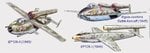
I think these may have been an effective ground attack aircraft. The Junkers EF 126 was to be powered by a single Argus As 044 or later Jumo 226 pulse jet engine.

The benefit of the pulsejet engine is that it's extremely easy to build and power, as documented by the V 1 flying bomb. The downside is that it is a rudementary engine which causes quite a bit of vibration. Plus, its performance drops at altitude. For that last reason it's no good as a fighter. But as an attack aircraft I think it would be excellent.

The EF 126 could carry about 400 kgs of bombs or Panzerblitz weapons at a speed of well over 600 km/h at sealevel. Quite an impressive performance for an attack aircraft.

But as said, the vibrations could have caused some problems like on the Me 328 parasite fighter. But this was a very fragile wooden miniature fighter. As the EF 126 was to be used as an attack aircraft it would have had a much strengthened fuselage. Then again there's the problem of weight increase. So perhaps two pulsejet engines for a bigger aircraft design would have been better and more reliable.

In 1945 Junkers and Argus tried to solve the power loss problems on the EF126 with an improved design with two Argus As-044 Pulso engines. The fuselage was based on the initial center wing and double tail design of the EF126. These rocket engines were mounted at the rear sides of the fuselage. There is no explicit new EF number known for this design. Probably it was developed still as the EF126, but also this can't be proofed by documents today.

Kris
 

Attachments

  • ef126_a3.jpg
    ef126_a3.jpg
    18.2 KB · Views: 255
I have a long list of axis aircraft. From the top of my head:

Messerschmitt Bf 109Z
Messerschmitt P 1101
Junkers Ju 248
Junkers-Argus attack aircraft (or the EF 126)
Focke Wulf P III or P IV
Focke Wulf P VI (aka Flitzer)
Arado Ar 240C or Ar 440
Lippisch P 20 (turbojet Komet)
Henschel Hs 123 (again)
Henschel Hs 132
Dornier Do 26 (as a long-range recon with Hohenthwiel)
Dornier Do 435
Focke Achgelis Fa 284 (flying crane)

Fiat G.56
Ambrosini SAI.403
Caproni Ca.331! (my absolute favourite!)
Savoia Marchetti SM.91
Fiat AS.14
CANT Z.1018 Leone

and a whole bunch of Jap fighters and the Ohka rocket version.
Kris

There were several I still haven't explained. So in short:


Messerschmitt Bf 109Z
A twin Bf 109 much like the Twin Mustang. I think it would have been an excellent stop gap aircraft as it required very little time to develop and no new production needed. The Bf 109Z would have been an excellent Zerstörer, faster than the P-51 and armed with up to 5 30mm cannons. I also think it could have been used as an escort fighter, a reconaissance fighter, a fighter bomber and a anti-Mosquito nightfighter. So within a few months it could have been used instead of the much more expensive Me 410, until the Me 262 would have been ready ('45).

Messerschmitt P 1101
Many people talk about the Focke Wulf Ta 183 although the P 1101 was quite similar but was actually built. It would have been built with non-adjustable wings and with the new HeS 011 engine. It would have been the best fighter on earth, superior to the P-80, Me 262, Meteor or Vampire.
Plus, it would have been easy to build.

Junkers Ju 248
aka Me 263. Basically a Me 163 with a double endurance. Was easy to build, easy to fly and with R4M rockets it would have been an excellent point interceptor, for instance in the Ruhr area.

Focke Wulf P III or P IV
I don't think the Me 262 was really what the Germans needed: it was complicated, expensive and needed two engines. Germany could not hope to compete with the industry of the allies. That's why I strongly believe in the Volksjäger program which asked for a cheap and simple single jet engined fighter. Of course it shouldn't have been used by the Hitlerjugend but by regular fighter pilots. One could build two or three Volksjäger for the price of one Me 262.
Now, the Volksjäger program was started in (IIRC) September 1944 when it was way too late. So I think it should have started a year earlier. There were few single jet engined fighter designs: the Messerschmitt P 1108, the Lippisch P.20, ... and the Focke Wulf P III (or P IV, the name is uncertain). I prefer the latter because it has the engine on top - so it wouldn't suck up objects on the grass airstrips - and had straight wings which were essential for rapid pilot schooling.

Focke Wulf P VI (aka Flitzer)
I like this one because it looks so much like the British De Havilland Vampire. That also makes me believe it was a succesful design even though it never flew.

Arado Ar 240C or Ar 440
The improved Ar 240. The Ar 240 was a remarkably fast aircraft, unlike the Me 210 and 410. But it was also unstable. This seemed to have been remedied by the later Arado designs but by then the Me 410 was already in service. Yet, the Ar 240C would have been an excellent night fighter and long-range reconaissance aircraft. I don't see much catching this Ar 240C.

Lippisch P 20 (turbojet Komet)
Already mentioned this one with the P III and P IV. The Me 163 was a delight to fly but the problem was its short endurance. The P 20 was like a Me 163 with a turbojet engine. Was also very simply to build and heavily armed. So this too could have been excellent Volksjäger interceptor.

Henschel Hs 123 (again)
I love this little aircraft and find it's a pity that it wasn't put back in production. Would have been excellent against partisans and for night nuisance missions but could also be used for daytime missions as they were more manoeuvrable than the Stuka or Hs 129 for dodging enemy fighters.

Henschel Hs 132
The well known turbojet dive bomber. Finally a successor to the Stuka (at least as a dive bomber) and excellent for attacks on specific targets (bridges, depots, rail junctions, ...) and naval targets.

Dornier Do 26
Perhaps the most beautiful seaplane ever (aka the Seeadler). It was designed as a transatlantic post and VIP aircraft but because of its great range I think it could have been excellent as a maritime reconaissance aircraft. It would have been used instead of the Fw 200 and Ju 290 because it also had the advantage of landing at sea, where it could be refuelled by U-boats as it had diesel engines. On the other hand, it could also supply U-boats (post, spare parts, wounded people).

Dornier Do 435/535
This is the night fighter version and the mixed propulsion version of the Do 335. The Do 435 had a side-by-side cockpit and would have been an excellent night fighter because of its high speed and good endurance. Also as an intruder, outclassing the Mosquito. The Do 535 had a jet engine in the back, and this might have made it a better fighter and especially an escort fighter. Would have been great to see this patrolling the seas or attacking targets far away.

Focke Achgelis Fa 284 (flying crane)
The Fa 223 is better known but had a limited carrying capacity. With a BMW 801 engine the Fa 284 could have carried 7 tons. This would have given the Germans a fantastic tactical weapon as it could suddenly fly in heavy weapons and halftracks to difficult terrain or to mountainous areas. Especially in the mountains it could fly in supplies in a few hours where else it would have taken days. Especially interesting because the Germans were often fighting in mountainous terrain.

Kris
 
Messerschmitt P 1101
It would have been built with non-adjustable wings and with the new HeS 011 engine. It would have been the best fighter on earth, superior to the P-80, Me 262, Meteor or Vampire.

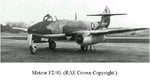
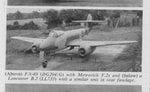
If the HeS011 engine ever gave it's designed power. It never did even with extensive postwar testing. In the same timeframe the Meteor F.4 appears with uprated engines, longer nacelles and clipped wings. As I said before, fit Metrovick F.3s to the aircraft to massively improve performance.
 
Agree with Red Admiral.

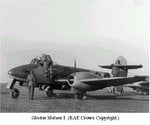
The Meteor Mk IV and Vampire Mk I were both flying before the P.1101 prototype was even fully completed, and would of easily been competitive (particularly the Vampire with uprated Goblin II).

Hard to see how you can label it "the best fighter on earth", when it never even left the ground.
 
I think you mean the Metrovick F.2/4 Beryl not the F.3 since that was a turbofan version (but maby I'm wrong as you said it woul improve Airliners, which a turbofan would). Aniway the Beryl wasn't ready untill after the war's end, though it was an excelent engine and would have done great in the Meteor (at up to 4000 lbf thrust). Though the design was still was quite complex ans not nearly as easy to repair compared to the Derwent V and they were cheaper.
The F-4 was operating pretty much at its limit with 3,500 lbf Derwent V engines. So more powerful ones would be pointless, except for improving rate of climb. (Beryls were tested in the Mk 4 as were R.R. Avon, but at altitude full throttle in level flight would likely push the craft past its .82 mach limit and easily in a dive) The longer nacelles would be about the same as those used with the Beryl. see: The Gloster Meteor

Though the engine was still excelent and comparable to the J35 or J34 engines in the us. (though lighter than the J35 but not designed with an afterburner as the J35 later was.)

Also the P.1101 was developed into the Bell X-5 which was supersonic, though with far more advances and twice the thrust the 011 would have ever made. Too bad the HeS-30 was canceled, it was the best class 1 engine and possibly the best engine of the war, 2 paired engines being superior to the 011 in almost all ways and most other class 2 engines as well. It would also have been ready much sooner since its prototype was running at full power around the same time as the 004A. Other class 2 engines like the 004H or BMW's design would have been better chouces to concentrate on for class 2 development.
 
This may have been brought up before but I didn't read all 35 pages. For me it's a no brainer, the Avro Arrow if for no other reason than to prove to those that doubt, that this would have been a world beater. Not to mention that the ****ards wouldn't have waisted millions of my tax dollars.
 
Ok the turbofan F.3 was what was meant earlier...

The F.2 powered Meteor was nice and would have inadvertently solved the compressibillity problems that went along with the Meteor I/III's centrifugal engines. If the F.2 had been made simpler by using flame cans it would have been much easier to servece, more reliable and easer to build. In this form it might have been ready for production by early '45. The Metrovick Meteor also had an interesting look with those underslung engines... Very different from the standard Mk I
 

Attachments

  • fs3-17.jpg
    fs3-17.jpg
    67.7 KB · Views: 144
  • index.jpg
    index.jpg
    31.6 KB · Views: 149
  • fs3-1b.jpg
    fs3-1b.jpg
    37.3 KB · Views: 134
This topic is abut the planes that were experimental and never saw action. You pick the top 3 that you would have liked to see in the fighting.Mine are the
XP60 WARHAWK a modified P-40 WARHAWK
XF5U CORSAIR A modified F4U CORSAIR
HEINKELL 100 a german fighter
What are you picks? :D

First - the P-51G with the 14 S.M. engine (similar to -9) had the potential for 48,000 feet and 510+ mph with a Packard 1650-11

Second - the F8F Bearcat

Third - the Ta152H-1 against both of those

Last the P-80 vs the 262
 
The Ta 152H saw service. It was limited numbers but it saw service.

Chris - I know it did -

that comment was to express a desire to see the F8F and P-51G in combat against it.. the 51H was slightly less capable than the XP-51G but had nearly the same performance with a proven production engine and prop.

It would have been interesting tactically also as the Ta 152 could always initiate a high altitude, high speed attack and disengage in a zoom climb from a F8F - but the 51G would have been able to be vectored to cruise into a combat area at very high altitude also.


Jes wonderin'
 
Ah I see, sorry I misunderstood you.

Chris, after re-reading my own post - how could you interpret it the way I intended. I was not very articulate.

It's just that the 51G and F8F kind of represented the next incremental development of the 51 and F6F had Germany's new piston engine fighters created serious problems. Had the land battles been stalled at the Rhine I suspect both the P-51H and P-80 would have been introduced into combat in ETO by April/May... and the Ta 152H would have been picking up steam
 
Too bad A.A. Griffith was so obsessed with perfection in the F.2. If he'd taken a more conservative design approach, it might have beed workable for production, but he was to focused on building the "best" design. With flame cans and less complex systems it could have been simple and reliable enough for the Meteor in 1944...
Though whittle's design still had it's own advantages of simplicity and durrabillity.

Also the XFU5 was the "Flying Flapjack" not a development of the F4U. I would certainly have liked it to see service though; can tou immagine the confusion of the Japanese seeing such a plane. Verry fast and maneuverable; quite tough and well armmed too.

This topic is abut the planes that were experimental and never saw action. You pick the top 3 that you would have liked to see in the fighting.Mine are the
XP60 WARHAWK a modified P-40 WARHAWK
XF5U CORSAIR A modified F4U CORSAIR
HEINKELL 100 a german fighter
What are you picks? :D

How about a P-59 with an improved cockpit, higher ammo (and raplace the M4 with an M10, or 2 more .50 cals) and fuel capacity, smaller, more streamlined wings (like the P-63's but with square tips), and more powerful engines (the J31 could have probably gotten up to 2,400 lbf like the Derwent-IV). The large-winged version would have been good for high-alt recon with a ceiling of over 46,000 ft. (kind of a primitive U-2) More reliable engines than the early P-80s and two so you could limp-home with an engine out, plus the inboard ingines made single-enge landings easier tha outboars ones of the Meteor or Me-262.

The XP-83 would have been nice (Adler mentioned it earlier), a decent escort but I'm not sure if it would have been better than the XP-72. Maby If the wings and control surfaces were improved and it had been fully developed, it would have been better than the P-72 with full development (P-47N's wings and , contrarotating props) but who knows.

The FH Phantom would have been nice if it had seen service in '45. Maby it would have been rushed into service if the invasion of Japan had continued.
 

Users who are viewing this thread

Back