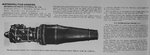
Usage has nothing to do with the design. The Germans used their axial jets that were inferior to the Metrovick type because they had no choice. The British did have the choice, with their centrifugal types which were easier to build and maintain. The Metrovick F.2 is superior in every way to the 003 and 004 (it was used on the SRA.1 before that was cancelled, and developed into the Sapphire) even without talking about the turbofan F.3 and F.5 versions.
I wonder what on Earth do you base that... wishful thinking perhaps?
Specs Jumo 004B / Metropolitan - Vickers F-2
First test flown: March 42 / June 43
Thrust 880 kgf / 817 kgf
Weight 719 kg / 692 kg
Diameter : 810 mm / 835 mm
Lenght 3860mm / 3251 mm
Given the specifications, the Jumo was a slightly superior engine.
Of course your wishful approach carries away you to the post-war F-2/4 type, which was enlarged compared to the F-2, and nowhere near ready for production: it only begun bench testing in 1946 and it was just passing its 100 hour tests in
1946.
The Jumo 004 completed those in
1943. Which is the major difference between the two. The Jumo 004 was there. The Metrovick axial jets were nowhere near being ready for production and combat application.
Kurfürst, do you have any information on the fuel consumption of DB series engines compared to the Rolls-Royce ones? The only data I've seen puts the DB series about 10% worse than the Merlin and Griffon.
Yes I have. Which is why I wonder where on Earth did you see specs stating the opposite..
The Merlin itself had some great development, going from 10300hp to 2640hp in 5 years.
I seriously doubt the latter figure. Perhaps on a bench pad, but thats an entirely different figure alltogether.
Juha said:
Now Griffon was some 170 kg heavier than DB 605AM but gave some 200 hp more power and if one add the weight of MW50 system which was. IIRC, essential for DB 605 AM to attain some 1800 hp, DB system was only appr. 70 kg lighter.
60 series Merlins were some 15 kg heavier than DB 605 AM but again when the weight of MW50 system was added Merlins were appr 85 kg lighter. So?
DB was shorter, IIRC, that's true.
The DB series (AM/ASM/DB/DB/DC) could develop 1800 HP without MW 50 with use of C-3. MW-50 was a sort of internal and/pr charge cooling for them, in the same manner as the intercooler in the Merlins/Griffons, which needs to be added into the comparison.
It was a fairly bulky system, making neccesarry adding:
- the inter/aftercooling unit of 32 kg weight
- an extra radiator for the intercooler weighting 42 kg,
- and 6.2 dm2 additional cooling frontal area (drag)
- cooling liquid (unknown quantity, perhaps 10-20 kg extra)
The weight peneleties of the sysytem are rather like the complete MW-50 system on the Bf 109, however the intercooler on the Merlins neccesitiated adding a radiator of the size equivalent of the 109G`s oil cooler (6.5 dm2, 8.5 on high alt (AS/D) versions), with considerable drag penalty.
This is for the Merlin 61; I think it is reasonable to believe the Griffon`s intercooling needs were considerably higher (given its enormous supercharger and the sheer size of its radiators).
All in all, when you look at it, the Merlin 60-series engines required a total of 154 kg cooling radiators alone to be installed, as compared to the DB 605A/AM`s of 87 kg. That was equivalent of a missing 70 kg that didn`t need to be lifted by the engine`s power.
So, for when one for example makes a comparison between the say DB 605 (at 720 kg dry weight without accessories), and the Merlin 60series engines (740 kg w/o accessories), one also has to take into account the different weight of the the cooling systems. Ie. on the Merlin there`s an additional 186 kg from the coolant, oil, and intercooler radiators and intercooler unit (as in the Spitfire IX), compared to the 87 kg extra from the oil/coolant radiators of the DB 605A (as in the 109G).
This does not include yet the supercharger unit (61 kg) and the carburator (+42 kg) of the Merlin 61; I am not sure of the DB 605, but I am sure OTOH its supercharger was much lighter, even on the AS engines, and probably the injection system is already included, as there is no seperate carbburator.
Then there is the question of propeller; higher powered engines require larger, and thus heavier propellers to absorb the power. In case of the DB 605A, a three bladed, light alloy VDM prop (complete with hub and all) would weight 170 kg; the 4 bladed Rotol, complete with hub weighted 181 kg.
Then there`s the question of fuel effiency of course. In case you`d need say 25% more fuel to achieve the same range, at the ca 500 kg total fuel capacity of the 109G/Spitfire, we are already talking about +125 kg needed to achieve the same range.