
why is the A6M Zero's lack of armor emphasized so heavily (3 Viewers)

Ad: This forum contains affiliate links to products on Amazon and eBay. More information in Terms and rules

There's a larger question here, involving the tradeoff study process of designing a new fighter. The customer tells companies what it needs/wants and then it's up to the companies to create something that meets those needs. If the customer demands maneuverability, then weight and wing loading and so forth will become dominant. If they want high speed, then drag and engine power move up the scale. High altitude brings different factors into play, and so on. The Zero's lack of armor and self-sealing tanks weren't goofs, they were legitimate tradeoffs to make the aircraft's design line up with what the customer said they wanted. Adding them would increase the weight and diminish maneuverability.

But the Navy was dead set against using prolonged multiple circles, and emphasized speed and hit and run, to the point actual witnesses and combatant thought the Zero turned poorly:

-Drachinifeld, YT, "Zero or Hero?" (Interview with Justin Pyke, UCalgary MA in Military and Intelligence
History, @CBI_PTO_History) 59:07 "Intelligence reports assumed that these tactics (hit and run) indicated the
Zero lacked maneuverability." 59:22 "Judging from their apparently long fuselage, these planes do not have a
small turning circle, and are not very maneuverable." 59:33 "The Chinese report in question noted the
reluctance of the Japanese Navy pilots to dogfight." 1:00:05 "Chinese pilots report that the Japanese will not
engage in a turning duel." 1:01:42 USN pilot comment (1942): "In my opinion, they [Zero pilots] had generally
poor fighter tactics: Zeroes could not be shaken by us if they would chop their throttles and sit on our
tails."


View: https://youtu.be/ApOfbxpL4Dg?si=feegNZnivaNZtmaN


The Navy did encourage the use of a high-reaching twisted loop maneuver called the Hinero-Komi, so keeping that vertical performance may have been the point of keeping the armour out. The idea was pretty much to stay above and twist down as the opponent went down (this started to work less well against the Hellcat, which could loop high and keep going).

Many things the Japanese Navy did were dumb. US pilots with actual first hand experience criticised the Zero for not following their turns!!! The slow-firing Type 99 (475 rpm) was a poor choice compared to the Army's Ho-5 (800 rpm!). Their triple mount 23 mm ship defence guns were notoriously poor due to vibrations, plus a hard to use tracking motion, and greatly contributed to IJN ship losses. Navy commanders though radios were not important for fighters...
 
F4U designers seemed to be quite confident of the armor against 50 cals.
 

Attachments

  • F4Uarmor.jpg
    F4Uarmor.jpg
    168.1 KB · Views: 22
F4U designers seemed to be quite confident of the armor against 50 cals.
As far as I know, F4U were the only US piston fighter that were armored against 50 cal, it also arguably more armored than P-47
 
More often than not, it is the opposite. The 20mm aircraft gun tends to have projectile relatively short in ratio to its caliber, added that it has a fuse that makes the tip mostly flat. This causes much larger drag to the 20mm than the sharp-tip 50cals, and the velocity drops drastically over the range. A good example would be the MG-151/20,
That interesting, is there any reason why they can't make the fuse sharp?
also early 20mm in USAAF were disliked because that M2/Hispano cannon, which was one of the best 20mm considering ballistic property, had relatively inferior trajectory and velocity compared with 50cals.
View attachment 882422
I thought the issue were that US version of hispano constantly jammed?.
Also weren't the Hispano and 50 cal essentially have the same muzzle velocity?
Screenshot 2026-06-09 174236.jpg
 
Last edited:
As far as I know, F4U were the only US piston fighter that were armored against 50 cal, it also arguably more armored than P-47
F4U presumably the most vulnerable R-2800 equipped single-engine fighter. Its oil cooler had always be a weak point and many cases it was knocked down by light rafle calibre fire from the ground. F6F is better at taking damage.
Naval Air Combat Statistics (NACS) states that "The F6F appears to have had considerable advantage over the F4U when flown under the same conditions. Receiving about the same number of hits per sortie in comparable operations, the F6F had a far lower rate of loss per plane hit."

The report continued, finding that "The F6F was slightly superior to tie F4U in combat, apparently chiefly because of itsgreater ability to survive damage."
It looks like in terms of taking pernishments, probably P-47 >= F6F > F4U. But at least you may argue its pilot is safer under armor protection, especially the armor cap aft of the cockpit.

The US 20mm probably featured a different projectile design compared to the British Hispano, which may lead to a slightly different ballistic property and less damage per round (American 20mm belt in the PTO usually consists of HE/I/T, in which the HE round has an instant fuze that is inferior to the delayed fuse used on British rounds).
 
M2/Hispano cannon, which was one of the best 20mm considering ballistic property, had relatively inferior trajectory and velocity compared with 50cals.
This is both true and false depending on what is being measured and what is the allowable tolerance.
The Hispano did have the best ballistics of any WW II 20mm gun/ammo. The initial velocity was just about the same as the .50, in fact it was better up until 1940(?) but the Hispano didn't see much combat in 1939-40. Neither did the pre-1940-41 US .50 cal. guns and ammo. US .50 added around 350fps to the velocity. British were still taking delivery of the slower ammo into 1941 and maybe 1942?
How important this was is certainly subject to question. Sight in charts for the P-38
Show no practical difference (aiming at entire airplane, not left oil cooler) out to over 600yds.
That interesting, is there any reason why they can't make the fuse sharp?
Depends on what you want. US .50 didn't use exploding ammunition. They wanted pointy bullets for streamlining. They didn't care if they skipped, tipped or ricocheted on impact.
With exploding ammo a blunt nose helped insure proper fuse functioning. And even with 20mm ammo a shell that goes off even a foot outside the plane (ship or ricocheted) does less damage than one that goes off in the wing/fuselage skin and a whole lot less than one that goes off one foot inside the plane.
Fuses did better with time but early fuses were not good. What they could do in 1944-45 was not what they could do in 1940-41.
Pointy shells were problem in anti-tank work and naval combat. Pointy shells/projectiles that hit sloped armor with their ogive
Bullet-Sections.jpg

and not their point tend to bounce off. Hitting with point or a blunt ogive tends to make them dig in.
 
I assume this was during the development of 'crash-proof' tanks, not self-sealing tanks.
Yes, I cannot find the exact reference but the tone was the idea of protected fuel tanks gave way to a policy that changed the requirement to crash proof, so testing consisted of throwing likely designs, fully fuelled, off the roof of a multi story building on to concrete and seeing if they leaked. Needless to say self sealing required less stringent testing.

Unfortunately we also seem to be stuck with yet another attempt at turn fighter ideas.
 
Question is what kind of 20mm gun/ammo?

What range and angle and what was in the way of the armor plate?

A Hispano gun will go through about 60-65% more armor than a German MG 151 assuming similar projectiles for both and close range.
A US .50 cal will go about 47% more than the German MG 151 (AP) assuming similar projectiles for both and close range.
British tested (proved) .303 AP at 70% penetrating 10mm at 100yds,
British .5in AP was supposed to do 70% penetrating 15-18mm at 100yds (different marks) and the British shifted to semi AP (cores were not hardened) for most war time ammo
Italian and Japanese 12.7mm should have been similar.
Early British ammo for the US .50 cal guns was supposed to do 1/2 in (12.7mm?) at 1000yds. testing that would have been fun (not).

British had trouble with the 20mm Hispano fuses in 1940 and later (?). Quick answer was just load inert training ammo about 50/50 with the HE. to get projectiles to penetrate more (not detonate on the skin).
 
Question is what kind of 20mm gun/ammo?

What range and angle and what was in the way of the armor plate?

A Hispano gun will go through about 60-65% more armor than a German MG 151 assuming similar projectiles for both and close range.
A US .50 cal will go about 47% more than the German MG 151 (AP) assuming similar projectiles for both and close range.
So US 0.5 cal can penetrate better than German 20 mm but worse than British 20 mm?. I didn't know German cannon were that bad.
Also were that penetration take into account the effect of 20 mm explosion?
I vaguely recalled reading somewhere that in testing US military found that 20 mm round were 3 times more effective at killing than 0.5 cal. Were that taking in consideration that 0.5 cal can penetrate more?
 
Last edited:
Read an article years ago that said that for the typical 7.92 and 20MM armament of a German fighter, the probability of downing a B-17 or B-24 on one pass was around 1%. So it took 50 firing passes to even get a 50% probability. I don't know what the probability was of doing 50 firing passes at an unescorted US bomber formation without the fighter sustaining serious damage but I'd guess it was pretty low.

Hence, the German move to 30MM and larger guns.
 
Question is what kind of 20mm gun/ammo?


British had trouble with the 20mm Hispano fuses in 1940 and later (?). Quick answer was just load inert training ammo about 50/50 with the HE. to get projectiles to penetrate more (not detonate on the skin).
Hi
Info on RAF 20mm fuzes as told in RAF AIR 41/82 SD 737 'Armament Volume II - Guns, Gunsights, Turrets, Ammunition and Pyrotechnics' 1954, source is found on AHB website:
Scan_20260609 (18).jpg


Mike
 
I read a report that said a B 17 that suffered a 6 o'clock attack from a FW 190 had less than a 50% chance of surviving.
 
For what it might be worth, my father, an F4F driver at Coral Sea, Midway, and in the Solomons, wrote the below in February 1993 as a missive to Bowen Weisheit in conjunction with his research on the loss of Ensign Markland Kelly of VF-8 at Midway. Transcribing his penciled rough draft . . .

Dear Bo,

After our telephone conversation last week I found myself brooding over an issue we had discussed – the infamous 'leak-proof' tanks. Continuing my brooding, I got in touch with Joe Fazio, Aviation Machinists Mate 1/c, and checked his recollections about the protected fuel system. He had joined the squadron in Dec '41 during some frantic days between 7 Dec – 16 Dec when we mounted up on USS Yorktown CV-5 for glory and ultimate shipwreck, Midway Battle. Joe is a live wire clear thinker, etc. We got our heads together and found complete agreement in our recollections of F4F-3 and -4 fuel systems and protective measures. He handled many tanks removing, installing, etc.

The enclosed dissertation results from our discussions. While writing, I broke out my Pilots' Handbook and was surprised at the language on p.55. It agrees with your terminology and most definitely disagrees with the recollections of Joe Fazio and yours truly. We know who is right here, and I believe you will find an explanation for the misleading words of the Handbook. Betcha there are other discrepancies and omissions in the Handbook caused by the desire to protect certain kinds of information.

So Bowen, I brood no more about the tanks. I hope you will find the information, if not useful, amusing.

Warm Regards,

Bill


SUBJECT: Fuel Protection in Grumman F4F-3, -4 airplanes in 1941-43

The F4F-3 delivered to VF-42 in early 1941 came equipped with a large fuel tank and a smaller reserve fuel tank. Both tanks were aluminum shells and vulnerable to fire/explosions in combat. We flew these machines in this state until Dec 1941 when in a crash program our crew assisted by technicians at Norfolk Assembly and Repair facility installed armor plating, bulletproof windshield panel, and measures to protect the fuel. These actions were completed in time for our departure to the Pacific aboard USS Yorktown CV-5 on 16 Dec 1941. We flew and operated F4F-3/4 so configured 1941, 42, and 43 (late).

Fuel protection was achieved by two separate measures. The small reserve tank was fitted with plumbing connected to a small flask of CO2​ with control knob in the cockpit. The prescribed operating procedure was for the pilot to select main tank for take off and shift to reserve in steady flight and use the reserve until the tank was empty. If on a combat mission with danger of hostile fire, the empty tank was to be purged once emptied by the pilot pulling on a T-handle somewhere in the shadows behind the seat. It was advisable to delay this action until imminent hostile contact as the CO2​ effectiveness diminished gradually after release. There was no other protection available for the small (27 gal) tank.

The main aluminum tank was replaced with a self sealing tank manufactured, I believe, by Goodyear or some such tire company using tire fabricating techniques. The tank was the same size and shape as the aluminum one but was somewhat flexible. It had a black rubbery appearance with walls about an inch in thickness. The tank had an inner and outer shell of rubberized fabric – looked like the inside of an automobile tire. Between these shells was a translucent rubbery material which accounted for the "self sealing" properties erroneously called "leakproof." It was said to be "natural rubber." Whatever, when exposed to gasoline it would not melt, but would swell. The shell, inner and outer, formed a sandwich structure of stable geometry contained and protected the seal forming material until it was needed. A bullet entering the tank would create allowing seepage into the active sealant which would swell and block the bullet hole. A tank could swallow several hits and be usable for several flights in an emergency. Standard practice was to replace an injured tank as soon as possible (!).

Note: The F4F-4 Pilots' Handbook, p.55, Grumman Contract No. 75736, says, "Both tanks are equipped with internal self-sealing lines." This is misleading, maybe deliberately. My guess is that they did not want to identify the specifics of fuel protection in a publication that was a low-grade security classification (Restricted) and in danger of being carried aloft. Following the quote above is the following: "NOTE: Refer to Technical Order # 55-41 FUEL TANKS PROTECTION AGAINST GUNFIRE."

It is my opinion that this note was inserted to steer the operator to an instruction of higher security classification where the true nature of the system would be expounded.

W N Leonard
February 1993
 
I read a report that said a B 17 that suffered a 6 o'clock attack from a FW 190 had less than a 50% chance of surviving.
I don't guess you know if that was before or after they figured out which areas of the B-17 were most likely to result in fatal damage and armored them? Those areas included the aileron control linkages, the fuel lines around the engines, and the cockpit.

A friend of mine's father was a B-24 waist gunner and talked to a B-24 tail gunner who had an unusually high score against German fighters. The tail gun on the B-24 was very impressive to German fighter pilots, having a turret that gave a very good view because of the twin tails. The tail gunner said hat when he saw a German fighter approaching from 6 o,clock low he would move the guns quickly back and forth, up and down, something the German pilots could see, in order to give the impression the guns were jammed or the turret was malfunctioning. The German typically would hold his fire, looking to get close in order to score a kill. Then, when the fighter got just to the right spot the tailgunner would open fire. He had quite a score of fighter using that tactic.
 
So US 0.5 cal can penetrate better than German 20 mm but worse than British 20 mm?. I didn't know German cannon were that bad.
No, it was the Hispano was that good.
We are getting off track here, but 20mm cannon shells varied from 79 grams (Japanese Army Ho-5) to 130 grams (Hispano) with a few heavier outliers.
Velocity varied from 585m/s (German MG/FFM) to 880m/s (long barreled Hispano). Some guns were in the middle like the 20mm ShVAK with 96gram shells and 750-770m/s velocity.
rates of fire for the cannon varied from around 490rpm to 800rpm. No one gun was the best at everything but some were better at several things, usually they paid for it by being heavier. HE content of the shells could vary from 3.7g(German MG/FFM) to 13 grams (one type of shell for Japanese Army Ho-3 cannon in the Ki-45 fighter).

The US .50 was trying to make a hole about 40% the size of a 20mm in area, it needs about 40% of the energy to get through the same thickness plate but the projectiles are not teh same construction.
Also were that penetration take into account the effect of 20 mm explosion?
This can depend on when/where the explosion actually takes place. If the round explodes with the nose in contact with the plate the armor may stop any penetration. If the round explodes as the nose is denting the plate (just 5-10mm more travel) the stressed plate may allow a hole to be blown though the plate. May also depend on how much the shell body deforms before detonation and how thick the plate/s were. 20mm Hispano sometimes blew a hole a number of inches across through a plate but this depended on how thick the plate was (and extra 2-3mm might mean no penetration at all) and the exact orientation/placement of the shell.
The goal was to get the shell to go through the armor and explode at it was leaving the plate. Penetrating is not the goal, the goal is to destroy or damage what the armor is trying to protect.
I vaguely recalled reading somewhere that in testing US military found that 20 mm round were 3 times more effective at killing than 0.5 cal. Were that taking in consideration that 0.5 cal can penetrate more?
A 20mm Hispano has about 3 times the kinetic energy of the .50 but kinetic energy is often wasted. Shell goes right through wing hitting nothing vital. US .50s never used HE in the projectile. In 1941-43 they did use a mix of AP, Incendiary and tracer. Starting in 1943 they began putting a few grams of incendiary in the AP rounds and cut back/eliminated the incendiary only rounds. The 20mm Hispano incendiaries carried about 5 times as much incendiary material. The US .50cal API also split the incendiary material with some in front of the AP core and some behind. The material in front of the core gave a nice indication of hits but that means it was burning on the outside of the target aircraft and not inside.
Figuring what was better is difficult as you can't compare one single round to another, You have to compare number of rounds fired in a given time period and the percentage of each type of round fired in that period (like a 2-2-1 mix or a 50/50 mix or??)
Be very careful of wording, the 20mm Hispano was around 4 times more powerful per shot. The HE content counts for a lot, but the .50 Browning fires about 30% faster.
And the Hispano can penetrate as much or more than the .50 cal. It is the German MG 151/20 that has trouble with penetration (and the Soviet 20mm gun) and the...............;)
 
But the Navy was dead set against using prolonged multiple circles, and emphasized speed and hit and run, to the point actual witnesses and combatant thought the Zero turned poorly:

-Drachinifeld, YT, "Zero or Hero?" (Interview with Justin Pyke, UCalgary MA in Military and Intelligence
History, @CBI_PTO_History) 59:07 "Intelligence reports assumed that these tactics (hit and run) indicated the
Zero lacked maneuverability." 59:22 "Judging from their apparently long fuselage, these planes do not have a
small turning circle, and are not very maneuverable." 59:33 "The Chinese report in question noted the
reluctance of the Japanese Navy pilots to dogfight." 1:00:05 "Chinese pilots report that the Japanese will not
engage in a turning duel." 1:01:42 USN pilot comment (1942): "In my opinion, they [Zero pilots] had generally
poor fighter tactics: Zeroes could not be shaken by us if they would chop their throttles and sit on our
tails."


View: https://youtu.be/ApOfbxpL4Dg?si=feegNZnivaNZtmaN


The Navy did encourage the use of a high-reaching twisted loop maneuver called the Hinero-Komi, so keeping that vertical performance may have been the point of keeping the armour out. The idea was pretty much to stay above and twist down as the opponent went down (this started to work less well against the Hellcat, which could loop high and keep going).

Many things the Japanese Navy did were dumb. US pilots with actual first hand experience criticised the Zero for not following their turns!!! The slow-firing Type 99 (475 rpm) was a poor choice compared to the Army's Ho-5 (800 rpm!). Their triple mount 23 mm ship defence guns were notoriously poor due to vibrations, plus a hard to use tracking motion, and greatly contributed to IJN ship losses. Navy commanders though radios were not important for fighters...

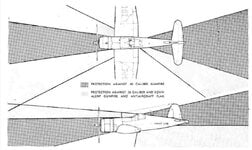
The Zero was designed to best the mostly biplane fighters in China. Tactics were developed for that purpose. Due to the rigid training doctrine, IJN pilots used the same tactics against American and allied aircraft. Early on, they had success against inexperienced allied pilots, but these tactics proved less effective as allied pilots gained experience.
 
Here is a book of mine that covers this topic very well. Surprisingly, the Japanese eventually saw the logic in armor and ss-fuel tanks and their later designs included them. Their ss-fuel tanks were not as good as those the US used, however. Edit: The appendices to this book contain the results of tests on Japanese pilot and other armor plate.

Exploding_Fuel_Tanks-A.jpg


Exploding_Fuel_Tanks-B.jpg
 
Last edited:
Read an article years ago that said that for the typical 7.92 and 20MM armament of a German fighter, the probability of downing a B-17 or B-24 on one pass was around 1%. So it took 50 firing passes to even get a 50% probability. I don't know what the probability was of doing 50 firing passes at an unescorted US bomber formation without the fighter sustaining serious damage but I'd guess it was pretty low.

Hence, the German move to 30MM and larger guns.

What read was that the hit rate was 2%. And that twenty 20 mm hits would down a B-17G. A 190A-8 carried 780 X 20 mm rounds, so expending half its ammo in one pass would get 4 hits. In a second pass (to empty) it would be at 8 hits. The crucial part is that by that point they likely got the all-important "separation" from the formation, which meant a slower less defended aircraft, so the remaining 3 passes would be easier if no escorts were around.

It does not strike me as an efficient use of resources to use fighters against bomber formations...

The 8th Air force noted that the lethality of Me-262 passes were only 30% of prop aircraft passes (keeping in mind that by 1945 only the Me-262 could realistically attempt passes, given the lopsided forces present). The R4M rockets brought the 262 to barely PAR the lethality of props per individual pass...:


View: https://youtu.be/d38EXBxPzms?si=Zo38oF81Q9k-5wFV

The reason for that is of course that guns HATED overtaking speed, and anything even approaching 60 mph in overtaking speed required last second point-blank fire at about 50-75 metres (to increase the weak 2% hit rate despite the burden of a mismatched overtaking path), 50 metres per second being 180 km/h, the overtaking had to be much slower than that).

It is now easier to understand why Hartman was brought down 12 times by colliding with debris, and why the Me-262 had such a low effectiveness...

In addition, the Me-262 dutch-rolled at higher speeds because its basic design was wrong, having a positive wing dihedral. Dutch rolls are essentially mild yaws that alternate right to left as each wing goes upwards alternatively, causing a yaw opposite to the wing rising. So its stability as a gun platform, where its speed was superior, was questionable. Given its losses it likely never got a 1:1 kill ratio.

As an aside, a very interesting study of all Me-262 losses found that over 70% of them crashed beyond 50 kilometres from their bases, and only about 10-20% within 10 kilometres of their bases, so the idea they were slaughtered while landing or taking off is false...

Another interesting side note is that the B-24 was easier to set on fire because of some of its fuel tank were concentrated in a central area in the spine of the fuselage (you can actually see those spine tanks lighting up in footage of fighter passes), and even the A6M Zero would routinely "light up the spine" and kill the B-24 in one pass... The B-24 had a higher fatality rate than the B-17 per aircraft shot down (or adding-in its higher accident rate maybe), but curiously it did not have much heavier losses in terms of loss per sortie in Europe (unless the figures I saw were wrong).... It cruised much faster at 180-200 mph where the B-17 was 160-170 mph, so that may have reduced its exposure despite the lower altitudes it flew at.
 
Last edited:

Users who are viewing this thread

Back