In general, yes, but in this case I really think it's more that the world was very war weary, there was a massive backlog of non-military investments (like rebuilding much of Europe and Japan, etc.), and there was a huge surplus of perfectly OK military equipment. Only the highest priority military investments like nuclear weapons and jet engines were urgently funded. Aircraft guns, while by no means perfect, very evidently considered good enough for the time being?
We are covering a fair bit of time and then we have different countries have different requirement standards.
In 1946-47 there was a huge slowdown in production although studies of some German weapons were done.
In The US in 1946-47 the Armor Research Foundation got a contract to study one of the German MG 213 guns. This was known as the T74A which lead to the T-74B which lead to the T110 of 1949. The gun was flipped upside down (gun fired at 6 o'clock instead of 12 o'clock) and other changes, They also changed from the German steel cases to Brass cases and use US projectiles. This gun was turned into the T150 and later T160 which used the 20 X 102 cartridge and it was this gun that was trialed in Korea in 1952/53.
The 20 X 102 cartridge was by way of the T160 gun (5 chamber revolver) using the old US .60 cal machine gun round (never actually used in service). The T160 became the M39 and was not considered totally debugged until 1959 despite being used in the F-86H, the F-100, the F-101. The F-5 came a bit later.
The US Navy had gone it's own way and adopted it's own gun/s and cartridges in 1940s/50s and the two services didn't really get together until the M61 Vulcan gun.
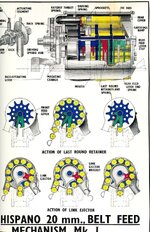
Now in the US some of the lack of interest in the MG 213 may have been because the USN, not liking the .50 cal Browning had several companies working on new version of the Hispano gun during WW II, which wound up close to the British MK V. But not exactly. These lead to the M3 in 1945, the M24 in Nov 1947 (electric primed) and a different path Hispano gun that lead to the T34 series of guns that lead to a modified cartridge that used a lighter projectile at higher velocity which lead to the Navy MK 12 gun in the early 50s which used a larger cartridge case, a lighter projectile, electric priming and a rate of fire of 1000-1100rpm from a 42kg gun. It gave quite a bit of trouble in the F-8s, less trouble in some other installations.
This is a short, condensed version (I have skipped over some projects and experimental cartridges) of US aircraft cannon development after WW II. They were not sitting on their hands waiting for prices to go up in the late 40s or 1950s.
There was also some cross over with some US projects using British 30mm ammo in the early 50s.
Maybe the Germans had lower standards, understandable when you are being bombed. But the idea that the MG 213 was just about fully developed and ready to go in 1945 does need a large dose of salt.