The use of delta wood (as well asSoviet wooden airplanes are kind of a case in point. Yes they used wood. They also used a crap load of phenol-formaldehyde resin. Were they wood or composite?
Last edited:

Follow along with the video below to see how to install our site as a web app on your home screen.
Note: This feature may not be available in some browsers.
The use of delta wood (as well asSoviet wooden airplanes are kind of a case in point. Yes they used wood. They also used a crap load of phenol-formaldehyde resin. Were they wood or composite?
The use of delta wood (as well as bakelite - they differ slightly in production technology) in the USSR was very limited - the own production of phenol-formaldehyde resins did not meet the needs of the aviation industry, and the Soviets purchased resin components from Germany before the war. After the outbreak of the war, the aircraft industry used the stocks, and then had to replace delta wood with ordinary plywood, which affected performance. In 1943, the limited production of delta wood was revived by lend-lease supplies.
Find the word "bakelite" here, please - it's not hard even in Cyrillic text:The Yak 9 and Yak 3 had basically thin bakelite resin coatings

I attached a zipped djvu-file (10Mb) - hopefully it helps.Do you have a link to that second manual please?
Find the word "bakelite" here, please - it's not hard even in Cyrillic text:
View attachment 851432
View attachment 851435
Source ("Yak-9 airplane. Temporary technical description", 1944):
View attachment 851424
"Manufacturing of wooden airplanes", 1945 - not a word about "bakelite coatings" in the chapter "Paint Coatings for Wooden Units".
The wooden skin of the airplane was coated with cellulose ether-based aircraft lacquer.
View attachment 851425

Some differences between the H-S 12-Z engine and the Saurer YS-2 from
H-S 12-Z...............................................................................................Saurer YS-2
two side injection pumps....................................one single injection pump inside the V
Motor cannon............................................................not compatible with cannon
one-outlet compressor..........................................Two outlet compressor
Light crankshaft;........................................................Sturdy crankshaft;
without balance weights........................................with balance weights
50kg................................................................................80kg
One damper in the last blade...............................Dampers in each blade.
This the only (or very few?) sources that say the Saurer YS-2 was not compatible with cannon
"Hispano Suiza in Aeronautics" by Manuel Lage page 247
Make of it what you will.
Thank youI attached a zipped djvu-file (10Mb) - hopefully it helps.
By the way, do you know what the HS Type 81 (ter) was? I have stumbled upon this designation regarding ground vehicle engines, but unlike other Type designations I've never found an exact proof of what it is.In order to correct some hesitations or errors in this thread:
The Hispano-Suiza type 57 engine commercial name was the 12M, a precursor to the 12X (27-liter displacement, bore/stroke 130 x 170 mm) without a supercharger.
The type 61 engine was a 12N, a precursor to the 12Y (36-liter displacement, 150 x 170 mm) without a supercharger.
The type 77 engine was a 12Y in the "moteur-canon" or "moteur affut" version, with an increased reduction gear center distance - the "normal" center distance engines family was the HS 73.
The 12Y-51 remained in the 77 family as it differed little from previous models (enlarged inlet valves, dynamic crankshaft damping, various reinforcements, etc.).
The 12Z (type 89 engine) was initially designed as a carburetor engine with Hispano supercharger. A version (12Z bis) was designed with a Planiol-Szydlowski supercharger, but seems to have not been in operation (or ever built) before the war. The 12Zter version, tested in 1940, was equipped with a Lavalette direct injection system (Bosch licensed). The Arsenal VG-39, equipped with a 12Z-ter, had a lower air intake, which shows that this engine retained the Hispano supercharger of the basic 12Z.
A single-cylinder 12Z was running in February 1938. The complete engine was on the test bench in March 1939 and was found to be "satisfactory." It should also be noted that Lage did not fully understand this engine; in particular, he was unaware of Louis Birkigt's patents, the principle of which is the "secret" of this engine (and probably the secret to its malfunction...).
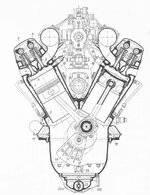
And finally, it's very clear that the Saurer YS-2 could accommodate an axial cannon, as its cross-section demonstrates.
This same cross-section shows that the YS-2 was much more of an evolution of the 12Z than the 12Y.
No. Nothing more than what Lage says: a 100 x 100 mm bore/stroke V-12 engine (9.4 liters), intended for military vehicles. Probably one of the many designs for land vehicles, which, apart from luxury cars, were only successful for railcars.By the way, do you know what the HS Type 81 (ter) was? I have stumbled upon this designation regarding ground vehicle engines, but unlike other Type designations I've never found an exact proof of what it is.
This is from the Swiss magazine "Schweizerische bauzeitung".A pair of Swiss articles on one of the Saurer engines that I got from who knows where in 2019. I cannot read them but some members probably can and, hopefully, provide a summary. The first appears to cover the fuel injection models for the YS-2, YS-3 and YS-4 and the second has 2 sections of the YS-2 plus photos.