Advanced French Fighters vs 1942/1943 contemporaries (2 Viewers)

Ad: This forum contains affiliate links to products on Amazon and eBay. More information in Terms and rules

Soviet wooden airplanes are kind of a case in point. Yes they used wood. They also used a crap load of phenol-formaldehyde resin. Were they wood or composite?
The use of delta wood (as well as bakelite balinite - they differ slightly in production technology) in the USSR was very limited - the own production of phenol-formaldehyde resins did not meet the needs of the aviation industry, and the Soviets purchased resin components from Germany before the war. After the outbreak of the war, the aircraft industry used the stocks, and then had to replace delta wood with ordinary plywood, which affected performance. In 1943, the limited production of delta wood was revived by lend-lease supplies.
 
Last edited:
The use of delta wood (as well as bakelite - they differ slightly in production technology) in the USSR was very limited - the own production of phenol-formaldehyde resins did not meet the needs of the aviation industry, and the Soviets purchased resin components from Germany before the war. After the outbreak of the war, the aircraft industry used the stocks, and then had to replace delta wood with ordinary plywood, which affected performance. In 1943, the limited production of delta wood was revived by lend-lease supplies.

The Yak 9 and Yak 3 had basically thin bakelite resin coatings
 
The Yak 9 and Yak 3 had basically thin bakelite resin coatings
Find the word "bakelite" here, please - it's not hard even in Cyrillic text:
1760303243173.png

1760304335719.png

Source ("Yak-9 airplane. Temporary technical description", 1944):
1760302918036.png

"Manufacturing of wooden airplanes", 1945 - not a word about "bakelite coatings" in the chapter "Paint Coatings for Wooden Units".
The wooden skin of the airplane was coated with cellulose ether-based aircraft lacquer.
1760302949244.png
 
Do you have a link to that second manual please?

Gobble translate is pretty crappy but it should give some basic idea of the text and that is an area that is seldom found in the old manuals.. I guess many of those who decided what manuals to keep did not think it significant.
 
Find the word "bakelite" here, please - it's not hard even in Cyrillic text:
View attachment 851432
View attachment 851435
Source ("Yak-9 airplane. Temporary technical description", 1944):
View attachment 851424
"Manufacturing of wooden airplanes", 1945 - not a word about "bakelite coatings" in the chapter "Paint Coatings for Wooden Units".
The wooden skin of the airplane was coated with cellulose ether-based aircraft lacquer.
View attachment 851425

I didn't say the specific word bakelite, but nice try. I really could give two shits what you think.
 
Some differences between the H-S 12-Z engine and the Saurer YS-2 from

H-S 12-Z...............................................................................................Saurer YS-2
two side injection pumps....................................one single injection pump inside the V
Motor cannon............................................................not compatible with cannon
one-outlet compressor..........................................Two outlet compressor
Light crankshaft;........................................................Sturdy crankshaft;
without balance weights........................................with balance weights
50kg................................................................................80kg
One damper in the last blade...............................Dampers in each blade.

This the only (or very few?) sources that say the Saurer YS-2 was not compatible with cannon
"Hispano Suiza in Aeronautics" by Manuel Lage page 247

Make of it what you will.
 
Some differences between the H-S 12-Z engine and the Saurer YS-2 from

H-S 12-Z...............................................................................................Saurer YS-2
two side injection pumps....................................one single injection pump inside the V
Motor cannon............................................................not compatible with cannon
one-outlet compressor..........................................Two outlet compressor
Light crankshaft;........................................................Sturdy crankshaft;
without balance weights........................................with balance weights
50kg................................................................................80kg
One damper in the last blade...............................Dampers in each blade.

This the only (or very few?) sources that say the Saurer YS-2 was not compatible with cannon
"Hispano Suiza in Aeronautics" by Manuel Lage page 247

Make of it what you will.

I doubt the Motorkanone part a lot, as the armament of the Doflug 3802 is described as either one 20mm HS 404 in the prop hub and four light machineguns in the wings, or one 20mm HS 404 in the prop hub and one more in each wing.

This also appears to be backed up by the photos

1760390113806.jpeg


1760390128550.jpeg


Those are the one cannon, four machinegun version.

This is the three cannon version which isn't supposed to exist.

1760390277081.png


Also there appear to be at least three different versions of the 12Z, which one are you referring to there?
 
"Also there appear to be at least three different versions of the 12Z, which one are you referring to there?"

I am inferring (guessing) the 1940 French Type 89 12-Z engine or a 1942 development.
Dealing with H-S Barcelona might have been even more difficult that dealing the French Hispano and anything post war is too late.
4 valves, nitrided cylinder liners and fuel injection (although a different type).

This book also claims that the Swiss in the 1930s had KTA (Kriegstechnishen Abteilung) license the 500hp type 57 engine to SLM with 60 units and the 650hp Type 61 12-Nb to Adolf Saurer A.G. for 80 units.
In 1935 The KTA also got license for type 77 12-Ycrs for 190 units with production between SLM and Saurer. These engines were fitted with Oerlikon guns of the type that Birkigt was using/building until he designed his own cannon.
By 1940 there was a new agreement to cover the Type 77 12-Y-51 and Saurer and SLM built 440 of these during the war time period.

The Saurer YS-2 did not use any form of license.

https://ww2aircraft.net/forum/posts/2065999/react?reaction_id=1
 
In order to correct some hesitations or errors in this thread:

The Hispano-Suiza type 57 engine commercial name was the 12M, a precursor to the 12X (27-liter displacement, bore/stroke 130 x 170 mm) without a supercharger.

The type 61 engine was a 12N, a precursor to the 12Y (36-liter displacement, 150 x 170 mm) without a supercharger.

The type 77 engine was a 12Y in the "moteur-canon" or "moteur affut" version, with an increased reduction gear center distance - the "normal" center distance engines family was the HS 73.

The 12Y-51 remained in the 77 family as it differed little from previous models (enlarged inlet valves, dynamic crankshaft damping, various reinforcements, etc.).

The 12Z (type 89 engine) was initially designed as a carburetor engine with Hispano supercharger. A version (12Z bis) was designed with a Planiol-Szydlowski supercharger, but seems to have not been in operation (or ever built) before the war. The 12Zter version, tested in 1940, was equipped with a Lavalette direct injection system (Bosch licensed). The Arsenal VG-39, equipped with a 12Z-ter, had a lower air intake, which shows that this engine retained the Hispano supercharger of the basic 12Z.

A single-cylinder 12Z was running in February 1938. The complete engine was on the test bench in March 1939 and was found to be "satisfactory." It should also be noted that Lage did not fully understand this engine; in particular, he was unaware of Louis Birkigt's patents, the principle of which is the "secret" of this engine (and probably the secret to its malfunction...).

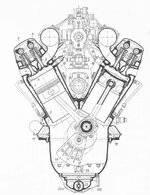
And finally, it's very clear that the Saurer YS-2 could accommodate an axial cannon, as its cross-section demonstrates.

This same cross-section shows that the YS-2 was much more of an evolution of the 12Z than the 12Y.
 

Attachments

  • Hispano Saure YS-2 01a.jpg
    Hispano Saure YS-2 01a.jpg
    120.8 KB · Views: 18
In order to correct some hesitations or errors in this thread:

The Hispano-Suiza type 57 engine commercial name was the 12M, a precursor to the 12X (27-liter displacement, bore/stroke 130 x 170 mm) without a supercharger.

The type 61 engine was a 12N, a precursor to the 12Y (36-liter displacement, 150 x 170 mm) without a supercharger.

The type 77 engine was a 12Y in the "moteur-canon" or "moteur affut" version, with an increased reduction gear center distance - the "normal" center distance engines family was the HS 73.

The 12Y-51 remained in the 77 family as it differed little from previous models (enlarged inlet valves, dynamic crankshaft damping, various reinforcements, etc.).

The 12Z (type 89 engine) was initially designed as a carburetor engine with Hispano supercharger. A version (12Z bis) was designed with a Planiol-Szydlowski supercharger, but seems to have not been in operation (or ever built) before the war. The 12Zter version, tested in 1940, was equipped with a Lavalette direct injection system (Bosch licensed). The Arsenal VG-39, equipped with a 12Z-ter, had a lower air intake, which shows that this engine retained the Hispano supercharger of the basic 12Z.

A single-cylinder 12Z was running in February 1938. The complete engine was on the test bench in March 1939 and was found to be "satisfactory." It should also be noted that Lage did not fully understand this engine; in particular, he was unaware of Louis Birkigt's patents, the principle of which is the "secret" of this engine (and probably the secret to its malfunction...).

And finally, it's very clear that the Saurer YS-2 could accommodate an axial cannon, as its cross-section demonstrates.

This same cross-section shows that the YS-2 was much more of an evolution of the 12Z than the 12Y.
By the way, do you know what the HS Type 81 (ter) was? I have stumbled upon this designation regarding ground vehicle engines, but unlike other Type designations I've never found an exact proof of what it is.
 
By the way, do you know what the HS Type 81 (ter) was? I have stumbled upon this designation regarding ground vehicle engines, but unlike other Type designations I've never found an exact proof of what it is.
No. Nothing more than what Lage says: a 100 x 100 mm bore/stroke V-12 engine (9.4 liters), intended for military vehicles. Probably one of the many designs for land vehicles, which, apart from luxury cars, were only successful for railcars.

I fondly recall a few trips I took in my youth in central France, in railcars that were perhaps equipped with Hispano engines... Very rustic transportation equipment !
 
A pair of Swiss articles on one of the Saurer engines that I got from who knows where in 2019. I cannot read them but some members probably can and, hopefully, provide a summary. The first appears to cover the fuel injection models for the YS-2, YS-3 and YS-4 and the second has 2 sections of the YS-2 plus photos.
 

Attachments

  • sbz-002_1948_66__24_d.pdf
    5.1 MB · Views: 21
  • sbz-002_1948_66__10_d.pdf
    5.2 MB · Views: 15
A pair of Swiss articles on one of the Saurer engines that I got from who knows where in 2019. I cannot read them but some members probably can and, hopefully, provide a summary. The first appears to cover the fuel injection models for the YS-2, YS-3 and YS-4 and the second has 2 sections of the YS-2 plus photos.
This is from the Swiss magazine "Schweizerische bauzeitung".

("SBZ" in the footnotes)

You will find below a translation of the first article.

The second article is much more interesting because it deals with the injection regulation system as well as the YS-3 and YS-4 developments, the latter of which integrates a specially intelligent and efficient supercharger drive system ! I will try to give a more technical and understandable translation than the very crude one that one gets on first reading.
 

Attachments

  • Hispano Saurer volume 1.pdf
    198 KB · Views: 18
Here is a translation of the second Swiss article dealing with the Hispano-Saurer YS-2, 3, and 4.

In summary:

- In the '30 years, Saurer had acquired the license for numerous Hispano-Suiza models, from the naturally aspirated 12Nb (HS 61) to the 12Y-51, the last operational Hispano V-12 version at the outbreak of the war.

- This last model revealed several flaws, including a lack of power and reliability.

- As support from Hispano-Suiza was considerably reduced at the beginning of the war, Saurer decided to develop in-house an improved version of the 12Y, designated the YS-2.

- This new model incorporated significant reinforcements, four valves [in an architecture very similar to the 12Z, which the article doesn't mention], and a new single-stage supercharger, with a design similar to that of the 12Y but equipped with a swirling throttle.

- A new lubrication design incorporated an anti-emulsion (anti-foaming) system on the scavenge circuit.

- The crankshaft was significantly reinforced and fitted with counterweights to relieve stress on the center bearings. It retained the Sarrazin dynamic dampers from the 12-Y. Due to supply shortages, Saurer had to develop the leaded-bronze bearings themselves.

- Fuel injection was developed in-house based on the German DB 601 system. This design was coupled to a fully automated control system similar to the German "Kommandogerät," where a single lever controls manifold pressure, fuel mixture, engine rpm, and propeller pitch according to external parameters and power requirements.

- The YS-2 was fully certified at 1,250 hp (metric) at 5,500 m.

- Given these impressive results, Saurer studied a YS-3 version with new reinforcements, increased manifold pressure, and higher engine speed, which produced 1,430 hp at 5,500 m.

- A new development called the YS-4 was identical to the previous one but incorporated a slipping supercharger drive that significantly increased power at low altitudes.

- This slipping system was based on a differential (similar to a car's wheel drive) that drove both the supercharger and a 5-pistons air compressor. The airflow through the second compressor determined the speed of the supercharger's rotor.

Owing to the choice of jet-propulsion, the story ended abruptly....
 

Attachments

  • Hispano Saurer volume 2.pdf
    292.5 KB · Views: 13
I have started to delve a little into the gargantuan depths of US digitized files at NARA on potential French docs, not much so far but the diaries of Henry Morgenthau talk about 1939-40 shenanigans, and there is something quite useful worth sharing now (I only studied a couple of the diary books).

Though not directly related to French fighters, I have found very useful reports from a US mission that went to France in June 1940 to visit French aero engine facilities and make some recommendations to the French about what could be improved. Somewhat over 100 pages worth of very useful info about existing and planned facilities, problems encountered by the French or conversely, rather good practices by some of them, recommendations. Of course, it was too late at this stage for France, but it gives a good idea of how what new capacities would have come online over 1940 and 1941 and possible changes that would have been implemented to ramp up production quantity and quality.

I have extracted the specific pages related to this, and gathered the reports here: US mission to the French aero engine industry 1940 – Google Drive

Some notable info from a cursory look:
- targets of 1800-1900 Gnome-Rhone and 1300 Hispano-Suiza aircraft engines per month to be reached at the earliest possible date in 1941
- anticipated production of the first GR-14R in late 1940, and 400 HS-12Z in 1940, so early industrialization efforts anticipated that year
- the new Hispano-Suiza and Fordair factories at Tarbes and Bordeaux respectively were tooled to effectively halve man-hours required for making a HS 12-cyl from the 2400-2700 man-hours at the H-S Bois-Collombes factory to 1400 and 1100-1200 at Tarbes and Bordeaux
- Extensive use of imported US materials, US practices and US tooling at Fordair, and other French factories also prefer US materials which are more uniform in quality than current French products.
- the trend towards shadow and underground factories from September 1939 onwards, esp G-R at Le Mans, Peugeot (G-R) near Bordeaux, Fordair and H-S in Bordeaux (with associated H-S underground assembly line at Jonzac) and Tarbes, H-S in an underground quarry near Paris; to insulate French production from bombing or WW1-style German territorial advance.

One of the Morgenthau diaries also mention Anglo-French orders for the P&W R2800 dated May 22nd, 1940, the British ordered 600 of them and the French 230, to be delivered repespectively January-November and January-July 1941.
 
There are several scattered reports on French pre- and early-War aircraft in NARA RG342 entries P26 and P27 (the Sarah Clark Collection). Some files are a single page, but others are complete evaluations with photos. Good Luck - once they reopen...

Cheers,


Dana
 

Users who are viewing this thread

Back
