
Navigation
Install the app
How to install the app on iOS
Follow along with the video below to see how to install our site as a web app on your home screen.
Note: This feature may not be available in some browsers.
More options
You are using an out of date browser. It may not display this or other websites correctly.
You should upgrade or use an alternative browser.
You should upgrade or use an alternative browser.
"All of Vlad's forces and all of Vlad's men, are out to put Humpty together again." (28 Viewers)
- Thread starter XBe02Drvr
- Start date
More options
Who Replied?

fubar57
General
I painted a Spitfire with zebra stripes

GrauGeist
Generalfeldmarschall zur Luftschiff Abteilung
Ages ago, I skinned my Fw190A-8 with camo from a Plecostomus (really cool fish) and it looked amazing - maybe actually using camouflage from animals might mess with AI?I painted a Spitfire with zebra stripes
Manmade dazzle/camo can be predictable, but nature does it best.
Russian strike on Ukraine leaves at least 18 dead and others feared trapped
A major Russian attack on parts of Ukraine and its capital, Kyiv, has killed at least 18 people, damaged buildings and left others feared trapped under rubble, local authorities say.
 www.abc.net.au

Massive Russian air attack on Ukraine kills at least 12 people
Moscow launched 650 drones and 73 cruise missiles in a fresh nighttime offensive that caused significant damage in Kyiv.
 www.politico.eu

Russian shadow fleet enabled by EU-linked insurers, investigators say
Brussels wants to target the network keeping Moscow’s oil moving — but the trail may lead back to Europe.
www.politico.eu
Its a tragedy that this should even be a question mark
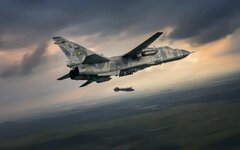

Su-24Ukraine MOD released this image yesterday 01062026 and its in some news
 And it's a strange picture. Glided bombs and rocket pods on the same aircraft... Doubtful.
I have a number of doubts about this paper. I worked for a number of years in Marine Insurance, insuring every different type of vessel. It is certainly possible that European Markets could be involved but only what I would call shadow underwriters. There are many different underwriters across the world and some have a higher security rating than others. Reputable Insurance brokers would only use underwriters with good security as that is the only way you can be sure that the claim will be paid. Disreputable brokers who could be based anywhere, will use pretty much any underwriter, from anywhere who will sign up to the risk, and good luck to you if you expect a claim to be paid.Russian shadow fleet enabled by EU-linked insurers, investigators say
Brussels wants to target the network keeping Moscow’s oil moving — but the trail may lead back to Europe.
There is also a second alternative and that is self insurance. Some large companies self insure which if done properly can save you considerable insurance premiums and they tend to reinsure total losses or losses above a certain limit. To put it another way a shipping company may well pay their own claims for the 'small' accidents that happen in day to day operations, but they pay someone else to take the risk of a total loss or significant liability claim.
On the probabilities, my guess is that the Shadow Fleet will be using 'second level' insurance brokers and underwriters. These could be anywhere and as I said earlier the acid test will be if the underwriters pay the claim when something significant happens, which it surely will.
One job I had was placing risks in overseas markets outside the UK and I have used companies from pretty much every continent. I should add that most insurance companies in these continents were absolutely fine, but I almost had my own desk in the security office so I could check before confirming coverage to a client.

Warspite63
Staff Sergeant
- 1,121
- Dec 8, 2022
GrauGeist
Generalfeldmarschall zur Luftschiff Abteilung
I recall reading about that "mystery munition" a while back - here's the article I had read:Su-24
Mystery Munition Appears Under Ukrainian Su-24 Fencer Attack Jet's Wing
RogerdeLluria
Staff Sergeant
- 1,410
- Jul 5, 2015
Nice try, but ... why zebras have stripes?View attachment 881596
Russian Trucks Get ‘Dazzle' Paint To Throw Off AI-Enabled Drones
The disruptive paint appears designed to confuse machine-vision targeting systems as autonomous drones become a growing threat. The disruptive paint appears designed to confuse machine-vision targeting systems as autonomous drones become a growing threat.www.twz.com
Does it hide them from predators? No, they don't hide them. In fact, the striking black and white patterns stand out to the human eye.
Herd Confusion: When a whole herd of zebras runs together, the overlapping stripe patterns blur into a confusing, moving mass. This makes it incredibly hard for a predator to single out and focus on one individual zebra.
Bite Prevention (Leading Theory): Extensive research shows that biting flies (like horseflies and tsetse flies) struggle to land on striped patterns. The stripes disrupt the insects' visual systems, protecting zebras from painful bites and deadly diseases. Normal Horse Approach: When flies approach a standard brown or black horse, they slowly decelerate in the final half-second to execute a controlled, graceful landing. Zebra Approach: When flies zoom toward a zebra, they fail to slow down. They completely misjudge the distance, causing them to either overshoot the zebra entirely or awkwardly careen straight into the hide and bounce off. Flies have low-resolution compound eyes. Scientists believe the alternating black and white lines create a localized visual illusion that tricks the fly's brain into thinking the landing surface is still far away, causing them to crash at full speed.
I doubt Russian trucks will run in an overlapping herd like zebras, guess Ukrainians will be really happy for this to happen
 . And I don't think they are interested in "gracefully landing" drones on them
RogerdeLluria
Staff Sergeant
- 1,410
- Jul 5, 2015
As a continuation of that I passed the picture to my AI of reference (remember AI may produce incorrect results) and asked if it might work.Nice try, but ... why zebras have stripes?
Does it hide them from predators? No, they don't hide them. In fact, the striking black and white patterns stand out to the human eye.
Herd Confusion: When a whole herd of zebras runs together, the overlapping stripe patterns blur into a confusing, moving mass. This makes it incredibly hard for a predator to single out and focus on one individual zebra.
Bite Prevention (Leading Theory): Extensive research shows that biting flies (like horseflies and tsetse flies) struggle to land on striped patterns. The stripes disrupt the insects' visual systems, protecting zebras from painful bites and deadly diseases. Normal Horse Approach: When flies approach a standard brown or black horse, they slowly decelerate in the final half-second to execute a controlled, graceful landing. Zebra Approach: When flies zoom toward a zebra, they fail to slow down. They completely misjudge the distance, causing them to either overshoot the zebra entirely or awkwardly careen straight into the hide and bounce off. Flies have low-resolution compound eyes. Scientists believe the alternating black and white lines create a localized visual illusion that tricks the fly's brain into thinking the landing surface is still far away, causing them to crash at full speed.
I doubt Russian trucks will run in an overlapping herd like zebras, guess Ukrainians will be really happy for this to happen
(on a side note, it seems the AI recognized the truck in the picture
)Here is the answer:
No, this camouflage is highly unlikely to work effectively against the vast majority of Ukrainian drone threats, though it might occasionally trigger software glitches in specific autonomous sub-systems. This striking black-and-white pattern on the Russian KamAZ truck is an adaptation of World War I naval "dazzle camouflage". Russian forces are implementing it specifically to combat advanced Ukrainian drone systems, such as the Hornet kamikaze drone, which utilize AI-driven machine vision and autonomous terminal guidance.
Why Russia is Doing It
- Target Recognition Disruption: Autonomous algorithms are trained on standard templates, shapes, and silhouettes of military vehicles. The aggressive contrasting lines are meant to lower the AI software's detection confidence score. If the algorithm cannot confidently classify the object as a "truck," it may fail to automatically lock on.
- Impeding Engineering Progress: Even if the camouflage is easily bypassed later, it forces Ukrainian software programmers to continuously burn resources and time re-training AI models on "zebra-striped" datasets.
Despite the intent behind it, defense analysts and military observers point out several fatal flaws in this strategy:
- Useless Against Human Operators: The majority of first-person view (FPV) kamikaze drones are still piloted manually by humans. To a human eyes, this loud, zebra-striped pattern completely eliminates traditional natural concealment, making the truck stand out vividly against green and brown landscapes.
- Thermal Cameras Render it Obsolete: Modern strike drones are heavily reliant on thermal imaging (infrared) optics for night operations and target acquisition. Thermal sensors detect the distinct heat signatures generated by the truck's engine block and exhaust systems, rendering any surface paint completely invisible.
- The Scale Inversion: Historical dazzle camouflage was effective for massive warships on flat, featureless ocean horizons to confuse human spotters tracking range and speed. It was never designed to hide a static or slow-moving ground truck from overhead aerial assets operating just a few meters away.
I am sure there were a couple of Russian soldiers who were happy to volunteer to do the painting so as to stay out of the front lineNice try, but ... why zebras have stripes?
Does it hide them from predators? No, they don't hide them. In fact, the striking black and white patterns stand out to the human eye.
Herd Confusion: When a whole herd of zebras runs together, the overlapping stripe patterns blur into a confusing, moving mass. This makes it incredibly hard for a predator to single out and focus on one individual zebra.
Bite Prevention (Leading Theory): Extensive research shows that biting flies (like horseflies and tsetse flies) struggle to land on striped patterns. The stripes disrupt the insects' visual systems, protecting zebras from painful bites and deadly diseases. Normal Horse Approach: When flies approach a standard brown or black horse, they slowly decelerate in the final half-second to execute a controlled, graceful landing. Zebra Approach: When flies zoom toward a zebra, they fail to slow down. They completely misjudge the distance, causing them to either overshoot the zebra entirely or awkwardly careen straight into the hide and bounce off. Flies have low-resolution compound eyes. Scientists believe the alternating black and white lines create a localized visual illusion that tricks the fly's brain into thinking the landing surface is still far away, causing them to crash at full speed.
I doubt Russian trucks will run in an overlapping herd like zebras, guess Ukrainians will be really happy for this to happen
Users who are viewing this thread
Total: 29 (members: 0, guests: 29)
Similar threads
- Replies
- 43
- Views
- 4K

- Replies
- 0
- Views
- 286
- Replies
- 1
- Views
- 531


- Replies
- 5
- Views
- 1K
