Alternative light and anti-tank guns, 1935-45 (2 Viewers)

Ad: This forum contains affiliate links to products on Amazon and eBay. More information in Terms and rules

French 47mm ATG was overweight, now by how much?
By at least 200 kg.
See the M.1942 Soviet 45mm ATG, with it's long barrel, was 400 kg lighter. Barrel seems to be very thick-walled (French vs. Soviet).
Perhaps the French could have used better steel in the carriage or perhaps the barrel.
Or used a muzzle brake to cut down on recoil forces allowing for a lighter carriage.
Muzzle brake - definitely. That will allow for a lighter carriage. Also the lighter barrel.
For my money, I'd try and install the gun on a tank or some other AFV, where the weight of the AT 47mm ordnance will not be a thing.

The 3.7cm Pak 36 is a big lie. It should be called the Pak 26 or Pak 28 or ????
They had licensed production to the Soviets in 1930-31. It was a pretty good gun in 1928-30. In 1936? not so much. Not mass producing a replacement in 1939 was a huge mistake.
And this is why just about everybody (Italians excepted) had a better AT gun than the Germans did in 1939-40.
Agreed all the way.

We can ask what the Germans could have done to improve the Pak 36 and/or we can ask what could they have made to replace the Pak 36. A light gun that could be moved by men (or one/two horses) and deal with most tanks of 1940-42.
The better, more powerful gun is a must. Don't muddle the waters with two different guns, but make a gun that can make a difference, especially once the Czech 47 is ... acquired.

As for the 37mm pak and what to do with it - depends on when the better, more powerful gun is available. If it is the historical situation, hot-load the gun within reasonable limits, stick the muzzle brake, adopt the pseudo-APCR and full-on APCR shots for it.
( we have axed the squeeze bore guns together with their tungsten-tipped ammo, ditto for the AT rifle an it's ammo)
If the number of 37mm guns is lower because the better gun is being made more early, don't over-produce the expensive ammo.
In the same time (1939 = best, 1940 = still good, 1941 = a must) have the 600-700m/s 75mm guns installed on the Pz-IVs, Stugs and Pz-IIs-turned-into self-propelled mounts.
 
E Elan Vital - how well you are acquainted with this Belgian AA gun, that looks suspiciously close to the 'French 75' mounted on the AA carriage? Re-bored to accept the Belgian ammo, for 700 m/s.
I'm not sure the picture actually shows the gun after the conversion, and I suspect that if this happened it rather meant using the 75mm Mle 1928 gun just like French conversions of older AA gun mounts (the ABS Mle 1932 which was a new mount used said piece without a muzzle brake).

I actually went down a rabbit hole about this, because I remember the Swiss Flab Kan 38 L/49 was a Schneider design (I suspect the S.A.A 800 due to the muzzle velocity of HE). By the looks of it this was a new firing piece which boosted service pressure to 2800-2900 MPa (exactly what I conceptualized), which resulted in an HE MV of 805 m/s and AP MV of 840-860 m/s (with 5.94kg AP weight instead of 6.4kg, which for the same muzzle energy would require 809-828 m/s). This served as the basis for some tank destroyer guns with some trying even higher service pressures. Not sure if the case is the French 75x518R. If I understood it right this means French Schneider had access to yet another class of 75mm guns the French could eventually use for tank/AT use if need be.

Incidentally, I figured out the Schneider S.A.A. n°4 tested by the French did have 750 m/s MV. However the wear was too fast and resulted in high dispersion so it wasn't successful in French testing and the French instead looked at using the Mle 1932 gun on the Schneider platform which had a number of qualities. The 75mm CA Mle 1940 which was to be adopted is normally derived from the Swiss gun, so probably uses the S.A.A. 800 piece unless it reused the standard Mle 1932 piece.

More info about Swiss late-war/postwar AT gun designs as food for thought: Viewer des Bundesarchivs
 
I haven't translated every document and organised them in order, but some tidbits on the Swiss tank/AT gun projects as of 1945, finally catching up with the needs.

The 75mm AA gun L49 (with ballistics of a Schneider design, possibly applied to 75mm CA Mle 1940), reached 840-860 m/s at 280-290 MPa service pressure. The Swiss tested up to 360 MPa (possibly to see how it goes at higher temperatures), gaining 30 m/s every 40 MPa of extra pressure. The shorter L42 PaK/tank gun needed 40 extra MPa to match the velocity of the longer gun, but was still quite powerful. When using the ammo of the field gun (resulting in a propellant volume of 2L instead of 2.5), it lost 40 m/s at a given pressure.

The picture on the right showed results of firing trials with the 75mm L70-L73 PaK, a counterpart to the German 75 L70, depending on propellant volume and pressure.
They ended up recommending 290 MPa and 1050 m/s MV at +10°C so that it would be 1080 m/s and 340 MPa at +40°C and 1090 m/s and 360 MPa at +50°C. This translated at +10°C in a 10% increase in muzzle energy over the German gun. This required a 5L propellant volume. It was suggested to make a 90mm barrel instead.
1766567597924.png
1766567885885.png


In the end, the Swiss ended up looking at the adapted FlaK L49 gun, the 75mm L73 (here with an anticipated MV of 1100-1150 m/s), and a 105mm L63 in the ballpark of foreign very long 100-105mm guns, giving 1050-1100 m/s. Also note the service pressures given for the German guns, 240 MPa for 7.5cm L48, 250 MPa for L70 and 275 MPa for 88 L71. This might check out as Panther1944 website gives a barrel life of 2000 (AP?) rounds for L70 and over 10 000 for L48.
1766568043575.png
 
Last edited:
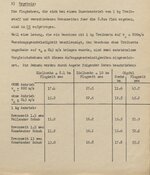
German calculations on the 'mildly rocketized' 8.8cm Flak L56 ammo. An 1kg rocket engine (nitroglycerin as the fuel, 2000 m/s speed of exhaust gasses) replaces part of the explosive payload. The 1st row is for a case when the rocket fuel is not igninited (basically, this mimics the 'normal' shell). 2nd row is for a case when the rocket engine is removed, so the shell is lighter by one kg and thus with a higher MV.
3rd row is for the 1.5 sec duration of the motor, with all of it's contens expended, the thrust is falling from max to zero in a diminishing curve roughly akin to this shape.
4th row is also for 1.5 sec duration, but for the constant thrust.
5th row is for 13 sec duration, constant thrust.
All in the table is for the max elevation.

Unfortunately, the max ranges are not noted, although the ceiling (Gipfel Hoehe) is. Also, unfortunately there is no listing of the speeds achieved.

rak flak.jpg

Note how much the flight time is reduced, and the ceiling is incresed. Even the reduction of the shell weight from 9kg to 8 kg improves these values.

What all of this has to do with killing the tanks? The long-duration rocket propulsion is obviously superfluous for this task, even if it does good for an AA gun, or for the field artillery (and surprisingly good considering that the rocket engine is actually small; also the range with the lighter shell).

Short-duration rocket engine makes more sense. Obviously, start with a small engine and short duration, say half a second, and work upwards until a satisfactory result is achieved.
On the 75-90mm 'classic' AT guns and aplied on the good APCBC ammo, it might've extended the ranges where penetration is achieved by at least 500m, if not by 1000m? Best-case, the US 76mm gun and the Pak/Kwk 40 might've came close to the 17pdr/Panther's guns; the Soviet 85 and Tiger's gun giving the Pak43 a good run for it's money.
On the lower end, the French 75 and the ZiS-3 matching the Pak/Kwk/40 and the US 76mm?

Keeping the projectile speed above the 500 m/s range, let alone above 300-450 m/s range reduces the drag by a good margin:

rak flak2.jpg
 

Users who are viewing this thread

Back