An Allison V-1710 with a two-speed supercharger in 1942 (4 Viewers)

Ad: This forum contains affiliate links to products on Amazon and eBay. More information in Terms and rules

The thing is, did they need to build 2500 Hurricanes in 1941? They definitely didn't need to build any Defiants (no they weren't any use as night fighters either) and the Merlin XX didn't really work out for the Beaufighter as previously noted.
I would like to know why they built Hurricanes in 1944.
If they did not build 2,500 Hurricanes in 1941 what else would they build? The factories were in place and production working. Stop for something else means stopping production for some time when this is only four months after the peak threat of the home island being invaded was perceived and that perceived threat was very real in 1941 and remained in place until Germany was held to a stop in 1942.

The planned expectation was for the Hurricane to be replaced by the next generation of Hawker Typhoon/Tornado but that fell behind schedule so the Hurricane kept going because it was there. No longer a front line fighter but a Typhoon substitute fighter bomber. It still had to be used right up until 1946, at the extreme, in places where Typhoons could not be spared. Especially in Burma. Again it existed. It worked, albeit with a reducing ability to defend itself.

As a ground support weapon a greatly hidden aspect of the late Burma campaign was the precision of the Hurricanes, especially with 2x40mm cannon, and Vultee Vengence dive bombers with which they could operate close to friendly troops. This was lost as they were replaced by other later types which could better defend themselves and carry larger bomb loads. The MkIV was a mainstay of the later Yugoslav Air Force of Tito in 1945 Yugoslavia too.

In Burma, as they were replaced by other types, being there already with spares and training etc. they became the mount of the Royal Indian Air Force. This was not done to give them inferior aeroplanes but to take the opportunity to be able to arm them with their own.

So the Hurricane remained in use from 1937 to at least 1946, not because it was there best, but because it worked and was there. Swapping from leading edge interceptor fighter to a serviceable ground support weapon where it was around in numbers to supplement the newer types. Cheap and easy to produce and repair maintaining serviceability at the front line and free from vices. Not good, not bad. Serviceable and available. Á sound workhorse still around in the stables. There were better types even as it entered service and far better at the end. One might note that the last RAF squadron with the Hurricane MkIV in 1946 transitioned through the Spitfire FR18 to the de Havilland Vampire in 1948.
 
Last edited:
With hindsight of course one would. But the USA was not at war then. Except for part of one month at the end. It had been soaking up Commonwealth, in particular British, money selling arms until the customer was all but bankrupt so whatever was done would be from US government income not selling off the British family silver invested in the USA. Remember that food in Britain was not just rationed in 1939 to save shipping. It was to save foreign exchange to pay for arms imports. Hence food was still being rationed into 1954.
I'm sorry, you are correct that we were not at war and further that the vast majority of Americans wanted zero participation in the war against the Axis. Historically, we (FDR and his cabinet) were preparing for the possibility that we were going to be drawn into the war, but the population - and Congress, while willing to fund military armaments for our own protection, were Not contemplating selling what we were building.

It was politically impossible to tax Americans to fund armaments to a nation engaged in a war we didn't want to be involved in. The fact that a.) Churchill was very persuasive that Great Britain was willing to pay for what we produced, and b.) FDR was persuasive enough to sway Congress to APPROVE of selling (not donating) a portion of what we were building, made it possible for the Lend Lease Act to pass in mid 1941.

Based on your comments I am left with the impression that you a.) seem bitter that Great Britain was compelled to pay for goods received from America, and b.) that the 'cash and carry' policy greatly affected the population's ability to eat (versus perhaps the U-Boat campaign which affected food supplies coming from America), and c.) feel that America did not give enough on behalf of the Commonwealth's campaigns against the Germans and Italians?

You may recall that we Leased property throughout the Atlantic and UK to base those aircraft and troops, provide staging for armaments delivered to Commonwealth - so that there were funds passing back in your direction. You may also note that Great Britain was not paying for the massive construction of Liberty ships transporting food and oil and aviation gasoline and troops and armaments that were beyond the Royal Navy's capacity and capability?

Recall also that the major funding for the massive financial requirements to fund the war came from American citizens buying Treasury Bonds with funds only returning in the future.

If my impression of your viewpoint of the unfair capitalist approach by the US to provide goods and services, when Americans should have been taxed to provide the materials 'gratis', then I apologize for the mild rant.

Building P51s in quantity in 1941 means either pausing building something else, with a significant hiatus in deliveries, or drawing in extra US funds to rapidly build new plants, new materials and components, recruit and train new labour etc. at a rate at least comparable to the actions taken in 1942 after being forced into the war. One might note that in 1942 US fighter squadrons in North Africa, and later in Italy, were arming themselves with British built Spitfires which otherwise would have been arming RAF fighter squadrons.
Conversely, the P-40s, A-20s, B-25s, C-47s, B-24s, PBYs, Hudson III that went to RAF and Coastal Command were desperately needed by AAF and USN at Guadalcanal and the Solomons at the same time the Commonweath campaigns against Rommel in Africa were still uncertain. And AFAIK, the Spitfires were not 'donated' to the 31st and 52nd FG, they were 'exchanged' for P-40s.

The War we wanted to fight (Pacific/China against Japan) was being throttled by the Germany 'first' agreement between Churchill and FDR.

As for the B29, one only has to look at the enormous costs associated with establishing mass production when it was decided to spend a fortune on the B29. Not to mention the questionable state of development of the engines in 1941. I would not want to be a politician arguing the case for the extra giant funding for a war in which the USA was just a spectator.
 
With hindsight of course one would. But the USA was not at war then. Except for part of one month at the end. It had been soaking up Commonwealth, in particular British, money selling arms until the customer was all but bankrupt so whatever was done would be from US government income not selling off the British family silver invested in the USA. Remember that food in Britain was not just rationed in 1939 to save shipping. It was to save foreign exchange to pay for arms imports. Hence food was still being rationed into 1954. Building P51s in quantity in 1941 means either pausing building something else, with a significant hiatus in deliveries, or drawing in extra US funds to rapidly build new plants, new materials and components, recruit and train new labour etc. at a rate at least comparable to the actions taken in 1942 after being forced into the war. One might note that in 1942 US fighter squadrons in North Africa, and later in Italy, were arming themselves with British built Spitfires which otherwise would have been arming RAF fighter squadrons. As for the B29, one only has to look at the enormous costs associated with establishing mass production when it was decided to spend a fortune on the B29. Not to mention the questionable state of development of the engines in 1941. I would not want to be a politician arguing the case for the extra giant funding for a war in which the USA was just a spectator.

These were fine aeroplanes when they arrived and did fine work but having them in useful production in 1941 is questionable. Politically in finding the funding, in engineering to have them ready with their engines up to standard and operationally in being enough to replace the OTL aeroplanes.

For the B29 with a decision in 1940, ideally 1939, where would one expect to base them and against what targets? There was nowhere within range of Japan. The B29, excellent though it was, was no B36 capable of transatlantic missions from the USA.

The only conceivable enemy at the time was Germany or Japan. So for Germany it would need bases in Britain or Egypt at best. Neither had spare suitable airfields capable of taking the B29. It would mean investing in a whole regime of foreign airfield construction with all the costs and resource that implies and to do so when the USA was not at war. Not to mention the implications for maintaining neutrality.

In the Pacific the furthest forward would be the Philippines. IOTL once the USA was forced into the war then the solution was to throw money at the problem and a series of hard fought campaigns to seize islands close enough to reach Japan. Indeed generally to throw money at the problems. The results were both expensive and remarkable and not only by the USA. Basing strategic US bombers In Britain caused the already stretched UK construction industry, in the midst of its century's largest construction project, to then build a huge extra number of large airfields to launch strategic heavy bomber raids against Germany. They then went on to build even more for the US strategic bombers. IOTL for the B17/24 of comparable weight and demands. But B29s means stronger and longer runways. Already Lincolnshire and East Anglia had airfields so close together that their circuits all but interlocked.

In the context of a peacetime economy the P51 was capable, with brave and determined decision making, of being made early in quantity and at the short term expense of fighter deliveries by making it the sole USAAF fighter turning new and existing factories over to it. It was mature enough to be ready for this and could use either the Allison or Packard Merlin IOTL put into the P40 or P39. The B29 was not so ready and one might find a manned turreted B23 á more suitable choice for an earlier introduction, but that latter is for another thread I think but the B29 was not necessary until the islands to base them were taken.

Overall there is much merit in bringing the P51 into service as the standard fighter earLy but the B29 not so much. In the given peacetime context I have severe doubts whether either would be politically possible due to political in fighting and the sheer government cost and lack of powers and will of government direction of industry that Britain had as a working wartime economy. Those many with a better knowledge of the political situation in the USA in 1940/41 can doubtless advise and correct me further.
Joking.
 
These were fine aeroplanes when they arrived and did fine work but having them in useful production in 1941 is questionable. Politically in finding the funding, in engineering to have them ready with their engines up to standard and operationally in being enough to replace the OTL aeroplanes.
Having the P-51 (Mustang I) in production in 1941 needed a time machine. I am just reinforcing your argument here.
It wasn't a question of just funding production. It is a question of having the factories and workers ready for production.
First production P-40D with Allison V-1710-39 (same as Mustang I) left the production line July 1940, they made 81 of them that month, down from 186-125 planes per of previous two months but Curtiss bounced back with 179 planes in Aug and 254 planes in Sept. North American made 2 Mustang Is in Aug, 6 in Sept and 25 in October.
Curtiss was able to make over 150 planes a month due to the plant expansions and hiring that had occurred while making the Hundreds of Hawk 75s and the long nosed P-40s.
Changing over Curtiss production in fall of 1941 to P-51 production might have seen the loss of several hundred fighters in production and quite possibly hundreds more. Assuming that Curtiss could build P-51s to the required fit/finish.
Allison was increasing production every month and Packard only built 48(?) Merlins (V-1650-1 singe stage) in 1941.
All of these "just build XXXX earlier" don't take into account the state of design and state of manufacturing and the size of the plants and the size of the existing work forces at the time.
For the B29 with a decision in 1940, ideally 1939, where would one expect to base them and against what targets?
That is true but again, a 1939-40 B-29 would be a far cry from a 1942/43 B-29.
Boeing had to figure out how to build it.
Wright had to figure out how to make the engines.
Trying to build a B-29 in 1939 might have resulted in something a lot closer to the Douglas B-19 which was obsolete when it was finished. Army AIr Force did get good engineering data from the project they could give to Boeing.
later model Wright R-3350 engines shared the same bore and stroke with the engines used in the B-19, nothing else.
When they started work on the later engines they added 2in to the length of crankshaft between the front bearing and the rear bearing, so new crankshaft, new crankcases.
They used the extra length to fit in different dynamic balancers.
If they did not build 2,500 Hurricanes in 1941 what else would they build? The factories were in place and production working. Stop for something else means stopping production for some time when this is only four months after the peak threat of the home island being invaded was perceived and that perceived threat was very real in 1941 and remained in place until Germany was held to a stop in 1942.
A lot of people seem to think that any aircraft factory can build any airframe without massive retooling. Much is made of the Hurricane being obsolete, the last Wellington rolled out the factory door on Oct 13th 1945. But without changing everything in a Wellington factory to go over to normal metal construction they were not going to be able to build any of the 4 engine bombers. And where does the tooling come from? The metal presses and sheet metal working tools and so on?
Same with the Hurricane but just not as bad. And the Typhoon was a real flop. In large part because of the Sabre engine.
The Tempest started showing up in service squadrons in the early 1944, it was what the Air Ministry hoped the Typhoon would be back in 1939-40 but wasn't. Tempest was still not the 20,000ft plus fighter that was wanted but it was closer ;)
People are also not looking at the cost, Hurricanes were relatively cheap. 2000hp Typhoons were expensive, very expensive with their Sabre engines. And nobody was dumb enough to send Sabre powered aircraft out of Europe until the war was over.
The planned expectation was for the Hurricane to be replaced by the next generation of Hawker Typhoon/Tornado but that fell behind schedule so the Hurricane kept going because it was there. No longer a front line fighter but a Typhoon substitute fighter bomber.
See above, except that the Typhoon in actual service was never a front line fighter. It went from a Spitfire replacement to a Spitfire back-up to tactical bomber. Poor altitude performance of the Typhoon due to Sabre engine and thick wing.

A lot of planes were over produced. But stopping production often did not save a lot of money. Stopping production with hundreds of sets of landing gear and hundreds of main spars in various stages of production does not get you the "new" airplane sooner. You still have to order and build all the long lead items before the production aircraft start rolling out the door. Hawker knew this, that is why they were ordering the parts/materials for the first 600 Hurricanes before they got the sighed contract.
Many aircraft companies dealt with hundreds of subcontractors and the main factory was just the assembly building.
Spitfires as fighter bombers took a while. Not only to under wing racks but to airfeilds to where the Spitfires could operate without breaking quite as often (ALL fighter bombers broke on occasion operating on rough fields, the question is how often) and at times some aircraft might be assigned to certain airfields that were very close to each other depending on local field conditions.
And aircraft production planners were often guessing as to potential airfield conditions months before the aircraft were operating from those airfields. There is a lot of behind-the-scenes stuff going on. US production of bulldozers turned out to have a large difference in airfield suitability/capability.
 
Do you know which Squadron was the first operational at more-or-less full strength with the Halifax MK II? The earliest I could find was in Apr'42.
According to RAF Squadrons by Jefford, Halifax I were used by
10 sqn December 1941 to August 1942, serving alongside Halifax II
35 sqn November 1940 to February 1942, being replaced by Halifax II from October 1941
76 sqn May 1941 to March 1942, being replaced by Halifax II from October 1941

I doubt a Halifax I was doing many operations in the second half of 1942.

102 squadron started to receive Halifax II in December 1941, last Whitley departed February 1942
78 squadron replaced its Whitley with Halifax II in March 1942.

Bomber Command says it first had an operational Halifax squadron as of 11 March 1941, another half squadron operational during June, by end July 2 operational squadrons, but really struggling to have more than single digit serviceable aircraft with operational crew on a given day until end October when it goes to around 12 aircraft plus crew. A third squadron declared operational 17 December, but back to 2 operational squadrons by end January 1942, back up to 3 squadrons on 31 March, to 4 on 26 April, to 5 in May, to 6 on 5 June, to 4 on 25 June, to 5 on 7 Jul, back to 6 on 3 August

To go any further means checking the squadron and aircraft histories.

https://www.lancasterbombers.net/form-78-aircraft-movement-cards/ has been taken down https://bombercommandhistory.net/ is replacing it but does not have the movement cards available yet it seems.

Halifax Mark I
50 L9485 L9534
25 L9560 L9584
10 L9600 L9609

According to the RAF census as late as end February 1943 Bomber Command had 2 Halifax I in operational units, 12 in miscellaneous units, while another 5 were under test/repair/storage, 7 had been converted to instructional airframes, 59 lost.

Correction time, what I get removing the Hurricane mark I from the 1941 figures but writing the opposite

Hurricane, production / export by year
1940 2,521 / 245 (exports are April onwards)
1941 3,169 (including 607 mark I)/ 2,231
1942 3,067 / 3,421
1943 2,742 / 3,568
1944 688 / 494
1945 0 / 51

Imports from Canada, 419 mark I no engines (56 in 1940, 363 in 1941), 447 mark II no engines, 234 mark II with Merlin 28, mark II imports were 7, 426 and 248 from 1941 to 1943. Many of the Canadian imports were exported.

The thing is, did they need to build 2500 Hurricanes in 1941?
Since you have claimed I have no expertise and make things up stop using any data I provide, verify the information independently first.

Need to build ideas, 3,898 B-29 to end 1945 of which 1,090 overseas end August 1945, all cause losses 535 by end 1945, add say 500 for training in the US and about half of all B-29 were not needed, scrub the Bell and Martin lines and about halve the capacity of the Renton line. And so on for any war material in production late in the war, the B-29 being the most expensive.

The Hercules was struggling with reliability issues in 1940/41 the Merlin XX was more reliable.

They definitely didn't need to build any Defiants (no they weren't any use as night fighters either) and the Merlin XX didn't really work out for the Beaufighter as previously noted.
The lack of radar and Beaufighters and the performance of the Blenheim meant the RAF night defences used Hurricanes and Defiants with the occasional Spitfires. The Defiant had the advantage of two pairs of eyes with the gunner not losing part of their night sight to the lights from the instrument panel. Since the Luftwaffe broke off the attacks in May as the good weather was approaching, the non radar fighters were not given a chance the later Luftwaffe Wild Boar units took.

AIR 22/35 to 38, Fighter Command Operational Squadrons
DateBeaufighterBeuf/BlenBlenheimBlenheim/HavocDefiantHavocHavoc LAMHavoc light
2-Jan-41​
0​
6​
0​
0​
3​
1-Feb-41​
0​
6​
0​
0​
4.5​
1-Mar-41​
0​
5​
0​
1​
4.5​
1-Apr-41​
4​
1​
1​
1​
7​
1-May-41​
4.5​
0​
1​
0​
7​
1-Jun-41​
5​
0​
0​
0​
7​
2​
1​
1-Jul-41​
6​
0​
0​
0​
7​
2​
1​
1-Aug-41​
6​
0​
0​
0​
7​
2​
1​
2​
1-Sep-41​
6​
0​
0​
0​
6.5​
2​
1​
2.5​
1-Oct-41​
7.5​
0​
0​
0​
7​
2​
1​
3.5​
1-Nov-41​
9.5​
0​
0​
0​
7​
2​
1​
3.5​
1-Dec-41​
10.5​
0​
0​
0​
7​
2​
0​
4.5​

AIR 16/1036 For 1941, night, Fighter Command defensive sorties and combat casualties
January, 585 sorties, 1 Hurricane and 1 Defiant lost. AI sorties claims 0-2-1, cat's eye sorties claims 3-2-2
February, 589 sorties, no losses. AI sorties 20 contacts, 5 visuals, 3 combats, claims 1-0-2, cat's eye sorties 34 visuals, 10 combats, claims 3-2-3
March, 1,027 sorties, 1 Beaufighter lost. AI sorties 49 contacts, 35 visuals, 26 combats, claims 14-3-6, cat's eye sorties 29 visuals, 18 combats claims 8-3-4
April 1,697 sorties, 4 Hurricane lost. AI 538 sorties, 143 contacts, 73 visuals, 48 combats, claims 27-8-11, cat's eye 1,122 sorties 78 visuals, 48 combats claims 20.5-7-11, Havoc LAM 37 sorties, claims 1-1-0
May 2,357 sorties, 1 Spitfire, 3 Hurricane, 1 Defiant, 5 Beaufighter lost. AI 651 sortie, 203 contacts, 110 visuals, 80 combats, claims 34-9-18, cat's eye 1,652 sorties 143 visuals, 3 visual+searchlight, 126 combats claims 62-13-25, Havoc LAM 54 sorties, 3 firings claims 0-0-0
"Fighter nights", 5/6th, 7/7th, 7/8th, 8/9th, 10/11th.
June 1,650 sorties, 1 Hurricane, 1 Havoc lost. AI 550 sorties, 131 contacts, 62 visuals, 4 Visual+searchlight, 40 combats, claims 20-4-6, cat's eye 1,083 sorties 24 visuals, 3 visual+searchlight, 11 combats claims 7-0-3, Havoc LAM 17 sorties, 3 firings claims 0-0-0
"Fighter nights", 4/5th
July 1,365 sorties, no losses. AI 569 sorties, 82 contacts, 33 visuals, 25 combats, claims 20-2-1, cat's eye 790 sorties 22 visuals, 15 combats claims 6-1-4, Havoc LAM 6 sorties, 0 firings claims 0-0-0
"Fighter nights", 4/5th, 7/8th, 8/9th, 14/15th, 17/18th, these sorties claimed 0-1-2 (in cat's eye total)
August 1,092 sorties, 1 Beaufighter lost. AI 581 sorties, 60 contacts, 8 visuals, 5 combats, claims 2-0-2, cat's eye 509 sorties 10 visuals, 2 combats claims 1-1-0, Havoc LAM 2 sorties, 0 firings claims 0-0-0
September 710 sorties, no losses. AI 371 sorties, 41 contacts, 12 visuals, 5 combats, claims 2-0-2, cat's eye 328 sorties 8 visuals, 3 combats claims 1-0-0, Havoc LAM 11 sorties, 0 firings claims 0-0-0
October 1,137 sorties, 1 Beaufighter lost. AI 677 sorties, 114 contacts, 62 visuals, 6 Visual+searchlight, 29 combats, claims 9-3-11, cat's eye 424 sorties 14 visuals, 3 combats claims 2-0-0, Havoc LAM 36 sorties, 1 firings claims 0-0-0
November 770 sorties, 1 Hurricane lost. AI 428 sorties, 70 contacts, 21 visuals, 1 Visual no AI, 15 combats, claims 7-0-5, cat's eye 340 sorties 9 visuals, 1 combat claims 1-0-0, Havoc LAM 2 sorties, 0 firings claims 0-0-0
December 650 sorties, no losses. AI 440 sorties, 58 contacts, 13 visuals, 6 combats, claims 3-0-3, cat's eye 210 sorties 2 visuals, no combat, no LAM

John Foreman lists, quick hand count: Defiant claims in 1941, January 0-2-1, February 1-2-0, March 3-2-2, April 13-3-4, May 31-3-18, June 2-0-2, July 0-0-3, August 0-0-0, September 0-0-0, October 1.5-0-1, November 1-0-0 (day claim), December 0-0-0.

Cat's eyes in 1941 claims 114.5-29-52, of these Defiant 51.5-12-31

The RAF reports (AIR 20/2020) 9,051 British and 288 American aircraft on strength on 3 September 1939, a year later 16,782+790, two years later 23,510+2,188, three years later 34,743+4,128, the aircrew were being trained, the aircraft needed to be provided, while in 1941/42 only Fighter Command was reporting it currently had enough aircraft, but then not of high enough quality. The fighter force had 1,263 single engine aircraft on 3 September 1939, all British, on 3 September 1941 it was 4,862+84 single and 1,075+168 twin engine aircraft.

The US sent a lot of food and agricultural machinery to Britain under Lead Lease and much more food to the USSR on the same terms, meantime things like Spitfires and 8th Air Force bases in Britain were reverse lend lease. A big trouble was a western world geared to war with integrated Lend Lease had a series of economic hernias when the program and war ended so quickly. Lend Lease was far more than the weapons, in 1944 Britain had started the process of removing items from Lend Lease so it could restart export industries.

With the mid 1940 crisis the British government withdrew its financial limits on war spending, after that it was mathematics when the foreign exchange ran out. India gained local ownership of much of its industry, including the rail system, as Britain sold assets.

The 31st and 52nd Fighter Groups had P-39 before equipping with Spitfires in Britain. The 52nd seems to have had some P-40 when in the US.

Republic Evansville represents a nice case study, It only produced P-47, it did not exist in March 1942, 61,700 square feet in June, 301,000 in September, 662,500 in December, kept growing to 910,200 in December 1943, still growing until 1,090,400 in December 1944.

First production 10 P-47D in December 1942, first reports of work on production in June 1942

For June to December 1942,
Monthly thousand direct man hours on complete airframes and spare parts
1, 14, 30, 61, 113, 162, 247, total 638
Monthly direct man hours by phase of work.
12.3, 27.4, 46.7, 112.7, 163.5, 236.0, 247.0, total 845.7 thousand direct man hours, with the following percentage of outside production,
10, 20, 25, 30, 35, 66, 85

Production switched to the P-47N in July 1945 with 75 accepted, Monthly thousand direct man hours on complete P-47N airframes and spare parts, May to July 1945 were 16, 93, 226 total 335

Evansville was employing workers for 6 months before it built its first aircraft, the switch to the P-47N required two months of preliminary work. It helps explain why what was in production stayed in production, the costs of change were high and shows the time delays setting up new lines.

 
If they did not build 2,500 Hurricanes in 1941 what else would they build? The factories were in place and production working. Stop for something else means stopping production for some time when this is only four months after the peak threat of the home island being invaded was perceived and that perceived threat was very real in 1941 and remained in place until Germany was held to a stop in 1942.

Why not convert these factories to producing Spitfires? Hurricane factories could switch over to specific subtypes of Spitfires in fact. Another option would be Beaufighters.

The planned expectation was for the Hurricane to be replaced by the next generation of Hawker Typhoon/Tornado but that fell behind schedule so the Hurricane kept going because it was there. No longer a front line fighter but a Typhoon substitute fighter bomber. It still had to be used right up until 1946, at the extreme, in places where Typhoons could not be spared. Especially in Burma. Again it existed. It worked, albeit with a reducing ability to defend itself.

It was pretty bad in Burma, it would have been so much better to send Spitfires. Or Kittyhawks for that matter.

As a ground support weapon a greatly hidden aspect of the late Burma campaign was the precision of the Hurricanes, especially with 2x40mm cannon, and Vultee Vengence dive bombers with which they could operate close to friendly troops. This was lost as they were replaced by other later types which could better defend themselves and carry larger bomb loads. The MkIV was a mainstay of the later Yugoslav Air Force of Tito in 1945 Yugoslavia too.

That may be the case but by the end of 1942 there were certainly better options than the Hurricane for ground support and as a fighter. Notably the Spitfire and the Kittyhawk, which is why they took precedence in North Africa and Italy. The Vengeance was another matter, I think it was valuable due to it's precision dive bombing ability and for whatever reason, they didn't lose a lot of them. I'd also say Beaufighters were very good in this role. The Kittyhawk, and in particular the Vengeance and Beaufighter all had the longer range which made them much more viable for the ground attack role. As did the

Spit VIII also had at least middling range like the Kittyhawk and was also a major help for the war effort in that Theater when they arrived though it was too few and too late. I'd love to take a closer look at how / where the extra fuel was added to the Spit VIII (was this one of the innovations that came from the Spit III?) and why couldn't that have been done earlier, it would have really helped make the Spit V much more useful. As would a Merlin XX.

In Burma, as they were replaced by other types, being there already with spares and training etc. they became the mount of the Royal Indian Air Force. This was not done to give them inferior aeroplanes but to take the opportunity to be able to arm them with their own.

I am well aware of this but again, I think Spitfires would have been much better for the IAF.

So the Hurricane remained in use from 1937 to at least 1946, not because it was there best, but because it worked and was there. Swapping from leading edge interceptor fighter to a serviceable ground support weapon where it was around in numbers to supplement the newer types. Cheap and easy to produce and repair maintaining serviceability at the front line and free from vices. Not good, not bad. Serviceable and available. Á sound workhorse still around in the stables. There were better types even as it entered service and far better at the end. One might note that the last RAF squadron with the Hurricane MkIV in 1946 transitioned through the Spitfire FR18 to the de Havilland Vampire in 1948.

I've read this kind of thing before many times, but I think the Hurricane was well past it's freshness date by early 1943 at the latest. This was certainly noticed in Burma and India and was raised as an issue by local officers. The transition to Spit VIII and Thunderbolt (for the RAF) while very helpful also came far too late.
 
A lot of people seem to think that any aircraft factory can build any airframe without massive retooling. Much is made of the Hurricane being obsolete, the last Wellington rolled out the factory door on Oct 13th 1945. But without changing everything in a Wellington factory to go over to normal metal construction they were not going to be able to build any of the 4 engine bombers. And where does the tooling come from? The metal presses and sheet metal working tools and so on?

Due to it's long range, large payload and reliability the Wellington still had a role (mainly as ASW) to the end of the war. It could be used far out to sea (and at night, carrying radar) where enemy fighters were very rare. The same can't really be said about the Hurricane due to it's limited range and in the sense that, if it actually saw combat against enemy fighters, it was very likely to suffer disproportionate losses.

Same with the Hurricane but just not as bad. And the Typhoon was a real flop. In large part because of the Sabre engine.

And for many other reasons. The wing being a big one, structural issues with the tail being another. Ventilation of said Sabre engine.

The Tempest started showing up in service squadrons in the early 1944, it was what the Air Ministry hoped the Typhoon would be back in 1939-40 but wasn't. Tempest was still not the 20,000ft plus fighter that was wanted but it was closer ;)

Tempest very well fulfilled the role that the Typhoon was supposed to have filled and is claimed to have filled in a lot of the postwar summaries. There was certainly a niche for low altitude fighters and fighter-bombers up to the end of the war. The real question about the Tempest was could it have been made a year or two earlier. Maybe not due to the engine issue. But as a design it seems to have solved many other problems with the Typhoon design.

People are also not looking at the cost, Hurricanes were relatively cheap. 2000hp Typhoons were expensive, very expensive with their Sabre engines. And nobody was dumb enough to send Sabre powered aircraft out of Europe until the war was over.

It's not cheap to have aircraft that suffer a high attrition rate, or to send aircraft to a Theater where they are going to be supported and maintained but only relatively rarely be in range of enemy aircraft or ground targets, so they end up just sitting around doing nothing.

Would it be better to have 2,500 Hurricanes in 1942 or 2,000 more Spitfire Vs? Or 1,500 Kitythawk IIs? Or 1,200 more Spitfire IXs? That is the kind of trade off which needs to be considered.

See above, except that the Typhoon in actual service was never a front line fighter. It went from a Spitfire replacement to a Spitfire back-up to tactical bomber. Poor altitude performance of the Typhoon due to Sabre engine and thick wing.

Also quite a high loss rate, they lost 2,4000 out of 3,300 built, with 666 pilot fatalities which was a bit more than half of the pilots who flew them.

A lot of planes were over produced. But stopping production often did not save a lot of money. Stopping production with hundreds of sets of landing gear and hundreds of main spars in various stages of production does not get you the "new" airplane sooner. You still have to order and build all the long lead items before the production aircraft start rolling out the door. Hawker knew this, that is why they were ordering the parts/materials for the first 600 Hurricanes before they got the sighed contract.
Many aircraft companies dealt with hundreds of subcontractors and the main factory was just the assembly building.

I do agree this is a fair point, and both cost and the far trickier production issues of retooling factories and retraining, reorganizing systems of subcontractors etc.

There is a tricky balancing act which has to be done, and you have made me understand better how much prognosticating which has to be done due to the long lead times involved in design, modification, and production of aircraft. During the Battle of Britain, given that Spitfires took half again as many man-hours to build per unit as Hurricanes, and Hurricanes were still very useful in battle, it made a lot of sense to build more Hurricanes.

But there was clearly a tipping point reached after the BoB. And while someone would perhaps need a crystal ball to have the foresight in early 1941, by 1942 and definitely by 1943 it should have been abundantly clear that building more Hurricanes was wasteful. The cost of a Spitfire vs a Hurricane varied by type, but a Spitfire Mk V (£9,500 – £12,600) wasn't much more expensive than a Hurricane II (£8,000 – £9,500), and was certainly much more useful, with a statistically significant lower attrition rate in combat. A Spitfire Mk IX (£13,000 – £15,000) was half again as much as a Hurricane II, but had a much lower attrition.

Pertinent to the OP, if some genius had decided to start retrofitting Spit Vs (or retooling factories to make Spit Vs) with Merlin XX it might have helped a great deal and would have been a much more useful use of those engines and the factory space and work-hours of the factory workers. If they also threw in a Bendix carb and a little extra fuel (maybe a bit later in the process) you might have accelerated the victory timetable in the MTO and in Burma.

Spitfires as fighter bombers took a while. Not only to under wing racks but to airfeilds to where the Spitfires could operate without breaking quite as often (ALL fighter bombers broke on occasion operating on rough fields, the question is how often) and at times some aircraft might be assigned to certain airfields that were very close to each other depending on local field conditions.

That is probably true that Hurricanes made better fighter-bombers than early-ish Spitfires, but there were other better options for fighter-bombers. Early P-47s seem to have been quite large numbers in 1943 Or just bomber-bombers. They may have still needed further work to be great fighters but they were already pretty good as fighter-bombers right out the gate. The British made good use of Martin Baltimore, Marauder, and Bostons in the MTO Theater, and after say, Sicily in mid 1943, some of these could have been sent to the CBI as well I think.

And aircraft production planners were often guessing as to potential airfield conditions months before the aircraft were operating from those airfields. There is a lot of behind-the-scenes stuff going on. US production of bulldozers turned out to have a large difference in airfield suitability/capability.

Definitely throw some more bulldozers into the Lend Lease order ...
 
Last edited:
I'm sorry, you are correct that we were not at war and further that the vast majority of Americans wanted zero participation in the war against the Axis. Historically, we (FDR and his cabinet) were preparing for the possibility that we were going to be drawn into the war, but the population - and Congress, while willing to fund military armaments for our own protection, were Not contemplating selling what we were building.

It was politically impossible to tax Americans to fund armaments to a nation engaged in a war we didn't want to be involved in. The fact that a.) Churchill was very persuasive that Great Britain was willing to pay for what we produced, and b.) FDR was persuasive enough to sway Congress to APPROVE of selling (not donating) a portion of what we were building, made it possible for the Lend Lease Act to pass in mid 1941.

Based on your comments I am left with the impression that you a.) seem bitter that Great Britain was compelled to pay for goods received from America, and b.) that the 'cash and carry' policy greatly affected the population's ability to eat (versus perhaps the U-Boat campaign which affected food supplies coming from America), and c.) feel that America did not give enough on behalf of the Commonwealth's campaigns against the Germans and Italians?

You may recall that we Leased property throughout the Atlantic and UK to base those aircraft and troops, provide staging for armaments delivered to Commonwealth - so that there were funds passing back in your direction. You may also note that Great Britain was not paying for the massive construction of Liberty ships transporting food and oil and aviation gasoline and troops and armaments that were beyond the Royal Navy's capacity and capability?

Recall also that the major funding for the massive financial requirements to fund the war came from American citizens buying Treasury Bonds with funds only returning in the future.

If my impression of your viewpoint of the unfair capitalist approach by the US to provide goods and services, when Americans should have been taxed to provide the materials 'gratis', then I apologize for the mild rant.


Conversely, the P-40s, A-20s, B-25s, C-47s, B-24s, PBYs, Hudson III that went to RAF and Coastal Command were desperately needed by AAF and USN at Guadalcanal and the Solomons at the same time the Commonweath campaigns against Rommel in Africa were still uncertain. And AFAIK, the Spitfires were not 'donated' to the 31st and 52nd FG, they were 'exchanged' for P-40s.

The War we wanted to fight (Pacific/China against Japan) was being throttled by the Germany 'first' agreement between Churchill and FDR.
Both of our posts are correct and are different. The situations were complex and I sought to illustrate some of that complexity. That same complexity makes both posts reflect only some of the aspects involved. I was not making value judgements.

I write in a house whose back garden, for a brief moment, contained two 110kg bombs and my grandchildren's school has a fine set of playing fields donated by that nice Mr Goering one night in 1941 when he modified the primary school which had previously occupied the site for some decades, and most of the rest of the city centre whilst he was at it. My mother, after fleeing to Morocco in 1940, as a refugee later became a US Army Master Sergeant. My father spent 1941 in Egypt, Iraq, Iran, Syria, Lebanon and Libya fighting the Iraqis, Italians, Germans and French, earning á Mentioned in Dispatches Oak Leaf having previously fought in France In 1939 and 1940 before leaving for Egypt.

I managed to dodge sugar and sweet rationing by being born in the latter part of 1953 whilst the Memsahib also dodged rationing by being born a year later and not being weaned before meat and bacon rationing ended. U Boats were not the reason for 1950s rationing. Indeed the civilian food ration got less after the war ended and bread was only rationed after the war ended. My own personal taxes since 1976 went to continue paying for US war loans well into the 21st century for both World Wars and our own loans abrogated by Russia after the Revolution, not to mention freeing British Empire slaves in the early 19th century so I can appreciate there are many different views of the situation in the third year of WW2. Including my father digging up two Australian POWs in our back garden in Singapore and ex civilian internees there telling us of their experiences as prisoners in our bungalow and how the Australians were bayoneted for being too Bolshie for the taste of the Japanese and Korean guards.

I am grateful that neither I nor my children have had to suffer wartime experiences even though I served for two engagements under the Colours.

History is complicated and often uncomfortable. As it should be.
 
Also quite a high loss rate, they lost 2,4000 out of 3,300 built, with 666 pilot fatalities which was a bit more than half of the pilots who flew them.
Hi
Reference the Typhoon, sources give 3317 aircraft with 670 deaths associated with the type, of that 520 KIA. For the P-40 (Tomahawk/Kittyhawk) in RAF/Commonwealth service about 3587 aircraft (sources figures differ,) but not many more than the Typhoon, with 738 deaths associated with the type, of that 465 KIA. The Mustang (all marks) in 'British' service 1930 aircraft with 487 deaths associated with the type, of that 300 KIA. I am not sure 'statistically' that there was really that much difference between the Typhoon and P-40 fatalities wise.
(source for deaths: 'Airmen Died in the Second World War 1939-45 - The Roll of Honour of the British, Commonwealth and Allied Air Services', DVD-ROM, Naval & Military Press Ltd.)

Mike
 
Having the P-51 (Mustang I) in production in 1941 needed a time machine. I am just reinforcing your argument here.
It wasn't a question of just funding production. It is a question of having the factories and workers ready for production.
First production P-40D with Allison V-1710-39 (same as Mustang I) left the production line July 1940, they made 81 of them that month, down from 186-125 planes per of previous two months but Curtiss bounced back with 179 planes in Aug and 254 planes in Sept. North American made 2 Mustang Is in Aug, 6 in Sept and 25 in October.
Curtiss was able to make over 150 planes a month due to the plant expansions and hiring that had occurred while making the Hundreds of Hawk 75s and the long nosed P-40s.
Changing over Curtiss production in fall of 1941 to P-51 production might have seen the loss of several hundred fighters in production and quite possibly hundreds more. Assuming that Curtiss could build P-51s to the required fit/finish.
Allison was increasing production every month and Packard only built 48(?) Merlins (V-1650-1 singe stage) in 1941.
All of these "just build XXXX earlier" don't take into account the state of design and state of manufacturing and the size of the plants and the size of the existing work forces at the time.

That is true but again, a 1939-40 B-29 would be a far cry from a 1942/43 B-29.
Boeing had to figure out how to build it.
Wright had to figure out how to make the engines.
Trying to build a B-29 in 1939 might have resulted in something a lot closer to the Douglas B-19 which was obsolete when it was finished. Army AIr Force did get good engineering data from the project they could give to Boeing.
later model Wright R-3350 engines shared the same bore and stroke with the engines used in the B-19, nothing else.
When they started work on the later engines they added 2in to the length of crankshaft between the front bearing and the rear bearing, so new crankshaft, new crankcases.
They used the extra length to fit in different dynamic balancers.

A lot of people seem to think that any aircraft factory can build any airframe without massive retooling. Much is made of the Hurricane being obsolete, the last Wellington rolled out the factory door on Oct 13th 1945. But without changing everything in a Wellington factory to go over to normal metal construction they were not going to be able to build any of the 4 engine bombers. And where does the tooling come from? The metal presses and sheet metal working tools and so on?
Same with the Hurricane but just not as bad. And the Typhoon was a real flop. In large part because of the Sabre engine.
The Tempest started showing up in service squadrons in the early 1944, it was what the Air Ministry hoped the Typhoon would be back in 1939-40 but wasn't. Tempest was still not the 20,000ft plus fighter that was wanted but it was closer ;)
People are also not looking at the cost, Hurricanes were relatively cheap. 2000hp Typhoons were expensive, very expensive with their Sabre engines. And nobody was dumb enough to send Sabre powered aircraft out of Europe until the war was over.

See above, except that the Typhoon in actual service was never a front line fighter. It went from a Spitfire replacement to a Spitfire back-up to tactical bomber. Poor altitude performance of the Typhoon due to Sabre engine and thick wing.

A lot of planes were over produced. But stopping production often did not save a lot of money. Stopping production with hundreds of sets of landing gear and hundreds of main spars in various stages of production does not get you the "new" airplane sooner. You still have to order and build all the long lead items before the production aircraft start rolling out the door. Hawker knew this, that is why they were ordering the parts/materials for the first 600 Hurricanes before they got the sighed contract.
Many aircraft companies dealt with hundreds of subcontractors and the main factory was just the assembly building.
Spitfires as fighter bombers took a while. Not only to under wing racks but to airfeilds to where the Spitfires could operate without breaking quite as often (ALL fighter bombers broke on occasion operating on rough fields, the question is how often) and at times some aircraft might be assigned to certain airfields that were very close to each other depending on local field conditions.
And aircraft production planners were often guessing as to potential airfield conditions months before the aircraft were operating from those airfields. There is a lot of behind-the-scenes stuff going on. US production of bulldozers turned out to have a large difference in airfield suitability/capability.
Hi
A book that deals with the problems of production for the UK during WW2, of all items for aircraft, is 'Planning in Practice - Essays in Aircraft Planning in War-time' by Ely Devons. This was first published in 1950 but re-published by Cambridge University Press in 2013 in paperback.

Mike
 
Why not convert these factories to producing Spitfires? Hurricane factories could switch over to specific subtypes of Spitfires in fact. Another option would be Beaufighters.

Both options mean no production from those factories for months and then the production SLOWLY ramps up. Getting the tooling alone is a major issue as much of it either has to be made in the UK where foundries and machine shops are being bombed as well as at full production or imported from the US or other sources like Australia and Canada which are also at fully committed production.
 
With hindsight of course one would. But the USA was not at war then. Except for part of one month at the end. It had been soaking up Commonwealth, in particular British, money selling arms until the customer was all but bankrupt so whatever was done would be from US government income not selling off the British family silver invested in the USA. Remember that food in Britain was not just rationed in 1939 to save shipping. It was to save foreign exchange to pay for arms imports. Hence food was still being rationed into 1954. Building P51s in quantity in 1941 means either pausing building something else, with a significant hiatus in deliveries, or drawing in extra US funds to rapidly build new plants, new materials and components, recruit and train new labour etc. at a rate at least comparable to the actions taken in 1942 after being forced into the war. One might note that in 1942 US fighter squadrons in North Africa, and later in Italy, were arming themselves with British built Spitfires which otherwise would have been arming RAF fighter squadrons. As for the B29, one only has to look at the enormous costs associated with establishing mass production when it was decided to spend a fortune on the B29. Not to mention the questionable state of development of the engines in 1941. I would not want to be a politician arguing the case for the extra giant funding for a war in which the USA was just a spectator.

These were fine aeroplanes when they arrived and did fine work but having them in useful production in 1941 is questionable. Politically in finding the funding, in engineering to have them ready with their engines up to standard and operationally in being enough to replace the OTL aeroplanes.

For the B29 with a decision in 1940, ideally 1939, where would one expect to base them and against what targets? There was nowhere within range of Japan. The B29, excellent though it was, was no B36 capable of transatlantic missions from the USA.

The only conceivable enemy at the time was Germany or Japan. So for Germany it would need bases in Britain or Egypt at best. Neither had spare suitable airfields capable of taking the B29. It would mean investing in a whole regime of foreign airfield construction with all the costs and resource that implies and to do so when the USA was not at war. Not to mention the implications for maintaining neutrality.

In the Pacific the furthest forward would be the Philippines. IOTL once the USA was forced into the war then the solution was to throw money at the problem and a series of hard fought campaigns to seize islands close enough to reach Japan. Indeed generally to throw money at the problems. The results were both expensive and remarkable and not only by the USA. Basing strategic US bombers In Britain caused the already stretched UK construction industry, in the midst of its century's largest construction project, to then build a huge extra number of large airfields to launch strategic heavy bomber raids against Germany. They then went on to build even more for the US strategic bombers. IOTL for the B17/24 of comparable weight and demands. But B29s means stronger and longer runways. Already Lincolnshire and East Anglia had airfields so close together that their circuits all but interlocked.

In the context of a peacetime economy the P51 was capable, with brave and determined decision making, of being made early in quantity and at the short term expense of fighter deliveries by making it the sole USAAF fighter turning new and existing factories over to it. It was mature enough to be ready for this and could use either the Allison or Packard Merlin IOTL put into the P40 or P39. The B29 was not so ready and one might find a manned turreted B23 á more suitable choice for an earlier introduction, but that latter is for another thread I think but the B29 was not necessary until the islands to base them were taken.

Overall there is much merit in bringing the P51 into service as the standard fighter earLy but the B29 not so much. In the given peacetime context I have severe doubts whether either would be politically possible due to political in fighting and the sheer government cost and lack of powers and will of government direction of industry that Britain had as a working wartime economy. Those many with a better knowledge of the political situation in the USA in 1940/41 can doubtless advise and correct me further.
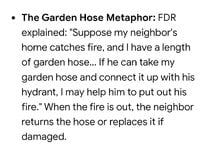
I would just like to add a bit about the political situation in the USA in 1940/41.Like dragondog wrote in his post #542 Vast majority of Americans wanted zero participation in the war against the Axis. Also the US Ambassador to the UK Joseph P. Kennedy regarded Britain as a lost cause.Four events changed this. 1.FDR press release December 17 ,1940. Concept of Lend -Lease. The "Garden Hose "Analogy. 2.December 29th 1940.The Fireside Chat. Mention of "Arensal of Democracy" 3. 6th January 1941.State of the Union Adress. "Four Freedoms " speech. 4. March 11th 1941 .Lend-Lease Act becomes Law. Most of this information comes from the WHW podcast.The Real moment the Allies won WW2.
 

Attachments

  • Screenshot_20260519_213808_Google.jpg
    Screenshot_20260519_213808_Google.jpg
    94.3 KB · Views: 22
Both options mean no production from those factories for months and then the production SLOWLY ramps up. Getting the tooling alone is a major issue as much of it either has to be made in the UK where foundries and machine shops are being bombed as well as at full production or imported from the US or other sources like Australia and Canada which are also at fully committed production.

No, it doesn't mean that, because obviously Spitfire (and / or Beaufighter etc.) production could be ramped up at the same time as Hurricane production was phased out. They didn't need to keep producing them through 1943 and into 1944. Foundries and machine shops were not being bombed that much in the UK after the BoB and the Blitz. You are overstating it.
 
To convert a factory from Hurricane production, which has a bolted and braced steel tube frame fuselage with wooden formers, with rolled steel wing and tail spars, plus other rolled steel structural components, to a factory that produces Spitfires or Beaufighters which have no bolted and braced or rolled steel components means totally gutting the factory, installing all the new tooling and training all the staff in the new procedures. That takes a lot of time and machinery and nothing gets built in the mean time.

As you say Foundries and machine shops were not being bombed that much in the UK after the BoB but you forget they were already working at full capacity and did not have the spare capacity for creating the tooling needed for Spitfires, especially tooling like stretch presses, drop and rubber presses, extruding the alloy sections, etc, or the different tooling needed for Beaufighter production.

As well as the shortage of tooling did Britain have the "spare" alloy stocks to increase Spitfire and Beaufighter production by converting the Hurricane factories? I doubt it.

All the existing Spitfire and Beaufighter factories were also working at full capacity so where else are you going to get those extra airframes to fit these "spare" engines to?
 
Hi
Reference the Typhoon, sources give 3317 aircraft with 670 deaths associated with the type, of that 520 KIA. For the P-40 (Tomahawk/Kittyhawk) in RAF/Commonwealth service about 3587 aircraft (sources figures differ,) but not many more than the Typhoon, with 738 deaths associated with the type, of that 465 KIA. The Mustang (all marks) in 'British' service 1930 aircraft with 487 deaths associated with the type, of that 300 KIA. I am not sure 'statistically' that there was really that much difference between the Typhoon and P-40 fatalities wise.
(source for deaths: 'Airmen Died in the Second World War 1939-45 - The Roll of Honour of the British, Commonwealth and Allied Air Services', DVD-ROM, Naval & Military Press Ltd.)

Mike

Interesting, that is more losses and pilot deaths than I was expecting.

But I would note that the majority of the P-40s lost by the RAF were early types (P-40B/C, D and early E) and were lost in 1941 and 1942, before they were using higher boost settings with the improved fuel etc., and most importantly I think, when the Axis was at it's zenith in terms of skilled aircrew and the Allies were in a very difficult position all over the world.

The first operational mission for a Typhoon (as far as I can determine, correct me if I'm wrong) was May 1942 and the first air to air victory with the type not until August 1942. The first bombing mission with a Typhoon was in Sept 42. Most combat use was in 1943-44, at a time when they could expect escort from late models Spitfires, Mustangs, Thunderbolts and other modern Allied types, and when they outnumbered the Axis air forces.

Hawker Typhoons were credited with a total of 246 'confirmed' air to air victories with the type.

By the time a Typhoon pilot scored his first air to air victory in August 1942, assuming that is the correct date, the majority of the 450 'confirmed' air victories by RAF Tomahawk and Kittyhawk (P-40) units were already in the books, along with a large number of fighter-bomber sorties, most flown without any other more modern fighters for escort (often just more Kittyhawks) and against some of the most experienced and well trained pilots the Axis powers fielded during the war.

The Typhoon flew quite hazardous missions, as any kind of CAS or low altitude bombing was very dangerous, and AAA was particularly intense near the channel where they operated (more so than in North Africa or probably Sicily etc.), but I'd say the P-40s flying in the Western Desert were definitely used in more dangerous air to air environment against much better trained enemy pilots in particular, and did so on their own until summer of 1942, and often continued to do so after that. They were also flying in more primitive conditions with more tenuous supply chains and logistics than Typhoon units flying out of Britain.

The P-40 also still has a pretty negative reputation postwar, still does in a lot of circles, and maybe with all those losses it's deserved for the RAF, whereas the Typhoon tends to be regarded as a modern and highly successful aircraft, which I don't think it really was. The Tempest was the solution to most of the design issues faced by the Typhoon.
 
Last edited:
To convert a factory from Hurricane production, which has a bolted and braced steel tube frame fuselage with wooden formers, with rolled steel wing and tail spars, plus other rolled steel structural components, to a factory that produces Spitfires or Beaufighters which have no bolted and braced or rolled steel components means totally gutting the factory, installing all the new tooling and training all the staff in the new procedures. That takes a lot of time and machinery and nothing gets built in the mean time.

What I mean by wind down one and ramp up the other, is you don't necessarily close all Hurricane factories at once, and while switching to Beaufighters would be a major shift in some respects, I'm not sure I buy that switching from Hurricane to Spitfire was that big of a jump, and in fact they did spread out Spitfire production to many other factories.

As you say Foundries and machine shops were not being bombed that much in the UK after the BoB but you forget they were already working at full capacity and did not have the spare capacity for creating the tooling needed for Spitfires, especially tooling like stretch presses, drop and rubber presses, extruding the alloy sections, etc, or the different tooling needed for Beaufighter production.

As well as the shortage of tooling did Britain have the "spare" alloy stocks to increase Spitfire and Beaufighter production by converting the Hurricane factories? I doubt it.

I'm sure US could and did help with alloys and other strategic materials. Take some from P-39 production.

All the existing Spitfire and Beaufighter factories were also working at full capacity so where else are you going to get those extra airframes to fit these "spare" engines to?

As for the spare engines, I think those could have been fitted to some of the very large numbers of Spitfire Vs they built
 
If they could have ramped up Spitfire production at that time, they would have.

Regardless of the situation with Hurricane production.

Well they did ramp it up quite quickly, but they did so in a rather conservative fashion - for understandable reasons. I suspect they could have done more. It may take a while to switch from Hurricane production, but I definitely don't buy that it would have taken through 1944.

I want to be clear about one thing, in the nature of these kinds of 'What if' type threads - I'm not saying that i would have made a better decision, or that somebody didn't do their job right in 1941 or 1942. I'm just speculating as to what was possible with the benefit of hindsight. I think that is the main point of these threads, not to condemn anyone or complain about what was done, but to think through how improvements could have been made, assuming someone had a crystal ball and could see the future.

It's about trying to explore possibilities and find out answers, not to assign blame or put any ghosts of long dead officers and officials on trial.
 
The P-40 also still has a pretty negative reputation postwar, still does in a lot of circles, and maybe with all those losses it's deserved for the RAF, whereas the Typhoon tends to be regarded as a modern and highly successful aircraft, which I don't think it really was.
I think the P-40 gets sort of a bad rap from a design perspective. Considering it's size/weight and installed power it pretty good at speed. Not a Mustang but nothing else was.

I do think the Typhoon is over-rated, in part to gloss over the Sleeve-valve fiasco. It took too long to get into service in large numbers and by the time it showed up in numbers other planes had equaled it or surpassed it.
 
I think the P-40 gets sort of a bad rap from a design perspective. Considering it's size/weight and installed power it pretty good at speed. Not a Mustang but nothing else was.

I do think the Typhoon is over-rated, in part to gloss over the Sleeve-valve fiasco. It took too long to get into service in large numbers and by the time it showed up in numbers other planes had equaled it or surpassed it.

And it wasn't just the engine, the wing, the tail, the fumes in the cockpit etc. there were a ton of really severe issues. It's kind of the poster child for 'development hell', it must have been a nightmare for the engineers and designers. And yet the Tempest seemed to sort so many of the problems out, if not all of them. I guess there were still some issues with vibrations and and overheating but nothing like with the Typhoon.
 

Users who are viewing this thread

Back