B-25 weapons thread

Ad: This forum contains affiliate links to products on Amazon and eBay. More information in Terms and rules

The 2 loop antennae are seen on some of those general-transports (check B-25 gen. Arnold or gen. Eisenhower). I do believe the second one is a back-up (double radio compass).

It is possible, considering the persons carried, that the two antennas were to allow the nav to triangulate the aircraft's position "instantly" rather than by taking one bearing then hunting for and finding a second known signal source given that the ADFs of the day required hand tuning the receivers.
 
It is possible, considering the persons carried, that the two antennas were to allow the nav to triangulate the aircraft's position "instantly" rather than by taking one bearing then hunting for and finding a second known signal source given that the ADFs of the day required hand tuning the receivers.
Quite possible in the case with the weather-plane - the both antennae are mounted with a distance one from another.
On the general's planes they were always together, under the nose. I think I read somewhere about doubling some of the systems on those important a/c. Below is the first B-25 of gen. Arnold (the one that still flies) - compare with the photo of the weather-plane. BTW don't know the purpose of the ring-antenna on top of the nose.
B-25 s_n 40-2168 gen. Arnold's first transport.JPG
 
And was usually part of an earlier type DF system. Three DFs on one aircraft appears an overkill but it may well be that the ring type was more sensitive on certain frequencies.
I too think that this is an overkill. Maybe in this case the top loop antenna and one of the radio-compass DF-antennae was used for that instant location of the position, you mentioned before? The same configuration was seen on the very first B-25 s/n 40--2165 modified for company needs (transport, tests) by NAA:
B-25NA s_n 40-2165 as NAA transport.jpg

Gen. Arnold's plane s/n 40-2168 was later used as a transport for other high ranking officers and then sold to the private market. The late nose-antenna was different:
B-25 40-2168 Gen. Arnold's plane - El Jaroco.jpg
 
Back to more weapons and weapon systems or weapon-related details.
I think I found a photo I haven't seen before that explains some earlier confusions and wrong statements.
Before that a drawing and a picture many of us have probably seen:
1, Drawing from a book showing a strange, "flattened" top turret (don't remember the exact source though):
Bendix upper turret - low drag.jpg

2. A photo of the same turret as above - I believe the drawing was made using the photo below:
Bendix upper turret - low drag-.jpg

It was said this is a B-25H turret with a new form. I've seen on some occasions modellers to argue that it is the real turret for the late models (H and J) - this is not true.
3. And here's the new (for me) photo from the Boeing-archive:
NAA low drag upper turret.jpg

It is a NAA-suggestion only. Didn't go in mass production. "Mustangs" in the background prove that this is the NAA-factory in Inglewood, California, manufacturing B-25H but not B-25J. Note the transparent gun slot shields.
And one more photo: on restored B-25 wee see sometimes different turrets like the one below:
Top turret with sloped front.jpg

IMHO this is not an original B-25 turret.

Cheers!
 
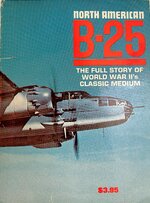
The last one is a Martin turret that has been adapted to mamy B-25 restorations. I think the confusion about the low drag version was started by the excellent book by Ed Schnepf, North American B-25. It used the illustration and photo of the low drag turrent and implied it was the standard top turret. My guess it that NAA had one made and tested it on the NA-98X Super Strafer, although I've never seen a photo of the low drag turret on that aircraft. Your photo at the B-25 factory is probably a closeup of the NA-98X taken before it was determined to not be worth the extra effort
 

Attachments

  • B-25 Challenge.jpg
    B-25 Challenge.jpg
    1.9 MB · Views: 0
The last one is a Martin turret that has been adapted to mamy B-25 restorations. I think the confusion about the low drag version was started by the excellent book by Ed Schnepf, North American B-25. It used the illustration and photo of the low drag turrent and implied it was the standard top turret. My guess it that NAA had one made and tested it on the NA-98X Super Strafer, although I've never seen a photo of the low drag turret on that aircraft. Your photo at the B-25 factory is probably a closeup of the NA-98X taken before it was determined to not be worth the extra effort
It's not in the "Blue book" - checked it immediately. Must be a different one. My problem is that I do not remember anymore where did I see something many years ago. I must check all books I have (need a couple of days maybe) but it's not the one you say.
P.S. I found the photo with the low drag turret in Bert Kinzey's book, page 68, not saying this was a NAA experiment only.

I haven't seen a photo of the "Super Strafer" with the low drag turret, but you might be right, that they used this particular a/c for the photos.
There is a famous factory illustration of a B-25H with strange cowlings and intakes, mixing reality with the test-plane (NA-98X) and the turret looks slightly lower than usual. Could be part of the same development:
b25h_SCHEME.jpg
 
Last edited:

Users who are viewing this thread

Back