Continuing on my trip to Thailand, we are at Chulachomklao Fort at the mouth of the Chao Phraya River and we are exploring the fort interior. As previously mentioned, the Siamese ordered ten Armstrong disappearing guns to equip its two new forts on the river that flows into its most important city. The Armstrong Disappearing Gun was a marvel of 19th Century design and represented the pinnacle of coastal defence engineering, but it was cumbersome in size, complicated to operate, and slow to reload. Nevertheless, a few coastal defence forts around the world received this type of armament from the British. The big wheels at each corner were how the unit was rotated, after information from an observer using an optical device in an elevated position gave reports on the range and bearing of the target warship, usually by shouting and signalling, but later by telephone. Barbettes were usually painted with directional markers around their rims to enable the gun to be positioned before firing. Following that, the gun was raised by winding a wheel on the right hand side of the carriage, then it was fired, its recoil being sufficient to return it to its original "crouched" position, arrested by a hydraulic ram.
View attachment 814848_ADP9577
The entire disappearing gun unit was expensive, which would have included ammunition and shipping costs, while the fort was paid for locally. It is interesting to note that the barbettes were open topped, thus exposing the guns and their crews to the elements, but later Elswick carriages had four posts at each corner, on which sat a steel shield slightly lesser diameter than the orifice opening, with a centre cut out for the gun in its raised position. The Siamese guns do not appear to have been equipped with this shield, which was more for weather and shrapnel protection, rather than the effects of plunging shells, against which they would not have been able to withstand. Truthfully speaking, a 19th Century ship's gunnery team executing a shot accurate enough to destroy a gun emplacement with a plunging shell was a near impossibility and would have been an extremely lucky shot, rather than by good aim alone. The canopy placed over the emplacement is a modern addition for weather protection.
View attachment 814849_ADP9578
The Armstrong rifled, breech loading, six-inch gun was the most common armament of the British Disappearing Gun, although the bigger eight-inch weapon was also used. The Siamese did not have this bigger gun however, contrary to a site I recently read. These guns are definitely the six-inch variety. The six-inch gun alone weighed five and a half tons, while the eight-inch gun weighed 13 tons. Following the Siamese decision to buy these guns, the British determined that it was unsafe to fire them with a full charge, and repair would require the fitting of an external hoop around the gun's diameter. This required the guns to be shipped back to Britain and a charge for each gun, at the owners' expense. It is not known whether this was done to the Siamese guns, but other countries evaded the cost by firing the guns with reduced powder and shell weight, thus reducing the erosion effects on the gun. This resulted in a lower projectile velocity but was still effective in damaging a warship.
View attachment 814850_ADP9579
The Elswick Carriage, designed at the Armstrong Elswick Ordnance Company at Newcastle-upon-Tyne, was an ingenious device, derived from the original disappearing gun dreamt up by Edinburgh Militiaman Capt A. Moncrieff in the 1860s. The first disappearing gun was built in 1871. Requiring hydro-pneumatic pressure to raise the gun, the fluid was a mix of soft soap and water, half a pound to a (Imperial) gallon for a total of 12 and a half gallons in the reservoir. Raising the gun was done manually via the big wheel and toothed bracket visible in this view. More advanced carriages than this were built, which used a hydraulic pump, which itself was man-power operated, but was faster in execution than turning the wheel.
View attachment 814851_ADP9580
The shells used were a mix of types, the most common was standard cast iron, later steel filled with powder, Shrapnel, which were time-fused for use against soft targets, personnel and small boats, Palliser shot, which was freeze-hardened and filled with shot or powder and sand to maintain weight, Case shot, made of tinned steel and filled with sand shot and packed with clay and sand for use against soft targets, and Paper shot filled with paper and sand shot, which were primarily used for training and testing the guns. The indent within the barbette was used for shell storage during action and was replenished from the bunkers in the entrance to the fort.
View attachment 814852_ADP9581
This is Gun No.5, our exhibition gun above was No.4 at the centre of the fort. This fort bears the distinction of firing its guns in anger, against French warships in 1893. That year was the Franco-Siamese Crisis, as it has come to be known, the culmination of which was the advancement of French warships up the Chao Phraya River during the Pak Nam Incident on 13 July. This was when French gunboats powered up the river to join the French ship Lutin already anchored off Bangkok in threatening the Siamese Monarch into surrender. Defending the river were the two forts, recently completed with a total of ten six-inch guns, as well as under-sea mines and hulks sunk in the channel to narrow it. A small handful of Siamese gunboats also awaited the French ships upstream. The French knew the river's defences were formidable but pressed on into the river mouth anyway...
View attachment 814853_ADP9586
An access tunnel within the fort, note the water channels, given the gun emplacements were open topped. Being so low to sea level, the fort frequently flooded.
View attachment 814854_ADP9593
Gun No.6. At the time the French ship crossed the bar into the river, it was raining and overcast, but the Siamese were ready. The fort was commanded by Dane Andreas du Plessis de Richelieu, who ordered the fort to fire warning shots at the approaching ships at around 6:30 pm. Ignoring these, the French pressed on and the firing continued, this time in earnest. Hits were recorded on the gunboat Inconstant, but further damage to the French ships was prevented by sheer incompetence within the fort itself...
View attachment 814855_ADP9594
Gun No.7 at the Western end of the fort, canted in from the row of guns. In support of their commander were three more Danes, who struggled to communicate effectively with the Siamese gunners as they did not speak the local language. Running up and down the steps and through the smoke-filled corridors, the three men struggled to control proceedings, using pidgin language and hand signals, but it was to no avail; the fort's guns could not be brought to bear effectively on the French ships...
View attachment 814856_ADP9598
Gun No.3, back the way we came. The Siamese gunships gunnery crews were suffering the same lack of leadership, but managed to hit the French ships, with one of them being beached after repeated hits, two of which were from the Chulachomklao Fort...
View attachment 814857_ADP9603
Gun No.2. By nightfall, the French squadron had breached the first line of defences, passed the Chulachomklao Fort and the gunboats and proceeded upriver toward the Phi Suea Samut Fort opposite Pak Nam, with its three disappearing guns, but a similar situation to that at Chulachomklao Fort existed there and these guns' fire was wildly inaccurate also...
View attachment 814858_ADP9609
The tunnel to Gun No.1, also canted inward at the fort's Eastern end. The room to the right of the emplacement entrance was for storage of cordite bags during action, which was replenished from the separate bunkers.
View attachment 814859_ADP9616
Finally, Gun No.1. The aftermath saw the French, having gained the initiative and successfully pushing upriver to Bangkok and threatening the King's palace from its gunboats, was forced into a negotiated peace with the Siamese. This was under the instruction of the British, who stood to lose significantly from French control of Siam, owing to it being the country's largest trading partner. This was one of the few times that disappearing guns were used in anger, but was not a shining example of their use, owing to the lack of control the commander had over his subordinates.
View attachment 814860_ADP9617
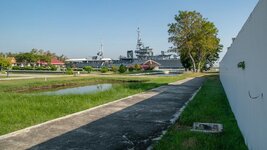
Outside into the warmth, with one of the site's main attractions behind, the training vessel HTMS Mae Klong.
View attachment 814874_ADP9570
The rear of the great monument to the King. The entire site is maintained by navy cadets and while I was walking around the fort's interior, they were busily sweeping up leaves and dirt while singing Oasis' song Wonderwall badly. I joined them for a few bars, also badly...
View attachment 814862_ADP9625
This is the front of the fort, showing the row of emplacements, with Gun No.2 to the right. Note how low the defensive wall is. I'm not even sure what this would defend against and I suspect it is a part of the site's remodelling into a visitor attraction.
View attachment 814863_ADP9630
The ceremonial mast on site is from the former Royal Yacht Maha Chakri, it's first incarnation as a gun armed-cruiser.
View attachment 814864_ADP9632
The fort layout can be seen from the deck of the Mae Klong. Note the pumping equipment, for obvious reasons as the water level is very low here. The decorative pond is a part of the visitor attraction modifications to the site.
View attachment 814865_ADP9633
The decorative part of the site. This was opened as a public attraction after considerable work to the site in 1993, with a dedication to King Rama V. The site includes the fort, which we've just seen and the Mae Klong, which we are about to see, as well as several artillery pieces and things of interest from Siamese and Thai naval history.
View attachment 814866_ADP9634
Finally for today, the mouth of the Chao Phraya River. Note how close to sea level we are. While I was here, a few boats entered the river and their wakes were cascading over the concrete wall. This is a problem affecting the greater Bangkok area and it is well known that the city of Bangkok is sinking.
View attachment 814867_ADP9635
Next time, HTMS Mae Klong, the last surviving warship built in an Imperial Japanese Navy shipyard.