Hi Claidemore,
>I'm of the opinion that the 'single stream' of projectiles from nose mounted guns is not that big of an advantage given the technology of gunsights used during WWII. The odds of hitting a fast maneuvering target were just too great.
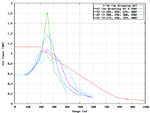
The problem with wing-mounted guns is that in most typical situations, the pattern extends horizontally while you need it to extend vertically.
a) Imagine a shooter setting up a tracking shot by turning with a target aircraft ... both are rolled into the same turn, and the difficult thing to get right is the lead, which is controlled by the vertical displacement of the pipper above the target in the sight picture. What convergence/divergence gives you is a horizontal spread - but that's the dimension that easy to get right anyway.
b) Imagine a shooter setting up a snap shot by crossing the flight path of the target ... typically, that's done by tracking for a short moment and then pulling ahead and letting the nose fall back again immediately, firing a short burst while this happens so that the target flies through the burst. Just as in case a), shooter and target will have their wings in the same plane so that the difficult dimension is the vertical while the convergence/divergence is in the vertical.
c) Imagine a target crossing in front of the shooter from the left to the right so that a snap shot is possible without prior tracking. OK, here the horizontal pattern is helpful

d) Imagine a target clearly beyond convergence range. This kind of long-range shooting is only feasible with a non-manoeuvring target, probably one trying to run at full power from a slower pursuer (for example a MiG running from an F-86, as described by Blese). The main problem is trajectory curvature there ... vertical dimension. The centreline-gun fighter can simply put the pipper on or above the target and fire away. The wing-gun fighter has to estimate the range and put the pipper on the wing, on the wing tip or even outside of the wing tip of the target, depending on the exact range. Even so, only half of the guns will hit. (If he aims right for the target, most of his fire will go above and below the wings if he's within about two times convergence range, or even miss the target entirely if he's yet farther away.)
e) Imagine a target in good shooting range. Whatever the situation, the centreline fighter can simply fire away without knowing the exact range. The wing-gun fighter still has to keep track of the range as getting too close is just as bad as being too far. Priller's "JG 26" has an example for a Luftwaffe pilot suddenly seeing tracers passing him closely on both sides of his fuselage, evidence of a P-47 attacking him from point blanc range (but failing to compensate for wing guns). USAAF pilots were aware of this effect as well - quoting Major Riemensnider (from "Combat Profile: Mustang" by Roger Freeman:
"I had previously flown the twin-engined P-38 Lightning where the nose-mounted armament made for an ideal gun platform. Ranging wasn't the problem it was with the P-51 and other fighters which had wing-mounted armament where the fire converged. It out outfit the guns were adjusted for a point of convergence 300 yd ahead where, theoretically, they gave an approximately 8 x 10ft bullet pattern. In practice, because of the speed of closure, it was not easy to achieve that exact range when you hit the gun trigger. So there was a tendency for pilots to open fire at a target further off and hold a long burst as they closed. If you got in a correctly ranged burst, it was highly destructive."
Mölders summed it up concisely as "One cannon in the nose is as good as two in the wings". (Galland, when asked by Hitler what he preferred, pointed out "I'd rather have all three" - thus the Me 109 wing gondolas
>Anecdotal evidence suggests that most WWII pilots fired at much longer ranges, often at too long a range.
Well, the RAF evaluation showed that killing ranges were shorter than 366 m in 86 % of the cases, and this number is already based on half of the kills being achieved with computing gunsights. With standard sights, 92 % of the kills were achieve at 366 m and less. This would actually support your view by showing that case d) above is just an unimportant disadvantage
An additional disadvantage of wing armament which you didn't mention is that wing guns also have a higher dispersion than centreline guns due to the flexiblity of the outer wings. This leads to a poorer concentration of fire and results in decreased effectiveness even beyond the pure convergence/divergence problems.
>On a completely different subject, this thread encouraged me to do some reading about the P61, and apparently no P61s were lost to enemy action!
One He 177 tail gunner claimed a P-61 shot down (though he misidentified it as a Lightning), but the P-61 actually managed to return home after putting out an engine fire caused by the tail gunner's hits in a steep dive. This dive of course created the illusion of a shoot down - what the gunner saw was a streak of fire going down rapidly, then disappearing at low altitude. I think I read about this several times, the first time in Jet + Prop which had full details on both the He 177 and the P-61 crews.
Regards,
Henning (HoHun)