Not an easy question to answer Keith, as there are a number of variables.
First of all, the pressure. This depends on the viscosity and type of paint being used, and - the distance being sprayed from ! This is governed by the type of coating required, for example, a thin misting, a number of thin coats to build up an effect, gloss finish to be smooth etc etc.
A good 'happy medium' is to set the pressure around 15 to 20 p.s.i. as a start point, and thin the paint so that it runs down the mixing container with the same consistency as milk.
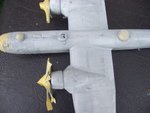
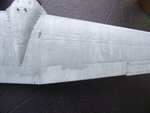
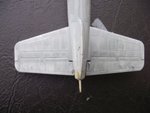
It looks, from the pics, as if there is a build - up of paint, causing runs. ALWAYS keep the airbrush moving, making straight, equal, and slightly overlapping passes. Do not twist the wrist, but keep the 'brush 'square' to the surface being sprayed.
Depending on the colour being used, don't expect a perfect, 'solid' finish first time - it may, and almost certainly will, need at least two coats.
Never go back over a 'thin' area when it is still freshly wet - this leads to runs, lumps, and 'orange peel', the 'textured' look of pitting and small pimples.
Always do a trial spray of the paint mix before hitting the model, to check for viscosity / consistency (to avoid runs) and ease of flow and so on. If the paint seems to be 'struggling', or starts to spit, then it is probably under thinned.
As for actually using the 'brush, the pressure is set at the compressor, either fixed, as with a simple compressor, or via a regulator. The trigger, when pressed down, only allows air flow at the pressure set. Pulling back on the trigger controls paint flow - the further back it's pulled, the more and heavier the paint flow.
The heavier the paint flow, the faster the movement of the brush.
This can only really be perfected by practice.
For practice in using the 'brush itself, try just spraying various effects onto paper or card, using ink, or cheap kiddies water colour paints, the type found in half -litre (approx.) bottles in toy shops. Just thin this with water and spray away.
For practice with getting the finish as required, use a normal paint mix, probably about 50/50 for enamels as a starting point, and spray a block or line(s) of a solid colour onto an old model. Use this to get the 'feel' of working around the shapes of a model, keeping distance and angle constant as required.
Spraying distance not only governs the width of the spray patten, but also the depth, or weight of paint. The further back, the wider, but thinner, the coverage pattern.
The actual distance will depend also on how far back the trigger is pulled, and what effect is required. This could literally be two or three millimetres, for tight, fine lines, at only partial trigger, or up to around nine inches for a wide, light, misting.
An average spraying distance for general - purpose coverage would be around two to four inches.
Bottom line is experiment and practice, practice, practice !
Hope this helps a bit.



 runs, to thin, to thick,