Dogfight: Me 262 vs. Meteor (1 Viewer)

Ad: This forum contains affiliate links to products on Amazon and eBay. More information in Terms and rules

Meteor and even early F-86A were not comparable in the high altitude air superiority role in Korea. Thrust to weight is only one factor. The low Mach limit of the straight wing jets (Meteor, US straight wing jets as well) made them completely non-competitive with the MiG-15 at altitude. But even the F-86A was quite competitive; and even the F-86F still had lower T/W than the MiG-15bis. The F-86's key advantage over the MiG-15 (besides pilot factors, just considering plane factors) was in high speed handling, an advantage which expanded with the later F-86's, though they also closed *part* (not all) of the gap with the MiG in climb and service ceiling.

75 sdn RAAF Meteors were used relatively briefly in the air superiority role in Korea in summer/fall 1951. They were a failure for the reason mentioned. The actual result was 4 Meteors downed by MiG's; all the engagements are known from the Soviet side and they lost no MiG's. Later the Meteors were shifted to the ground attack role (like the US straight wings) were they downed 2 intercepting MiG's of the PLAAF in a low altitude combat in 1952 per PLAAF account; another Meteor was picked off on a ground strike mission by a Soviet MiG same year, so 2:5 overall.

But the F-86A was quite successful in the high altitude air superiority role, and the variation in success among F-86 versions also depended on the varying quality of MiG opposition. Through spring 1951 for example the MiG's had only downed a single F-86A in combat. Later in 1951 the MiG opposition was strongest, F-86 air combat losses rose significantly and the kill ratio was lowest, though still distinctly in F-86's favor based on losses reported in each side's records. The F-86E was being introduced at that time. At the end of the war F-86F's had the highest kill ratio, but the quality of the opposition was lowest, having shifting away from the Soviets toward more PLAAF and KPAAF MiG units. I don't think we can determine the relative effectiveness of F-86 versions by calculating each version's kill ratio, but there is no comparison in the air combat effectiveness of the F-86 and Meteor in Korea.

Joe

I'm sorry: Re Meteor F8 and MiG 15, there is a lot of commonly erroneous information in this post. Much information has come to light in recent year to set the story straight. Some commonly held and widely disseminated statements are easily disproven by basic physics and actual aircraft performance tests.

Bias about the Meteor Mk 8's performance against the Mig 15 is helped by the fact that the aircraft were a full generation apart in aerodynamic technology but in reality, a major part of the wartime air-to-air combat disparity is that the Aussies from 77 SQN had been flying exclusively ground attack in CAC built P-51 (F-51 by then) Mustang since their arrival, and not only had to convert onto a jet (a completely different way of flying) but had to train in bomber escort and how to use a Meteor's strengths in air combat, a task that would take a normal peacetime squadron probably a year of training.

After some difficulty and a few victories over MiGs, 77SQN RAAF was switched to ground attack where they performed extremely well.

The truth is that the Meteor F8 was a much more capable fighter than it has been given credit for. (It would eat an Me 262s lunch)

It was not that much slower than the MiG 15 (about 60mph) if we use 'peak' figures. The 585mph often quoted for the Meteor is misleading, as this was at sea level in dense thick air. The F8 was capable of 600+ mph at altitude.

Despite its swept wing, the MCrit of the MiG was 0.82–0.85 and the Meteor Mach 0.82-not a big difference. The MiG was transonically unstable in a dive (as many pilots found to their cost) so its escape manouevre could be terminal.

Its first generation swept wing design had to be ameliorated by large wing fences to prevent excessive spanwise airflow and it would experience tip stall and depart in a tight turn, long before the Meteor.

The MiG 15 typically used common slashing attacks (as did the 262 as it turned like the Queen Mary) and avoided turning fights (unless piloted by experienced Russian pilots) but if a Meteor saw it first, the MiG would have no hope in a turning fight, as the Meteor had a wing loading of 22lb/sq ft compared to 60.7 lb/sq ft with an almost identical thrust to weight ratio.

The MiG did have a superior rate of climb thanks to its VK1 (copied British Nene) engine.

The Meteor had better fighter armament in the 4 Hispano 20mm (the MiG was designed with heavier armament for shooting down bombers) which had a much flatter trajectory.

In reality, a properly trained F8 pilot with good situational awareness and using the strengths of his aircraft, would have a very good chance of easily avoiding a MiG 15 and if it could be drawn into a turning fight-dispatching it.
 
Last edited by a moderator:
I'm sorry: Re Meteor F8 and MiG 15, there is a lot of commonly erroneous information in this post. Much information has come to light in recent year to set the story straight. Some commonly held and widely disseminated statements are easily disproven by basic physics and actual aircraft performance tests.

Bias about the Meteor Mk 8's performance against the Mig 15 is helped by the fact that the aircraft were a full generation apart in aerodynamic technology but in reality, a major part of the wartime air-to-air combat disparity is that the Aussies from 77 SQN had been flying exclusively ground attack in CAC built P-51 (F-51 by then) Mustang since their arrival, and not only had to convert onto a jet (a completely different way of flying) but had to train in bomber escort and how to use a Meteor's strengths in air combat, a task that would take a normal peacetime squadron probably a year of training.

After some difficulty and a few victories over MiGs, 77SQN RAAF was switched to ground attack where they performed extremely well.

The truth is that the Meteor F8 was a much more capable fighter than it has been given credit for. (It would eat an Me 262s lunch)

It was not that much slower than the MiG 15 (about 60mph) if we use 'peak' figures. The 585mph often quoted for the Meteor is misleading, as this was at sea level in dense thick air. The F8 was capable of 600+ mph at altitude.

Despite its swept wing, the MCrit of the MiG was 0.82–0.85 and the Meteor Mach 0.82-not a big difference. The MiG was transonically unstable in a dive (as many pilots found to their cost) so its escape manouevre could be terminal.

Its first generation swept wing design had to be ameliorated by large wing fences to prevent excessive spanwise airflow and it would experience tip stall and depart in a tight turn, long before the Meteor.

The MiG 15 typically used common slashing attacks (as did the 262 as it turned like the Queen Mary) and avoided turning fights (unless piloted by experienced Russian pilots) but if a Meteor saw it first, the MiG would have no hope in a turning fight, as the Meteor had a wing loading of 22lb/sq ft compared to 60.7 lb/sq ft with an almost identical thrust to weight ratio.

The MiG did have a superior rate of climb thanks to its VK1 (copied British Nene) engine.

The Meteor had better fighter armament in the 4 Hispano 20mm (the MiG was designed with heavier armament for shooting down bombers) which had a much flatter trajectory.

In reality, a properly trained F8 pilot with good situational awareness and using the strengths of his aircraft, would have a very good chance of easily avoiding a MiG 15 and if it could be drawn into a turning fight-dispatching it.


I hope you are aware that JoeB was seen last here on March 19, 2014. And the thread is 10 years old. at least.
 
From the report by the RAE from april1946 found here, the meteor (at least the Mk3) was simply not fitted to combat.
engine surge above 20000ft, snaking before critical mach, ailerons heaviness (something very important in combat to induce maneuvres :rolleyes: ), no power generator in case of engine failure, bad cockpit layout(switches, indicators), no cockpit heat, no cockpit ventilation, no G-sustaintable pilot position...and also throttle sensitive engines, just like the german-ones with also a slow spool-time (? the right english word?). I do not say that, it's the RAE in 46:p

Read the repport, there are only 33pages:D

so what in a fictive combat against a 262? a german rookie with 20h or an experienced KG pilot with hundreds missions on bombers? or an Expert? i'd say with the 2last options, not much luck for the meteor,the expert using the full potential of the plane, the Kg pilot using the much greater mach speed to evade,even with the 2 babies under the nose. With the rookie option, it'd be like 50/50, depending if the rookie is a brainer or not:twisted:.

the P80 was something different, but between the yp-80 and the P-80 there was still a lot of modifications if i remember correctly (even the size,not?) i'd like to know the stats about the j-33 built into the P80 in 45, and generally, i'd like to know if there is a really good book, with tons of details, factory reports and other intersting data about the p-80. (thanks)
These reports by RAE are indicative but not always contemporary and often of 'development aircraft. It was yheir job to pick it apart to see what could be made better. By this time the F4 was entering service with most of these bugs cured and you had a 600mph or Mach 0.80-82 aircraft. Also remember Meteors and Vampires were deliberately not given top priority because the Luftwaffe was already in steep decline. If you read Dan Sharp's outstanding book on the 262 and compare key items like wing loading, weapons and power delivery particularly as the F4 came into service it is clear that 262's would have been bested by the Meteor. Remember an F3 captured the world air speed record in 1945 at 606mph and that was in the thick bumpy draggy air at sea level!

The 262 turned like the Queen Mary. It also had snaking problems (never solved) The Jumo's turbine section was made of butter. The only advantage it briefly had was speed and that disappeared with the Derwents being fitted to the Meteor, something that could easily have happened earlier. The guns on the Meteor were far superior with higher muzzle velocity and flatter trajectory and a higher rate of fire. remember to the the simple but fast and extremely manoeuvreable Vampire flew in 1943 but then had its engine stolen and give to Lockheed for the P-80. The F4 Meteor could have entered service with its more powerful 3,500lbf Derwents much earlier if needed.

And here's a reality check: In a test at Iwakuni in 1951 during the Korean War against Sabre, the only advantage the F-86 had over a RAAF Meteor was outright speed. If the Meteor turned into the attack the Sabre had to dive away because the Meteor with it much lower wing loading could out turn and outclimb it. In effect, once in the merge, the only escape for the Sabre was to dive away.

The story was the same in Korea with the MiG 15. The RAAF (77SQN) had been flying ground attack missions in F-51s when they had Meteors given to them. Nowhere near enough training just flying the thing before they were sent into combat, much less how to understand and use its strengths and to actually fight the jet. They were using the tactics that had been successful with the Mustang and suffered for it. Later with more ecxperience they scored ssome victories agains MiG 15s but in reality, it was like Like stepping from a Skyhawk into an F-35 and being expected to fight.
 
The 262 turned like the Queen Mary. It also had snaking problems (never solved)
You just described the Meteor F.3's issues.

The Me262A-1a was stable at speed and was very capable of holding a high speed bank. It was this ability that caused it to best Allied fighters if the pilot chose to engage (and avoiding a sustained turning fight).
Regarding the Jumo engines, the later 004B engines were much improved over earlier versions, but were late to enter service, so made little difference in the end.
 
You just described the Meteor F.3's issues.

The Me262A-1a was stable at speed and was very capable of holding a high speed bank. It was this ability that caused it to best Allied fighters if the pilot chose to engage (and avoiding a sustained turning fight).
Regarding the Jumo engines, the later 004B engines were much improved over earlier versions, but were late to enter service, so made little difference in the end.
In Dan Sharp's authorative book 'Me 262 Development and Politics, (Crowood press) Messerschmitt Me 262: Development & Politics : Sharp, Dan: Amazon.com.au: Books he has test pilot reports on the lack of turning ability of the 262 and its directional instability that they tried but failed to cure. Airbus test pilot and world's most experienced 262 pilot Geri Krahenbuhl offers this evaluation: (There is an excellent article by him in Aeroplane Magazine on this)
Handling and Flight Characteristics
  • Takeoff and Safety Speed: Krähenbühl notes a critical 32-knot gap between the slow stall speed (110 knots) and the high 142-knot safety speed required to get airborne safely in case of an engine failure on takeoff.
  • In-Air Behavior: The jet features a tricycle nosewheel making it easier to manage on runways than tailwheel piston planes, but throttle changes cause noticeable pitching moments, and the small tail design makes it prone to Dutch roll requiring constant pilot concentration.
  • Tactical Limits: Designed for WWII "hit-and-run" tactics rather than tight turning dogfights, Krähenbühl uses specialized flight techniques to perform tight aerobatic displays for modern airshow. "It's not a turning aeroplane."
Engine-wise the contemporary British MetroVick axials (first run in 1941) F2-F4 were developed to be far superior in durability, flexibility and thrust than the Jumos or BMWs that remained unreliable, had to be treated very gently and likely killed more pilots than the Allies.

The F2 was flown in a Meteor in 1943 but was given a lower priority to the current (and much simpler to manufacture) centrifugal units already in development and production (RR Derwent and Halford H1/DH Goblin at 3,500lbs and Nene at 5,000lbs). The Metrovick F2/4 Beryl produced 4,000lbs. As the line developed it became the Sapphire (licenced as the Wright J-65) and powered British, French and US aircraft including the B-57 Canberra and the A4 Skyhawk demonstrating the essential correctness of its design. Metropolitan-Vickers F.2 - Wikipedia
 
In Dan Sharp's authorative book 'Me 262 Development and Politics, (Crowood press) Messerschmitt Me 262: Development & Politics : Sharp, Dan: Amazon.com.au: Books he has test pilot reports on the lack of turning ability of the 262 and its directional instability that they tried but failed to cure. Airbus test pilot and world's most experienced 262 pilot Geri Krahenbuhl offers this evaluation: (There is an excellent article by him in Aeroplane Magazine on this)
Handling and Flight Characteristics
  • Takeoff and Safety Speed: Krähenbühl notes a critical 32-knot gap between the slow stall speed (110 knots) and the high 142-knot safety speed required to get airborne safely in case of an engine failure on takeoff.
  • In-Air Behavior: The jet features a tricycle nosewheel making it easier to manage on runways than tailwheel piston planes, but throttle changes cause noticeable pitching moments, and the small tail design makes it prone to Dutch roll requiring constant pilot concentration.
  • Tactical Limits: Designed for WWII "hit-and-run" tactics rather than tight turning dogfights, Krähenbühl uses specialized flight techniques to perform tight aerobatic displays for modern airshow. "It's not a turning aeroplane."
Engine-wise the contemporary British MetroVick axials (first run in 1941) F2-F4 were developed to be far superior in durability, flexibility and thrust than the Jumos or BMWs that remained unreliable, had to be treated very gently and likely killed more pilots than the Allies.

The F2 was flown in a Meteor in 1943 but was given a lower priority to the current (and much simpler to manufacture) centrifugal units already in development and production (RR Derwent and Halford H1/DH Goblin at 3,500lbs and Nene at 5,000lbs). The Metrovick F2/4 Beryl produced 4,000lbs. As the line developed it became the Sapphire (licenced as the Wright J-65) and powered British, French and US aircraft including the B-57 Canberra and the A4 Skyhawk demonstrating the essential correctness of its design. Metropolitan-Vickers F.2 - Wikipedia

Such interesting snippets.
Many twins had/have a a big speed gap between stall and Vmca, I wonder what it was with the Meteor?
Rough-air-snaking plagued the Meteor and caused it to stick with ground attack where it was less prone due to lower TAS. The Germans thickened the rudder trailing edge. Overall, modern aircraft usually have auto stab to stop awkward habits.
Interesting that this pilot manages to perform "tight aerobatic displays" with his "not a turning aeroplane".

Eng
 
AFAIK, the 77th Squadron RAAF scored only one verified victory over a MiG-15 (William H. Simmonds on May 8, 1952, while escorting B-29s during a raid on Pyongyang) according to Robert O'Neill.
From 77SQN records: "The Squadron's final victory was recorded on March 27th 1953 when Sgt George Hale, flying Meteor A77-851 as Number 3 of a four aircraft sortie was tasked with conducting straffing (sic) and rocket attacks along the Pyongyang-Singosan road. On reaching the road junction at Namch'onjom they spotted two USAF RF-80s heading south easterly and behind these, the familiar squat noses of two MiG 15s.

Hale alerted(his wingman) Sgt Irlam and both pilots jettisoned their ventral fuel tanks and turned to intercept the MiGs. Hale remembered he had two remaining rockets which he fired and saw pass between the MiGs which broke left and right. Hale set off in pursuit of the leader but heard his number two call that he was hit.

Hale turned and saw that two more E/A were attacking from out of the sun. He turned to face the MiG which had set its sights on him. The MiG pilot had extended its speed brakes to reduce speed and so fall in behind but he overshot and as he did so, Hale extended his airbrakes which proved much more effective and dropped into an ideal position behind the enemy's tail.

The blast from the Meteor's cannons hit the MiG behind the cockpit and large metal strips fell off it as it rolled over belching black smoke in a near vertical dive. Hale was about to follow the falling MiG when he spotted two more MiGs diving towards him. He turned inside the enemy and rolled his aircraft behind them and fired, his shots finding their target and one aircraft climbed away trailing while smoke- probably fuel. It was claimed as a probable. Out of ammunition he headed back to base. He was credited with one confirmed and one probable"
 

Attachments

  • George Hale.jpg
    George Hale.jpg
    72.5 KB · Views: 14
Such interesting snippets.
Many twins had/have a a big speed gap between stall and Vmca, I wonder what it was with the Meteor?
Rough-air-snaking plagued the Meteor and caused it to stick with ground attack where it was less prone due to lower TAS. The Germans thickened the rudder trailing edge. Overall, modern aircraft usually have auto stab to stop awkward habits.
Interesting that this pilot manages to perform "tight aerobatic displays" with his "not a turning aeroplane".

Eng
The Meteor with its straight wing had a lower stall speed but as with the 262 the distance between nacelles was a VMCA issue. The problem as Geri comments, was that the vertical stab on the 262 is too small and the rudder authority too low for adequate control. The Meteor has a much longer rear fuselage and therefore moment arm and a larger, broader chord stab.

Also, snaking usually happens at high speed, not in the dense air of low altitude. It is, if memory serves, a function of Mach Number. The 262 and Meteor suffered from it. Again, I cannot recommend Dan Sharp's book highly enough. He debunks many 262 myths with official records, test data, RLM memos and more. He has original drawings and wind tunnel test models and reports showing that Messerschmitt tried tried broadening the vertical stabiliser, shortening it and all manner of fixes that did not work.

The lengthened rear fuselage and square vertical stab change between the Meteor F4 and F8 was in part to deal with this.

Interestingly the RAF AFDU operating the Mustang in combat well before the US, discovered that the Mustang 1 was also subject to snaking at high speed and also tried broadening the chord of the vertical stab and adding a dorsal strake but it was not really solved until the 'H' model's taller fin. (David Birch - Rolls Royce and the Mustang) Rolls-Royce and the Mustang: no 9 : Birch, David, Rolls-Royce Heritage Trust: Amazon.com.au: Books Also 'Mustang- the Untold story'- Matthew Willis Amazon.com.au : mustang the untold story

Finally and ironically, while it held world speed records down low, the Meteor did not stick to ground attack.- that was situational and more about a rapid introduction and minimal training of 77SQN pilots in Korea. It's ideal performance altitude was 20-25,000'.

As mentioned when a RAAF F8 was tested against an F-86 at Iwakuni, the only advantage the Sabre had was speed to dive away. It could not engage in a turning or vertical fight with the F8.

The Meteor performed its role as a fighter/ interceptor/fighter bomber in the RAF, RAAF and many other air forces for decades. (I worked on them as part of my AIR FORCE engineering education in the 1980, to study the evolution of aerodynamics and structures. Always had a soft spot for the Meatbox.

Ironically, when they tried to sell a specialised version for ground attack, did not succeed. (turbojets are too thirsty down low)
Read 'The Quick and the Dead-Bill Waterton.'Quick and the Dead: The Perils of Post-War Test Flying : WATERTON, WILLIAM ARTHUR: Amazon.com.au: Books

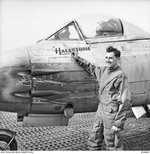
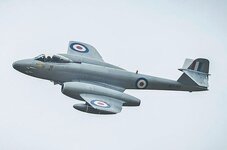
The RAAF Historical flight 100SQN still has an F8 flying for displays marked as 'Halestorm' after FLTSGT George Hale, the last RAAF Meteor pilot to down a MiG over Korea.
 

Attachments

  • Gloster_Meteor_Centenary_of_Military_Aviation_2014_(cropped).jpg
    Gloster_Meteor_Centenary_of_Military_Aviation_2014_(cropped).jpg
    20.2 KB · Views: 16
Last edited:
From 77SQN records: "The Squadron's final victory was recorded on March 27th 1953 when Sgt George Hale, flying Meteor A77-851 as Number 3 of a four aircraft sortie was tasked with conducting straffing (sic) and rocket attacks along the Pyongyang-Singosan road. On reaching the road junction at Namch'onjom they spotted two USAF RF-80s heading south easterly and behind these, the familiar squat noses of two MiG 15s.

Hale alerted(his wingman) Sgt Irlam and both pilots jettisoned their ventral fuel tanks and turned to intercept the MiGs. Hale remembered he had two remaining rockets which he fired and saw pass between the MiGs which broke left and right. Hale set off in pursuit of the leader but heard his number two call that he was hit.

Hale turned and saw that two more E/A were attacking from out of the sun. He turned to face the MiG which had set its sights on him. The MiG pilot had extended its speed brakes to reduce speed and so fall in behind but he overshot and as he did so, Hale extended his airbrakes which proved much more effective and dropped into an ideal position behind the enemy's tail.

The blast from the Meteor's cannons hit the MiG behind the cockpit and large metal strips fell off it as it rolled over belching black smoke in a near vertical dive. Hale was about to follow the falling MiG when he spotted two more MiGs diving towards him. He turned inside the enemy and rolled his aircraft behind them and fired, his shots finding their target and one aircraft climbed away trailing while smoke- probably fuel. It was claimed as a probable. Out of ammunition he headed back to base. He was credited with one confirmed and one probable"
We are talking about verified victories, not just credited ones. There are plenty of examples where the MiGs credited to the pilots of the 77th Squadron were just merely damaged. However, the scale of the Soviet overclaim regarding the Meteors is far more impressive.

In addition: two Sabre pilots from the 67th Fighter-Bomber Squadron claimed for Hale's victory.
 
Last edited:
These reports by RAE are indicative but not always contemporary and often of 'development aircraft. It was yheir job to pick it apart to see what could be made better. By this time the F4 was entering service with most of these bugs cured and you had a 600mph or Mach 0.80-82 aircraft. Also remember Meteors and Vampires were deliberately not given top priority because the Luftwaffe was already in steep decline. If you read Dan Sharp's outstanding book on the 262 and compare key items like wing loading, weapons and power delivery particularly as the F4 came into service it is clear that 262's would have been bested by the Meteor. Remember an F3 captured the world air speed record in 1945 at 606mph and that was in the thick bumpy draggy air at sea level!

The 262 turned like the Queen Mary. It also had snaking problems (never solved) The Jumo's turbine section was made of butter. The only advantage it briefly had was speed and that disappeared with the Derwents being fitted to the Meteor, something that could easily have happened earlier. The guns on the Meteor were far superior with higher muzzle velocity and flatter trajectory and a higher rate of fire. remember to the the simple but fast and extremely manoeuvreable Vampire flew in 1943 but then had its engine stolen and give to Lockheed for the P-80. The F4 Meteor could have entered service with its more powerful 3,500lbf Derwents much earlier if needed.

And here's a reality check: In a test at Iwakuni in 1951 during the Korean War against Sabre, the only advantage the F-86 had over a RAAF Meteor was outright speed. If the Meteor turned into the attack the Sabre had to dive away because the Meteor with it much lower wing loading could out turn and outclimb it. In effect, once in the merge, the only escape for the Sabre was to dive away.

The story was the same in Korea with the MiG 15. The RAAF (77SQN) had been flying ground attack missions in F-51s when they had Meteors given to them. Nowhere near enough training just flying the thing before they were sent into combat, much less how to understand and use its strengths and to actually fight the jet. They were using the tactics that had been successful with the Mustang and suffered for it. Later with more ecxperience they scored ssome victories agains MiG 15s but in reality, it was like Like stepping from a Skyhawk into an F-35 and being expected to fight.

Looks like you have a very well build idea of the meteor, like some propaganda narratives on wikipedia.

Let's break those ideas a little bit:

The RAE wasn't indicative, it was an authority, it wasn't some topgear weekend car testing; if the CfE told that an airplane sucks and is not a viable fighter, then it was so; no bs narrative can overule it; and this was the CFE conclusion in 46 after having tested several MK3 production airframes.

The CFE report in question, was done in 46, using fully production airframes. you can search them up on Gloster Meteor Production List (new page Added), so it's not a question about some prototypes here but fully military equipped , serial produced airplanes.

As about the prioritization of the meteor (not even talking about the vampire, as in 46 it had so much quirks that needed to be solved that even if the war was prolonged with 2 years, it still wouldn't be ready); it wasn't because the LW was in decline, but because England wasn't able to mass produced the engines needed for the hypothetical airframes ( see Gloster Meteor Performance (new page Added) ).Before RR, those engines were build like in a garden shack. it wasn't until spring45, when prop planes started to be fased-out of production(and thus the engines for those airplanes), that RR took over and greater production Numbers of jet engines could be achieved, but by very far matching the german level. The meteor was the sole semi viable production ready airframe, that's why England was stuck with it. (Don't forget england was bankrupt after ww2, developement isn't cheap).
German engines were maybe built from butter, but they mass produced(see engine production link above). Statistically, germans built 5 engines for each 262 airframe, theoretically, spares enough. Do you know what was the average german airframe life time in operational squadrons starting autumn44? it was 25hours. Now tell me why you should make engines that last more than the airframe? Germans build for mass consumption, those were war-tools, weapons, not some cult-objects.

As for the famous equation wingloading/power you should check the basic principle: few wingload equals lot of drag the faster you go and the meteor had such nice big fat wings, straight from mid 30's aerodynamic rules book. bigger wingload, the faster you go. (fat wings turn better, small wings go faster. Simplification). Another point is the turning ability, something like a religion for the english fanatics, it seems. If you know the basics of flying, you know that you start your turn with ailerons, especially in all combat maneuvres, now tell me how fast will you get in the turn with a roll-rate of 30°sec in your best flight enveloppe? How fast will you change your "angles" with such a roll rate? again, CFE confirms the MK3 sucks.
Well yes, a totally stripped, modified MK3 broke some record (in straight line, the only attitude it could fly), but could the production-ones be able to do so?, Wel, the CFE tell us no and even very far from it. So a one-off can not be used as an argument, otherwise we could use the Me-209 as argument for the Me-109. Or we could use the stripped P-39 example and start a new 200 pages thread.

Don't even start about guns, 1 MK-108 MG bullet and the meteor is gone, like all small or medium airplanes. Check the Blenny in the test here: Rheinmetall‑Borsig Mk-108 Test
And even if the hispano had a better trajectory, the meteor would still need to get into position. When the other airplane cruise speed exceed the meteor combat max speed, this would have been hard to achieve.

Now, how could a Schwalbe be bested by an airplane that wasn't even there? From the CFE report in46, we can easily conclude that the schwalbe would just play around a meteor MK3 in any situation at any altitude. But you try to put into equation the MK4, based on the fact that their production started in 46 (May46 to be precise, 55 build in 46), but you seem to kindly forget that none of them was actually assigned to active squadrons before april-50. that's just 5 years after the end of the war. The first 50 were mostly some kind of test beds. What would the 262 look like 5 years later? Even 2 years later? HG-II config? HG-III config? or totally removed from the front lines and replaced in 46/47 by the ta-183 ERF-III or Me-1112? So many what-if's here. Would a F-16 block-1 be bested by a F-16 block50? you know the answer. Total dyschronia.

I won't go into the korea period as it's less attractive for me than the ants nest in my garden so, even if the meteor could achive mach2 in 53 i do not give a damn.
From the moment, people try to compare the MK4 to a Me-262 the discussion is totally screwed. Apples and oranges, and all that stuff...

The meteor, in 46 stil, as a fighter, Sucked... badly. It was a flying cow with an anvil attached to the neck.
 
re
It was not that much slower than the MiG 15 (about 60mph) if we use 'peak' figures. The 585mph often quoted for the Meteor is misleading, as this was at sea level in dense thick air. The F8 was capable of 600+ mph at altitude.

The Meteor Mk.8 was limited in Vmax to M0.82 due to Mach tuck, which works out to 585 mph TAS at 18,000 ft Standard Day density altitude. The Mk.8 was actually faster at lower altitudes - with a Vmax of 610 mph TAS at SL. The M0.82 limit begins at ~4,000 ft with a Vmax of 615 mph TAS.

The Meteor Mk.3 was limited in Vmax to M0.70 due to the somewhat poor aerodynamics (in particular the short nacelles) which caused a nose up movement requiring a drag inducing downward force from the elevators to counteract. The excess drag of the short nacelles and the Mach limit reduced the Vmax in level flight. M0.70 works out to 495 mph TAS at 20,000 ft Standard Day density altitude. The Vmax was 499 mph TAS at ~18,000 ft.

The following are the Vmax at altitude for the Meteor Mk.3 (short nacelles w/2200 lbf Derwent II) and Mk.8 (long nacelles w/3500 lbf Derwent V).

___________Mk.3_____Mk.8
35,000_____463______544 mph TAS
30,000_____474______555
25,000_____485______568
20,000_____495______580
18,000_____499*_____ 585
15,000_____497______592
10,000_____493______603
_5,000_____488______613
_4,000_____387______615*
___ SL_____484______610

NOTE that the record breaking Meteor Mk.4 (Mk III rebuilt to Mk IV w/long nacelles, a bit cleaned up aerodynamically for the attempt, and 3500 lbf Derwent V engines) managed 603 - 611 mph TAS at 500 - 1,000 ft.

Also, FWIW, here is a transcript of the RAAF report giving their view on the Meteor Mk.8 vs the MiG-15, and their ideas on the best role for the Meteor. The report is dated Jun'52(I think) so they possibly(probably?) had already encountered the MiG-15bis as well as the base MiG-15. NOTE that I reformatted it slightly and modified some of the spelling to keep it simple and to make it easier to read (for me at least :)). The green scripted characters and the signature were written in pen originally - I have no idea what the scripted "28/21" or "11 Not received ?" are referring to. Nor do I know what the stamped number "29" near the top of page 1 is for.
 

Attachments

  • Meteor Mk8 vs MiG-15 RAAF.pdf
    45.4 KB · Views: 10
Last edited:
Why a more bulky Centrifugal compressor engine with around the same thrust? In my opinion it would be a step back in the evolution.
cimmex
Whittle's centrifugal turbojet, the first so-called jet engine in history, invented in April 1937, was, by design, reliable, easy to service with 100+ hours between overhauls, and easy to develop.
That is why, in 1929, when being judged on behalf of the Air Ministry by a sole person, a certain A.A. Griffith, he ditched the axial solution, enraging the man, who was the author of the famous seminal paper on axial compressors dated 1926.
Griffith, either because of jealousy or a blatant conflict of interest, dismissed Whittle and made sure he would be ignored and ridiculed.
We would have never seen his brilliant interim solution if not for a friend, who in mid-1935 found a private investor who funded Whittle with a very small amount of money.
The first working turbojet in history was born in less than two years and with minimal resources, but many, many years had been lost, and more would be lost when the government finally took control and handed his engine to Rover, another disastrous move.
Finally, Rolls-Royce too, over in 1943, a staggering loss of enormous opportunities for no less than 14 years!
As a final blow to Whittle, in 1934 he did not have the money to renew his 1930 patent, which he had merely filed to protect his invention.
It was either feeding his family or renewing the patent, so he chose his wife and kids.
It expired for lack of money, then Germany quickly snatched his invention and distributed it across German universities, for the benefit of the likes of Hans Von Ohain, the pampered and later fully bankrolled by Heinkel.
The He 178, which to a degree sparked the German race for a turbojet, had a mixed-power engine (and Whittle's work in it)
Had Whittle's 1929 invention been approved by Griffith, his work would not have been patented, but secreted, so no German could have used parts of it.
Despite the involvement of the might of the German industry for many, many years, the Me 262's Jumo engine was an operational disaster, lasting perhaps 25 hours in the hands of an Ace, and a mere 10 in the hands of a rookie. Overhauls were also basically impossible, so they amounted to trash.
Whittle's engine, despite over a decade lost in properly funded R&D, was rated and certified at 150 hours between overhauls by Rolls-Royce.
Not only did it last, but unlike the result of the mighty German industry, it did not fall apart almost immediately.
The Jumo also had the rather lethal tendency of flaming out in flight, not a great proposition for a jet aircraft that lacked an ejection system. Probably at the end of 1944, when it was deployed out of a mix of desperation and last-ditch propaganda, the pilots' lives were a mere afterthought, as most in charge knew the war was lost.
The Jumo was so bad and useless that after the end of WWII nobody gave it a thought, with the exception of the French, but despite them having 120 former Nazi engineers at their disposal, and government funding, it took them eight years to make that disaster work, but to do so, they had to radically modify it, dismissing the ubiquitous excuse of mere lack of materials.

The Brits had both the axial (Metrovick) and centrifugal variants.
The United States was gifted both Whittle's engine and the inventor himself in 1941, and needless to say, Metrovick also shared their knowledge of their axial engine, which was eventually pitted against Whittle's in the 1940s, but discarded as overall inferior (possibly one of the best news, since Griffith had to take notice).
The first proper axial turbojet was the F-86 Sabre, quickly deployed during the Korean War to counter the formidable, swept-wing MiG-15, which proved to be no match for the Lockheed F-80 Shooting Star, designed by none other than Kelly Johnson.
Both the MiG and the Lockheed were powered by Whittle's engine, the first turbojet for both countries.
As a matter of fact, in a still-to-this-day not fully explained and controversial event, Rolls-Royce was ordered to sell a few Nene engines (Whittle's) to the Soviets for testing purposes.
They, it goes without saying, illegally copied them and also made a very good business out of it by selling them left and right.
The F-80, needless to say, lacked swept wings, but the MiG proved to be a valid opponent even for the Sabre with both swept wings (thank you, Lippisch) and an axial turbojet.
As brilliantly predicted by Whittle in 1929, it would have taken decades to develop a proper axial turbojet.
Whittle's engine was also leased to Pratt & Whitney, on top of General Electric, which got it for free.
At least G.E. is still grateful to this day for kickstarting their division. RR and P&W are less vocal about that, and the Russians are not so keen on bragging about illegally copying it (Klimov).

What is unforgettable is that Griffith's 1929 decision literally changed aviation history to this day.
Had he approved the project, it would have been funded and supported by the government, and it would have been kept secret; it is hard to dispute that Britain would have had a jet-engine aircraft well before the beginning of WWII, sending everyone else in the world back to the Stone Age.
They certainly would not have been forced to gift all they knew about both the centrifugal and axial variants (and the inventor himself) to the United States; they would certainly not have given engines to the Soviets, and the He 178 would have never flown in 1939, as Von Ohain's pure axial prototype was useless, so the RLM would have not seen much of anything, at least on that date.
It has to be said that at least the Americans finally recognized Whittle's genius, and somehow forced Britain to also acknowledge the long-ignored man.
Eventually, they made him a Sir, a small token of appreciation for what he went through for most of the 1930s and beyond.
The only true visionary of the whole story was Whittle, who, as a young man, tried to gift his country the future and the perfect revolutionary engine at the time, but also someone who, in his thesis, fully understood the massive benefits of jet propulsion and even theorized the need for high-altitude flight.
All the likes of Von Ohain could understand were comfort benefits; he had no clue at the time,
One last note: Von Ohain, besides part of Whittle's brain, also needed another, often forgotten brain: his priceless mechanic, Max Hahn.
Unfortunately, Hahn was of Jewish descent, and Von Ohain was a staunch Nazi supporter, yet he did not get rid of him, probably because he would not have gone anywhere without Max (and Whittle)
After the war, Von Ohain initially downplayed Whittle's contribution, but Hahn, perhaps in an act of revenge, disclosed the extent of the use of the British genius's work.

...Long story short, perhaps Galland was aware that the Me 262 aerodynamics were good, but the engine was useless.
Again, think about that engine with an extra 10 years of fully funded development during the rise of the Nazi regime.
A pure David VS. Goliath (and a few more enemies) story.

Here are Whittle's rare and raw interviews:
Whittle's raw interviews

And here are Von Ohain's raw interviews, and some more (you can clearly tell who the Genius is, and it's definitely not him):
Von Ohain's raw interviews
 
The He 178, which to a degree sparked the German race for a turbojet, had a mixed-power engine (and Whittle's work in it)
There is so much wrong with what you posted, I don't even know where to start.

The HeS03 was developed from the hydrogen powered HeS01, and was a joint effort between Von Ohain and Max Hahn.

When the He178 was test flown, it received a yawn from the RLM and again, when the He280 (the world's first combat jet) was trialed.

There is much more damn, I hope you're not putting this bullsh!t on the internet.
 
There is so much wrong with what you posted, I don't even know where to start.

The HeS03 was developed from the hydrogen powered HeS01, and was a joint effort between Von Ohain and Max Hahn.

When the He178 was test flown, it received a yawn from the RLM and again, when the He280 (the world's first combat jet) was trialed.

There is much more damn, I hope you're not putting this bullsh!t on the internet.
Watch the real interviews and figure out much more than what is published on Wikipedia.
Your very limited remarks are sketchy at best and sound like the Wikipedia page.

Both Von Ohain (initially reluctantly) and Hahn admitted to having had access to Whittle's work, which is probably why Von Ohain later credited Whittle as the inventor.
The HeS03, in order to work, had a centrifugal component, and yes, the RLM was not utterly impressed, but it still put a bug in their brain. You also forget that eventually the RLM realized the Jumo wasn't going anywhere in operational terms, and Heinkel and Von Ohain were given the green light for their mixed-power solution, but it was too late.
The HeS01, by the way, would never have been able to propel the He 178; hence, it was useless, which is why they implemented Whittle's idea.
As I said, listen carefully to both Whittle's and Von Ohain's raw interviews; there is much to learn and understand there, as it also quite apparent that Von Ohain is at times defensive, exactly the contrary of Whittle.
We purchased the interviews not long ago from the son of the producers, and being 16mm films, we had them digitized at Pinewood Studios.
Unless you have already seen them not long ago, you could never have heard their testimony to this extent before.
The Griffith path to an axial engine is clearly on paper and dates back more or less a decade before Von Ohain, and so is Whittle's solution by a number of years, including the "forced" 1930 patent. The failed renewal, the mid-1935 private investor, and so on.
Make no mistake, Whittle understood quite well the potential of a fully developed and reliable axial solution, but also understood how far away in time it was for all the issues related to it, which is why when Griffith's axial turbojet (Metrovick) was pitted against his, despite all the time lost and wasted, Whittle's was chosen for further development.
The pure axial Metrovick was bench-tested in 1940-1941, then it was eventually compared to Whittle's in 1943 with a Meteor.
The Metrovick and the Jumo were bench-tested more or less at the same time, but they both failed to reach their stated goals, especially the essential reliability, by the end of the war.
I would not call any Jumo a success, as it was, operationally speaking, a joke.
Not deploying novel technologies, also because of the obvious landscape of the theater of war, was the only intelligent thing to do, although, as we all know, both the Meteor and the Lockheed Shooting Star test-flew their aircraft during WWII.
The Allies would have been idiots to focus on deploying them at the time, as the Nazi regime was on the brink of total collapse, even when the Me 262 was deployed (late 1944).
Although it was a gimmick, in operational terms, it certainly left a mark.
Most know and glorify the Me 262; very few, comparatively, know that it had a disastrous engine, or that the Allies also had jet aircraft, but they did not use them.
Nazi wonder weapons have countless hours of exposure for reasons I am not going to debate, but it is obvious that they are somehow very attractive and make a good story, even if they were a practical failure (not the aerodynamics, the engine).

Despite being superior in terms of raw power, just like the Jumo engine, it had crucial flaws; therefore, it was set aside, proving that Whittle's interim solution was correct all along.
This is also documented, perhaps not in a few lines on Wikipedia.
It is also undeniable that the Jumo was deemed useless after the end of WWII (with the exception of France), and everyone else chose Whittle's engine, gifted, stolen, or licensed.
That is also very well documented, if you do some basic research.
Names like Rolls-Royce, Pratt & Whitney, General Electric, and Klimov should ring a bell, and as we all know, they seem to have done well in the jet engine world.
They all have Whittle's engine as their foundation; that's also a known fact, and it is factually true that Whittle's legacy still lives and thrives in most helicopters to this day.

You could dispute what would have been if Whittle had been given the go-ahead by Griffith in 1929, but it would also be childish to deny what he achieved with minimal private funding in less than two years (mid-1935 to April 1937), also known as the first turbojet (commonly referred to by most as a jet engine) in history.
Simply multiply the Government funding and access to resources; had his project been green-lit by Griffith in 1929, and then draw conclusions that, at least for me, are as obvious as they get, including the inability of any German whatsoever to access his work after 1934.

When it comes to Von Ohain's dates, the evidence we have is Heinkel's diaries, and he places Von Ohain's engine after Whittle's, also not powered by an unrealistic, viable (hydrogen) fuel.
They eventually power it with a proper fuel, what they refer to as "gasolene" in 1938.
To add to the mix, Griffith's dismissal of Whittle's idea led to an R&D moratorium on turbojet research in 1934, including his axial engine.
Needless to say, had Whittle's engine been funded in 1929, Griffith's axial engine would also have benefited from a boost in R&D.
On Whittle's side, there is a ton of historical documentation, whereas on von Ohain's side there is very little to speak of.

As for Hahn, it is hard to justify how a fervent Nazi like Von Ohain (as the producer who spent a long time with him stated) would keep him by his side, or how his presence could be ignored by Heikel, the RLM, the Gestapo, etc.
Perhaps the only logical reason is that he was essential, or 1/2 Von Ohain's brain.
Whittle's did not have an essential collaborator for his 1929 paper, just historical inspiration, and he was never shy about listing them.
Among the things you might also want to study, you cannot miss his University papers; they give you a clear understanding of the visionary he was.
As many other things, those are also on paper, accessible and ready for you to study.
 
Last edited:
Sir Stanley Hooker was right there in the thick of development of Whittle's engine and he has interesting comments upon the Wartime progress, or lack-of!
Hooker points out that even he was sceptical about the actual power of the Jet engine until he did the calculations and saw the reality. Hooker also points out that
Whittle was the first to really see the power of the Jet as a means of propulsion itself, many other early schemes saw the Turbine as a means of turning a propeller, rather than keeping the energy in a jet. Thrust =Ma x (Vj-Va).
Hooker also agreed that desirable though the axial compressor looked, its detail design was far more difficult and Hooker agreed that the centrifugal compressors designed by Whittle were a pragmatic choice of the time. Hooker himself fell flat on the floor with the design of the AJ65, and his views of early axials were that they were immature technology at the time.

As regards the Jumo 004B and other German WW2 production Jets, they were wartime mass-produced units, made from low quality materials and burning low quality fuels because Germany was on it's knees by 1944. The hot section of the 004B was basically mild steel. The development Jumo 004A engines were built with higher grade metals and had good serviceability.

As far as the comparison between the 004 powered 262 and the Welland Meteor go, the 262 was the better warplane.

Cheers

Eng
 
Sir Stanley Hooker was right there in the thick of development of Whittle's engine and he has interesting comments upon the Wartime progress, or lack-of!
Hooker points out that even he was sceptical about the actual power of the Jet engine until he did the calculations and saw the reality. Hooker also points out that
Whittle was the first to really see the power of the Jet as a means of propulsion itself, many other early schemes saw the Turbine as a means of turning a propeller, rather than keeping the energy in a jet. Thrust =Ma x (Vj-Va).
Hooker also agreed that desirable though the axial compressor looked, its detail design was far more difficult and Hooker agreed that the centrifugal compressors designed by Whittle were a pragmatic choice of the time. Hooker himself fell flat on the floor with the design of the AJ65, and his views of early axials were that they were immature technology at the time.

As regards the Jumo 004B and other German WW2 production Jets, they were wartime mass-produced units, made from low quality materials and burning low quality fuels because Germany was on it's knees by 1944. The hot section of the 004B was basically mild steel. The development Jumo 004A engines were built with higher grade metals and had good serviceability.

As far as the comparison between the 004 powered 262 and the Welland Meteor go, the 262 was the better warplane.

Cheers
 
It was clear from the 30s that an axial turbojet would eventually be better solution rather than a centrifugal one, at least to the few who actually understood the complexity of the goal, probably just Whittle at the time, and at least to a degree Hans Von Ohain later, but the ardous task ahead, innovative materials needed, and other issues were precisely what gave Whittle the idea to find a novel interim solution, presented to the Air Ministry in 1929, where he, by design, ditched the axial compressor.

Unfortunately, they appointed a single examiner to evaluate his work, none other than A.A. Griffith, the only competent person they could think of to judge such an exotic engine.
Griffith was also the author of the seminal 1926 paper on axial compressors, which was quite famous at the time. It was aptly titled "An Aerodynamic Theory of Turbine Design."
This is an important paper, as it also shows how far ahead Britain was in turbojet theory.
The paper was written 10 years prior to the beginning of Von Ohain's work on his first engine.

Griffith, later on, became one of the fathers of the axial turbojet with Metrovick, test-benched more or less at the same time as the Jumo engine in Germany, and later set aside when pitted against Whittle's engine (1943) because of all the issues the axial engine came with, despite, like the German counterpart, being more powerful than Whittle's engine.

Whittle's brilliant invention filled the temporal gap needed to develop a proper axial turbojet, one that did not fall to pieces after a few hours or flame out with potentially disastrous consequences.

Unfortunately, thanks to Griffith's shameful decision to dismiss and ridicule Whittle's work, Britain lost between 8 and perhaps more than 10 years, depending on whether you want to include the part where the Air Ministry handed Whittle's engine over to an incompetent Rover.

To see a proper, operationally sound axial turbojet, we had to wait until the Korean War, with the rushed deployment of the F-86 Sabre, as the Lockheed F-80, lacking swept wings among other things, proved to be vastly inferior to the lethal MiG 15. Both were powered by Whittle's engine; the American was a gift from the British in 1941, together with Whittle, and also the sharing of Metrovick's axial research, while the Soviet engine, also their first one (Klimov), was an illegal copy of the Rolls-Royce Nene (aka Whittle's), after the company sold a few units to Russia for testing purposes only with the permission of the Government.

It is interesting to note that even the Sabre did not "crush" the MiG, despite having a proper axial turbojet.

A couple of things to note here:
After the end of WWII, only the French showed any interest in the German engine, if we dismiss the Czech Air Force attempt to make something out of the Me 262 and the Jumo engine, as they assembled them for the Nazi regime during WWII.
They eventually purchased Whittle's Soviet copy, just like the Chinese did.
It took the French eight staggering years to make it into a proper engine, and to do so they radically modified the Jumo, and this despite being government-backed and funded, and having a platoon of (former, of course) Nazi engineers, 120 of them, at their disposal to achieve the goal.
They also ended up seeking joint ventures to finally make what was no longer a Jumo work.
It is perhaps the best proof that materials were only part of the problem; the Germans had many more to solve.
Eight years post-war, when materials were available, is in itself evidence that a lot was wrong with the Jumo.

Also, in 1945 the Meteor proved to be just as fast as the Me 262, and this despite lacking the crucial swept wings.
Not a bad result, I would say.
At the time, and all along, one of Whittle's engine advantages was the ease of development, something the axial counterpart lacked.
Unlike the axial, it was also very reliable and easy to service and overhaul, something the German engines could only dream of.
Rolls-Royce certified some 150 hours between overhauls.
The Jumo had to be literally trashed after a few hours, making it a massive production nightmare, especially for a Nazi regime only months from total defeat.

When comparing the operationally useless Jumo (both during and after the war) to Whittle's engine, it would be only fair to add to the mix a key detail: the 8 to 10 years lost by the British genius because of jealousy, ignorance, conflicts of interest, or mere idiocy- you choose the one you prefer.
More importantly, Whittle was the visionary who made no mistakes in his goals at a perilous time in history.
Everyone else, from the Germans to Griffith and the British government, made gross mistakes all along.

All he wanted was to give his country the perfect engine at the time, in the perfect country to fight Nazi Germany, at the perfect time in history.
Britain missed the boat.

He should also be remembered as the one who gave the first turbojet to companies that still represent some of the industry's most famous leaders, such as G.E., Rolls-Royce, and Pratt & Whitney.
Not bad for a young man who had been ignored for as much as a decade, especially when the other side had mighty names such as BMW, Daimler, Junkers, and Heinkel, yet they failed to deliver a proper engine that did not fall to pieces.
Deploying the Me 262 was more an act of desperation than anything else, and good luck if you were not an Ace, as handling that engine was a real challenge because of the many flaws. The absence of an ejection system probably did not boost confidence, but at that stage of the war, they probably couldn't care less about their pilots.
Comparing the Me 262 engine to Whittle's is, in many ways, unfair because of all the years when he was penniless, unsupported, and regularly ostracized, but that's what happened in Britain in other instances.
I understand it is a bit of an excuse, but Whittle was not responsible for the idiocy of a few higher-ups.
He just tried to gift his country a brilliant engine at the time, and one that opened the doors to jet aviation, both military and civilian.
Even the Comet's prototype was initially equipped with his engine, and so were several other aircraft until the mid-50s.
His work still lives and thrives in modern helicopters, almost 100 years later.
 
all the text....


With such a BS and Wikipedia arguments, You should write on Quora for the incult-ones, you'd have a lot of likes....


Also, in 1945 the Meteor proved to be just as fast as the Me 262, and this despite lacking the crucial swept wings.
Not a bad result, I would say.

No, No and No again and not even in 1946: RTFM

Dreams and wishful thinking are not tangible things.

The following effect happen at the following Mach Numbers;

meteor-mach.jpg


Look at that great performance, especialy above 20KFt, top notch, and the same for 3 different airframes.... :rolleyes:

Meteor-CFE_Page_29.jpg


1°At the time, and all along, one of Whittle's engine advantages was the ease of development, something the axial counterpart lacked.
2°Unlike the axial, it was also very reliable and easy to service and overhaul, something the German engines could only dream of.
Rolls-Royce certified some 150 hours between overhauls.
3°The Jumo had to be literally trashed after a few hours, making it a massive production nightmare, especially for a Nazi regime only months from total defeat.

4°When comparing the operationally useless Jumo (both during and after the war) to Whittle's engine, it would be only fair to add to the mix a key detail: the 8 to 10 years lost by the British genius because of jealousy, ignorance, conflicts of interest, or mere idiocy- you choose the one you prefer.
More importantly, Whittle was the visionary who made no mistakes in his goals at a perilous time in history.
Everyone else, from the Germans to Griffith and the British government, made gross mistakes all along.

All he wanted was to give his country the perfect engine at the time, in the perfect country to fight Nazi Germany, at the perfect time in history.
Britain missed the boat.


1° it seems he forgot to put the" ease of manufacturing" into the equation, cause no much spares were available. Again, if you had read the previous posts you'd know: LearnHere

2° please provide the Overhaul manual for the Welland and the Derwent I to III. After all those years of asking (like 20y), i couldn't find one, but the strange thing is that we could rebuild a 004 from scratch with all the technical documentation available, who thought that there would be more information available on such a bad engine and none of the winner's magnificient tripled-sized frontal area turbines. :rolleyes: Maybe an oopsie-doopsie repeated for 80years legend here???
Now if you look at the 616 squadron, they didn't flew much, the number of sorties is very limited.(see freely available orbs) and there are mentions about aircraft unavailability in them.

3° Again, if you had read the previous posts, you'd known: in autumn44 when the 262 started it's operational life, the life-time of a front line mono-engined fighter airframe was an average of 25hours, sure they'll build engine able to run for thousend hours, just like the 1000y reich, for high risk short life expectancy....sure...but damn, they could produce 5820 of them, meanwhile the UK couldn't even get to 300 in the same period.

4° Take the british flag, your bag of fish and chips and start singing god save the queen....:vomit:
 
With such a BS and Wikipedia arguments, You should write on Quora for the incult-ones, you'd have a lot of likes....


No, No and No again and not even in 1946: RTFM

Dreams and wishful thinking are not tangible things.

The following effect happen at the following Mach Numbers;

View attachment 891971

Look at that great performance, especialy above 20KFt, top notch, and the same for 3 different airframes.... :rolleyes:

View attachment 891972


1° it seems he forgot to put the" ease of manufacturing" into the equation, cause no much spares were available. Again, if you had read the previous posts you'd know: LearnHere

2° please provide the Overhaul manual for the Welland and the Derwent I to III. After all those years of asking (like 20y), i couldn't find one, but the strange thing is that we could rebuild a 004 from scratch with all the technical documentation available, who thought that there would be more information available on such a bad engine and none of the winner's magnificient tripled-sized frontal area turbines. :rolleyes: Maybe an oopsie-doopsie repeated for 80years legend here???
Now if you look at the 616 squadron, they didn't flew much, the number of sorties is very limited.(see freely available orbs) and there are mentions about aircraft unavailability in them.

3° Again, if you had read the previous posts, you'd known: in autumn44 when the 262 started it's operational life, the life-time of a front line mono-engined fighter airframe was an average of 25hours, sure they'll build engine able to run for thousend hours, just like the 1000y reich, for high risk short life expectancy....sure...but damn, they could produce 5820 of them, meanwhile the UK couldn't even get to 300 in the same period.

4° Take the british flag, your bag of fish and chips and start singing god save the queen....:vomit:
I am not exactly sure what you are rambling about.
I referred to a broader argument about the Me 262's performance and the speed record of a Meteor on November 7, 1945, of over 600 mph in level flight.

You obviously switched on the TikTok brain, read a couple of broken phrases here and there, and then lost it.
Please educate me on what happened to the great Jumo engine after WWII, who operated it, and then provide a list of companies, aircraft, and nations that chose Whittle's engine in the following decade or so.
I can only recall the French, and I explained, but I guess you did not read a line of it, how they had to literally spend eight years trying to make it work properly despite all the resources, in addition to 120 former Nazi engineers working for them to do so!
Last time I checked, from the US to Russia, everyone opted to still use Whittle's engine until the Korean War (when Nazi Germany had long been defeated).
I don't recall Jumo engines during the Korean War, but there were plenty of Whittle's engines.
Rather than losing your mind, try to read, understand the context, and then offer your point of view, perhaps without citing random out-of-context things.
To deny the Jumo was a disaster is like pretending the earth is flat.
By the way, the Welland entered service in May 1944 with 180 hours between overhauls after passing a 500-hour test.
Compare that with the 10 to 25 hours, depending on how good the pilot was, before the Jumo started to fall apart.
I am sure you have heard of a certain Eric Brown.
It is a pity he is not among us anymore, as he could have explained to you what a nightmare the Jumo was, according to perhaps the most famous test pilots that ever lived, and one who knows a thing or two about those aircraft and engines, having tested all of them.
There are plenty of interviews in which he praises the Me 262's aerodynamics and points out how fragile its engines were.
I have no doubt that you are more of an expert than he was.
My main argument concerns the period between 1926 and 1945, with brief citations of the post-WWII period, mainly to point out the obvious, but if, as you mentioned, the Jumo was so amazing, I fail to understand why almost everyone didn't think twice about using Whittle's engine.
By the way, I think some of Whittle's 1930 (expired) patent still lives on in some of today's Rolls-Royce engines, but I am sure you already know that as well.
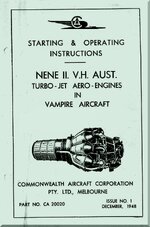
Are you perhaps looking for something like these:


ROLL_ROYCE_DERWENT_V_0_000.1__72126.jpg
 

Attachments

  • Nene-op_Page_02_Image_0001__44698.jpg
    Nene-op_Page_02_Image_0001__44698.jpg
    125.7 KB · Views: 25
  • Rolls_Royce_Nene_Overhaul_Manual_Appendix_1_Page_001__69894.jpg
    Rolls_Royce_Nene_Overhaul_Manual_Appendix_1_Page_001__69894.jpg
    38.7 KB · Views: 12
  • Rolls-Royce_Nene_10_Engine_Repair_and_Overhaul_instructions__99684.jpg
    Rolls-Royce_Nene_10_Engine_Repair_and_Overhaul_instructions__99684.jpg
    103.2 KB · Views: 23

Users who are viewing this thread

Back