Completeaerogeek
Airman
- 12
- Sep 13, 2016
Meteor and even early F-86A were not comparable in the high altitude air superiority role in Korea. Thrust to weight is only one factor. The low Mach limit of the straight wing jets (Meteor, US straight wing jets as well) made them completely non-competitive with the MiG-15 at altitude. But even the F-86A was quite competitive; and even the F-86F still had lower T/W than the MiG-15bis. The F-86's key advantage over the MiG-15 (besides pilot factors, just considering plane factors) was in high speed handling, an advantage which expanded with the later F-86's, though they also closed *part* (not all) of the gap with the MiG in climb and service ceiling.
75 sdn RAAF Meteors were used relatively briefly in the air superiority role in Korea in summer/fall 1951. They were a failure for the reason mentioned. The actual result was 4 Meteors downed by MiG's; all the engagements are known from the Soviet side and they lost no MiG's. Later the Meteors were shifted to the ground attack role (like the US straight wings) were they downed 2 intercepting MiG's of the PLAAF in a low altitude combat in 1952 per PLAAF account; another Meteor was picked off on a ground strike mission by a Soviet MiG same year, so 2:5 overall.
But the F-86A was quite successful in the high altitude air superiority role, and the variation in success among F-86 versions also depended on the varying quality of MiG opposition. Through spring 1951 for example the MiG's had only downed a single F-86A in combat. Later in 1951 the MiG opposition was strongest, F-86 air combat losses rose significantly and the kill ratio was lowest, though still distinctly in F-86's favor based on losses reported in each side's records. The F-86E was being introduced at that time. At the end of the war F-86F's had the highest kill ratio, but the quality of the opposition was lowest, having shifting away from the Soviets toward more PLAAF and KPAAF MiG units. I don't think we can determine the relative effectiveness of F-86 versions by calculating each version's kill ratio, but there is no comparison in the air combat effectiveness of the F-86 and Meteor in Korea.
Joe
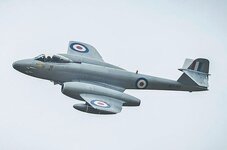
I'm sorry: Re Meteor F8 and MiG 15, there is a lot of commonly erroneous information in this post. Much information has come to light in recent year to set the story straight. Some commonly held and widely disseminated statements are easily disproven by basic physics and actual aircraft performance tests.
Bias about the Meteor Mk 8's performance against the Mig 15 is helped by the fact that the aircraft were a full generation apart in aerodynamic technology but in reality, a major part of the wartime air-to-air combat disparity is that the Aussies from 77 SQN had been flying exclusively ground attack in CAC built P-51 (F-51 by then) Mustang since their arrival, and not only had to convert onto a jet (a completely different way of flying) but had to train in bomber escort and how to use a Meteor's strengths in air combat, a task that would take a normal peacetime squadron probably a year of training.
After some difficulty and a few victories over MiGs, 77SQN RAAF was switched to ground attack where they performed extremely well.
The truth is that the Meteor F8 was a much more capable fighter than it has been given credit for. (It would eat an Me 262s lunch)
It was not that much slower than the MiG 15 (about 60mph) if we use 'peak' figures. The 585mph often quoted for the Meteor is misleading, as this was at sea level in dense thick air. The F8 was capable of 600+ mph at altitude.
Despite its swept wing, the MCrit of the MiG was 0.82–0.85 and the Meteor Mach 0.82-not a big difference. The MiG was transonically unstable in a dive (as many pilots found to their cost) so its escape manouevre could be terminal.
Its first generation swept wing design had to be ameliorated by large wing fences to prevent excessive spanwise airflow and it would experience tip stall and depart in a tight turn, long before the Meteor.
The MiG 15 typically used common slashing attacks (as did the 262 as it turned like the Queen Mary) and avoided turning fights (unless piloted by experienced Russian pilots) but if a Meteor saw it first, the MiG would have no hope in a turning fight, as the Meteor had a wing loading of 22lb/sq ft compared to 60.7 lb/sq ft with an almost identical thrust to weight ratio.
The MiG did have a superior rate of climb thanks to its VK1 (copied British Nene) engine.
The Meteor had better fighter armament in the 4 Hispano 20mm (the MiG was designed with heavier armament for shooting down bombers) which had a much flatter trajectory.
In reality, a properly trained F8 pilot with good situational awareness and using the strengths of his aircraft, would have a very good chance of easily avoiding a MiG 15 and if it could be drawn into a turning fight-dispatching it.
Last edited by a moderator:

 ), no power generator in case of engine failure, bad cockpit layout(switches, indicators), no cockpit heat, no cockpit ventilation, no G-sustaintable pilot position...and also throttle sensitive engines, just like the german-ones with also a slow spool-time (? the right english word?). I do not say that, it's the RAE in 46

 .
.

 ). The green scripted characters and the signature were written in pen originally - I have no idea what the scripted "28/21" or "11 Not received ?" are referring to. Nor do I know what the stamped number "29" near the top of page 1 is for.