Finnish air force Mustang kills on Russian Front? (3 Viewers)

kotelnikov_flypast_2014-02.png

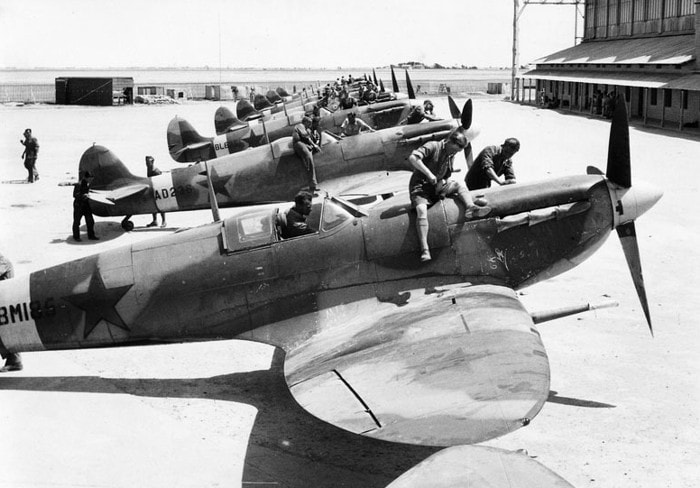
Three (or two, according to other sources) Mk.Vbs were delivered in the summer of 1943 to 2 Guards Fighter Aviation Corps (GvIAK), which protected Leningrad. For some time these machines flew with 26 GvIAP. Spitfires Vbs served with anti-aircraft defence regiments until the end of war - 12 were listed in records at the end of 1945.
 
Three (or two, according to other sources) Mk.Vbs were delivered in the summer of 1943 to 2 Guards Fighter Aviation Corps (GvIAK), which protected Leningrad. For some time these machines flew with 26 GvIAP. Spitfires Vbs served with anti-aircraft defence regiments until the end of war - 12 were listed in records at the end of 1945.
Out of 150 ?
 
From Ships-USSR
150 Spitfire Vb to Basra in October to December 1942.
201 Spitfire IX to Basra February to July 1944
864 Spitfire IX in Convoys JW.59 to 64 to North USSR August 1944 to May 1945
128 Spitfire IX in independent sailings to North USSR May and June 1945
1,336 Total, Empire Archer reported to have 23 mark IX on board, 22 traced, part of convoy JW.63, the list omits RK915 on Fort Island which was part of JW.62, however RK915 replaces SM455 which moves to Fort Highfield also part of JW.62. Changes give a total of 1,337.

Five Spitfire Vb damaged in transit and written off (NOT sent to India as per comment) from City of Lille, 1 more damaged in transit and written off from Palma, 1 returned to UK from Bandar Shahpour. Of the Spitfire Vb 92 were new, that is only reported at maintenance or ferry/packing units before export, of these 1 was returned to the UK and 1 damaged beyond repair in transit. Serials listed. The new aircraft had serials from EN911 except EN923, EN930 and EP165.

AIR 19/524
150 Spitfire exported October to December 1942
1,187 Spitfire exported February 1944 to June 1945

Copying a table direct from a spreadsheet did not work. Spitfire exports to USSR by month

14 in Oct-42
35 in Nov-42
101 in Dec-42

6 in Feb-44
34 in Mar-44
56 in Apr-44
62 in May-44
16 in Jun-44
51 in Jul-44
40 in Aug-44
50 in Sep-44
100 in Oct-44
85 in Nov-44
155 in Dec-44
99 in Jan-45
90 in Feb-45
22 in Mar-45
170 in Apr-45
30 in May-45
121 in Jun-45
1,337 Total

Air 22/310
Protocol deliveries Final position as at 30 June 1945
985 Spitfire IXE, 201 Spitfire IX, 1 Spitfire HF.IXE, total 1,187

Extra to protocol
150 Spitfire Vb Offered in October 1942, shipped to Basra and handed over
3 Spitfire PR.IV Handed over in North USSR October 1942
3 Spitfire PR.IV Handed over in North USSR June 1944
Total 1,337 fighter and 6 PR versions.

End of Month unless noted
4 February 1943, 63 Spitfire Vb arrived Basra, 87 en route
March 1943, 107 Spitfire Vb arrived Basra, 43 en route
14 April 1943, 150 Spitfire Vb arrived Basra, 59 being erected, 91 handed over.
28 May 1943, 150 Spitfire Vb arrived Basra, 7 being erected, 143 handed over.
17 June 1943, 150 Spitfire Vb arrived Basra, 149 handed over to USSR, 1 awaiting collection.
June 1943, 150 Spitfire Vb handed over to USSR
To reconcile this with the Airhistory listing would require the RAF to replace the 6 damaged beyond repair in transit and the 1 returned to UK.

February 1944, 6 Spitfire IX en route to Basra
March 1944, 40 Spitfire IX en route to Basra
April 1944, 56 Spitfire IX en route to Basra, 36 arrived awaiting erection, 4 erected.
May 1944, 62 Spitfire IX en route to Basra, 24 handed over, 66 arrived awaiting erection, 6 erected awaiting hand over.
June 1944, 94 Spitfire IX en route to Basra, 36 handed over, 56 arrived awaiting erection, 4 erected awaiting hand over.
July 1944, 27 Spitfire IX en route to Basra, 77 handed over, 93 arrived awaiting erection, 4 erected awaiting hand over. 24 Spitfire IXE in ships currently expected to sail in Convoy JW.59.
August 1944, Basra, 116 handed over, 76 arrived awaiting erection, 9 erected awaiting hand over. 64 Spitfire IXE in Convoy JW.59, sailed 15 August.
September 1944, Basra, 171 handed over, 23 arrived awaiting erection, 7 erected awaiting hand over. 64 Spitfire IXE in Convoy JW.59, 50 on JW.60 all arrived.
October 1944, Basra, 186 handed over, 13 arrived awaiting erection, 2 erected awaiting hand over. 214 Spitfire IXE arrivals in North USSR, including 100 in Convoy JW.61.
November 1944, Basra, 198 handed over, 1 arrived awaiting erection, 2 erected awaiting hand over. 214 Spitfire IXE arrivals in North USSR, 85 en route in Convoy JW.62.
December 1944, Basra, 200 handed over, 1 arrived awaiting erection, 2 erected awaiting hand over. 299 Spitfire IXE arrivals in North USSR, 155 en route in Convoy JW.63.
January 1945, Basra, 200 handed over, 1 erected awaiting hand over. 454 Spitfire IXE arrivals in North USSR, 99 en route in Convoy JW.64.
February 1945, Basra, 200 handed over, 1 erected awaiting hand over. 553 Spitfire IXE arrivals in North USSR, 111 IXE and 1 HF.IXE en route in Convoy JW.65
March 1945, Basra, 201 handed over. 664 Spitfire IXE and 1 HF.IXE arrivals in North USSR, 100 IXE en route in Convoy JW.66
April 1945, Basra, 201 handed over. 764 Spitfire IXE and 1 HF.IXE arrivals in North USSR
May 1945, Basra, 201 handed over. 864 Spitfire IXE and 1 HF.IXE arrivals in North USSR, implying 100 IXE in Convoy JW.67
June 1945, Basra, 201 handed over. 985 Spitfire IXE and 1 HF.IXE arrivals in North USSR, implying 121 IXE in Convoy JW.68
No further statements.

The Airhistory listing agrees with the JW convoy totals except 1 more on JW.62 and 1 less on JW.63 and lists JW.68 as independent sailings.

The lists in Air Arsenal North America add 2 Vb both considered new, but EP120 reported never left UK and is still in existence, EP788 sent to NW Africa, no further trace, reported as new and also ex Middle East. The book also reports 8 Vb sent were not delivered, replaced from RAF stocks. W3936, EP145, EP242, EP386 are not in the Air Arsenal North America mark V list. The mark IX list book total is 1,181 but has 1,176 serials.

It cannot have taken 6 months to fly them to Leningrad ?
 
It cannot have taken 6 months to fly them to Leningrad ?
They were all deployed in the southern sector of the Eastern Front (mainly 57 GIAP); only 20-30 Vbs were sent in the summer of 1943 to the Air Defence units protecting Moscow and Leningrad to counter high-altitude reconnaissance aircraft. Have you ever read Kotelnikov's article?
 
They were all deployed in the southern sector of the Eastern Front (mainly 57 GIAP); only 20-30 Vbs were sent in the summer of 1943 to the Air Defence units protecting Moscow and Leningrad to counter high-altitude reconnaissance aircraft. Have you ever read Kotelnikov's article?
I read Kostelnikov frequently......very productive hero of the Soviet Union.

 
Last edited:
re
"It cannot have taken 6 months to fly them to Leningrad ?"

IIUC the Oct-Dec'42 is the period when the British initiated the shipment. The shipment process itself involved:

Getting boxed up and prepped at the holding facility - upto 2 weeks

Railed or trucked to the port of departure - upto 1 week

Loading on board ship - upto 1 week

Sit around at the port while waiting for other cargo - upto 4 weeks

Go to sea and sail around the Cape of Good Hope upto the Persian Gulf and to the port of Basra - upto 6 weeks

From Basra they were probably railed and/or trucked (still boxed up) north to the Soviet Union - upto 3 weeks

Unbox, assemble, flight test, etc - upto ? weeks

So figure upto 4 months and 1 week getting the aircraft to Baku, Ashkabat, etc, in the Soviet Union, followed by however long it took to get the aircraft ready to head north to Leningrad.
 
Last edited:
:rolleyes: This is another Kotelnikov, who had absolutely nothing to do with aviation. The article was written by Vladimir Rostislavovich Kotelnikow, who died in 2022.
Ok I found him:

Vladimir Kotelnikov (1951–2022) was a prominent Russian aviation historian, author, and aerospace engineer. [1, 2]

Background and Career
  • Education: Graduated from the Moscow Aviation Institute in 1975 and earned his Candidate of Science degree in 1981.
    Teaching & Consulting: Lectured on aircraft piston engine design at the Moscow Aviation Institute and served as a consultant for Russian aviation museums and aircraft restoration projects.
    Editorial Work: Acted as an editor for the Moscow-based aviation history journal Aviakollektsiya starting in 2003. [1, 2]

Notable Research and Writing
  • Focus: Conducted extensive archival research into Russian aviation history during the inter-war and World War II periods, with a special emphasis on foreign aircraft operations and testing in Russia. [1]
    Publications: Authored dozens of books and hundreds of articles published internationally. Major works include:Lend-Lease and Soviet Aviation in the Second World WarRussian Piston Aero EnginesEarly Russian Jet Engines: The Nene and Derwent in the Soviet UnionAir War Over Khalkhin GolSoviet Military Aviation in Central Asia 1917–41 [1, 2, 3, 4, 5]


I bet he is the "untouchable authority" like Stenman and Keskinen in Finland.

I found this AI info:

Soviet politruks (political commissars) did not systematically alter individual Soviet Air Force (VVS) kill scores on their own whim, but the structural demands of the Soviet propaganda apparatus—which they managed—incentivized and institutionalized the heavy over-claiming of victories. [1]
While a politruk could not simply sit at a desk and write fake numbers into a pilot's official logbook without any combat context, the entire bureaucratic system they oversaw was geared toward producing high-morale figures. Post-Cold War archival research and cross-referencing with declassified German Luftwaffe logs have revealed that Soviet combat units over-claimed aerial victories significantly, sometimes by massive margins. [1, 2, 3]
The phenomenon of inflated kill scores in the Soviet Air Force was driven by several key systemic factors rather than isolated administrative forgery:

1. The Strict Verification System (On Paper)
To prevent outright lying, the VVS officially required a stringent verification process. For a pilot to receive credit for a kill, the downing of the aircraft had to be: [1]
    • Confirmed by gun camera footage (which was rare on Soviet planes until late in the war).
    • Witnessed by other pilots in the formation.
    • Verified by ground observers (ground troops, spotters, or local partisans) who saw the crash. [1, 2]
Because pilots were financially rewarded with cash bonuses for every confirmed enemy aircraft destroyed, the pressure to get these verifications was immense. [1]

2. How the System Was Manipulated
Despite the rules, politruks and commanders routinely bypassed verification accuracy in ways that inflated individual and unit scores: [1]
    • Group Kills Credited as Individual Kills: A common practice in Soviet squadrons was to take a single shared victory (where 3 or 4 pilots shot at one German plane) and credit it as an individual victory to each pilot, or to the squadron commander, to build up "Hero of the Soviet Union" resumes. [1, 2]
    • The Ghost of "Socialist Competition": Politruks were responsible for driving "socialist competition" between different regiments. Regiments competed for elite "Guards" status, flags, and collective awards. This created an unspoken agreement between pilots, commanders, and politruks to validate highly optimistic combat claims so the entire unit looked superior on paper. [1]
    • Rubber-Stamping Poor Verification: If a pilot claimed a Messerschmitt dived into the clouds smoking, a politruk eager for a propaganda victory would easily accept vague ground-troop testimony to officially log it as a confirmed kill rather than a "damaged" aircraft. [1]

3. Historical Reality vs. Claims
Archival studies highlight the scale of this inflation. For example, during the massive air battles over the southern flank of the Battle of Kursk in July 1943, Soviet Air Force records claimed they had shot down roughly eight times as many German aircraft as the Luftwaffe actually lost in that sector. [1]

Summary
Soviet politruks did not secretly rewrite official air force logbooks out of nowhere, but they actively fostered a high-pressure environment where over-claiming was highly rewarded, protected, and weaponized for state propaganda.

So as the records are a "fairytale"...then possibly the enemy score on their records weren't accurate either....no matter how much engineering background you have as an author.

Soviet politruks (political commissars) and zampolits (deputy commanders for political affairs) played a significant role in altering, inflating, and reshaping enemy aircraft kill scores, primarily driven by the demands of wartime state propaganda. [1, 2]
While overclaiming occurred in every major air force during World War II due to the chaotic nature of dogfights, the Soviet system had a unique political apparatus layered on top of its military command that systematically incentivized score inflation. [1, 2, 3]

The Role of Politruks in Score Inflation
  • Propaganda Over Accuracy: The primary job of a politruk was to maintain ideological purity and boost troop morale. A highly decorated, high-scoring fighter pilot was the perfect tool for state propaganda. Politruks actively managed "trench newspapers" and press releases. If an aggressive or politically favored pilot claimed a victory, political officers frequently pressured the unit's technical staff to officially register it, even if the strict military criteria for confirmation (such as ground team confirmation or wreckage retrieval) were lacking. [1, 2, 3]

The Discrepancy in the Numbers
Because of this political padding, modern archival research comparing Soviet combat logs directly against German Luftwaffe loss records (Kriegstagebuch) reveals significant inflation. For instance, during intense battles like Kursk, Soviet fighter units routinely claimed up to 40% to 100% more aircraft shot down than the German records indicate were actually lost or damaged in that sector. [1]
This institutionalized distortion was so deeply embedded that even senior Soviet officials recognized it; post-war Soviet staff officers noted that in the field, it was informally understood that a unit's reported enemy losses were automatically expected to be higher than reality as a matter of standard ideological reporting. [1]


AI data also.
 
Last edited:
I came across a detailed listing of Finnish Air Force kills during 1944, 334th Eagle Squadron Forums » Post 1824 » Re: Tali-ihantala Fin vs Russia 25.6-9.7.44 interesting that these 109G's claimed Mustang kills? Did the Soviets receive any Mustangs? Otherwise I cannot see how the Finnish AF planes would have flown anywhere near usual USAAF areas? All on the same day 26 June 1944..................

26.6.1944 10.55–12.10 Tali Ylik Aimo Vahvelainen 109G-2 MT-238 Mustang
26.6.1944 16.30–17.40 Mannikkala Kers Kosti Keskinummi 109G-6/U2 MT-443 Mustang
26.6.1944 12.55–14.00 Juustila-Tali Ltm Ilmari Juutilainen 109G-6/U2 MT-422 Il-2 ja Mustang
26.6.1944 15.00–16.10 Tammisuo Ltm Ilmari Juutilainen 109G-6/U2 MT-459 Mustang
They must have runned out of mustangs quickly if also Kössi Karhila got two ?
 
While true that June 26, 1944 could be a plausible connection, there are some key issues.

First, the Poltava attack on night of June 21st(?) damaged some Mustangs and were left behind when the 4th/352nd squadrons departed for Italy. Those were the first P-51B/D Mustangs in VVS hands. Second, it is highly unlikely that the VVS could repair them, provide instruction and fly them within several days? Last, why would they decide to move (recently restored to flyable condition) to Finland for any reason?
It took a while for them to get accustomed to it...albeit they had them already in Musmansk.

 
This is how it was described in all literature we have availbale...up to 50 at a time....with 20-30 Il-2 that they were escorting.
Please cite at least one source relevant to topic ("cobras over Karelia"). So far, you haven't presented anything other than your own fantasies and irrelevant texts.
 

Users who are viewing this thread

Back