
Greg Spouts Off About P-38 Drop Tanks (3 Viewers)

Ad: This forum contains affiliate links to products on Amazon and eBay. More information in Terms and rules

That's exactly the point. You can't consider this without talking about procurement and context.

Winning Desert Storm is an illogical step because the system was designed to defeat the Soviet Union, not an isolated second-tier Middle Eastern power. That much is true. Pietrucha is saying that CBP is being used as a substitute for strategy and strategic thinking.

I'm not putting this here to prove solutions, Squish. I'm putting it here to prompt/ask questions.

I don't see any point in asking questions if you do not even want to even begin to consider the answers to them.

So does that mean we shouldn't ask questions? This is why, historically, we learn more from our defeats than we do from our victories. Pietrucha's point was that the United States learnt the wrong lessons from Desert Storm. In fact, if you read enough of his stuff, he makes it very clear that the whole basis for tactical planning is a flawed premise, a scenario that was used after all the major threats had been extinguished. If that's not a case for asking questions then I don't know what is.

There is no evidence of this axiom one way or the other. Arguably there is strong evidence to the contrary; hence a common criticism of the US Military is that it's always "fighting the last war."

The lessons that Boyd/Sprey etc took from Vietnam were that the only relevant fighter aircraft was going to be a pure dogfighter that was not equipped with radar missiles in the first place. History has proven this assertion wrong.

We can see this with our most recent defeat in Afghanistan. What lessons did the Army learn from it? Well the lessons of Afghanistan have resulted in a return to the "Battle Rifle" concept and adopting a cartridge that is more powerful than even the 30-06 that was used during World War II.

This is all because of our experience with goat herders taking pot shots at FOBs from a hillside away using ancient Lee-Enfield rifles.

What were his reasons? Without any context, of course this looks ridiculous. I don't think he was literally advocating for the M-48.
It was the same set of tropes that he always used. I would suggest you look up his studies/articles where he singled out specific programs during the 1970s/1980s and labeled them "cheap winners / expensive losers."

Of around the 10 or so programs that he singled out for critique...the only one that he was proven correct about happened to be the M-16 Rifle.

Yeah but the point here was that the missiles could have been fired from anything that could carry them. Control of the electronic battle space was what mattered. The Pakistani J-10 and J-17 fighters didn't even turn on their radar.

The purpose of this wasn't to prove that Sprey's ideas were right. The point was that people need to ask questions, rather that persisting in the time honoured way because there's a belief that it's always worked. Much of what you've written simultaneously validates what I'm saying. My comment that adding capability was not an unreasonable point of view was interpreted as an unreasonable point of view because designers kept adding capability!

With context removed, you can prove anything. That graphic (which I assume you got from Sprey) is one example. Your use of it is another. Both are context-free arguments.

Now, I'm quite sure everyone has had enough of me. I'm not trolling, believe it or not but I can see I'm not getting anywhere.
Even if we assume that then J-10 or J-17 fighters never turned their radars on (which is likely untrue), and that the missile was guided via datalink (something that is true) it still proves my point.

This kind of highly network centric battlefield is exactly the kind of highly complex and high technology solutions that Sprey fought against his entire career!

I'm not defending everything Sprey said either. During the development of the F-35, a whole industry sprang up generating context-free material with which to attack Pierre Sprey. He became a lightning rod for all kinds of Aunt Sally arguments, whataboutism and ultimately, the defence of a system that lives on blind faith and self-evident truths, something Lockheed-Martin did nothing to prevent. It went a lot further than that but I'm not interested in examining the darker side of what happened. That's an aside to this.

He was wrong about the P-47. He was probably wrong about a lot of things. He was not wrong to challenge the status quo.
I am not apart of any industry and I have been critical of some of the critiques of Sprey/Boyd that downplay their significance to the point of irrelevancy. He does get trotted out as a boogeyman a little too often.

This does not change a few facts though; namely that himself and Boyd were wrong about far more things than they were right about. And that the degree to which they were wrong only increased over time.

Neither Boyd nor Sprey were ever willing to admit their assumptions were wrong about anything. Sprey in particular was not capable of any kind of intellectual growth or self-reflection which is why his proposals and positions looked increasingly ridiculous over time. They basically never changed and were frozen in the dogma of the 1970s.

It is one thing to say that the M1 Abrams is going to be a failure in 1980, that it's too expensive, that the Chobham armor isn't going to work, and that the Army should just continue to buy M-60s instead. It is entirely another thing to have that exact same position and even double down on it in 2007!

But if you look at the current situation, it's not hard to see where he was right.
In what ways does the "current situation" prove that he is right? Do we honestly think that the Iran War would be going better if the USAF inventory consisted of gunfighting F-16s, A-10s, and dumb-bombs?

The degree to which Sprey has been proven correct is in the same sense that a broken clock can be right once a day or in the sense that anyone can point out that water is wet.

Now let's all be friends and get back to Greg and the P-38.

If we get back to Greg and the P-38 then the only thing that he really brings to the conversation and how his position differs from Sprey is that he at least doesn't discount it as a failure of a fighter.

Aside from that, when engaging with the actual case history, he makes similar attempts to pin the deaths of thousands of airmen at the feet of Hap Arnold by concocting a totally false narrative that the Army Air Corps erroneously decided not to seriously develop escort fighters or drop tanks until after the first Schweinfurt mission.

The only kind of nuance to Greg's narrative is that he believes the P-47 was a superior fighter to the P-51 in practical terms; whereas Boyd/Sprey regarded it as the complex and expensive and poor dogfighting counterpart to the "lightweight" P-51.
 
Last edited:
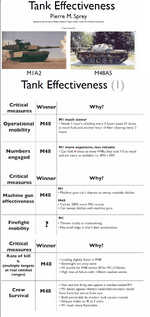
Even in 2007 Sprey was still claiming that the M-48, a medium tank from the Korean War, was a better proposition than the M2A2!
I would love to see that one............or maybe I wouldn't as it makes zero sense.
Comparing an MBT to an AFV (gussied up APC) that is roughly 20 tons lighter is bad enough.
Holding out the M-48 as an example of a "simple" weapons system is downright laughable.
It was the most complex mass produced MBT tank of it's time and a lot of the complexity didn't very work in practice.
Sometimes newer technology is better. Laser rangefinders soon became smaller, lighter, less likely to get out of adjustment than optical range finders.
The commander's cupola on most M-48s was bad joke and was a far from cheap as it could be.
The M-48s gun was great.............................in 1944, in 1953 it was not first rate and in 1955-56 is even worse.
List goes on. If that is an example of Sprey's thinking/scholarship then then it certainly shows flaws. Perhaps a longer example of his thinking would show up better?
 
I would love to see that one............or maybe I wouldn't as it makes zero sense.
Comparing an MBT to an AFV (gussied up APC) that is roughly 20 tons lighter is bad enough.
Holding out the M-48 as an example of a "simple" weapons system is downright laughable.
It was the most complex mass produced MBT tank of it's time and a lot of the complexity didn't very work in practice.
Sometimes newer technology is better. Laser rangefinders soon became smaller, lighter, less likely to get out of adjustment than optical range finders.
The commander's cupola on most M-48s was bad joke and was a far from cheap as it could be.
The M-48s gun was great.............................in 1944, in 1953 it was not first rate and in 1955-56 is even worse.
List goes on. If that is an example of Sprey's thinking/scholarship then then it certainly shows flaws. Perhaps a longer example of his thinking would show up better?
Click on the attached image.
 

Attachments

  • Screenshot_20260806-203716.png
    Screenshot_20260806-203716.png
    197.5 KB · Views: 21
Thank you.

Once we correct to M1A2 vs M48A5 things are both a bit better and a lot worse.
Both are MBTs but now we are comparing a new tank (or a newer referb) to a very old tank with an old referb job.
M1A2 dating from the 1992 and later compared to around 1975 for the M48A5. did they adjust for inflation?
Reliability is rather suspect. Granted they used a lot of new stuff in the mid 70s but they were rebuilding a tank made in the 1950s. How reliable the 1975 tanks were in 1992-5 is certainly subject to question.
Basically, they only listed questions where the M48A5 would come out ahead and didn't ask any questions where it would come out behind. M48A5 was away to get M60A3 performance on cheap. That is up-grade the old M48s up to close to the M-60 performance levels.
One thing (out of many) is that the M48A5 did not use a gun stabilization system. Very hard to fire on the move. Some M-60s got stabilization added on in retro fits. M1 Abram had it from the start. Not all systems preform the same.

The comparison seems to be not valid. M48A5s may have been out of service (retired) before the M1A2 was put in service?
 
Thank you.

Once we correct to M1A2 vs M48A5 things are both a bit better and a lot worse.
Both are MBTs but now we are comparing a new tank (or a newer referb) to a very old tank with an old referb job.
M1A2 dating from the 1992 and later compared to around 1975 for the M48A5. did they adjust for inflation?
Reliability is rather suspect. Granted they used a lot of new stuff in the mid 70s but they were rebuilding a tank made in the 1950s. How reliable the 1975 tanks were in 1992-5 is certainly subject to question.
Basically, they only listed questions where the M48A5 would come out ahead and didn't ask any questions where it would come out behind. M48A5 was away to get M60A3 performance on cheap. That is up-grade the old M48s up to close to the M-60 performance levels.
One thing (out of many) is that the M48A5 did not use a gun stabilization system. Very hard to fire on the move. Some M-60s got stabilization added on in retro fits. M1 Abram had it from the start. Not all systems preform the same.

The comparison seems to be not valid. M48A5s may have been out of service (retired) before the M1A2 was put in service?
I was able to pull up the full slideshow. It is from 2007 and in that context it is incredibly silly.

 
I was able to pull up the full slideshow. It is from 2007 and in that context it is incredibly silly.

Thank you very much.
From that presentation ( 😵‍💫 ) I can conclude that either they were using GIGO (garbage in garbage out) or were out right lying to make their point.

It was silly at any point in time. It started off bad and did not get better. His/their ability to mix/ignore timelines was amazing as was the ignoring of different capabilities.

It was much like the stuff put out by AI without AI.
maybe he/they have better stuff out there but that was enough to deter me from wasting any more time on it.
 
Your comments about the YF-22 / 23 above fail to take into a count the fact that the Northrop YF-23 avtually met the specification as it was issued and the YF-22 did not. The "powers that be" at the time, re-wrote the spec to a lower level so the YF-22 could compete, but did NOT give Northrop any time to change the YF-23 to address shortcomings that were inherent due to meeting the stealth specification. They screwed Northrop AGAIN and even likely smiled while doing it.

Another triumph for honest procurement, sorry ... I mean politics as usual.

Don't get me wrong, the F-22 is a very good airpalne. But it didn't meet the original spec and the YF-23 DID.

Hi,
You might be interested that the great British designer Sir Sidney Camm is quoted by Stanley Hooker as saying to him about aircraft design and specifications, "stick to the spec and you're dead".

Eng
 
North American never designed to a spec until the F-100
Interesting to know.
I suspect that with that Camm comment from about 1939, he was speaking from his experience in aircraft design that had always been in a climate of extreme technological advance. I suspect that the good designers were actually well ahead of the Air Force and Ministry men and sticking to a specification was likely designing something for the past. I think that Camm new the difference between aspects of specifications that were important and those which were limiting in particular ways.
Overall, Camm was a heavyweight, designing most of the Hawker aircraft from the Biplane Hart, to the P.1127 VSTOL fighter/bomber.

Eng
 
There is designing to a specification (?).
Responding to a proposal?
Submitting a proposal to a design competition?

NA Fury was a response to a Navy request for proposals for a new carrier fighter to replace the McDonnell XFD-1 Phantom (according to wiki) and three planes (designs) were selected. Wiki does not say how many designs were submitted.
I have no idea what criteria were used or performance 'goals' were aimed for to judge or guide the selection process.
There may have been a further refinement/s so that each of the 3 aircraft selected had to meet slightly different performance goals or weight goals or ???? in order to get more contracts/ or keep from being cancelled.

F-100 design evolution (according to wiki which may not be accurate)
''The F-100 can be traced back to an internal design study performed by North American Aviation as early as 1949.[8] It was named Sabre 45 in reference to its 45° wing sweep and essentially represented an evolution of the company's successful F-86 Sabre. In January 1951, the company delivered an unsolicited proposal for a supersonic day fighter to the United States Air Force (USAF).[8] On 7 July 1951, a mockup of the aircraft was presented for inspection; the USAF produced a general operational requirement that called for an air superiority weapon to be operational no later than 1957, preferably by 1955. During October 1951, the Air Force Council advocated for the development of a refined model of the Sabre 45; furthermore, it agreed with the Aircraft and Weapons Board's recommendation that it be purchased in quantity even prior to flight testing despite the risks involved in this approach.[8]

By mid-November 1951, in excess of 100 aircraft configuration change requests had been received, necessitating numerous modifications to the original design; several of these alterations were focused on its armaments and were intended to improve its lethality.[8] The new aircraft was accepted as the F-100 on 30 November 1951. On 3 January 1952, the USAF placed an order for two prototypes; one month later, a follow-on production order was issued for 23 F-100As while an additional 250 F-100As were ordered in August of that year as well.
[9] "

So when was the specification issued and for which version?
US "specifications" were often very specific as to weights and performance and failure to meet the contracted 'specification' (performance guarantees) could mean substantial financial penalties, even on prototypes. Things many have changed after WW II?
 
Hi,
You might be interested that the great British designer Sir Sidney Camm is quoted by Stanley Hooker as saying to him about aircraft design and specifications, "stick to the spec and you're dead".

Eng
British aviation history is littered with examples where the aircraft met the spec and it was the spec that killed the crews. I should also add that this also applies to tanks.
 
British aviation history is littered with examples where the aircraft met the spec and it was the spec that killed the crews. I should also add that this also applies to tanks.

Perhaps it is worth considering the contemporary context of the "specifications" that Camm was talking about in that quote in 1939? British "specifications " were issued by the Air Ministry for private companies to tender against, the Air Ministry deciding the ones that they liked and issuing contract(s) for prototypes. The specification could be more or less detailed and they often were detailed in performance criteria, engines to be used and often for weapon fit or even minor detail.
Private companies could also tender private developments at their own cost, hoping to provide a superior prototype that attracted production contracts despite not being chosen initially. Here, I think, is the nub of Camms' comment.
Remember also that the initial development of the RR Merlin was as a private venture (the PV12), initially persued by RR privately at a time in the early 1930's when the British Government had no money for a contract. The glory of that decision by RR was, IMO, the most critical element in the survival of Great Britain in the 1940 BoB. Furthermore, the basic design parameters chosen by RR, though not perfect in all aspects, were to prove to be the "sweet-spot" for the development of V12 aero-engines and that was not luck, RR from their success with the "R-type" Schneider Trophy engines in 1929 and 1931 could see that their Merlin configuration was the way forward (with further developments).

Eng
 
NA Fury was a response to a Navy request for proposals for a new carrier fighter to replace the McDonnell XFD-1 Phantom (according to wiki) and three planes (designs) were selected. Wiki does not say how many designs were submitted.
The Navy's request was issued late in '44, hoping to have a carrier capable jet fighter operational by May '46 for Operation Olympic (invasion of Japan).

The four were:
North American FJ-1 Fury (as mentioned)
McDonnell FD-1 Phantom
McDonnell F2D-1 Banshee
Vought F6U-1 Pirate
 
I agree with pretty much everything you say. Generally speaking, the more detailed and therefore restrictive the official spec, the less successful the design.
In the UK there was a dread from the government spec drafters to letting the designers have their head and let them use their initiative.

Probably the best example is American with the A4 Skyhawk.
 
There is designing to a specification (?).
Responding to a proposal?
Submitting a proposal to a design competition?

NA Fury was a response to a Navy request for proposals for a new carrier fighter to replace the McDonnell XFD-1 Phantom (according to wiki) and three planes (designs) were selected. Wiki does not say how many designs were submitted.
I have no idea what criteria were used or performance 'goals' were aimed for to judge or guide the selection process.
There may have been a further refinement/s so that each of the 3 aircraft selected had to meet slightly different performance goals or weight goals or ???? in order to get more contracts/ or keep from being cancelled.

F-100 design evolution (according to wiki which may not be accurate)
''The F-100 can be traced back to an internal design study performed by North American Aviation as early as 1949.[8] It was named Sabre 45 in reference to its 45° wing sweep and essentially represented an evolution of the company's successful F-86 Sabre. In January 1951, the company delivered an unsolicited proposal for a supersonic day fighter to the United States Air Force (USAF).[8] On 7 July 1951, a mockup of the aircraft was presented for inspection; the USAF produced a general operational requirement that called for an air superiority weapon to be operational no later than 1957, preferably by 1955. During October 1951, the Air Force Council advocated for the development of a refined model of the Sabre 45; furthermore, it agreed with the Aircraft and Weapons Board's recommendation that it be purchased in quantity even prior to flight testing despite the risks involved in this approach.[8]

By mid-November 1951, in excess of 100 aircraft configuration change requests had been received, necessitating numerous modifications to the original design; several of these alterations were focused on its armaments and were intended to improve its lethality.[8] The new aircraft was accepted as the F-100 on 30 November 1951. On 3 January 1952, the USAF placed an order for two prototypes; one month later, a follow-on production order was issued for 23 F-100As while an additional 250 F-100As were ordered in August of that year as well.
[9] "

So when was the specification issued and for which version?
US "specifications" were often very specific as to weights and performance and failure to meet the contracted 'specification' (performance guarantees) could mean substantial financial penalties, even on prototypes. Things many have changed after WW II?
SR - NAA wrote the Specification to accommodate the proposal. The changes which resulted in many modifications to both the airframe and the 'specifications'.

Prior to that NAA basically wrote Specs after the preliminary design was complete and was pretty much boilerplate based on knowing what the Customer (AAF, RAF) wanted.


The changes you mention including penalties were far more prevalent during and after the Korean War - and draconian in the 60's. During WWII, there was always a 'cancellation provision based on milestones , such as XP-46 and P-60 and XP-75.
 
Acceptances to end 1941, 1 XP-38, 13 YP-29, 29 P-38, 36 P-38D, 115 P-38E, 13 P-322, total 207
Deliveries to end 1941, 1 XP-38, 13 YP-29, 29 P-38, 36 P-38D, 11 P-38E, 3 P-322, total 93, yes, less than end December 1941 strength

I'm curious if you (or anyone else here) have a monthly breakdown as to how many P-38's the AAF expected to (as opposed to how many they actually did) receive in 1942 and/or 1943. Of course that was probably a moving target but I'd appreciate it if anyone had some real numbers on that.
 

Users who are viewing this thread

Back