

Navigation
Install the app
How to install the app on iOS
Follow along with the video below to see how to install our site as a web app on your home screen.
Note: This feature may not be available in some browsers.
More options
You are using an out of date browser. It may not display this or other websites correctly.
You should upgrade or use an alternative browser.
You should upgrade or use an alternative browser.
Groundhog Thread Part Deux - P-39 Fantasy and Fetish - The Never Ending Story (Mods take no responsibility for head against wall injuries sustained) (4 Viewers)
- Thread starter greybeard
- Start date
More options
Who Replied?
GrauGeist
Generalfeldmarschall zur Luftschiff Abteilung
I will admit that the P-39 was an attractive and innovative design.So how about the Groundhog Mk 2? Actually I quite like all the groundhogs -- cool airplanes...
View attachment 825154
If we take into consideration aircraft technology and design of that point in time, Bell did a fantastic job of creating a fighter that was ahead of it's time.
Several innovations, like tricycle gear, buried engine, centerline cannon, protective armor and unitised construction were cutting edge.
It's closest contemporary, the Piaggio P.119 ended up being a one-off and several years behind.
ThomasP
Chief Master Sergeant
In all seriousness, I would have to say that the P-39 was a good basic airplane.
IMO, the main problem was that the P-39 came along just a little bit too late and offered no significant and useful performance advantage over the other aircraft available (ie P-40x, Spit Mk x, etc) for the US or UK. For the US and the Soviets it offered another platform in terms of additional numbers, and for the Soviets it may have offered a performance advantage in some areas as well. For the UK it would simply have been another logistics chain hog.
The 37mm might have been helpful in shooting down heavy bombers or other large aircraft, but the US, UK, and the Soviets did not run into any number of such aircraft.
The 20mm HS404 in place of the 37mm could have been a significant improvement if the US manufacturer of the 20mm HS404 had gotten it together sooner and made reliable weapons, particularly if they had incorporated a belt-feed in place of the 60-round drum. There was room for about 120x 20mm rounds for the same volume and weight as the original 15-round box magazine arrangement - more if you include the removal weight of the 2x nose-mounted .30 cal guns.

The low ROF (135 rpm) and MV (1900 ft/sec) of the P-39's 37mm was a significant disadvantage?
The low ROF (382-425 rpm depending on the source and reduction gearing) of the P-39's 2x nose mounted synchronized .50 cal was a significant disadvantage? (The contemporary P-40 changed to all wing mounted .50 cal guns.)
The P-39's wings were too thin(?) for effective fitting of .50 cal guns internally, so they were limited to the 4x .30 cal normally installed, or 2x gondola mounted (and performance reducing) .50 cal guns.
The P-39 supposedly had a speed advantage early-war, but for some reason it almost never seemed to show to advantage in combat(?).
IMO, the main problem was that the P-39 came along just a little bit too late and offered no significant and useful performance advantage over the other aircraft available (ie P-40x, Spit Mk x, etc) for the US or UK. For the US and the Soviets it offered another platform in terms of additional numbers, and for the Soviets it may have offered a performance advantage in some areas as well. For the UK it would simply have been another logistics chain hog.
The 37mm might have been helpful in shooting down heavy bombers or other large aircraft, but the US, UK, and the Soviets did not run into any number of such aircraft.
The 20mm HS404 in place of the 37mm could have been a significant improvement if the US manufacturer of the 20mm HS404 had gotten it together sooner and made reliable weapons, particularly if they had incorporated a belt-feed in place of the 60-round drum. There was room for about 120x 20mm rounds for the same volume and weight as the original 15-round box magazine arrangement - more if you include the removal weight of the 2x nose-mounted .30 cal guns.
The low ROF (135 rpm) and MV (1900 ft/sec) of the P-39's 37mm was a significant disadvantage?
The low ROF (382-425 rpm depending on the source and reduction gearing) of the P-39's 2x nose mounted synchronized .50 cal was a significant disadvantage? (The contemporary P-40 changed to all wing mounted .50 cal guns.)
The P-39's wings were too thin(?) for effective fitting of .50 cal guns internally, so they were limited to the 4x .30 cal normally installed, or 2x gondola mounted (and performance reducing) .50 cal guns.
The P-39 supposedly had a speed advantage early-war, but for some reason it almost never seemed to show to advantage in combat(?).
Last edited:
wuzak
Captain
The M4 cannon had a flat trajectory across any range required to dismiss an argument for its replacement.
What the P-39 lacked for greatness was a set of automatic leading edge slats, which would have enabled it to shoot across the circle.
What the P-39 lacked for greatness was a set of automatic leading edge slats, which would have enabled it to shoot across the circle.

Pretty much.In all seriousness, I would have to say that the P-39 was a good basic airplane.
What was not there was a really competitive engine, in a timely manner.
The P-39's wings were too thin(?) for effective fitting of .50 cal guns internally, so they were limited to the 4x .30 cal normally installed, or 2x gondola mounted (and performance reducing) .50 cal guns.
Spitfire's wings were even thinner, yet people shoved up 4 cannons per an A/C there - so I'd say that P-39's wing was thick enough. How much of the effort Bell's engineers and techincians wanted to invest into modifying the wing for the .50 to fit is another story.
The P-39 supposedly had a speed advantage early-war, but for some reason it almost never seemed to show to advantage in combat(?).
P-39 in service never held the speed advantage vs. the German or UK's best, not even early in the war. Aerodynamics were there, engine was not.

GregP
Major
Me, too.

We get this one as an airshow visitor, and it's quite nice to see flying down the runway at 75 feet in a 40° bank. It is very apparent when it flies with other fighters that the canopy is moved forward and the wing is moved aft, and it LOOKS like it is going faster than it is.
We get this one as an airshow visitor, and it's quite nice to see flying down the runway at 75 feet in a 40° bank. It is very apparent when it flies with other fighters that the canopy is moved forward and the wing is moved aft, and it LOOKS like it is going faster than it is.
Shortround6
Lieutenant General
P-39 had two problems.
The already mentioned lack of power.
It was overweight. It was about 500lbs or more overweight in the prototype and things did NOT get better.
The P-39C had no protection and was just over 7000lbs in early 1941. They quickly modified the contract to complete most of the contract to the P-39D and weight ballooned up to 7500lbs with protection and increased guns/ammo but no increase in power. Some performance tests were done at a reduced fuel load (common among US planes of the time) of 104 US GAL (86-87IMP GAL).
Even if they could have stuffed a Merlin 45 engine (early 1941 spec) into the P-39 for more power, the P-39 was about 1/2 ton heavier than British/German/Soviet/Italian MC 202. Roughly 15% heavier than it needed to be to be competitive. There is only so much you can do with good streamlining.
The already mentioned lack of power.
It was overweight. It was about 500lbs or more overweight in the prototype and things did NOT get better.
The P-39C had no protection and was just over 7000lbs in early 1941. They quickly modified the contract to complete most of the contract to the P-39D and weight ballooned up to 7500lbs with protection and increased guns/ammo but no increase in power. Some performance tests were done at a reduced fuel load (common among US planes of the time) of 104 US GAL (86-87IMP GAL).
Even if they could have stuffed a Merlin 45 engine (early 1941 spec) into the P-39 for more power, the P-39 was about 1/2 ton heavier than British/German/Soviet/Italian MC 202. Roughly 15% heavier than it needed to be to be competitive. There is only so much you can do with good streamlining.
GregP
Major
I'd have to say that power-wise, the Allison was competitive. The Air Corps decided the high-altitude boost system would be a turbocharger and then deleted it from the P-39 that didn't really have enbough room inside the airframe to mount one anyway, so the altitude performance was not up to what was needed in Europe. And they never funded an integral 2-stage supercharger, so it never got developed and produced. That means the P-39 was not competitive at higher altitudes like it was at lower altitudes.Pretty much.
What was not there was a really competitive engine, in a timely manner.
Spitfire's wings were even thinner, yet people shoved up 4 cannons per an A/C there - so I'd say that P-39's wing was thick enough. How much of the effort Bell's engineers and techincians wanted to invest into modifying the wing for the .50 to fit is another story.
P-39 in service never held the speed advantage vs. the German or UK's best, not even early in the war. Aerodynamics were there, engine was not.
The P-39 was about as good as anything else at lower-altitudes and shorter ranges. The main issue with the P-39 is that a lower-altitude, shorter-range airplane wasn't among the needs in the ETO. Ergo, it really didn't have much of a purpose there. In retrospect, we really didn't need the P-39 except for the fact that it was there and available when the war broke out.
But, it's hard to fault the P-39's record in Soviet service. They DID have such a need for a shorter-range, lower-altitude airplane and managed to get very good service from their P-39s.
We didn't acquire the P-63 because, while it was very good, it also didn't offer much of a real advantage over existing equipment like the P-51 (being a better roller and turner but slightly slower than the P-51), and it also had a shorter range than the P-51. In point of fact, almost everything else did, too. But the P-63 would give a P-51 all it could handle in a dogfight up to 25,000 feet or so, which WAS competitive in the ETO and about anywhere else. If we HAD acquired them, they would have done OK wherever they were deployed as long as there were shorter-range missions to fly. If all we needed was longer-range missions, then the P-63 wasn't going to meet the needs.
In retrospect, the USAAF made the correct decision about the P-63, but that doesn't mean it wasn't a decent airplane; it was. It just wasn't possible to justify acquiring it in numbers given the mission needs at the time. I don't lament the fact that the P-63 wasn't procured, but I also don't think it was a bad design. I'm not too sure about the possibilities for P-63 development growth, but any such developments would have come right about when jets were being seen as the future of military aviation. I suppose it oversaw the beginning of the end of Bell Aircraft as a fixed-wing manufacturer. A sad commentary on what wasn't really a bad airplane. The P-40 did the same for Curtiss Aircraft, but not quite as solidly as the Buffalo did for Brewster Aircraft.
Last edited:
In all seriousness, I would have to say that the P-39 was a good basic airplane.
IMO, the main problem was that the P-39 came along just a little bit too late and offered no significant and useful performance advantage over the other aircraft available (ie P-40x, Spit Mk x, etc) for the US or UK. For the US and the Soviets it offered another platform in terms of additional numbers, and for the Soviets it may have offered a performance advantage in some areas as well. For the UK it would simply have been another logistics chain hog.
The 37mm might have been helpful in shooting down heavy bombers or other large aircraft, but the US, UK, and the Soviets did not run into any number of such aircraft.
The 20mm HS404 in place of the 37mm could have been a significant improvement if the US manufacturer of the 20mm HS404 had gotten it together sooner and made reliable weapons, particularly if they had incorporated a belt-feed in place of the 60-round drum. There was room for about 120x 20mm rounds for the same volume and weight as the original 15-round box magazine arrangement - more if you include the removal weight of the 2x nose-mounted .30 cal guns.
View attachment 825158
The low ROF (135 rpm) and MV (1900 ft/sec) of the P-39's 37mm was a significant disadvantage?
The low ROF (382-425 rpm depending on the source and reduction gearing) of the P-39's 2x nose mounted synchronized .50 cal was a significant disadvantage? (The contemporary P-40 changed to all wing mounted .50 cal guns.)
The P-39's wings were too thin(?) for effective fitting of .50 cal guns internally, so they were limited to the 4x .30 cal normally installed, or 2x gondola mounted (and performance reducing) .50 cal guns.
The P-39 supposedly had a speed advantage early-war, but for some reason it almost never seemed to show to advantage in combat(?).
Hello ThomasP.
The P-39 was a strange little design with a boat load of problems that pretty much required a significant redesign to solve.
The airfoil chosen was a symmetrical one which in the 1930s theory was supposed to be really great for streamliniing. Problem was that it would always need a positive angle of attack to generate any lift which more or less negated the streamlining benefits. The B-26 Marauder had the same issue which is why in the last version, the entire wing was canted upward.
The Airacobra had a reasonably credible fuel load when it was first created but as soon as self sealing tanks were added, Fuel Capacity was down to 120 US Gallons with no room anywhere in the airframe to add more.
The Airacobra had a very clean cooling system but the problem was that there really wasn't a lot of excess capacity. The planes would often overheat if they spent too much time on the ground. Substituting a more powerful engine such as a Merlin 45 would have been interesting but could the cooling system handle it? Look at what the racing Cobras had to do when they substituted some tweaked engines from the P-63. They needed an external radiator.
In aerial combat, airplanes tend to get shot in the A$$ a fair amount. The problem with the Airacobra is that the engine, oil and cooling reservoirs are all in the back where incoming fire is likely to come from. There normally is a rather heavy piece of armour at the tail to offer some protection which is also the worst place to have something heavy for aircraft CoG purposes.
The idea of deleting the cowl guns and increasing the ammunition load for a 20 mm cannon will not be a space issue in my opinion.
I believe the problem will more likely be a balance issue. The .50 caliber ammunition in the nose was the disposable load with the greatest effect on shifting the CoG of Airacobra. Deleting the guns also means that you lose the main weapons of the aircraft. A single 20 mm cannon with a firing rate of 600 RPM is not really a good substitute for a pair of .50 cal even if the .50 cal each have a lower rate of fire.
As you pointed out, there really isn't the room to put .50 cals inside the wing structure outboard of the fuel tanks and landing gear. The wing section is getting pretty thin and the chord is fairly short when you get that far outboard.
Note that in the P-39C (see attached photographs) with the .30 cal guns in the nose, the ammunition load for the 37 mm cannon was only 15 rounds.
- Ivan.
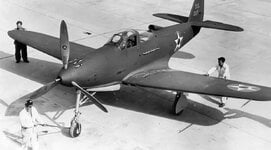
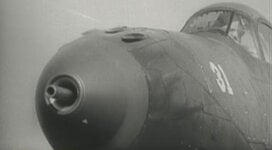
Escuadrilla Azul
Master Sergeant
- 2,320
- Feb 27, 2020
I thought that the F3A was the one that killed BrewsterThe P-40 did the same for Curtiss Aircraft, but not quitre as solidly as the Buffalo did for Brewster Aircraft.
Lousy management killed Brewster.I thought that the F3A was the one that killed Brewster
Shortround6
Lieutenant General
This tended to go back a forth a bit. In 1939/early 1940 the Allison was completive. In late 1940 and early 1941 it was falling behind. And it pretty much stayed behind in late 1941 and for 1942. We can play games with what the squadrons were over boosting their engine to at low levels but the supercharger ran out of breath in the low teens.I'd have to say that power-wise, the Allison was competitive.
This was part of the problem with the weight. 109s in 1940-41-42 (pre DB 605) worked at altitudes in the 20,000ft range not because of a high altitude supercharger but because the light weight of the airplane gave them a usable performance from an engine that peaked in the mid/hi teens.That means the P-39 was not competitive at higher altitudes like it was at lower altitudes.
The excessive weight of the P-39 and P-40 meant they needed a more powerful engine and/or a engine that performed around 15-20% better at the higher altitudes.
The P-40 was fine. It was everything that came after it that was the problem. P-46, P-53, P-55, P-60 (five of them) and the XP-62 are what killed Curtiss. Blaming the P-36/P-40 seems unfair.A sad commentary on what wasn't really a bad airplane. The P-40 did the same for Curtiss Aircraft,
P-39 had a number of problems. How much was Bell and how much was the Army is a little hard to judge.Note that in the P-39C (see attached photographs) with the .30 cal guns in the nose, the ammunition load for the 37 mm cannon was only 15 rounds.
The US demanded an excessive amount of guns/ammo (and fuel) for the installed power of the planes.
They also demanded some the strongest levels of structural strength. This compounds the problems.
If you load 750lbs worth of guns and ammo into a plane and then demand that the plane needs to have a service G load of 8 and an ultimate strength of 12 Gs you wind up with a heavier structure than a plane that is only supposed to carry 500-600lbs are guns and ammo. Same with the fuel load.
Now the practical problem is that you don't have to fill the ammunition boxes full or go into combat with full internal fuel. But short of redoing the production lines you can't take structural weight back out. (Thinner spars? Thinner wing skins?)
P-39s with wing .30s could carry 1000rpg. They often didn't. Carting around 200lbs worth of .30 cal ammo when the 37mm and .50 cal guns had already run dry wasn't all that effective.
Perhaps if the P-39s had carried a single 20mm and a single .50 and two .30 cal in the nose and saved 450lbs worth of guns and ammo they might have performed a bit better at high altitude ( a little savings in structural weight too?)
P-40 was crippled the same way. Instead of carting around 500lbs like a P-40C the P-40E was stuck with 900lbs of guns/ammo which helped kill off any performance boost the 1150hp engine had over the 1040hp engine.
GregP
Major
Agree with most of what you said, but I didn't quite go into the same detail as you did, Shortround. The only thing I disagree with is that the P-40 was fine. It was OK for when it came out, but rapidly fell behind world-wide developments. It was never a great performer in any theater it fought in, but DID hold the line until more competitive designs came down the pike. Don't get me wrong, I LIKE the P-40, but would have tried to make it a ton or more lighter if I didn't have more horsepower. I think that was possible and might have addressed some of the performance shortcomings, but since it had a non-turbocharged Allison, it also wasn't ever going to be any good at 25,000 feet, ever, without the turbocharger anyway.This tended to go back a forth a bit. In 1939/early 1940 the Allison was completive. In late 1940 and early 1941 it was falling behind. And it pretty much stayed behind in late 1941 and for 1942. We can play games with what the squadrons were over boosting their engine to at low levels but the supercharger ran out of breath in the low teens.
This was part of the problem with the weight. 109s in 1940-41-42 (pre DB 605) worked at altitudes in the 20,000ft range not because of a high altitude supercharger but because the light weight of the airplane gave them a usable performance from an engine that peaked in the mid/hi teens.
The excessive weight of the P-39 and P-40 meant they needed a more powerful engine and/or a engine that performed around 15-20% better at the higher altitudes.
The P-40 was fine. It was everything that came after it that was the problem. P-46, P-53, P-55, P-60 (five of them) and the XP-62 are what killed Curtiss. Blaming the P-36/P-40 seems unfair.
P-39 had a number of problems. How much was Bell and how much was the Army is a little hard to judge.
The US demanded an excessive amount of guns/ammo (and fuel) for the installed power of the planes.
They also demanded some the strongest levels of structural strength. This compounds the problems.
If you load 750lbs worth of guns and ammo into a plane and then demand that the plane needs to have a service G load of 8 and an ultimate strength of 12 Gs you wind up with a heavier structure than a plane that is only supposed to carry 500-600lbs are guns and ammo. Same with the fuel load.
Now the practical problem is that you don't have to fill the ammunition boxes full or go into combat with full internal fuel. But short of redoing the production lines you can't take structural weight back out. (Thinner spars? Thinner wing skins?)
P-39s with wing .30s could carry 1000rpg. They often didn't. Carting around 200lbs worth of .30 cal ammo when the 37mm and .50 cal guns had already run dry wasn't all that effective.
Perhaps if the P-39s had carried a single 20mm and a single .50 and two .30 cal in the nose and saved 450lbs worth of guns and ammo they might have performed a bit better at high altitude ( a little savings in structural weight too?)
P-40 was crippled the same way. Instead of carting around 500lbs like a P-40C the P-40E was stuck with 900lbs of guns/ammo which helped kill off any performance boost the 1150hp engine had over the 1040hp engine.
I have heard rumors that Don Berlin actually made one turbocharged P-40, but haven't ever seen any proof of same, so it's hard to actually argue about it when there is no proof of its existence whatsoever. Until such proof is uncovered, we have to assume it never got built, leraving us with such stellar performers as the P-40N, which is decent at low altitudes, but falls off rapidly above 12 - 15,000 feet, depending on what "falls off rapidly" actually means.
Last edited:
GrauGeist
Generalfeldmarschall zur Luftschiff Abteilung
The P-39D had a 37mm centerline, two cowl mounted .50 MGs and four wing mounted .30 MGs - this could have been modified to omit the two cowl MGs and replace the centerline cannon with a 20mm and replace the four .30 MGs with four .50 MGs.
The reduced weight of the eliminated two cowl .50s would allow for more ammunition for the 20mm cannon, though the heavier AN/M2 .50s in the wings may not help with an overall weight reduction, which the P-39 really needed.
The reduced weight of the eliminated two cowl .50s would allow for more ammunition for the 20mm cannon, though the heavier AN/M2 .50s in the wings may not help with an overall weight reduction, which the P-39 really needed.
The P-39D had a 37mm centerline, two cowl mounted .50 MGs and four wing mounted .30 MGs - this could have been modified to omit the two cowl MGs and replace the centerline cannon with a 20mm and replace the four .30 MGs with four .50 MGs.
The reduced weight of the eliminated two cowl .50s would allow for more ammunition for the 20mm cannon, though the heavier AN/M2 .50s in the wings may not help with an overall weight reduction, which the P-39 really needed.
How would you address the resulting CoG issues?
The centerline 37 mm cannon and cowl mounted .50 cal guns are all very far forward and all very heavy items. Unless you can replace all that weight with some other equipment, you will have a seriously tail heavy bird. Just expending the typical 400 rounds of .50 cal in the cowl seemed to be enough to make the aeroplane dangerously unstable.
The Wing guns are pretty near the aircraft CoG, so exchanging the .30 cal guns for .50 cal guns would not move the CoG much assuming they would actually fit into the existing spaces.
The obvious question would be, "What happens when the rather heavy 37 mm cannon gets replaced with a lighter 20 mm gun???"
On factory aircraft that were so equipped, the weight of armour in the nose was increased to maintain balance. Not sure what was done if the cannons were swapped in the field.
- Ivan.

buffnut453
Captain
How would you address the resulting CoG issues?
The centerline 37 mm cannon and cowl mounted .50 cal guns are all very far forward and all very heavy items. Unless you can replace all that weight with some other equipment, you will have a seriously tail heavy bird. Just expending the typical 400 rounds of .50 cal in the cowl seemed to be enough to make the aeroplane dangerously unstable.
The Wing guns are pretty near the aircraft CoG, so exchanging the .30 cal guns for .50 cal guns would not move the CoG much assuming they would actually fit into the existing spaces.
The obvious question would be, "What happens when the rather heavy 37 mm cannon gets replaced with a lighter 20 mm gun???"
On factory aircraft that were so equipped, the weight of armour in the nose was increased to maintain balance. Not sure what was done if the cannons were swapped in the field.
- Ivan.
Aaaaand…..it's Groundhog Day!
These are precisely the discussions that we had with the "expert."
He wanted to remove the nose armour because he thought it was of no use. Alas, he couldn't ever be persuaded to consider the CoG impacts.
That nervous tick has returned to my left cheek. I KNEW resurrecting this thread was a bad idea!

GrauGeist
Generalfeldmarschall zur Luftschiff Abteilung
You already had CoG issues when the foreward weapons expended their ammunition.How would you address the resulting CoG issues?
The centerline 37 mm cannon and cowl mounted .50 cal guns are all very far forward and all very heavy items. Unless you can replace all that weight with some other equipment, you will have a seriously tail heavy bird. Just expending the typical 400 rounds of .50 cal in the cowl seemed to be enough to make the aeroplane dangerously unstable.
The Wing guns are pretty near the aircraft CoG, so exchanging the .30 cal guns for .50 cal guns would not move the CoG much assuming they would actually fit into the existing spaces.
The obvious question would be, "What happens when the rather heavy 37 mm cannon gets replaced with a lighter 20 mm gun???"
On factory aircraft that were so equipped, the weight of armour in the nose was increased to maintain balance. Not sure what was done if the cannons were swapped in the field.
- Ivan.
The combined weight of the .37mm and .50 MG ammo accounted for substantial weight.
In the case of eliminating the two .50 MGs and ammunition, plus exchanging the Olds 37mm for a 20mm cannon, the 20mm's weight plus ammunition may provide for a near balance, but if there's a deficit, then do like Supermarine did with the Spitfire: add counterweights in the aft section.
And for the love of God, leave the nose armor and IFF transmitter alone...

SaparotRob
Unter Gemeine Geschwader Murmeltier XIII
And the heater?
GrauGeist
Generalfeldmarschall zur Luftschiff Abteilung
Yes, and the heater.And the heater?

You already had CoG issues when the foreward weapons expended their ammunition.
The combined weight of the .37mm and .50 MG ammo accounted for substantial weight.
In the case of eliminating the two .50 MGs and ammunition, plus exchanging the Olds 37mm for a 20mm cannon, the 20mm's weight plus ammunition may provide for a near balance, but if there's a deficit, then do like Supermarine did with the Spitfire: add counterweights in the aft section.
And for the love of God, leave the nose armor and IFF transmitter alone...
You do realise that the 20 mm cannon and ammunition weigh a lot less than the 37 mm cannon and ammunition, right?
That is why they had to increase the weight of the nose armour in aircraft equipped with the 20 mm guns.
Expending the 37 mm ammunition wasn't that critical. Expending all the .50 cal cowl gun ammunition was a lot worse. It was all a matter of the longer moment arms.
Users who are viewing this thread
Total: 5 (members: 0, guests: 5)


