How often did wing-folding mechanisms fail in flight?

Ad: This forum contains affiliate links to products on Amazon and eBay. More information in Terms and rules

From the pictures I saw of the recovered wreckage of the Hudson's helicopter, it doesn't seem as if the rotor separated from the fuselage.

All naval aircraft with folding wings have mechanisms incorporating interlocking pins and hooks in such a way that ensures security of the wing attachment. The wing fold locking mechanism is usually accompanied by the aileron control interconnect that doesn't work if the wing is not locked. Once engaged, a mechanical indicator shows the pilot that the wing is locked. He should also operate the ailerons to make sure that they operate correctly. If he fails to pay attention, he would wind up taking off with an unlocked wing, ruining the rest of his day. I never heard of a locking mechanism failing, causing the wing to fold. Anyone?
 
There is absolutely no reason not to make them stronger (apart from obvious cost and weight reasons)

As D don4331 said - making any area stronger means a stress concentration. That causes the surrounding structure to fail because the loads are transferred to them.

One of the LEAP mods on the Lockheed L188 Electra was to remove certain structural elements in the wing to fuselage joint area because they were too strong.
 
From the pictures I saw of the recovered wreckage of the Hudson's helicopter, it doesn't seem as if the rotor separated from the fuselage.

All naval aircraft with folding wings have mechanisms incorporating interlocking pins and hooks in such a way that ensures security of the wing attachment. The wing fold locking mechanism is usually accompanied by the aileron control interconnect that doesn't work if the wing is not locked. Once engaged, a mechanical indicator shows the pilot that the wing is locked. He should also operate the ailerons to make sure that they operate correctly. If he fails to pay attention, he would wind up taking off with an unlocked wing, ruining the rest of his day. I never heard of a locking mechanism failing, causing the wing to fold. Anyone?

That F4U photo shows that it could happen. My sole experience with folding wing aircraft was with the TBF and TBM Avengers. They had a klaxon behind the pilots head that squawked at you unless the wings were fully locked or fully folded. NOT pleasant.
 
I recall reading of an incident where a drunk pilot got in an A-1 and tried to take off with the wings folded. I guess that was deliberate; he claimed it would fly like that.

And then there was a famous incident where an F-8 took off with the wings folded. They can't be seen from the cockpit and the pilot was unaware. They called him on the radio and told him to come back very carefully and he made it down Okay.

Never heard of one failing in flight. The original design of the F8F had the wingtips blow off in the event the wing was being overstressed, but I don't think it was anywhere near the wing fold joint.
 
F-8 wings folded.jpg
 
The original design of the F8F had the wingtips blow off in the event the wing was being overstressed, but I don't think it was anywhere near the wing fold joint.

I remember reading that it was near the fold, and also was not always wing-symmetrical, so the "feature" was dumped.
 
The only ones I've read of are the F8F, which snapped off at the fold, but IIRC that was allegedly a design feature, later removed.
It wasn't at the wing fold - it was the wing tip, at about 1/2 the span of the ailerons. Yes, it was a design feature - if the airplane was sufficiently over-Gd, a weak spot in the wing spars was supposed to fail, jettisoning the tips, allowing higher Gs to be pulled (Less wing bending moment from the tips);
The problem was getting the tips to come off symetrically - the weak link wasn't predictable enough, so the wings were modified to jettison the tips with Detcord, fired by a G switch, cutting the spars. That still was deemed to be more trouble than it was worth, so they dropped the idea and strengthened the separation points in the spars - turns out they really didn't need it anyway.
 
I recall reading of an incident where a drunk pilot got in an A-1 and tried to take off with the wings folded. I guess that was deliberate; he claimed it would fly like that.

And then there was a famous incident where an F-8 took off with the wings folded. They can't be seen from the cockpit and the pilot was unaware. They called him on the radio and told him to come back very carefully and he made it down Okay.

Never heard of one failing in flight. The original design of the F8F had the wingtips blow off in the event the wing was being overstressed, but I don't think it was anywhere near the wing fold joint.
A Crusader could (and has, a few times) get away with it because it has its ailerons inboard on the wings (They also act like flaps), and not on the tips.
Inboard Ailerons were a not-uncommon feature in the Early Supersonic Age - Most jets knocking on the Sound Barrier had issues with the ailerons twisting the wings, producing an opposite rolling moment, reducing roll rate, and stressing the wings. In some cases, it would actually reverse direction.
F-86s, for example, could take a set - where a wing was permanently warped - the solution was to get into a high-mach dive, and slam the stick in the opposite direction, hopefully taking out the warp.
Early supersonic fighters, like the F-100 and F8U had inboard ailerons. The Convair Deltas had more-or-less inboard Elevons. The F-104 didn't have enough wing to warp. The F-105 used spoilers.
 
It wasn't at the wing fold - it was the wing tip, at about 1/2 the span of the ailerons. Yes, it was a design feature - if the airplane was sufficiently over-Gd, a weak spot in the wing spars was supposed to fail, jettisoning the tips, allowing higher Gs to be pulled (Less wing bending moment from the tips);
The problem was getting the tips to come off symetrically - the weak link wasn't predictable enough, so the wings were modified to jettison the tips with Detcord, fired by a G switch, cutting the spars. That still was deemed to be more trouble than it was worth, so they dropped the idea and strengthened the separation points in the spars - turns out they really didn't need it anyway.
The F8F's wingtip shear-off was originally tested and shown to operate symmetrically. But it didn't always do so, leading to fatalities. So they added a system to explosivly remove both, in case either failed. This led to a fatality during servicing. Finally the whole thing was scrapped and later production aircraft had the wingtips strengthened.
 
There's a Granpa Pettibone account of a TBF/M pilot at night who taxied to runway, did all t/o checks, and then was instructed to change runways.
Apparently to facilitate taxiing clearance in the dark, he folded the wings.
Cleared for t/o while approaching active, he made a rolling start and when torque lifted a wheel, found the ailerons ineffective.
Ran off runway and rolled with wings still folded.
TBF.jpg

btw - I flew 28 different birds while in the Navy, and all folding wing craft had a red painted rod indicator or flag that disappeared when the locking pin went in, easily visible by pilot.
The tired training command S2Fs had a reputation for being a bit sticky, so it was common to unfold the wings, and if the rod(s) didn't slide home, to run up engines while holding brakes and rocking ailerons to waggle wings until they seated.
 
There's a Granpa Pettibone account of a TBF/M pilot at night who taxied to runway, did all t/o checks, and then was instructed to change runways.
Apparently to facilitate taxiing clearance in the dark, he folded the wings.
Cleared for t/o while approaching active, he made a rolling start and when torque lifted a wheel, found the ailerons ineffective.
Ran off runway and rolled with wings still folded.
View attachment 827777
btw - I flew 28 different birds while in the Navy, and all folding wing craft had a red painted rod indicator or flag that disappeared when the locking pin went in, easily visible by pilot.
The tired training command S2Fs had a reputation for being a bit sticky, so it was common to unfold the wings, and if the rod(s) didn't slide home, to run up engines while holding brakes and rocking ailerons to waggle wings until they seated.
THREADJACK ALERT:
Which plane did you like the most and which plane did you like the least?
 
THREADJACK ALERT:
Which plane did you like the most and which plane did you like the least?
Loved the F-4J for all its bulk, and liked something about them all. One of last to fly the F11F (F-11A) in Advanced Training, and immediately knew why the Blues held onto it for so long. In reality, only role was a day fleet defense bird, but it always seemed to anticipate your next move. Terrorized enemy T-33/38s in the Battle of South Texas.
Only got a few hours hand flying a WV in the middle of the endless Pacific, found it responsive, but cockpit was horrible ... not only cramped, and uncomfortable, but stuff hard to find and actuate ... a real three person airplane. Made me appreciate the snug but friendly AD-7 (A-1H)
 
My high school physics teacher was a naval aviator in WW2. He said there was a case where a number of Navy aircraft were in a big landing pattern at night. The pilot of one F4U did not like the buffeting from the landing gear when he was flying in that big slow circle, so he retracted the gear. This resulted in the gear warning horn blowing, so he switched it off. That still left the warning light shining in his eyes so he put a glove over it. And he flew the F4U into the runway in that configuration. And he had loosened his harness and opened his canopy to enable him to look for traffic better, so on impact he was thrown out of the cockpit, landed in front of the airplane and was chased down the runway by his own engine.
 
My high school physics teacher was a naval aviator in WW2. He said there was a case where a number of Navy aircraft were in a big landing pattern at night. The pilot of one F4U did not like the buffeting from the landing gear when he was flying in that big slow circle, so he retracted the gear. This resulted in the gear warning horn blowing, so he switched it off. That still left the warning light shining in his eyes so he put a glove over it. And he flew the F4U into the runway in that configuration. And he had loosened his harness and opened his canopy to enable him to look for traffic better, so on impact he was thrown out of the cockpit, landed in front of the airplane and was chased down the runway by his own engine.

I know I shouldn't laugh, but here I am ...
 
Could a WW2 era aircraft fly with folded wings?


As SaparotRob SaparotRob mentioned, the A6Ms and perhaps earlier A5Ms might have managed it. I very much doubt any other type could be flown, primarily because there simply wasn't enough thrust and unfolded wing area to keep the planes in the sky.

Aircraft like the F4F, F6F and Firefly had backwards-folding wings so there's no way the wing root stump could generate enough lift. The F4U folded at the undercarriage mount and, again, not enough wing root to maintain lift, certainly not given the power available from piston engines.
 
With that helicopter crash in New York spotlighting a worst-fear occurrence—the fuselage breaking free from the rotor—I'm wondering about folding-wings mishaps. One might suppose that the folding mechanism on WW2 U.S. Navy aircraft was a weak spot, or one might guess that Grumman and the rest knew enough to design systems that were practically fail-proof. What do the actual statistics show? How often did American wing-folding mechanisms fail during non-combat (or pre-combat) flights? (Professor Google did not know the answer when I asked.)
Awkward when the Jesus! Nut falls off !
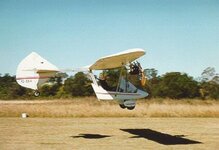
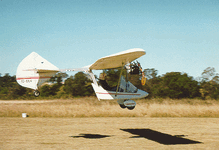
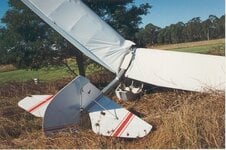
It happened to me about 15 years ago. The Port wing strut pin was not fully entered in its socket before the locking pin was inserted and safety pinned. With full right aileron in I could not stop an un-commanded left turn. The aircraft contacted the ground and apparently did 1 180 deg turn on its none before falling backward with one wing propped on a tree. The fuel tank was sheared by the port wing spar, and I woke up with a wash of cold petrol ! That woke me up. then in a panic couldn't release the harness until I looked down and pressed the right button. I de-planed leaving 1 shoe behind and ran across the blackberrys not feeling any pain. I don't like take-apart aeroplanes anymore. I loved old Brumby - just lovely for doing vertical reverses.
Hampdemon
 

Attachments

  • box brumby.jpg
    box brumby.jpg
    58.5 KB · Views: 31
  • brumby.gif
    brumby.gif
    55.8 KB · Views: 26
  • brumcrh-1.jpg
    brumcrh-1.jpg
    54.2 KB · Views: 27
Loved the F-4J for all its bulk, and liked something about them all. One of last to fly the F11F (F-11A) in Advanced Training, and immediately knew why the Blues held onto it for so long. In reality, only role was a day fleet defense bird, but it always seemed to anticipate your next move. Terrorized enemy T-33/38s in the Battle of South Texas.
Only got a few hours hand flying a WV in the middle of the endless Pacific, found it responsive, but cockpit was horrible ... not only cramped, and uncomfortable, but stuff hard to find and actuate ... a real three person airplane. Made me appreciate the snug but friendly AD-7 (A-1H)
WV?
 

Users who are viewing this thread

Back