I also found some interesting information regarding HJM's older sister.
So in his biographies it's stated that he had a sister named Ingeborg who was 2 years older than him (born in 1917) and that they were really close.
However, in Walter Wubbe's book, instead of referring to her as Ingeborg Marseille, the author refers to her as Ingeborg Freifrau von Ledebur.
So I did some research into the name and I found out that Ingeborg had married someone named Oberst Leopold Freiherr von Ledebur on 8/31/1939, who was related to another noble family in Germany called von Lattorf.
Leopold was born in 1899 which would make him eighteen years older than Inge when they got married. (personally i thought this age discrepancy was kind of strange seeing as people in the 1930s married for love and that arranged marriages and things like that were outdated).
The strange thing is that in the books I have read about Marseille, they all say that his sister was "murdered in Vienna by a jealous lover".
However, using a free trial on Ancestry.com I was able to locate Ingeborg Marseille's death certificate and it states that she was "found dead in her apartment in Berlin" and that the reason for death was "unknown". This made me remember a book I had read a while ago called "Behind Enemy Lines" by James Dean Sanderson that had a section about Marseille, and it stated that Inge had been killed in a car accident while she was out for an excursion with a high-ranking Nazi officer named Krefft. Apparently what had happened was that Krefft had had too much to drink and had rolled the Mercedes over on the autobahn, and Inge bled to death while he fled the scene. When Krefft was brought to trial about it, he said that it was Inge's fault that they had gotten into the accident, but official records stated she didn't know how to drive at that time. Krefft was sent to a penal unit in Russia to fight, but when he tried to flee the country he was captured at the Swiss border and beheaded. According to the book, Marseille was crushed and he felt betrayed, because he had always put Inge up on a pedestal of virtue and to see her with another man while her husband was away fighting in Russia at the border made him very upset.
I did try to find out who this man Krefft was, but I couldn't find anything about him.
The strange thing is, if she had truly been killed in an automobile accident, why would her death certificate have stated that she was found dead in her apartment? My only theory is that maybe her husband's family didn't want a scandal seeing as she had died while on an outing with a man who wasn't her husband, and so they covered it up by stating that she was found dead in her apartment and that the cause of death was 'unknown'.
This book (Behind Enemy Lines) also talks about Marseille's engagement to Hanne-Lies. It states that he met her in "Augsburg" while he was on an inspection tour at an airplane factory. However, according to Walter Wubbe Marseille met Hanne-Lies in March 1942, when he was on convalescent leave from getting dysentery and jaundice in Africa. According to Wubbe, the only accolades Marseille was given during that time was the Italian Bravery Medal in Silver, and that took place sometime in February. Furthermore, Marseille never went to any inspection tours of aircraft until much later in 1942, when he was asked to go on a propaganda tour, and by that time he was already engaged.
The book states that "although it is unfair to assume that Marseille was looking for a replacement for Inge in Hanne-Lies, he accorded to her the same devotion and admiration he had given to Inge when she was alive." It also states that Marseille wrote of Hanne-Lies: "She was like a star that lit up the bright night." However, I am still unsure as to where he got that quote from (perhaps maybe a letter to someone? In the interview with Hans-Rudolf Marseille many letters that were written by Marseille were shown; however since they are in the cursive writing of those times I can't read them...it would have been interesting to see what else he had to say about Hanne-Lies, if anything else at all).
This is all just really interesting, especially the part about his sister and how that relates itself to his engagement.
Ingeborg's Murderer:
Karl Heinz Töpken was born on April 28, 1907, in the town of Rastede (Oldenburg) to Friedrich and Adele Töpken (née Grabhorn). After completing his higher education, he became a certified economist (Diplomvolkswirt). Töpken was married to Ilse Töpken (née Baade), with whom he had two children, and the family resided in Berlin (Wilmersdorf district, Babelsberger Straße 5).
Later, Töpken became the central figure in a high-profile criminal case and was placed on the wanted list by the State Criminal Police in Munich on suspicion of murdering Ingeborg (listed in the archival records of the Deutsche Digitale Bibliothek as Ingeborg von Ledebur, geb. Marseille, born on April 20, 1917, from Berlin). According to the criminal case file from the Deutsche Digitale Bibliothek, the murder took place on December 30, 1941, and Töpken was prosecuted for a crime under the Ordinance Against Violent Criminals (Gewaltverbrecherverordnung) in conjunction with murder (Mord).
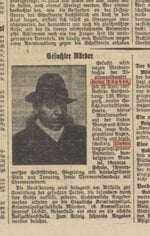
Newspaper wanted notices from that time published his photograph alongside a detailed physical description, noting in particular his striking height of 1.95 meters (6 ft 5 in), strong and broad-shouldered build, oval face with a long nose, dark blond hair, gray-blue eyes, and small dueling scars (Mensurnarben) on his left cheek and forehead. Before the manhunt was announced, he was last seen wearing a gray velour hat, a dark gray coat, and black shoes, carrying a signet ring with a dark green stone, a wedding band, and a chrome wristwatch.
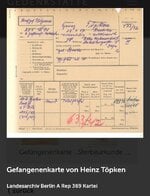
Some time later, Töpken was apprehended—he was initially held in pretrial detention in Munich, and on June 25, 1942, he was transferred to the Plötzensee Prison in Berlin (prisoner book number 473/42). According to his prison index card and the Deutsche Digitale Bibliothek records, he was sentenced to the maximum penalty—the death sentence (Todesstrafe)—for murder (Mord).
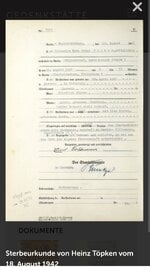
The sentence was carried out at Berlin-Plötzensee Prison on August 18, 1942. His official death certificate states that Heinz Töpken died at precisely 5:33 a.m., with the cause of death listed as decapitation.
Strafsache gegen den Kaufmann Heinz Töpken, *28.4.1907, aus Berlin wegen Verbrechens nach der Gewaltverbrecherverordnung in Verbindung mit Mord an Ingeborg von Ledebur, geb. Marseille, *20.4.1917, aus Berlin am 30.12.1941 (Todesstrafe) - Deutsche Digitale Bibliothek
Making sure you're not a bot!