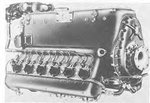
Yes the Merlin or PV-12 as it was first called was schemed as an inverted engine in 1933, but when Camm and Mitchell discussed it with Royce they decided to un-invert it. This photo from my collection will show you what the Germans saw... did it give them something to copy? I reckon not as they had already started work on inverted V but it probably gave them confidence to continue and reap some oiling problems!
The Germans had already decided to try for /\ as can be read below (from AEHS author I think..can't find a link)
"The Origin of the Inverted V-12 German Aero engines.
This goes back to 1928 when a committee of aeronautical experts was assembled in Berlin at the bidding of the R.V.M.
Representatives from the Army, the D.V.L. research centre, the Navy (airships were at their peak in 1928 ) and Deutsche Lufthansa were instructed to make an in-depth study of of the international scene regarding aero-engines and then produce specific guide lines for the future development of large air- and liquid-cooled motors.
Along with others, Prof. Wunibald Kamm (of "Kamm Tail" fame), Ing. Wolfram Eisenlohr (famous pilot and head of the D.V.L. power plant division) and Dr. Helmut Sachse (later, co-designer of the B.M.W. 801) served on this panel.
The specifications drawn up by this "think tank" were very detailed and incorporated some very advanced features including, for the liquid -cooled engines:
- 12-cylinder, inverted installation,
- mono-block cylinder banks,
- wet cylinder liners,
- propeller reduction gear,
- supercharger,
- fuel injection,
- high temperature glycol cooling,
- provision of a cannon tunnel in the Vee.
Tender documents were sent to Daimler-Benz, Junkers and B.M.W., all of which eventually produced a V-12 engine model in response although none was able to incorporate all of the required features immediately, eg the DB600 had dry liners and carburettors, the JU210 also had only carburettors and the B.M.W. 116/117 only got as far as the prototype stage.
The specifications were presented to the manufacturers as a fait accompli. If they wanted production orders, the engines had to comply with the tender descriptions.
Wolfram Eisenlohr was interviewed in 1980 re the 1928 requirement for inverted V-12s and he cited three reasons for the decision vis,
- more compact installation,
- better pilot view for single engined aircraft,
- less exhaust flame dazzle during night flying.
Ref: Junkers Flugtriebwerke by Müller, R, p 150 - 151. (Helion and company)
von Gersdorff et al "Die Deutsche Flug..." p 42.
ISBN 1-85260-163-9; Fred Jakobs, Robert Kröschel and Christian Pierer. "BMW aero engines". BMW Group Classic, 2009 ISBN 978-3-86852-214-3. p 85 -87."
A Rolls-Royce engineer was one of a team that went to Germany near the end of WWII. The Report is called, "Comments on Visit to Germany, July 24th 1945 to August 12th 1945".
10 persons made up the visiting party, including P.G.Barlow and E. Wolsey (M.A.P.), Mr A. Thomas (Armstrong Siddeley Motors), Mr N. Quinn (Bristol Aero Co.), Mr R. Chamberlin (D. Napier Son) and Mr G. Morris (Rolls-Royce Ltd).
Page 3 of the Report says, "A good example of Air Ministry control lies in the inverted Daimler-Benz engine. The D.B. people said that both from a technical and production point of view they would have preferred to make an upright engine but they were compelled to make it inverted by the Air Ministry."
The Air Ministry people were in the team that went to R-R Derby in 1933... hence my thought that the mock up had some influence on German choice of /\.
With the inverted engine, they said it was very difficult to obtain consistent oil consumptions and due to the rotation of the crankshaft, one bank gets more oil than the other. For this reason the engine is built with a lower compression ratio on one bank than the other."
The DB 605 compression ratios were, I believe:
Right bank - 7.3 : 1
Left bank - 7.5 : 1