If it isn't better based in facts than this little discussion don't bother with the RN vs IJN thread.
I'm very glad to say that you are not the arbiter of literally anything I do, say, or type online.
You skip right passed the total lack of 10" and 12" guns that you claimed.
No, you bulldozed through to the conclusion that you already believed before you even checked the data. The US in fact did have warships - 'super' heavy cruisers, with 12" guns which did see action in WW2, albeit later in the war

en.wikipedia.org
The 10" gun or naval rifle was obsolete by the war, (though there were still some old shore guns with them) so I agree, that is a mistake on my part. I should have double checked each caliber I mentioned and I too am guilty here. But it's really a slight omission on my part which doesn't at all change the point I was making one bit, i.e.
that the outcome of surface battles in the Pacific war was typically decided by larger guns, and / or torpedoes. Not the light guns.
Therefore 'flashless' powder is not decsive factor as RCAFson was trying to claim. Battleships if they were present (with 14" or 16" guns, usually) did most of the killing, or heavy cruisers (with 8" guns, usually), and / or the torpedoes and not so much by the 5" or 6" guns, which were secondary guns on the bigger warships and / or the main guns on destroyers and light cruisers. The only battles in which the secondary guns were really decisive were those where there were only lighter ships present, or where the ships ended up at very close range (such as during the first naval battle of Guadalcanal).
There is a reason they built battleships and heavy cruisers. The caliber of the guns isn't the only factor either, the armor also plays a role.
All of which either you know already, but choose not to think about, or didn't know because you aren't that well informed about naval warfare but made very categorical statements about anyway.
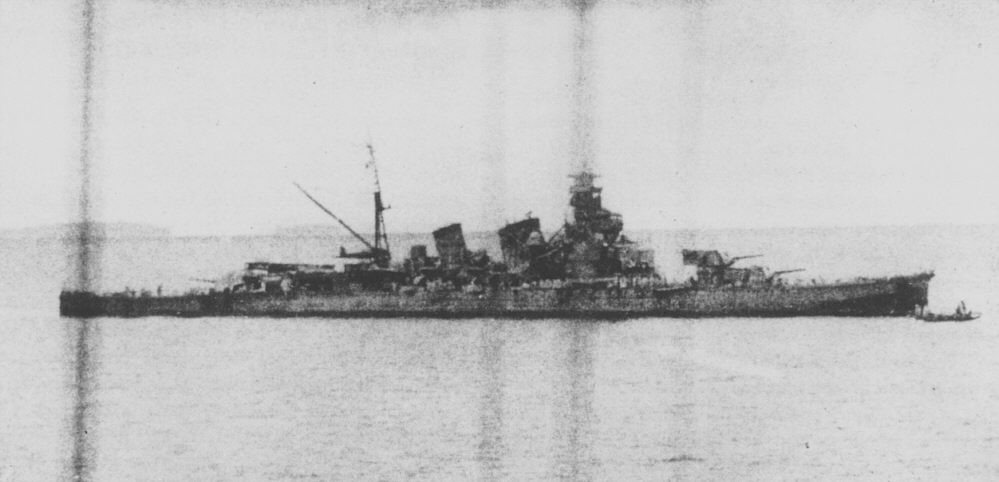
You also don't seem to know that the Mogami class was re-armed with 8in guns in 1939-40, granted western intelligence didn't know that either that got good recon photos in 1942.
So what? It had 8" guns during the war like most heavy cruisers on both sides in the Pacific War. I don't think it matters they got the 8" guns in 1940.
3 of the 5 class of 8" ships you list total 6 ships. 2 ships each and the Furutaka and the Aoba classes had six 8"in guns (three twin turrets) These four ships had four 4.7in guns for AA (or star shell) so good with torpedoes but not so good in a night gun fight.
You aren't changing the story here. Most of the major surface engagements in the Pacific War did involve heavy cruisers or battleships with 8" or larger guns on one or both sides. The Japanese also had their quite deadly torpedoes which were often the most telling weapon.
The Ise class (2) spent most (all?) of the Solomon's Campaign being converted to hybrid carriers, how much the US knew???
The Fuso class was good for about 24-25kts so they wanted to keep them back, away from carrier strikes in daylight which limits the 14" ships to the 4 Kongo's.
BTW the Nagato's sister ship didn't blow itself up until June of 1943.
Japanese had 5-6 classes of light cruisers (17 ships total) that date back to 1918-1924 that were close to the RN C & D classes, single 5.5in guns and rearmed with 24in torpedoes. Some of these saw action in battles in the Solomons, some in the classic role of destroyer leaders.
Ok lets cut to the chase and go strait to the actual major surface battles in the Pacific.
Battle of Badung Strait (Feb 1942) *
IJN - 4 destroyers
HNLMS - Tromp (6"), Light cruiser, destroyer
USN - 3 destroyers
(one destroyer sunk, cruiser and three destroyers damaged by naval gunfire)
Battle of the Java Sea (Feb 1942)
IJN - Haguro (8"), Nachi (8"), two light cruisers, 14 destroyers.
RN - Exeter (8"), three destroyers
USN - Houston (8"), three destroyers
HNLMS - Light cruiser, two destroyers
RAN - Light Cruiser
(noteworthy at this battle that HMS Exeter had radar but scored no hits and was crippled by IJN 8" gunfire, while Houston did score some hits but not enough to sink anything. The Japanese got one torpedo hit, sinking a destroyer, and sunk 2 light cruises and 2 other destroyers by long range naval gunfire)
Second Battle of the Java Sea (March 1942)
IJN - Haguro (8"), Nachi (8"), five destroyers, a light carrier and two seaplane tenders
RN - Exeter (8") (already damaged), one destroyer
HNLMS - one destroyer
Battle of Savo Island (Aug 1942)
IJN - Chokai (8"), Furutaka (8"), Kako (8"), Aoba (8"), Kunugasa (8"), two CL,
USN - Chicago (8"), Vincennes (8"), Astoria (8"), Quincy (8)", four destroyers
RAN - Australia (8"), Canberra (8")
(two US destroyers had radar but it didn't help)
Battle of Cape Esperance (Oct 1942):
IJN - Furutaka (8"), Aoba (8"), Kinugasa (8") and 2 destroyers
USN - New Orleans (8"), Salt Lake City (8"), two light cruisers and 5 destroyers
Battle of Santa Cruz Islands (Oct 1942)
IJN - Atago, Takao, Myoko and Maya (all with 8"), Hiei, Kirishimi (14"), Kongo, Haruna (with the CVs - 14"), Suzuya (8"), Tone (8"), Chikuma (8") - plus CL and many destoryers
USN - Northampton (8"), Pensacola (8"), Portland (8"), South Dakota (16")
Naval battle of Guadalcanal (Nov 1942)
IJN - Hiei (14"), Kirishima (14"), 1 light cruiser, 11 destroyers
USN - New Orleans (8"), Portland (8"), 3 light cruiser, 8 destroyers
(major damage caused by Japanese heavy guns, but US destroyers also wrought havoc with very close range gunfire, including with light AA)
Second Naval Battle of Guadalcanal (Nov 1942)
IJN - Kirishima (14"), Takao (8"), Atago (8"), two CL, 9 DD
USN - Washington (16"), South Dakota (16"), four DD
(Washington used radar somewhat effectively, South Dakota suffered a malfunction. Damage was caused mainly by Washington and Kirishima guns, US DDs were destroyed)
Battle of Tassafaronga (Nov 1942)
IJN - 8 Destroyers
USN - Minneapolis (8"), New Orleans (8"), Pensacola (8"), two CL, six DD
(US had radar but it didn't help because they waited too long, Japanese victory was due to torpedoes)
Battle of Vella Gulf (Aug 1943) *
IJN - 4 destroyers
USN - 6 destroyers
(victory with torpedoes due to successful use of radar by US destroyers)
Battle of Horaniu (Aug 1943) *
IJN - 4 destroyers
USN -4 destroyers
(no warships sunk, 5 x Japanese 'auxiliary ships' sunk)
Naval battle of Vella Lavella (Oct 1943) *
IJN - 9 destroyers
USN - 6 destroyers
Battle of Samar (Oct 1944)
IJN - Yamato (18"), Nagato (16"), Kongo (14"), Haruna (14"), Chokai (8"), Haguro (8"), Kumano (8"), Suzuya (6"), Chikuma (8"), Tone (8"), two CL, 11 DDs
USN - six CVE, three DD, four DE
So that is 13 battles, of which I count 4 in which there wasn't at least an 8" gun armed warship on one or both sides (8 with heavy guns on both sides, 1 with only on one side)
In almost every case, the vast majority of the losses and damage were caused by the heavy guns (8" or larger) and / or the torpedoes.
An Atlanta class Cruiser was nothing to scoff at in a night battle.
View attachment 731867
Fourteen 5" guns on broadside, maybe it couldn't pierce belt armor but the topsides could take quite a beating.
The Atlanta class was a CLAA - a light anti-aircraft cruiser, designed for shooting down planes. They did not do well in surface actions which they were not designed for. The only two which got into surface actions, Atlanta and Juneau, were sunk at the Naval Battle of Guadalcanal on Nov 1942. Atlanta was crippled by a torpedo and naval gunfire (and later scuttled), Juneau was crippled by a torpedo in the same action and then sunk by an IJN sub (with 100 of her surviving crew tragically abandoned to sharks in the water for 8 days, only 10 eventually being rescued).
BTW, the Japanese often only used 1in plate on their 8" gun turrets so getting shot up by 5in guns was not a good game plan.
As noted, their 8" guns seem to have played a significant role in most of the naval surface engagements during the war.