Japanese Versus American Victory Claims (6 Viewers)

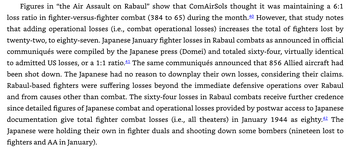
If you've read Dunn's narratives you would immediately find his bias and trying to create the sense that Japanese fought evenly with Allied forces, both in combat results and in materials.

I disagree entirely. I just finished his "South Pacific Air War" which you should check out sometime if you're interested in the subject.

He makes it clear the allies had a tremendous material advantage in almost every respect, and that almost every Japanese operation in the South Pacific in 1943-1944 ended in failure.

He also confirms that, yes, there was great deal of overclaiming by aircrews.
 
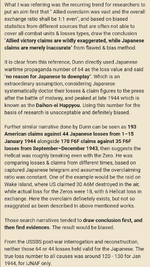
From the USSBS post-war interrogation and reconstruction, neither those 64 or 44 losses held valid for the Japanese. The true loss number to all causes was around 120 - 130 for Jan 1944, for IJNAF only.

You appear to have a reading disability. The figures that Dunn cites are from the source that you are alluding to but not actually posting.

This is Annex B from
INTERROGATION NAV NO. 50
USSBS NO. 202
AIRCRAFT AVAILABILITY AND LOSS REPORTS


This is the way the Navy has it digitized. Note that when they made the annex into a table that they didn't do a particularly good job. The months are all displaced to the left one. This is why if you look at total column there is only 26 combat losses but if you look at Apr there is 136 / 164. There are similar issues with how the Fiscal Years are lined up in the table as well.


1791827940334.png


When we look at the column from February 1944 (which is actually January because of how the Navy digitized it) we see that Japanese fighter losses in combat were 80 fighters due to combat and 183 in the other category.

1791828635777.png


1791829220560.png


The Navy digitized version of the document can be found here.


It really just appears that you have taken a chart from a different part of the study and then just drawn your own interpretation of it. Or asked ChatGPT to read it for you.
 

Attachments

  • 1791829034925.png
    1791829034925.png
    38.9 KB · Views: 1
Just want to remind everyone to maintain a friendly tone. If someone is sharing information that you believe is wrong, it's an opportunity to correct the record and educate that user.

The use of AI chat applications to generate posts is annoying, but I'd hope everyone is open to learning something new!
 
Donald Blakeslee made ace flying Spitfires for the RCAF and RAF Eagle Squadron, then acquired 10 more victories flying for the USAAF in P-47s and P-51s.

Flying for the RAF's Eagle Squadron would be no different than flying for the Chinese American Volunteer Group.

England and China were allies of the U.S. flying legitimate combat missions against an enemy at war.

I guess I'm confused then. Blakeslee's RAF service was RAF service, not USAAF service. Boyington's AVG service was Chinese Air Force service, not USMC service.

I'm trying to understand why it's controversial for the military to treat their service in foreign air forces as such, rather than as part of their US military career?
 
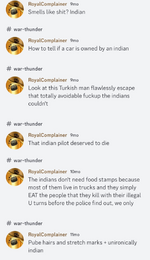
The ban was for posting a screenshot of another users conversation because he was crying that everyone arguing with him was being racist against Indians. It turned out that the guy himself was just projecting and ended up going on a whole tangent how his point of view was actually justified.
Which makes sense, heard complaints about your racism behavior against Turkish and other players, and now Indian players, which now lead to your ban.

Hopefully you would learn a lesson from it be not to be racist or doing personal attacks tones that been off-topic.

Meanwhile I think I've explained enough and no need to spend more of my words with a person getting banned from been racism.

Hope you live long on this forum and try not to get banned. :)
 
I guess I'm confused then. Blakeslee's RAF service was RAF service, not USAAF service. Boyington's AVG service was Chinese Air Force service, not USMC service.

I'm trying to understand why it's controversial for the military to treat their service in foreign air forces as such, rather than as part of their US military career?
Blakeslee was initially RCAF and then transferred to USAAF.

Regardless, an aerial victory remains with the pilot, not the organisation that they belong to.

Robin Olds shot down 12 enemy aircraft during WWII while with the USAAF. During Vietnam, he shot down 4 enemy aircraft while with the USAF, which was a separate branch of service. He is officially credited with 16 victories.
 
Last edited:
Which makes sense, heard complaints about your racism behavior against Turkish and other players, and now Indian players, which now lead to your ban.

Hopefully you would learn a lesson from it be not to be racist or doing personal attacks tones that been off-topic.

Meanwhile I think I've explained enough and no need to spend more of my words with a person getting banned from been racism.

Hope you live long on this forum and try not to get banned. :)

Which complaints? Which Turkish player? Is it the one that's currently posting Chat GPT arguments about how unfair the video game is to Axis players? The one that accuses anyone who shoots him down of cheating in the game?

I did not get banned for racism. This is simply another instance of you not having the ability to read plain English.

image-27.png


Note that the OP here is replying to me. He was upset because he cried that a different user was being racist towards him.

So why is he replying to me? It's because I asked him about statements like the following. And showed the screenshot on the forum.


Screenshot_20261012-173126.png

Note that I shared the screenshot of the some of his statements. That was what earned a forum ban. But hey don't let the truth get in the way of a good story!

Keep in mind there are other screenshots from your adopted associate that are worse. But they aren't really related to this topic at all. Your the one that wanted to derail this with some tangent about WarThunder and attempt to attack my character.
 
Last edited:
I disagree entirely. I just finished his "South Pacific Air War" which you should check out sometime if you're interested in the subject.

He makes it clear the allies had a tremendous material advantage in almost every respect, and that almost every Japanese operation in the South Pacific in 1943-1944 ended in failure.

He also confirms that, yes, there was great deal of overclaiming by aircrews.
Dunn's narrative is largely that both sides over-claimed at more or less similar rates in aggregate but that the rate of over-claiming depends on the timeframe, theater, etc. There are multiple points in his book that he points this out.


The use of AI chat applications to generate posts is annoying, but I'd hope everyone is open to learning something new!

Unfortunately the use of AI/LLM is going to be something that we will continue see on the forum, and AI generated post quality will improve with time.

The way that irregular23 is using it is most likely as a translator from English to his native language, to craft some of his arguments, and then translating back. There are a couple of reasons to suspect this.

Screenshot_20261012-183912.png

The whole structure of this argument, the random bolding, and the randomized grammatical mistakes show this.

Note how the author knows the capitalize some places, locations, and titles...but not others. And that sometimes there native sentence structure seeps into their post.

Wake Island is capitalized as a place, but Midway is not. Or we can look at sentence structure here;

"Those search narratives tended to draw conclusion first, and then find evidences. The result would be biased."

We understand what the author means but as a sentence it is close to complete gibberish.

This is also why the characterization also ends up being completely wrong. He told the LLM that the factoid was based on a captured telegram.
 
Dunn's narrative is largely that both sides over-claimed at more or less similar rates in aggregate but that the rate of over-claiming depends on the timeframe, theater, etc. There are multiple points in his book that he points this out.

Absolutely. He also is very transparent in trying to piece together which claims are likeliest to have been accurate, and propose explanations for erroneous or contradictory aircrew reports when possible, which I appreciate. I'm not sure how anyone could read the study (SPAW) referenced above and conclude there's any factual sleight of hand going on.

It's not always as compelling a narrative as it could be, and I think some of the larger arguments about the importance of air power in the South/Southwest Pacific campaigns could be fleshed out more and address the historiography more directly. But it's quite detailed and always crystal clear what sources he's working with.

I'm guessing some of the pushback is because this sort of work makes it clear that a lot of the long-established legends about the war simply weren't accurate. I mentioned earlier in this thread that one of the sacred cows is individual pilots' official combat records, but I think another, at least in aviation enthusiast circles, is the set of myths surrounding certain warplanes.

The idea that the P-38, F4U, and F6F were war-winning super weapons in the Pacific is one. I think what the recent research shows is that, yes, they were effective combat aircraft that had some very useful performance advantages over the mid-war fighters they complimented and/or replaced (P-40, P-39, F4F), but they didn't exactly turn the air war upside down either. That runs counter to the stories folks grew up hearing and reading. Hence the skepticism.

Speaking for myself, I find it clears up some problems that never made sense to me when I first read about air combat in the pacific war… e.g. "from what dimension were the famously undersized Japanese air forces magically producing all of these aircraft and pilots to be shot down day after day, month after month?"

It also creates a new shade of appreciation for the skill and courage of allied pilots who, even later in the war, were taking on a persistently dangerous foe who often gave as good as he got—or worse!

 
Absolutely. He also is very transparent in trying to piece together which claims are likeliest to have been accurate, and propose explanations for erroneous or contradictory aircrew reports when possible, which I appreciate. I'm not sure how anyone could read the study (SPAW) referenced above and conclude there's any factual sleight of hand going on.

It's not always as compelling a narrative as it could be, and I think some of the larger arguments about the importance of air power in the South/Southwest Pacific campaigns could be fleshed out more and address the historiography more directly. But it's quite detailed and always crystal clear what sources he's working with.

I'm guessing some of the pushback is because this sort of work makes it clear that a lot of the long-established legends about the war simply weren't accurate. I mentioned earlier in this thread that one of the sacred cows is individual pilots' official combat records, but I think another, at least in aviation enthusiast circles, is the set of myths surrounding certain warplanes.

The idea that the P-38, F4U, and F6F were war-winning super weapons in the Pacific is one. I think what the recent research shows is that, yes, they were effective combat aircraft that had some very useful performance advantages over the mid-war fighters they complimented and/or replaced (P-40, P-39, F4F), but they didn't exactly turn the air war upside down either. That runs counter to the stories folks grew up hearing and reading. Hence the skepticism.

Speaking for myself, I find it clears up some problems that never made sense to me when I first read about air combat in the pacific war… e.g. "from what dimension were the famously undersized Japanese air forces magically producing all of these aircraft and pilots to be shot down day after day, week after week?"

It also creates a new shade of appreciation for the skill and courage of allied pilots who, even later in the war, were taking on a persistently dangerous foe who often gave as good as he got—or worse!
In light of this dissertation, one must ask: then why did Japan lose?

If the current sentiment is leaning toward "a persistently dangerous foe" then how is it that Allied air power (which is pointed out to be less than superior) was able to overcome the magnificent Imperial Japanese war machine?
 
In light of this dissertation, one must ask: then why did Japan lose?

If the current sentiment is leaning toward "a persistently dangerous foe" then how is it that Allied air power (which is pointed out to be less than superior) was able to overcome the magnificent Imperial Japanese war machine?
The consensus amongst historians is more or less that the war itself was largely a battle of attrition and this also applies to the air war in the Pacific as well as Europe. The collapse of the various Axis air forces can largely be attributed to the collapse of their pilot training programs, and their overall inability to wage a long-term war. The technological superiority of individual fighter aircraft was not as large of a contributor to the outcome of the air campaigns as enthusiasts would like to believe.
 
In light of this dissertation, one must ask: then why did Japan lose?

If the current sentiment is leaning toward "a persistently dangerous foe" then how is it that Allied air power (which is pointed out to be less than superior) was able to overcome the magnificent Imperial Japanese war machine?

Because the Allies had far larger, much better supplied, better equipped, and more effective air forces, naval forces, and land forces? Better intelligence? Better leadership?

All this new research points to is that allied fighter aircraft were not, in fact, consistently racking up extravagant kill ratios over Japanese planes in air battles, as contemporary U.S. claims would suggest. Allied fighters were still better than breaking even, and the exchange rate became more lopsided as the war moved into its final year and change when Japanese pilot quality really fell off a cliff.
 
Last edited:
How are your bombers faring?
Are they getting through to the target and safely home again?
One of the reasons the Japanese started using suicide planes is that their bombers were often not coming back anyway.

Japanese bomber and attack plane losses were often pretty appalling even in the first year of the war, especially during attacks on warships.

The Japanese concluded they needed something like a 3:1 to 5:1 ratio of fighter cover to bombers in order to execute daylight strikes in contested airspace. Lots of Japanese strike packages over the Solomons and New Guinea in 1943 featured 10 or fewer bombers plus dozens of fighters split between close cover duty and enemy fighter-hunting. Even still the losses were sometimes unsustainably high.

I'd attribute a lot of the extremely high loss rate to allied anti-aircraft capabilities and not just air superiority. Attacking an American task force by the last year of the war meant flying into radar directed guns firing proximity fuze rounds and literally hundreds of 40mm Bofors and 20mm Oerlikon. It took a lot of training and skill to pull off accurate torpedo and dive bombing attacks even in more or less ideal conditions, let alone under that kind of fire. So not only did the losses become completely unsustainable, the results were fewer and fewer. By Formosa in October, 1944, you had some sizeable formations of Japanese attack planes and bombers achieving tactical surprise by approaching US carriers at low level below radar, and nevertheless incurring crippling and irreplaceable losses with only a handful of bomb and torpedo hits to show for it.

It figures kamikaze was an anti-ship tactic.
 
Last edited:
Japanese bomber and attack plane losses were often pretty appalling even in the first year of the war, especially during attacks on warships.

The Japanese concluded they needed something like a 3:1 to 5:1 ratio of fighter cover to bombers in order to execute daylight strikes in contested airspace. Lots of Japanese strike packages over the Solomons and New Guinea in 1943 featured 10 or fewer bombers plus dozens of fighters split between close cover duty and enemy fighter-hunting. Even still the losses were sometimes unsustainably high.

I'd attribute a lot of the extremely high loss rate to allied anti-aircraft capabilities and not just air superiority. Attacking an American task force by the last year of the war meant flying into radar directed guns firing proximity fuze rounds and literally hundreds of 40mm Bofors and 20mm Oerlikon. It took a lot of training and skill to pull off accurate torpedo and dive bombing attacks even in more or less ideal conditions, let alone under that kind of fire. So not only did the losses become completely unsustainable, the results were fewer and fewer. By Formosa in October, 1944, you had some sizeable formations of Japanese attack planes and bombers achieving tactical surprise by approaching US carriers at low level below radar, and nevertheless incurring crippling and irreplaceable losses with only a handful of bomb and torpedo hits to show for it.

It figures kamikaze was an anti-ship tactic.

Not even the last year of the war :during the Santa Cruz Island battle (25–27 October 1942), even if tactically a japanese navy victory, they had to cope with an air defense they never saw before resulting with an appaling cost for the Kido Butai, in term of trained crewmen and pilots and above all of an invaluable veteran cadre loss (groups, squadrons and sections leaders).
 
Not even the last year of the war :during the Santa Cruz Island battle (25–27 October 1942), even if tactically a japanese navy victory, they had to cope with an air defense they never saw before resulting with an appaling cost for the Kido Butai, in term of trained crewmen and pilots and above all of an invaluable veteran cadre loss (groups, squadrons and sections leaders).
That's what I had in mind when I said losses were sometimes appalling even in the first year of the war. Actions like Santa Cruz or the attack on Lexington off Rabaul even earlier in the war. At least at Santa Cruz the attack and bomber pilots dished it out while getting mauled.

I'm not even sure I'd call Santa Cruz really a victory—I mean, I guess strictly speaking the American fleet lost more ships and retired from the engagement zone. But it was in support of an offensive on Guadalcanal that failed horribly, so the Japanese didn't end up really accomplishing any operational objective.
 
That's what I had in mind when I said losses were sometimes appalling even in the first year of the war. Actions like Santa Cruz or the attack on Lexington off Rabaul even earlier in the war. At least at Santa Cruz the attack and bomber pilots dished it out while getting mauled.

I'm not even sure I'd call Santa Cruz really a victory—I mean, I guess strictly speaking the American fleet lost more ships and retired from the engagement zone. But it was in support of an offensive on Guadalcanal that failed horribly, so the Japanese didn't end up really accomplishing any operational objective.
At least a tactical victory : the damaged Enterprise had to have been jury rigged and for a little span of time, the only flat top (temporarily) on stage was japanese.
But the dire outcome was to come later.
To sum up :
- the core of carriers were lost at Midway ;
- the core of pilots/crewmen was lost at Santa Cruz.
 
At least a tactical victory : the damaged Enterprise had to have been jury rigged and for a little span of time, the only flat top (temporarily) on stage was japanese.
But the dire outcome was to come later.
To sum up :
- the core of carriers were lost at Midway ;
- the core of pilots/crewmen was lost at Santa Cruz.

That's probably a fair shorthand. Attrition kept Japanese carrier air groups from ever really fully reconstituting their skilled aircrews over 1943-1944 as well. There weren't many shipboard combat deployments since the allies were largely on the offensive. And yet, every time additional air power was needed in the Southeast Area (every few months), a carrier division's air groups would deploy temporarily down to the South Pacific from Truk, where they would incur additional losses which prolonged the rebuilding.

By the time you got to Philippine Sea, most carrier aircrew simply didn't have the training and experience to be very combat effective, and so the US Navy (with all of its other material advantages—numbers of aircraft, numbers of ships, radar-directed intercept, radar fire control, etc) simply chewed them up.
 

Users who are viewing this thread

Back