
Navigation
Install the app
How to install the app on iOS
Follow along with the video below to see how to install our site as a web app on your home screen.
Note: This feature may not be available in some browsers.
More options
You are using an out of date browser. It may not display this or other websites correctly.
You should upgrade or use an alternative browser.
You should upgrade or use an alternative browser.
KC-135 Lost over Iraq
- Thread starter fubar57
- Start date
Ad: This forum contains affiliate links to products on Amazon and eBay. More information in Terms and rules
More options
Who Replied?
Night Fighter Nut
Master Sergeant
Sounds like a refueling accident. Sad when it happens.
D
Deleted member 82436
Guest
I got to fly on a KC-135A when I was stationed at Grissom AFB, IN May 1979. It was a 4 day sortie we called an incentive flight. I got to watch RF-4s of the Missouri Air National Guard on the way to Travis AFB, CA. I did get to try my hand at flying the refueling boom. On the way back to Grissom, we did a night refueling of a C-5 Galaxy. That monster is HUGE. I couldn't see nose, tail or wing tips!
From what I have feen able to find, the Air Force years ago removed the parachutes from the KC-135s. There are no ejection seats. I was told back then that no crew member had ever successfully bailed out of a KC-135.
I have grave doubts any of the crew survived the crash landing.
From what I have feen able to find, the Air Force years ago removed the parachutes from the KC-135s. There are no ejection seats. I was told back then that no crew member had ever successfully bailed out of a KC-135.
I have grave doubts any of the crew survived the crash landing.
ThomasP
Chief Master Sergeant
Sounding like a mid-air of some sort between 2x KC-135s, where one was refueling the other when the accident occurred.

No ejection seats in C-130s, or parachutes from my experience. Common practice in cargo types.From what I have feen able to find, the Air Force years ago removed the parachutes from the KC-135s. There are no ejection seats. I was told back then that no crew member had ever successfully bailed out of a KC-135.
I have grave doubts any of the crew survived the crash landing.
D
Deleted member 82436
Guest
The latest news is 4 of the crew are dead. The article has pictures showing the vertical tail damage to the other.
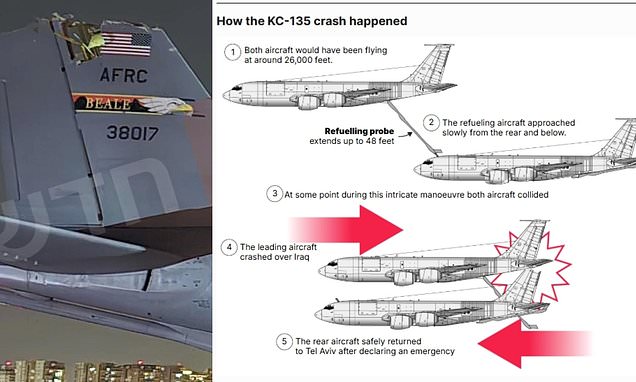
 www.dailymail.co.uk
All six crew on US refuelling plane that crashed confirmed dead
Iraq became the main theatre of war in the Middle East on Wednesday as one drone attack killed a French soldier in the country and another hit British special forces.
D
Deleted member 82436
Guest
When I flew on the KC-135A, the crew of 4 had parachutes. There were none for the 7 of us passengers.
When I flew on C-130s in 2003-4, you are right, there were no parachutes. Of course, that isn't true when carrying airborne troops. They do have parachutes!
When I flew on C-130s in 2003-4, you are right, there were no parachutes. Of course, that isn't true when carrying airborne troops. They do have parachutes!

Thumpalumpacus
Colonel

While flying aboard a -135 to Roswell for exercises in Jan 1992, I got to "sit" with the boomer as he refueled a B-52. Those planes get f*&king close.
MIflyer
Captain
When riding on C-141A's in 1972 we were required to wear parachutes. Of course those were low altitude CAM cargo drop missions with the big ramp open in the back, so the possibility of falling out really was there.
D
Deleted member 82436
Guest
It is now reported that all 6 of the crew have died.
Prayers!
Prayers!
- Thread starter
- #11

fubar57
General

If the suggestions that the two aircraft collided during an AR mission, one of the two aircraft wasn't a simple KC-135. The electronics and reconnaissance 135s are equipped to receive fuel, but the vanillas are not. I suspect we have a lot more to learn about this sad loss.
Dana
Dana
ThomasP
Chief Master Sergeant
re
As of 2 years ago there were KC-135 tanker variants that could be refueled themselves as well as refuel other aircraft. IIRC they were designated KC-135R(?), but not sure of the suffix. There was a perceived need for the ability to keep a tanker on station for longer periods than were 'normal' and, while the R variants already had longer mission times than the previous variants, they were equipped to receive fuel in order to extend their time on station even further. They were not one of the ELINT variant(s).. . . The electronics and reconnaissance 135s are equipped to receive fuel, but the vanillas are not. . . .
Last edited:

smutny
Airman 1st Class
As of 2 years ago there were KC-135 tanker variants that could be refueled themselves as well as refuel other aircraft. IIRC they were designated KC-135R(?), but not sure of the suffix...
The R signifies the CFM powered KC-135's. The few that can receive inflight fueling are designated KC-135RT.

Lucky13
Forum Mascot

Since serving in 'Nam, I have paid attention to two flight crews: aerial refueling and rescue helos and amphibs. I observed these guys willingly go unarmed into hostile territory to save us when we needed it the most. Seldom are they noted and many perish without fanfare or medals.
I quietly covered their O'club bar bills whenever I knew.
I quietly covered their O'club bar bills whenever I knew.
Thumpalumpacus
Colonel
Since serving in 'Nam, I have paid attention to two flight crews: aerial refueling and rescue helos and amphibs. I observed these guys willingly go unarmed into hostile territory to save us when we needed it the most. Seldom are they noted and many perish without fanfare or medals.
I quietly covered their O'club bar bills whenever I knew.
A buddy of mine when I lived In SoCal was a Vietnam vet, disabled. He earned a Silver Star as a UH-60 gunner when, out on SAR, his helo got shot down in the trap and crashed very near the F-4 crew they were SARing for. He was the only survivor from the helo, and had a cracked upper spine. Pulled his .30 (.50? I can't remember) off the frame, set up a position, and the two aircrew from the F-4 gathered to him and they got picked up the next day.
He lived the rest of his days in pain for his actions that got him that Silver Star.
, Gary Mann.
Last edited:

buffnut453
Captain
Do you mean UH-1 rather than UH-60?
Gary was clearly a VERY brave man. Surviving veterans have to live with all sorts of pain which, itself, requires a lot of courage and fortitude to bear.
Gary was clearly a VERY brave man. Surviving veterans have to live with all sorts of pain which, itself, requires a lot of courage and fortitude to bear.
Thumpalumpacus
Colonel
Do you mean UH-1 rather than UH-60?
Gary was clearly a VERY brave man. Surviving veterans have to live with all sorts of pain which, itself, requires a lot of courage and fortitude to bear.
I do mean UH-1, thank you. I blame beer.
They flew that day knowing that they were flying into a trap. He suffered spinal stenosis the rest of his life. After his retirement he went on to drive stock-cars, mostly on the B circuit, but he did, iirc, do Talladega one year as a substitute.
Last edited:
I don't want to denigrate any heroics or disagree out of hand, but here are 'facts' from my fallible memory, six decades later with some Internet backup that reinforces:
This is not to overlook the heroic Army UH-1 dust off/Medevac choppers, and some may have been used in crew rescues, but in my limited experience, the Air Force bigger SAR helos and occasionally Navy Plane Guard craft did the work outside of South Vietnam. Of course, with a flight crew down, EVERY ordinance carrying craft from O-1 Bird Dogs to A-1 Sandies to B-52 Buffs participated on occasion to suppress hostile capture.
Not SAR related, but in '63-4 when I did an enlisted tour with MACV in the Iron Triangle and highlands, I often flew as door gunner in a RVN H-34, with a M-60, firing 7.62×51mm NATO cartridges from a disintegrating belt mounted in various ways as we tried them out. This seemed to be the norm for all door gunners until the later Gatling guns, which only Sylvester and Dolph were capable of demounting and using as a personal weapon.
Finally, regarding cargo/tanker personal chutes. As an AF dependent in '55, we flew in a MATS C-118 across the Atlantic in stages from Rhein Main to McGuire. We had inflatable life preservers in the seat backs, and were afforded a pre takeoff demo, BUT I noted a large pile of parachutes in an aft compartment, seemingly enough for all souls, and they were NOT MENTIONED. I later rode as a CAP cadet in C-46s, C-47s, C-54s and KC-97s, and for a while, fresh chutes were loaded without mention to match people, but that practice ceased without notice. I do recall a C-119 incident about then where it lost an engine, descended into icing over TN, and all on board successfully bailed out, including a neighbor, but that was the last I know of.
Edited from https://www.nationalmuseum.af.mil - "The Air Rescue Service (later the Aerospace Rescue and Recovery Service) first used Kaman HH-43 Huskie helicopters, unofficially known as "Pedro" from their radio call sign. They later added larger Sikorsky HH-3 "Jolly Green Giant" helicopters, with greater range, and Grumman HU-16B Albatross amphibians to rescue Airmen who went down in the Gulf of Tonkin.
Air operations over dangerous enemy territory forced Search and Rescue (SAR) to evolve into Combat Search and Rescue (CSAR) teams. A major improvement came in November 1965, when the Sikorsky HH-53E "Super Jolly Green Giants" arrived. Capable of being refueled in flight, the HH-53E helicopters could reach any point in the Southeast Asia theater.
During the Southeast Asia War, CSAR personnel had a significant impact and lived up to their motto: "That Others May Live." They saved a total of 4,120 people, including 2,780 in combat situations. Their individual achievements earned them two Medals of Honor, 38 Air Force Crosses, and numerous other awards. However, the cost was high as 71 U.S. rescue personnel were killed and 45 aircraft destroyed during the war."
In addition, though not as organized or armed (!!), Navy carriers sometimes used their Tonkin Gulf plane guard helicopters, nicknamed "Angels," to rescue pilots downed during launch or recovery. They were Sikorsky SH-3 Sea Kings, Kaman UH-43C Huskies, and Piasecki H-25 Retrievers that were occasionally called upon to chase downed crews into hostile coastal waters, even into Haiphong and other harbors.Air operations over dangerous enemy territory forced Search and Rescue (SAR) to evolve into Combat Search and Rescue (CSAR) teams. A major improvement came in November 1965, when the Sikorsky HH-53E "Super Jolly Green Giants" arrived. Capable of being refueled in flight, the HH-53E helicopters could reach any point in the Southeast Asia theater.
During the Southeast Asia War, CSAR personnel had a significant impact and lived up to their motto: "That Others May Live." They saved a total of 4,120 people, including 2,780 in combat situations. Their individual achievements earned them two Medals of Honor, 38 Air Force Crosses, and numerous other awards. However, the cost was high as 71 U.S. rescue personnel were killed and 45 aircraft destroyed during the war."
This is not to overlook the heroic Army UH-1 dust off/Medevac choppers, and some may have been used in crew rescues, but in my limited experience, the Air Force bigger SAR helos and occasionally Navy Plane Guard craft did the work outside of South Vietnam. Of course, with a flight crew down, EVERY ordinance carrying craft from O-1 Bird Dogs to A-1 Sandies to B-52 Buffs participated on occasion to suppress hostile capture.
Not SAR related, but in '63-4 when I did an enlisted tour with MACV in the Iron Triangle and highlands, I often flew as door gunner in a RVN H-34, with a M-60, firing 7.62×51mm NATO cartridges from a disintegrating belt mounted in various ways as we tried them out. This seemed to be the norm for all door gunners until the later Gatling guns, which only Sylvester and Dolph were capable of demounting and using as a personal weapon.
Finally, regarding cargo/tanker personal chutes. As an AF dependent in '55, we flew in a MATS C-118 across the Atlantic in stages from Rhein Main to McGuire. We had inflatable life preservers in the seat backs, and were afforded a pre takeoff demo, BUT I noted a large pile of parachutes in an aft compartment, seemingly enough for all souls, and they were NOT MENTIONED. I later rode as a CAP cadet in C-46s, C-47s, C-54s and KC-97s, and for a while, fresh chutes were loaded without mention to match people, but that practice ceased without notice. I do recall a C-119 incident about then where it lost an engine, descended into icing over TN, and all on board successfully bailed out, including a neighbor, but that was the last I know of.
Last edited:
Users who are viewing this thread
Total: 1 (members: 0, guests: 1)


