Light fighters alternatives, 1935-1945 (5 Viewers)

How might Frank Halford's Napier Dagger H24 approach feature in light fighter engines?
It shouldn't be considered as light fighter engine.
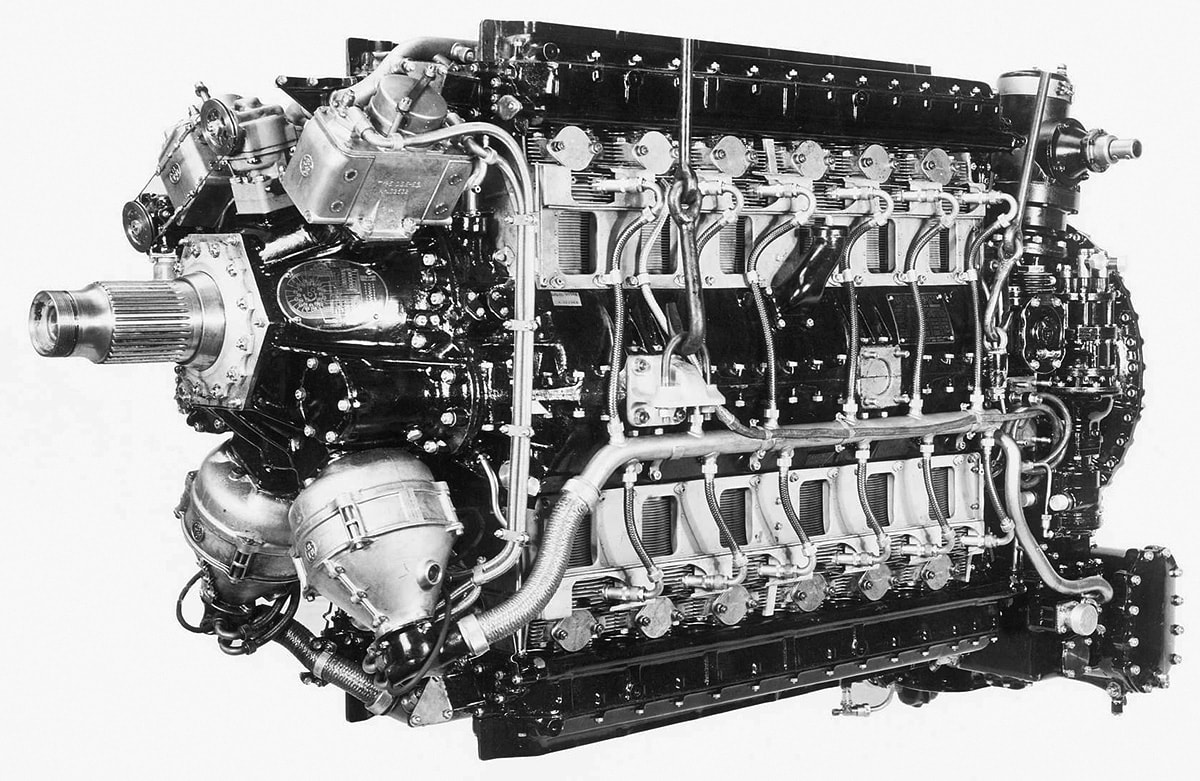
Multi small capacity cylinders designed around the concept of running twice as fast rather than twice the capacity. A crude description but covers the essence of it. 805bhp at 4,000rpm from 16.8 litres. 1,000bhp from the Dagger VIII. 2.69:1 reduction to the propellor. 616kg
If you are looking at an engine that weighs 616/630kg (1390lbs) we are not looking at a "light fighter" any more in 1938-40.
The MB2 with the older, lighter Dagger IIIM engine was about 140lbs lighter than the prototype Hurricane.
Both had fixed two bladed propellers.
Despite Napier fitting the engine with double entry, two sided supercharger on the MK VIII engine it only gave 5lbs of boost at 8750ft. That headline 1000hp would have been down to around 870hp (?) at over 16,000ft.
Using lots of small cylinders turning really fast means a heavy engine for the power. Race cars love them because they have rules about the displacement, there is almost never a weight limit on the engine while there is on car as whole.
The Peregrine engine was about 280lbs lighter the Dagger VIII and that should pretty well cover the weight of the radiator and coolant.
 
Last edited:
'Light' engines in Germany.
The obvious engine is the Jumo 210, and the historical light fighter around it were the early Bf 109s. A short-stroke of the BMW or Bramo 9-cyl engines should've also do, sorta 'German Mercury' equivalent.
The further development of the 210 series might've been concentrated on 2 things: uprating the engine to 3000 rpm operation at least, and a better S/C. With that acomplished, the engine should've come close the the a bit bigger ~21L RR Peregrine, that did 885 HP at 15000 ft on 87 oct fuel.
The 'Mercury' should also be getting the better S/C
Later, use the bore & stroke of the Jumo 222A/B, to get to about 23 or 25L vs. under 20L of the Jumo 210. With 3000 rpm and decent S/C, it should be worth of 90% or the 1-stage S/Ced Merlin on 87 oct, and with 3200 rpm should equal the 1-stage Merlin. With MW50, this might put it in the league of the 1-stage Merlin on 100/130 grade.

Who does this, and what does not get built? Argus becoming the, at least, subsidiary of Jumo; the As 410 and 411 engined don't happen. Hirth makes something not fancy, but the simple engines for light aircraft and trainers. Smarter use of the captured stuff.
3 quick improvements for the Jumo 210:
1. Manufacture the 4 valve head which was already designed - which will allow your 3k rpm (or more)​
2. Change from water to glycol/water mix - this will take more effort to stop leaks, but development is reusable on 211, 213 engines.​
3. Implement pressurized cooling​
​
1. Makes you more power, 2 & 3 allow the engine to hang together after the extra power. That will get you to 95% of the power as the RR Peregrine.

This approach starts with a proven engine and a historically proven upgrade path. Which is one of the issues with many other light fighter solutions - trying to develop a light fighter without a proven engine was recipe for failure.
 
BMW went to the 155mm stroke with the BMW 139 and quickly after that on the 801; RPM went to 2700 from the get go.
The very early 132 was allowed for just 2050 rpm, next versions like the F did 2350, and the later versions, like the H, K and M went to 2500 rpm, and 2550 rpm for 1 min rating. The increse in finning area was a part for the course here, too.
Shvetsov also went with shorter stroke for the M-82 vs. the M-62, RPM went from 2200 to 2400, and to 2500 on the -FN.
Changes of 5-10mm in stroke are not going to really allow much change in RPM. Other things have to brought into play. Often it was improved crankcases/crankshafts/bearings.
Even if you do not increase boost, higher rpm means more fuel burned in the cylinders per minute and needs, as you noted, better cooling fins.
I don't know why the Bramo 323/ P&W Hornet was a big as it was in diameter. It was 3in bigger than the R-1340 Wasp but the stroke on each cylinder was only 12mm longer. Call it 1 in total. Bigger crankcase? longer rods? Bigger cylinder head?
 
This approach starts with a proven engine and a historically proven upgrade path. Which is one of the issues with many other light fighter solutions - trying to develop a light fighter without a proven engine was recipe for failure.
Very true. In fact, it was not just light fighters but just about every aircraft project from fighter to transport. Either use an existing engine in a new airframe or new engine in an old airframe. Never try to do both at once. It may have succeeded on occasion but the number of times in the last 100 years can be counted on the fingers of both hands.
3 quick improvements for the Jumo 210:
1. Manufacture the 4 valve head which was already designed - which will allow your 3k rpm (or more)
Not sure you really need 4 valves. The 210 used small cylinders, which means small valves. It might be a problem for breathing but the valve springs should have been able to take care of the rpm. Granted the 211 didn't turn as fast but the bigger valves heavier. 211s did get up to 2600rpm. 213s with 3 valve heads (same size cylinders as 211) turned at 3250rpm to start. Granted 213s were record setters in large cylinder high rpm engines.
2. Change from water to glycol/water mix - this will take more effort to stop leaks, but development is reusable on 211, 213 engines.
Leakage may not be as bad as we think. Pure glycol was an absolute bear. A glycol/water mix was much easier to deal with. Maybe it was more leak prone than pure water? Maybe if varied a bit with the exact mixture? 30/70 or 50/50 or???
3. Implement pressurized cooling
Yes
 
How might Frank Halford's Napier Dagger H24 approach feature in light fighter engines?

Multi small capacity cylinders designed around the concept of running twice as fast rather than twice the capacity. A crude description but covers the essence of it. 805bhp at 4,000rpm from 16.8 litres. 1,000bhp from the Dagger VIII. 2.69:1 reduction to the propellor. 616kg.

These on 87octane fuel whilst his twice the capacity Sabre ran on 100/130 octane at similar revs.

De Havilland looked at the Hawker Hector installation and deemed it to have too much emphasis on ramming high pressure cooling air in rather than a low pressure exit drawing it through.

How much lighter than the Rolls Royce Merlin was the Napier Dagger? By World War_II standards, the Merlin was a small engine, quite suitable for a light weight fighter. The Merlins on the de Havilland Hornet put out 2,000HP each, so my concept of a 2,000HP light weight fighter is feasible.

The Allison V1710 was only slightly bigger.
 
How much lighter than the Rolls Royce Merlin was the Napier Dagger? By World War_II standards, the Merlin was a small engine, quite suitable for a light weight fighter. The Merlins on the de Havilland Hornet put out 2,000HP each, so my concept of a 2,000HP light weight fighter is feasible.
Which Rolls Royce Merlin?
It not just the basic engine but the 'power plant'
The RR Merlin III was actually about 15lbs lighter than the Dagger VIII
1375lbs for the "dry" engine according to RR but another source says 1412lb but the engines do vary in weight a little bit and what are considered accessories also vary a little bit.
However the "power plant" for a Spitfire I totaled 2035lbs according to one accounting.
Engine..................................1412
Airscrew hub..........................36
Wooden prop/spinner.......96
Ejector exhausts...................30
Accessories +piping...........61
Radiator..................................98
Cooling system....................56
Cooling fluid.......................142
Petrol tanks...........................57
oil tanks.................................47

This system of accounting puts the 86lbs of the cowling in the structure along with 56lbs engine mount.
Also no protection for the fuel tank/s.

The Merlin III and the Dagger are going to need roughly the same amount of cowling, mounts, propeller and just about everything else except the cooling system (just under 300lbs) except that an air-cooled engine will need a bigger oil system for equal power.

Now the 2000hp Merlin did not come into being by magic or at least it won't survive very long without it.....................or a lot of extra weight.
The Merlin 130 in the Hornet was about 1715lbs, that bigger two stage supercharger. I don't know where the intercooler is listed. A dry engine has no fluid in the intercooler.
P-51B (1700lb Packard) used a 483lb propeller. Not sure if the wooded Watts propeller would survive take-off trying to transmit around double the power.
P-51B used a 663lb cooling system (radiator, pipes, intercooler and fluid and intercooler?) Oil system was now 101lbs (larger tank for long flights and/or larger oil cooler)
Engine mounts to keep a 1600-2000hp engine attached to the airframe?

A late model Merlin was around 2850-2900lbs depending on propeller and exact accessories.
A fighter using such an engine can be a lot lighter than P-47 or P-38 but how heavy a "light fighter" are we talking about?
how much fuel, how much armament, what kind of radio/s/IFF and that starts leading back to how big the generator is.

Is 7500-7800lb fighter a "light fighter" or is it only light in comparison to several of the American and British Hawker aircraft?

 
How might Frank Halford's Napier Dagger H24 approach feature in light fighter engines?
Perhaps as an upgrade to a modern-looking light & small fighter that started out as Kestrel-powered (with the beard radiator, as the Miles Kestrel)? Sorta almost like the Jumo-powered Bf 109s morphed into the DB power?
We don't add too much to the total (engine + coolers) height and weight of the powerplant, and there is a lot of power to be gained between sea level and, say 10K ft.

Alternatively, a faster-turning impeller should've added more power above 10K ft, while loosing some at low altitudes.
The similar, RR Exe was with a 2-speed S/C. It did 1000 HP at low alt, and 950 HP at 15000 ft. The best Dagger also doing 1000 HP down low, but only 800 HP at 15000 ft; all power figures for 4200 rpm, with the note that the power graph also shows 4400 rpm and more than 1100 HP down low - on a fast fighter, cooling for this RPM and power might be easier to pull than on a slow bomber?
 
Changes of 5-10mm in stroke are not going to really allow much change in RPM. Other things have to brought into play. Often it was improved crankcases/crankshafts/bearings.
Even if you do not increase boost, higher rpm means more fuel burned in the cylinders per minute and needs, as you noted, better cooling fins.
Very true.

I don't know why the Bramo 323/ P&W Hornet was a big as it was in diameter. It was 3in bigger than the R-1340 Wasp but the stroke on each cylinder was only 12mm longer. Call it 1 in total. Bigger crankcase? longer rods? Bigger cylinder head?
Vs. the R-2600 that was also 55in, the comparable Kasei was even with the longer stroke - 170 vs. 160.3mm - yet it was 2in smaller in diameter.
 
The similar, RR Exe was with a 2-speed S/C. It did 1000 HP at low alt, and 950 HP at 15000 ft. The best Dagger also doing 1000 HP down low, but only 800 HP at 15000 ft; all power figures for 4200 rpm, with the note that the power graph also shows 4400 rpm and more than 1100 HP down low - on a fast fighter, cooling for this RPM and power might be easier to pull than on a slow bomber?
The Rolls Royce Exe was also following the 'Halford method' with 4,200 rpm and close to the capacity at 22 litres to the last planned Dagger version at 20 litres. 690kg producing 1,150bhp and reliable to boot, although somewhat thirsty in oil.

But then it is all in the Pratt & Whitney Twin Wasp weight and power region so our model would be more F-22 than Vickers Venom. Bristol could offer the Taurus which is a touch lighter and in a similar power range using 25 litres. In the period there was a whole set of @900-1,200bhp <25 litre engines including those in front line fighter service with Japan the Soviet Union and Italy.

OT but it does all rather underline the efforts Rolls Royce put into maintaining the development of the 27 litre Merlin. In 1933 suggesting that the 740bhp initial Merlin (eventually exceeded in power by the later normally aspirated Meteor tank engine) would be one day able to put out 2,060 bhp would seem total madness. Let alone demonstrating an equivalence to 2,500bhp and over 300 lb of exhaust thrust from the development 26 litre Rolls Royce Crecy at 3,000rpm and an extrapolated 5,000bhp from single cylinder test results.
 
The Rolls Royce Exe was also following the 'Halford method' with 4,200 rpm and close to the capacity at 22 litres to the last planned Dagger version at 20 litres. 690kg producing 1,150bhp and reliable to boot, although somewhat thirsty in oil.
Maybe it is just me, but the adjective 'reliable' should be reserved for non-prototype engines, or the ones with at least some record of series production and everyday service use. The examples of prototypes doing fine, while the 1st year of service being riddled with problems - Sabre, BMW 139 and 801, Homare, HS 12Y-51, Taurus, R-3350 - are too big to ignore. Even the ramp-head Melin.
 
690kg producing 1,150bhp and reliable to boot, although somewhat thirsty in oil.
Different ways of saying the same thing?
"Consumed unusually large amounts of oil"
"suffered from a formidable rate of oil consumption"
So basically, you have a 690kg engine, running on 100 octane fuel, that gives 1150hp HP for T-O and is rated 1100hp at 3800rpm at 5000ft in low gear and 950hp at 3800rpm at 15,000ft in high gear. These are the 5 minute combat ratings (?).
The continuous climb rating was at 3600rpm and was 1050hp at 4000ft and 925hp at 13,250ft.
48 spark plugs to change and the cost of building a 24 cylinder sleeve valve engine on a production basis?
I can see we are throwing the idea of the light fighter being inexpensive (cheap) right out the window.
Granted this is a prototype test rig and streamlining (low drag) was not the first priority (or even the 4th) but..................
rolls-royce-exe-battle.jpg

Suddenly a fighter powered by a Wright R-1820 doesn't look so bad ;)
 
Bristol could offer the Taurus which is a touch lighter and in a similar power range using 25 litres.
And it needed 1-2 years more development and was never going to be in the same league as the R-1830.
The Taurus was often listed as 46.25in in diameter. The R-1830 was listed as 48.0-48.5 in depending on exact model.
IS that 2 in really going to make a big difference in speed?
 

Users who are viewing this thread

  • Back