Light fighters alternatives, 1935-1945

Ad: This forum contains affiliate links to products on Amazon and eBay. More information in Terms and rules

Alternate: A 60 round drum is quite substantial in diameter - Bf.109E wings were substantially bulged to make it fit; bigger ones get really large and heavy. 90 rounds of MG-FF (134g bullet) weighs 36kg for the rounds alone, add in the weight of the drum and you're looking at 50kg+. For a motor cannon, you have to fit that through the cockpit to the breech - that's why rear seaters in Bf.110 had issues -> maneuvering the ?40kg? 60 round drums while in a flying suit in a maneuvering aircraft was...challenging.
The 109E wings were not 'substantially bulged' in order for the drum to fit, it was just a single bulge between two ribs on each wing side.
Ammunition - 2x90 rds - for the two MG FFM cannons on the Fw 190 weighted 37 kg (presumed most of the ammo was the 92g Mine shell + some 115g HE shells?). The 190A-5 was lighter by 135 kg if the MG FFM + full ammo were removed from it.
A full 90 rd drum, filled with the heavier MG FF ammo, weighted 30.2 kg; empty was at 12 kg.
Most importantly, the 90 rd drum was of the same height and width as the 60 rd drum.

The Bf 109 'swallowed' the even bigger MG 151s or MK 108s in the motor cannon position, so let's not make a mountain out of the mole hill.

I'm not sure you want to move Jumo 210 production to Poland in '38 when the factory was being repurposed for Jumo 211s. And I'm not sure about Czechoslovakia; they weren't quite as open arms to joining Germany as the Austrians were.
Note that time frame for this thread is 1935-45.
 
My thoughts on the annular radiators:
It seems to have been easier to design a solution which wasn't adding several ft^2 of frontal area/drag while minimizing the routing of the cooling system. I would say the annular radiator of the Fw.190D series is a finned tube style radiator, its just circular, not flat.
Tempest and Firefly both seemed to enjoy performance greater than just power increase when they traded bearded radiators for wing leading edge. But Germany didn't really have any wing leading edge radiators (and you wind up with more piping/larger target regardless).​
Somethings look good on paper and not as good in practice.
Does the annular of lower frontal area actually offer substantially lower drag than the conventual radiators?
Some of the British wing leading edge radiators don't look good from an internal airflow stand point but I don't know.
If you reduce frontal area but increase internal drag what is the net gain?
I'm sure we're all familiar with the report and the Flight magazine article about the Tempest annular radiator. They've been posted several times in this forum, I'm attaching them again for convenience.

Per those the Tempest annular radiator was quite a lot better than either the chin or wing leading edge radiators. However I think one should keep in mind it's not an entirely apples to apples comparison. The Tempest V chin radiator was more or less the Typhoon radiator, taken for expediency to get the Tempest in service ASAP. And the Typhoon was originally supposed to have a belly radiator in roughly the same position as on the Hurricane (you can find pictures of early Typhoon prototypes with this radiator) but there were some problems with it during testing (vibration at high speed? I don't remember) that caused it to be rapidly redeployed to the chin position. In particular, the Tempest chin radiator was still of the same obsolete honeycomb style design as the Hurricane radiator, whereas the annular radiator is clearly a fin-and-tube style, which generally substantially outperforms the honeycomb style radiator. How different would the Tempest chin radiator look if it was designed from scratch using the (at the time) latest fin-and-tube technology and carefully optimized for minimal drag?

Edit: I'm not sure about the radiator core used on the Tempest wing leading edge radiators, so I'm not commenting on them above.
 

Attachments

  • Napier Annular.pdf
    7.7 MB · Views: 19
  • Napier Engine Testing 1946.pdf
    1.7 MB · Views: 23
Last edited:
I agree on the potential of using larger drums.
Does not solve either the rate of fire or the slow velocity.
An MG 151 was about 50% more effective than an MGFF/M but yes, it weighed more.

The Jumo 210 is a lot harder to accept.
You can do a lot of things.................Should you is the real question.
The Jumo 210 was about 50-60kg lighter than a Peregrine or around 10%.
Increasing the engine weight by 10% is not really a big deal except now you don't really have a Jumo 210.
You have a Jumo 210+ ( Jumo already used all the the other numbers unless I call it a Jumo 310?)
You may need a new crankshaft, you might need a new crankcase. Any suggestions of using 4 valve heads means new cylinder heads.
Using a better supercharger impeller is certainly doable but what boost pressure were they using to begin with? Jumo 211 A was using about 3lbs of boost?
Going to 1.3 Ata gets you about 8%, if you are staying with 87 octane you are limited to boost.

If you do a lot of work to the Jumo 210+ what else is Jumo not doing, like better Jumo 211s.
 
The Jumo 210 is a lot harder to accept.
You can do a lot of things.................Should you is the real question.
The Jumo 210 was about 50-60kg lighter than a Peregrine or around 10%.
Increasing the engine weight by 10% is not really a big deal except now you don't really have a Jumo 210.
You have a Jumo 210+ ( Jumo already used all the the other numbers unless I call it a Jumo 310?)
You may need a new crankshaft, you might need a new crankcase. Any suggestions of using 4 valve heads means new cylinder heads.
FWIW, Peregrine gained ~170 lbs vs. the late marque Kestrels. Kestrel was already making 3000 rpm, though.
The 210+ will probably gain a bit more, talk 200+ lbs, if it is upgraded for 3000 rpm operation?
I wouldn't bother with the 4 valve head. Better use the time and resources to make a better S/C.

Going to 1.3 Ata gets you about 8%, if you are staying with 87 octane you are limited to boost.
Seems like the German engines were limited to under 1.45 ata with 87 oct fuel and no ADI. Smaller cylinders were less susceptible to the bad sides of the 87 oct fuel (the As 411 was doing 1.80 ata on 87 oct), so we'd probably see easy 1.4 ata early on, later 1.5-1.6 ata?

If you do a lot of work to the Jumo 210+ what else is Jumo not doing, like better Jumo 211s.

Perhaps the Jumo diesels meet the swift end?
 
I saw this thread and figured it might be a good place to post this. I originally wrote this to a few Discord servers back in February:

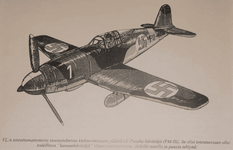
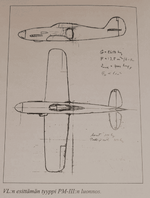
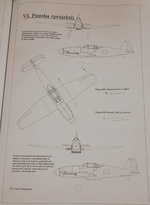
The VL Puuska, a Finnish Volksjäger.

The Puuska, meaning a gust of wind, was one of the Finnish State Aircraft Factory's, or Valtion lentokonetehdas (VL), projects from 1943-44, also known by the prototype names PM-5 and PM-III. It was envisioned to be an unarmoured fighter made of wood armed with a single 20 mm cannon, although the option for two additional fuselage-mounted domestic 12.7 mm LKK 42 machineguns was also considered. One VL engineer also suggested a single 37-40 mm cannon in place of all other armament. The engine was supposed to be a DB 605 A, i.e. the same engine as found in the Bf 109 G and Pyörremyrsky, another VL project for a wooden fighter. With a theoretical maximum speed of 680 km/h and a climb rate of 4.7 minutes to 6,000 m, the Puuska was envisioned to be capable of competing with the modern fighters of great powers. It was also envisioned it would compensate the Pyörremyrsky, with the two types even being used together on the tactical level.

Prototype production was to begin on 1 July 1944, with a delivery schedule of two prototypes in the first half of 1945, and serial production on 30 August 1945, with a series of 80 aircraft (and 40 Pyörremyrskys). However the German retreat to the Baltic States in 1944 created an urgent need for modern materiel for the Finnish Defence Forces, and more Bf 109 Gs were ordered from Germany instead. In February 1944 Finnish Air Force HQ designated the Bf 109 G and Ju 88 A-4 as the FAF's primary fighter and bomber aircraft respectively. On 3 March the Puuska project was put on hold, and finally formally cancelled during the Lapland War on 18 November.

Source used: Jukka Raunio (2007): Valtion Lentokonetehtaan Historia, Osa 2: Tampereella ja sodissa 1933-1944 [The History of the State Aircraft Factory, Part 2: In Tampere and in Wars 1933-1944]

475366875_1747293802669659_9194164286286837316_n.png
475732041_1325423192104141_283561190918711840_n.png

475418361_1803100057143736_8253667495039613150_n.png
 
Seems like the German engines were limited to under 1.45 ata with 87 oct fuel and no ADI. Smaller cylinders were less susceptible to the bad sides of the 87 oct fuel (the As 411 was doing 1.80 ata on 87 oct), so we'd probably see easy 1.4 ata early on, later 1.5-1.6 ata?

Seems they eventually got up to ~2ata on the 213J [source: graph on TSHPR page 456], using B4(?) fuel. Of course that's a ~1945 prototype engine, so maybe not that applicable to this thread.

Perhaps the Jumo diesels meet the swift end?

The 204 was already in service by 1932, first run 1929 (per wikipedia). But I suppose you could cancel the later developments (205, etc.), though not sure how much R&D resources those sucked up? The 222 is a white elephant they could well do without, but hard to say at the time I suppose.
 
The French Roussel 30 and MB-700, two takes on the "miniaturized Bloch 152 with GR-14M", were respectively said to have top speeds during their few trial flights of 520kph at 5800m and 550 kph (no altitude given). Weights of 1765 and 1850 kg. Any idea of how would performance improve when using the GR-14S (516 kg engine, 25% more than 14M), esp with the overcharge?

1760900939337.png
 
I agree on the potential of using larger drums.
Does not solve either the rate of fire or the slow velocity.
An MG 151 was about 50% more effective than an MGFF/M but yes, it weighed more.

The Jumo 210 is a lot harder to accept.
You can do a lot of things.................Should you is the real question.
The Jumo 210 was about 50-60kg lighter than a Peregrine or around 10%.
Increasing the engine weight by 10% is not really a big deal except now you don't really have a Jumo 210.
You have a Jumo 210+ ( Jumo already used all the the other numbers unless I call it a Jumo 310?)
You may need a new crankshaft, you might need a new crankcase. Any suggestions of using 4 valve heads means new cylinder heads.
Using a better supercharger impeller is certainly doable but what boost pressure were they using to begin with? Jumo 211 A was using about 3lbs of boost?
Going to 1.3 Ata gets you about 8%, if you are staying with 87 octane you are limited to boost.

If you do a lot of work to the Jumo 210+ what else is Jumo not doing, like better Jumo 211s.
A Jumo 210 should be 10% less than a Peregrine, its ~10% smaller in displacement.
Why does increasing the weight by 10% no longer make it a Jumo 210? Merlin gained >20% from the "B" to "140 <2 stage, 2 speed, contra rotating>", yet we consider them all Merlins...
Germans add letters as suffix to denote improvements - some more than 20 letters. No reason 210 can't go to "N" or more...​
New 4 valve cylinder heads were already prototyped for the Jumo 210H when the engine was canceled - this is a what if; the 4 valve heads aren't cancelled, but rather they are proceeded with. Merlin/Allison certainly received stronger (heavier) cranks and crankcases - I don't see why Jumo couldn't do the same with the 210.
Jumo 211 gets to 1.45 atm, 25% increase staying on B4; Germans were adding MW50 for even more.

As we said, skip the evaporative cooling, skip the rotary valves and Jumo could have much better Jumo 210.
 
A Jumo 210 should be 10% less than a Peregrine, its ~10% smaller in displacement.
To further illustrate this a Peregrine had the same displacement as a Kestrel, same bore and stroke.
Kestrels came 2 ways during their production run,
Reduction gear (3 different ratios) and no supercharger.
Reduction gear (3 different ratios) and supercharger which could come with different gear ratios on the supercharger.
There was also an uprated version (the Kestrel XIV, XV and XVI) that operated a more rpm and power. Obviously the versions without supercharger were lighter. In the late 30s Kestrels could vary from around 885lbs to around 985lbs depending on supercharger and hub and fitting for a controllable pitch propeller ( two pitch?).
The Peregrine went to about 1100lbs but since it gave about 885hp at 15,000ft instead of 745hp at 14,500 for the best Kestrel it was a good trade off. If you want to use higher rom and make more power than old versions of an engine you have to either beef things up (add weight) or accept shorter service life/more breakdowns.

RR could use a lot of the same tooling from the Kestrel to make the Peregrine but not all and even if you can use the same tooling some of the parts are not the same. The small displacement engines are not economic to to make if they are cutting into the production of the large engines. If the order books are not full then building small engines helps with the cash flow. If the order books are over flowing and production is getting behind then build small engines is wasting resources.
P&W never wanted to build the R-1535 engine. It was too small and competed directly with the R-1690 Hornet. The Navy wanted it for the smaller nose and the better view. P&W ditched it as soon as they could (completed existing contracts).
 
To further illustrate this a Peregrine had the same displacement as a Kestrel, same bore and stroke.
Kestrels came 2 ways during their production run,
Reduction gear (3 different ratios) and no supercharger.
Reduction gear (3 different ratios) and supercharger which could come with different gear ratios on the supercharger.
There was also an uprated version (the Kestrel XIV, XV and XVI) that operated a more rpm and power. Obviously the versions without supercharger were lighter. In the late 30s Kestrels could vary from around 885lbs to around 985lbs depending on supercharger and hub and fitting for a controllable pitch propeller ( two pitch?).
The Peregrine went to about 1100lbs but since it gave about 885hp at 15,000ft instead of 745hp at 14,500 for the best Kestrel it was a good trade off. If you want to use higher rom and make more power than old versions of an engine you have to either beef things up (add weight) or accept shorter service life/more breakdowns.

RR could use a lot of the same tooling from the Kestrel to make the Peregrine but not all and even if you can use the same tooling some of the parts are not the same. The small displacement engines are not economic to to make if they are cutting into the production of the large engines. If the order books are not full then building small engines helps with the cash flow. If the order books are over flowing and production is getting behind then build small engines is wasting resources.
P&W never wanted to build the R-1535 engine. It was too small and competed directly with the R-1690 Hornet. The Navy wanted it for the smaller nose and the better view. P&W ditched it as soon as they could (completed existing contracts).
We need to be a little careful of the Peregrine's weight increase:
Kestrel mostly mount a fixed pitch wooden propeller; Peregrine mounts a constant speed metal propeller - some of the additional weight is for constant speed pump/piping/shaft/control.​
Kestrel was mounted on fixed gear aircraft; the Whirlwind needed a hydraulic pump for the retractable gear - again that weight is additional on the Peregrine.​
The Whirlwind needed a vacuum pump on the engine for some of the instruments in the cockpit. Again, weight added over the Kestrel.​
Are the 3 pumps add 1.5lbs? 15lbs? or 150lbs (Personally I'd guess about 45 - the constant speed pump and control bolted to the front on the crank is...substantial.

Someone should have told RR the Merlin was too small (smaller than the Hornet).
If your customer - airframe manufacturer - wants the smaller engine, then that's what you build. No point in building R-7755 if there's no airplane to use it.​
 
We need to be a little careful of the Peregrine's weight increase:
Kestrel mostly mount a fixed pitch wooden propeller; Peregrine mounts a constant speed metal propeller - some of the additional weight is for constant speed pump/piping/shaft/control.Kestrel was mounted on fixed gear aircraft; the Whirlwind needed a hydraulic pump for the retractable gear - again that weight is additional on the Peregrine.The Whirlwind needed a vacuum pump on the engine for some of the instruments in the cockpit. Again, weight added over the Kestrel.Are the 3 pumps add 1.5lbs? 15lbs? or 150lbs (Personally I'd guess about 45 - the constant speed pump and control bolted to the front on the crank is...substantial.
I gave the weights listed in a 1938 Jane's from lightest to heaviest (two pitch airscrew) for the Kestrel.
Engine weights were almost always given without hydraulic pumps, air pumps, vacuum pumps or generators or even exhaust manifolds. The Aircraft designer knows (or should know) what he needs for pumps/accessories for his aircraft and he can look up the weights in various companies catalogs.
If the engine doesn't need it to run then it usually was not included, with magneto ignition the engine does not need a generator to run. In fact the starting system was usually not included in the weight of the engine as an aircraft designer (company) had their choice of several different starter systems from more than one company. Engines with a strong export market were often equipped with accessories that were popular in the customer nation and not in the home country or home air force.
Weight for the Peregrine would be in similar condition, basically bare. It was up to the aircraft designer, not the engine maker, to 'dress' the engine for it's intended role/use. Engine maker simply provided several different drives and mounting pads to take a variety of accessories.
Someone should have told RR the Merlin was too small (smaller than the Hornet).
Well, in this case we both comparing air cooled to liquid cooled engines and liquid cooled could always deliver more power per cu/in (in the 1930s) and we are comparing engines of different RPM capabilities. P&W Hornet engines maxed out at 2300rpm but then the Hornet was a pre-1930 engine in basic architecture.
The R-1535 was actually P&W's 2nd two row radial, it came after the R-1830, not before it. Airliner companies already had their choice of the R-1690 9 cylinder, the Wright R-1820 9 cylinder and the P&W R-1830 engines. Nobody except the US Navy was interested in the R-1535 and why should they be? Aside from better view over the nose it had nothing to offer.
 
Someone should have told RR the Merlin was too small (smaller than the Hornet).
Especially by the moment a supercharger is a thing, the engine weight is much more of a pointer towards the power it will be making, rather than a displacement. Heavy engines of the same era will make better power. Hornet was a featherweight.
 
Especially by the moment a supercharger is a thing, the engine weight is much more of a pointer towards the power it will be making, rather than a displacement. Heavy engines of the same era will make better power. Hornet was a featherweight.

In general newer engines tended to be much heavier on a per displacement basis, but still managed to produce more power/weight (which is the metric that matters).

Consider a 1926 liquid cooled V-12, the BMW VI. Displacement 47L, weight 510kg (per Wikipedia specs), 740hp takeoff, and compare to WWII inlines.
 
In general newer engines tended to be much heavier on a per displacement basis, but still managed to produce more power/weight (which is the metric that matters).

True.

Consider a 1926 liquid cooled V-12, the BMW VI. Displacement 47L, weight 510kg (per Wikipedia specs), 740hp takeoff, and compare to WWII inlines.

This is why I've said 'once supercharging is a thing' - the BMW VI was not supercharged.
The comparison between the non-supercharged engines of the same generation would've also probably favored a heavier engine.
 
Internal combustion engines are air pumps. The more air that goes through the engine per minute (or hour) the more power it can make.
There are two ways to do it.
A large, slow rpm engine moving a certain amount of air.
A smaller, high rpm engine moving the same amount of air.

As Tomo has said, superchargers changed things. You could stuff more air per minute/hour into the existing engines..............assuming you could cool them and assuming the engine would not break.
Cramming 30% more air in means you can make 30% more power but it also means both higher temperatures in the cylinder and higher pressures in the cylinder with more strain on the pistons/connecting rods/crankshaft and more strain on the cylinder head and however you are holding the cylinder head to the crankcase. And trying to keep the cylinder walls from bulging although that was usually the least worry.
High Rpm has it's problems, moving parts like pistons and crankshafts have the strain go up with the square of the speed. increasing the rpm by 10% means 21% more strain on the moving parts. 20% more rpm means 44% more strain. Better materials and heat-treat can only go so far and sometimes the better materials/methods showed up late or were constrained by raw material shortages.
Many engine designers tried to reach a careful balance between size and rpm. In the 1920s and 30s there was very rapid developments in fuel and this meant that the allowable pressures in the cylinder, from a stand point of fuel combustion without detonating, went way up. This meant the engines had to be stronger (heavier) to stand up to the increased pressures and temperatures.
Going back to the BMW VI it used a 7.3 compression ratio in the cylinders in the last models built. Earlier models used less compression because they were built to handle the lower octane fuel of their time. As a crude approximation the BMW VI using 6.0 compression ratio could have been fitted with a supercharger giving about 3lbs of boost to get the same pressures inside the cylinder as the higher compression engine. Such an engine would have given a little more power (assuming the supercharger doesn't take too much to drive) and assuming that the cooling system can handle the 20% rise in fuel burn. The 7.3 compression gives you better fuel economy in the engine. Less fuel burned for the amount of power going to the crankshaft.

This ability to improve the engines and having strong engines to start with is what made the Merlin and Allison stand out. But it was not easy and a lot of the improvements were behind the scenes. Trying to operated a Merlin III at 25lbs of boost was not going to last very long.

And engines are only part of the powerplant system. The BMW VI did not use a reduction gear, which was acceptable given the max RPM of 1700 kept the tip speeds of the props within reason. The Curtiss Conqueror, a 600hp V-12, gained 90lbs when fitted with a reduction gear. It also ran at around 2400rpm or a bit higher with the reduction gear.
 
The pre Sabre Napier engines were designed around the idea that running an engine at twice the speed as opposed to twice the capacity will give you more power per weight. Did not quite work out but that was the guiding principle.
Rolls Royce went down the road of stuffing in twice the air at higher pressure which did work as chemistry and metallurgy progressed. It was not for nothing that Rolls Royce was known for the triumph of development over design I think that I may be quoting from LJK Setright The Greatest Engines of All Time by LJK Setright.

Of course I am grossly generalising a far more complex situation, but it summarises the two approaches.
 
Especially by the moment a supercharger is a thing, the engine weight is much more of a pointer towards the power it will be making, rather than a displacement. Heavy engines of the same era will make better power. Hornet was a featherweight.
That's a complicated idea. I am reading up on the Napier Sabre. It had the same displacement as the Rolls Royce Griffon, and quite a bit more power. It was also way more complicated, expensive and heavy. The power to weight ratios turn to be very close. Obviously, a Merlin with a two-speed, two-stage supercharger weights more than a Merlin with a single-speed, single-stage supercharger. Otherwise, how thick are the cylinder walls, and how much pressure can be safely generated in the cylinders? How strong is the crankshaft and the speed reducer?
 
The pre Sabre Napier engines were designed around the idea that running an engine at twice the speed as opposed to twice the capacity will give you more power per weight. Did not quite work out but that was the guiding principle.
Rolls Royce went down the road of stuffing in twice the air at higher pressure which did work as chemistry and metallurgy progressed. It was not for nothing that Rolls Royce was known for the triumph of development over design I think that I may be quoting from LJK Setright The Greatest Engines of All Time by LJK Setright.

Of course I am grossly generalising a far more complex situation, but it summarises the two approaches
All aircraft engines are a triumph of development over design. Read Shortrounds posts on US radials. They ended up as radically different engines.
Setright was a lawyer not an engineer. His father was the engineer. I read Setrights column in Car magazine for years and there are two (of many) themes that I learned: he loved sleeve valves and despised Rolls Royce. He also believed that cigarettes are good for you. He died of cancer but I'm not sure that it was smoking related.
In short he had a real bug against Rolls Royce and missed no opportunity to disparage them. If anyone thinks the Sabre didn't need a lot of development please raise your hand.
 
That's a complicated idea. I am reading up on the Napier Sabre. It had the same displacement as the Rolls Royce Griffon, and quite a bit more power. It was also way more complicated, expensive and heavy. The power to weight ratios turn to be very close. Obviously, a Merlin with a two-speed, two-stage supercharger weights more than a Merlin with a single-speed, single-stage supercharger. Otherwise, how thick are the cylinder walls, and how much pressure can be safely generated in the cylinders? How strong is the crankshaft and the speed reducer?
The Sabre wound up having a problem with boost limits. Building a cylinder wall to hold the pressures in the cylinders of a late WW II engine was not easy but building a strong cylinder wall that moved up and down and side to side and had parts of the cylinder unsupported at times during it's travel was very, very hard. Sabre's were using 12-15lbs of boost when Griffons were using 18-21lbs? Sabre VII used 17.5lbs with ADI while a Griffon 69 used 21lbs with 100/130 fuel and 25lbs with 100/150 fuel.

RR does not get some of the credit it deserves for basic materials development. In the 1930s and 40s (and later?) there were a bunch of different Steel, Aluminum and high temperature alloys that carried an RR as part of their code. Developed by, for, or in partnership with Rolls-Royce. You can't make great engines without good materials.
 

Users who are viewing this thread

Back