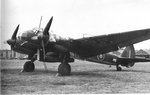
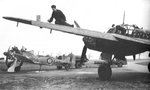
Interesting snippet taken from Testing Years by Roland Beamont; p42-3, Junkers Ju88:
At Tangmere in June 1945 the Tactics Branch of the Central Fighter Establishment had access to the Enemy Aircraft Flight and one of the aircraft on their charge was the Ju88 Nightfighter.
The large paddle-bladed propellers revolved readily and sprang into smooth life with a rumble reminiscent of a vintage car, but this soon changed to a higher-pitched and aggressive noise level as power was increased. In fact, this turned out to be a noisier than expected aeroplane but that was about the only criticism. On initial taxying in the nose-high, tail-down attitude of this tail-wheel aircraft with its tall main undercarriage there was an awkward feeling that it could easily overswing on the turn, especially downwind: but once lined up on the runway the feeling of being in a much larger aeroplane than one's previous experience had practically gone and the 88 felt a compact and well-organised aeroplane.
A short run-up to full power caused the pedal-operated brakes to slip and produced a crescendo of sound that was impressive. I had decided to increase the power progressively on take-off to forestall any unbriefed tendency to swing. This was not necessary and the 88 unstuck at less than full throttle and without any further elevator activity after my initial action to lift the tail conventionally with forward wheel to an appropriate take-off attitude. The initial climb was brisk and I needed to retract the undercarriage before increasing the power to avoid overstepping the undercarriage limit.
Cleaned up, the rate of climb in this light configuration was similar to a Mosquito and the aircraft responded pleasantly to the controls with light ailerons and conventional harmonisation. I noticed that it needed commendably little trimming also, and only when levelling out at 4,000ft and throttling back to cruise at about 230mph* were small tweaks of the elevator and rubber trim switches required.
Rapidly gaining confidence with the aeroplane I tried a few partial rolls, tight turns, rolling pull-outs and dives, climbs and wing-overs; and in all of these the aircraft was stable, responsive and apparently quite viceless except for the noise level which reached crescendo in a dive and was distracting.
Returning towards Tangmere I was about to slow down to look at low speed behaviour when I noticed a Mosquito in the circuit below. Thinking it might be Bob Braham, also a member of the Tactics Branch and the leading exponent of long-range Mosquito fighter tactics, I rolled down toward him and increased power; it was immediately apparent that it was Bob and that he wanted a fight.
The Mosquito wound into the turn in my direction and with full throttle and fine pitch I pulled the 88 into a vertical bank after him. The results were impressive for although I did not know the aircraft it was easy to hold firmly on the opposite side of the circle to the Mosquito and begin to make progress towards getting on his tail. Bob got down to it and took the Mosquito on to its stall boundary with wings rocking perceptably, but I could still see him in my forward arc. I was not far off getting into a firing position but after a number of descending full power turns over Tangmere which had the station out watching, I felt that discretion had to be the better part. I was getting into areas in which I could not possibly know the 88's characteristics so I eased up and out of the turn and Bob was promptly round and on my tail.
This flight and another the next day were enough to show why the 88 was regarded by the Germans as their best large aircraft of WWII. The performance of this nightfighter version when matched against the latest Mosquito of 1945 was remarkable when it is realised that apart from increased power in the nightfighter version, the basic 88 airframe was largely unaltered from the 1940 bomber version.
*British standard ASI fitted for trials
Below: Ju88 nightfighter flown at Tangmere in June 1945 IWM