Aircraft crashes:
Thank you for identifying the crash site of Sgt Ono (on the 'Data Base: Japanese Aircraft Engines' thread). There is a second IJAAF crash site up on a mountain top near that of Ono's crash site which is down on the river plain. Very little information is currently available about it as yet.
Access to the site required Ben Svasti to leave a local highway for a three hour drive in 4WD low, followed by a two hour seemingly "vertical" hike. Eye witness information --- second hand now from a second generation --- recounted a plane exploding midair in a cloud of white smoke. Debris seemed scattered round a wide area. There were no survivors. At first villagers dared not approach the site for fear of poison and disease, and superstition no doubt. Eventually they overcame their reluctance and found a debris field of body parts, engine parts, and aluminum framework.
The site is now largely overgrown. While cultivating bananas in the area, locals have uncovered hip bones. In addition, they retrieved some engine parts which point to a radial aircraft engine (one or more) and mechanical parts of a more tenuous nature --- see photos by Svasti:
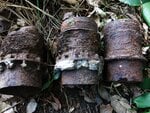
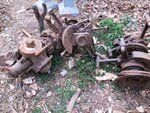
The extent of the crash site as described by Svasti seems to imply a large aircraft, such as a Ki-21. In that vein, there was a suggestion that
Senshi Sosho had described the loss of a 12th Sentai Ki-21 in the Thai mountains on 25 Dec 1941. But that is not borne out by the Google translation of
Senshi Sosho Vol 34 p 344 (1970) which mentions three losses (however, to which unit was not clear, at least as translated by Google).
Ford in
Flying Tigers on p 134 (1991), in describing 25 Dec 1941 events, mentions a pilot from the 77th Sentai as crash-landng in Thailand --- but that was a Ki 27 (that already identified by Shinpachi as piloted by Sgt Ono). Immediately thereafter in Ford's text, perhaps confusing for a reader, is mention of a badly damaged 12th Sentai Sally crashing in a bamboo forest --- no location given, but with the crew all surviving.
Shores, et al, in
Bloody Shambles, Vol 1, p 250 (1992) tells of the "12th Sentai . . . losing three Ki 21s over the target area, while a fourth was badly hit and later force-landed --- no location given.
Umemoto in
Burma Air War Vol 1, pp 41, 450 (2002) confirms that three 12th Sentai Ki-21s had been shot down over Rangoon, and added that a fourth, badly damaged crash landed in a bamboo forest in northern Malaya, with crew all surviving.
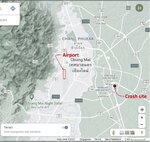
The course between Don Muang (or Phnom Penh, for that matter (see further below)) and Rangoon does not go near the crash site --- unless, as in the case of Sgt Ono, the pilot changed course to get to Japan-friendly Thailand before an anticipated crash (see mark ups on attached map from
Kameta Junichi and Jeffrey Stickley:
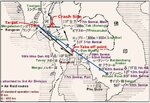
Secondary sources don't provide much guidance:
Senshi Sosho, Shores et al, Umemoto make no mention of a candidate.
Ford mentions a possible incident in two publications, but those are unfortunately ambiguous / contradictory:
- In Flying Tigers (1991), p 120: . . . the 60th Sentai . . . twenty-seven Sallys dropped their bombs on the city and headed back to Thailand with occasional interference from Allied fighters. A crewman was shot through the forehead, and one plane crashed on the way home, probably from battle damage; the fate of its crew isn't known.
- and in Rising Sun Over Burma (2014), p: Kindle: . . . the 60th Sentai under Colonel Ogawa . . . . All returned to Phnom Penh, but evidently one bomber was destroyed by a crash landing, its pilot unknown, as is the fate of the crew.
(
Senshi Sosho, Shores, et al, and Umemoto do not mention such an incident.)
There are other possibilities. Did all the aircraft listed as lost in the Rangoon raids crash in the Rangoon area?
- 12th Sentai Ki-21s on 25 Dec 1941
- Backtracking, the 62th and 98th Sentai Ki-21s on 23 Dec 1941
- Moving ahead in time, the 14th Sentai Ki-21s on 24 Jan 1942
- Setting aside the assumption of a Ki-21, the 31st Sentai Ki-30 on 23 Jan 1942
- Might the bodies at this crash site have been already dead before the plane crashed; ie, might the bodies be those in an aircraft from which survivors were known to have parachuted, such as the 3/98 Ki-21 piloted by Nogami on 23 Dec 1941? That is, the plane flew on, pilot-less, 250 km easterly to finally crash?
Any thoughts?
I thank you.
Hak Hakanson
Chiang Mai