More figures, note some of these contradict earlier reports, showing what is being measured and when is important.
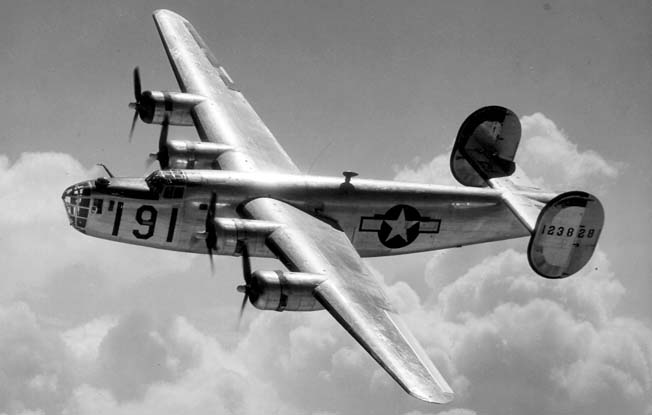
The B-24 was designed as the B-17's replacement. It was better in every respect.
The claims it was 'harder' to fly' and had a higher loss rate? Nonsense.
It wasn't 'harder to fly', it just was a more modern plane that required higher skill from the pilot.
It had no higher a loss rate than the B-17 - while carrying a bigger bomb load further.
The B-17 quickly faded away except in the ETO where its short range and small bomb load wasn't much of an issue - after all, their prime purpose once the P-51 turned up in the NWETO was fighter bait.
The last batches made in early 1945 weren't even delivered as bombers, their days were done and they were converted to SAR planes etc.
The B-24 was the USAAF's 'big hitter' until the B-29 turned up, and it wasn't even going top be replaced by the B-29. It was going to stay in production right on past 1945 as the USAAF's mainstay medium bomber. The B-29 becoming the heavy.
5,000 much improved B-24N's were cancelled with the end of the war.
(
Consolidated 32 XB-24N Liberator )
And damage resistance?
The only reason the B-17 was apparently 'tougher' was its old fashioned fat airfoils meant its wings - the bits most often hit, were mostly air - most shells went through - and it was needlessly over engineered for a disposable warplane. The wings on a B-24 were much more advanced, had a much slimmer profile with much less empty space were actually doing something useful like carrying fuel.
And the claim the B-24 was 'flimsy' and 'more lightly built' than the 'sturdy' B-17? The B-17 was 20% lighter than a B-24 - yet the B-24 flew 50mph faster on the same 4 1200hp engines
Most of the above is contradicted by the documents I have. The B-17 had a higher ceiling, important in Europe, the loss rates vary depending on time and place but overall the B-17 had the lower rates in Europe. Many reports indicate the B-17 was the easier to fly. The purpose of the bombers in Europe was to destroy ground targets, like the oil refineries, the wings of the B-17, like the B-24, had plenty of things in them, mostly fuel tanks. The B-24 fuel system, particularly in the fuselage, was prone to leaks. Over the course of the various models the B-17 and B-24 kept similar top speeds, even as each successive model tended to became slower. The B-17 was originally sold as hemisphere defence carrying the 1,600 AP bombs against approaching ships, the B-24 was meant as a heavy bomber, not a B-17 replacement but a second design in production. The B-17H, air sea rescue, with a radar set replacing the front turret. Apparently the plan was to convert 130 B-17G to H variants, but a smaller number were done. Officially the aircraft were accepted and delivered as B-17G, then modified. It looks like Cheyenne was where all the conversions to B-17H occurred then in mid July 1945 Cheyenne was ordered to shut by the end of the month so shutting down the B-17H program.
15th Air Force report,
B-24 86,838 effective sorties, 8,703 encounters, 1,374 enemy aircraft destroyed, 505 probable, 336 damaged, 803 B-24 lost to flak, 377 to enemy aircraft, 219 to mechanical and other reasons, 257 unknown, 2% loss rate, 7,538 damaged category I 1,346 category II
B-17 41,751 effective sorties, 4,531 encounters, 824 enemy aircraft destroyed, 265 probable, 124 damaged, 244 B-24 lost to flak, 179 to enemy aircraft, 108 to mechanical and other reasons, 93 unknown, 1.5% loss rate, 3,319 damaged category I 968 category II. The B-17 had 34.2% of encounters, for 32.2% of total B-17 and B-24 losses to fighters, the B-17 was 32.5% of total effective sorties but 23.3% of losses to flak, 25.3% mechanical/other and 26.6% of unknown losses.
Using Effective sorties, Mediterranean Theater, April to June 1944, selected targets,, Total bomb tonnage dropped, tons of bombs dropped per sortie, loss rates per 1,000 tons of bombs dropped, A loss rates per 1,000 effective sorties, all causes, B loss rates per 1,000 effective sorties, to enemy aircraft, C loss rates per 1,000 effective sorties, to flak.
| Target | aircraft | Sortie | bomb tons | tons/sortie | loss/bomb | A | B | C |
| Vienna | B-17 | 307 | 825 | 2.69 | 4.8 | 13 | 6.5 | 6.5 |
| Vienna | B-24 | 954 | 2142 | 2.25 | 23.8 | 53.5 | 28.3 | 23.1 |
| Wiener Neustadt | B-17 | 705 | 1973 | 2.8 | 12.2 | 34 | 19.9 | 11.3 |
| Wiener Neustadt | B-24 | 900 | 1963 | 2.18 | 21.4 | 46.7 | 11.1 | 35.6 |
| Munich | B-17 | 214 | 463 | 2.16 | 4.3 | 9.3 | 0 | 9.3 |
| Munich | B-24 | 766 | 1847 | 2.41 | 16.8 | 40.5 | 14.4 | 19.6 |
| Belgrade | B-17 | 732 | 2179 | 2.98 | 1.4 | 4.1 | 0 | 4.1 |
| Belgrade | B-24 | 704 | 1652 | 2.35 | 2.4 | 5.7 | 0 | 4.3 |
| Budapest | B-17 | 559 | 1423 | 2.55 | 10.5 | 26.8 | 14.3 | 7.2 |
| Budapest | B-24 | 801 | 1762 | 2.2 | 9.1 | 20 | 7.5 | 10 |
| Ploesti | B-17 | 1565 | 3938 | 2.52 | 7.6 | 19.2 | 8.9 | 7.7 |
| Ploesti | B-24 | 4003 | 9360 | 2.34 | 14.6 | 34.3 | 17.7 | 14.7 |
| Toulon | B-17 | 497 | 1480 | 2.98 | 0 | 0 | 0 | 0 |
| Toulon | B-24 | 1023 | 2468 | 2.41 | 4.5 | 10.8 | 0.1 | 8.8 |
Record Group 18 Entry 7 Box 5938, USAAF Mediterranean Theater for Operations 1 August 1943 to 31 January 1944, B-17 9.52 aircraft lost per 1,000 sorties, B-24 25.77. April to June 1944, B-17 14.5, B-24 17.9.
A reason I have heard for the difference in lifetimes between the B-17 and B-24 in the 15th air force was the smaller B-17 formations flying higher were often left alone for the bigger, lower B-24 formations. Things like the warning times and altitude performance of the Romanian fighter designs probably had a part as well.
The incomplete set of 15th Air Force target and duty sheets I have often record the altitude the bombs were released at, the maximum was 32,000 feet by a B-17 group, the highest recorded B-24 altitude was 27,000 feet, it is the only B-24 entry of 26,000 feet or higher, versus the 120 B-17 entries. Lowest bombing altitude, assuming no mistaken entries, was 2,300 feet, then one at 3,500 feet, all other entries are 11,000 feet or higher.
Now to where the USSBS is contradicted, the 15th Air Force figures say the B-17 dropped 104,877 tons of bombs January 1944 onwards, the B-24 192,113 tons, B-17 effective sorties from November 1943 onwards are 41,751, B-24 86,838. Even with the missing 1943 bomb tonnage it is clear the B-17 was carrying the heavier loads on average. The average bomb loads using the data in the "Target and Duty Sheets", which give a break down by bomb group, for the December 1943 to October 1944 period, noting the December 1943 figures do not include tonnage classified as jettisoned. For effective B-17 sorties December 1943 to October 1944 the average bomb load dropped was 5,400 pounds, for B-24 it was 4,690 pounds. These figures are a slight underestimate, as some sorties classified as effective have at least some of their bomb tonnage classified as jettisoned.
To the 8th Air Force, B-17 made up 70.2% of effective sorties, 72.2% of MIA, 65.2% Cat E, 5,139.4 pounds average bomb load, the B-24 29.8% of effective sorties, 25.3% of MIA, 34.8% Cat E, 5,321 pounds average bomb load, but the B-17 had the large 1943 losses the B-24 units largely avoided, for 1944 the B-17 had 66.1% of the effective sorties, 69.5% of MIA, 59.2% Cat E, B-24 33.9%, 40.8% and 30.5%
As of December 1944 the USAAF plan was to end B-17 production at Boeing in April 1945, and Douglas and Lockheed in January 1946, the B-24 was already down to 2 open production lines, San Diego scheduled to finish in July 1945 and Ford in June 1946, with 2,952 B-17 and 5,588 B-24 outstanding on current orders. End April 1945 the B-17 lines were to remain open until November and December 1946, delivering another 2,054 B-17, the B-24 lines were to shut in July 1945, delivering another 601 B-24. Actual B-24 end of production June 1945, B-17 end of production July 1945.
USN PB4Y-1 performance, all at 1,500 feet
2,814 gallons, 3,090 statute miles at 149 mph
3,214 gallons, 3,440 statute miles at 151 mph
3,063 gallons, 3,260 statute miles at 148 mph
2,019 gallons, 2,065 statute miles at 154 mph
1,272 gallons, 1,255 statute miles at 155 mph
3,614 gallons, 4,190 statute miles at 152 mph
USN PB4Y-2
3,020 gallons, 2,780 statute miles at 140 mph
2,764 gallons, 2,590 statute miles at 138 mph
2,868 gallons, 2,630 statute miles at 141 mph
1,881 gallons, 1,560 statute miles at 144 mph
3,050 gallons, 2,800 statute miles at 140 mph
3,716 gallons, 3,650 statute miles at 146 mph
The largest fuel loads are for ferry condition.
RAF Pilot's notes, Liberator III, IV and V, Maximum range cruise speeds, fully loaded, outward, 175 mph IAS, light loaded, homeward 155 mph IAS, if one speed it so be used throughout 165 mph recommended. If Special Coastal Command radio equipment is fitted reduce these speeds by 5 to 10 mph. For maximum endurance the optimum speed is about 125 to 130 mph IAS, but it may not be found to be easy to handle the aircraft for long periods below 145 mph IAS.
RAF Pilot's notes, Liberator III, VI and VIII, recommended cruising speeds for maximum range, 160 mph IAS with external ASV aerials, 170 mph IAS without external ASV aerials, 155 to 160 mph IAS at high altitudes on bomber version.
B-24D and J flight manual, 1,000 foot density altitude, revised per latest C.V.A.C flight tests 17 August 1943. P&W R-1830-43 engines 16:9 gearing, 11 foot 5 inch diameter wide blade prop. no. 6477A-O or narrow blade prop. No. 6353A-18. Ranges exclude allowances for wind, warm up and climb.
165 MPH TAS/163 IAS, 6,100 miles, 180 TAS,/177 IAS 5,875 miles, TAS 200 mph/IAS 197 mph 4,550 miles, TAS 220 mph/IAS 217 mph 2,750 miles, TAS 231 - 241 mph/IAS 228 - 238 mph 2,125 miles.
As above but for 20,000 foot density altitude, maximum range 6,150 miles speed not given, 220 MPH TAS/160 IAS, 5,750 miles, 240 TAS/175 IAS 4,525 miles, TAS 280 mph/IAS 190 mph 3,125 miles, TAS 269 - 292 mph/IAS 196 - 213 mph 2,475 miles.