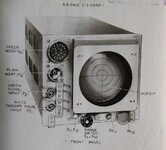
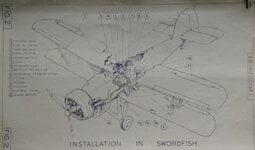
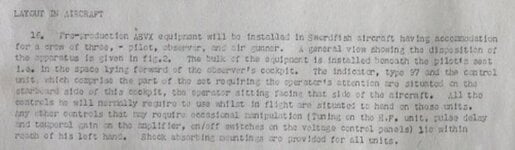
The ASV.XI set from a Swordfish III if I'm not mistaken. Big radome between the undercarriage legs, a two man crew (no TAG) and the Observer's position filled with the radar black boxes with the Observer himself sitting in the TAG's position. That model entered front line service in June 1944. Most of the squadrons that used it were on the Russian convoy run during the winter of 1944/45, so a lot of night flying in appalling weather in that open cockpit. 119 squadron RAF also operated them hunting E boats and midget subs in the southern North Sea / English Channel area in 1945 mostly at night.
What everyone seems to be looking for is photos of the Observer's cockpit of the Swordfish I/II fitted with the earlier ASV.II radar fitted from early 1941. They retained the 3 man crew.
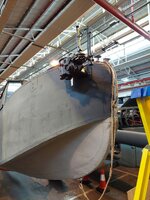
Another example of a tough call in open air. A Mark IX bombsight at the nose of, I think, a Seamew. The user had to adjust the detailed controls in a head wind with either bare, cold fingers or gloved fingers. Good luck.
When I was first taught ultrasonics, the guy teaching was C.J. Abrahams a pioneer of UT testing. He had a HUGE garage where he held his classes and in the corner some old sets, that looked exactly like the picture. It is impossible to describe how difficult it was to actually see the display let alone interpret it.
It did seem a bit like gazing into a crstal ball. Unlike today, the horizontal "time base" wasnt stable and wasnt focussed either and resolution was so poor it was just a lime green blur.
It did seem a bit like gazing into a crstal ball. Unlike today, the horizontal "time base wasnt stable and wasnt focussed either and resolution was so poor it was just a lime green blur.
Yes, out in my garage I have a WW2 vintage radar test Oscope that I paid the princely sum of $1 in 1982 and then did some repairs to get it working. Originally it had a rubber hood over the front, with the CRT located well back in the set, several inches from the front, to let darkness aid in seeing the trace.
As this is a WW2 forum I am compelled to point out that prior to WW2 the Charpy test was used in academia, with the failures on Liberty ships it became an industry standard test along with the "Batelle" drop weight tear test to verify that the material had sufficient fracture toughness to be used.