Radial engine powered Miles Master question

flateric

Recruit
5
1
Joined
Oct 5, 2015
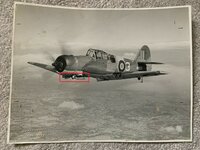
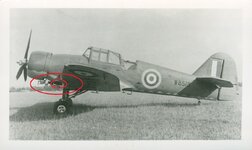
What exactly was this complicated set of bulges and what was this oval shape seen on radial engine powered Masters?
Looking also for more detailied photos of the area/drawings.

Thanks in advance!
 

Attachments

  • s-l1600 (8).jpg
    s-l1600 (8).jpg
    222.3 KB · Views: 125
  • s-l1600 (3) (1).jpg
    s-l1600 (3) (1).jpg
    251.6 KB · Views: 124
  • s-l1600 (2) (1).jpg
    s-l1600 (2) (1).jpg
    127 KB · Views: 127
Make sure you are looking at the right/correct radial engine version.

FlyboyJ's picture is a Bristol Mercury engine, a 9 cylinder radial.

The pictures in the 1st post look like P & W R-1535 engines. A 14 cylinder radial.

Just a guess but the place in circles maybe an oil cooler or outlet for the oil cooler?
 
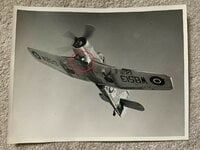
The big black oval thing inside the small red oval in the last photo is the Pratt exhaust which would have been bought down low so it was not heating the wing leading edge. The scoop facing forward will be the carb scoop. The outlet that is beside where the carb scoop enters the cowl is probably oil cooler outlet and may depend on being that far below the cowl for to provide a low pressure to drag air thru the cooler(s). I haven't a clue what the other mikey motion between and below the scoop and exhaust are in photo 3. From the first photo some of it could be some sort of oil cooler shutter to prevent overcooling the oil. The triangular item to the left of the carb scoop will probably be the oil cooler intake. If so the whole oil cooler instal must create a lot of drag.
1642486478284.png


1642485753253.png
 
The aircraft shown in the OP pictures are M.27 Master IIIs, which were, as SR stated powered by P&W Wasp Junior engines. The Master II was powered by a Bristol Mercury and had an exhaust collector ring fitted as in the image that Joe posted.

I'm with Mitasol in what the configuration of the different bits are, as the big oval holes are a mystery at first glance, but they were a feature of production Master IIIs. The type was, having a less powerful engine, 10 mph slower than the Mercury engined Master II.
 
Since the serials are present,
DL30? DL302, was a Master mark II Mercury XX engine
W8513 and W8518 were Master mark III Wasp Junior engine.

The R-1535 was an interesting choice, 602 Master III built January 1941 to October 1942, versus 1,291 R-1535 produced January 1940 to end of production in February 1941, with a whole 5 R-1535 imported into the UK after 1 July 1941.

W8513 on strength 11 June 1941, off 15 Apr1l 1944
W8518 on strength same date, no off date.
DL302 on strength 19 May 1942, off 27 March 1950.
 

Users who are viewing this thread

Back