I am well aware of where it was and the circumstances.Yes, it was an interception in the Pacific, which is an exception to bomber escort in Europe.
Your blanket statement was incorrect.

Follow along with the video below to see how to install our site as a web app on your home screen.
Note: This feature may not be available in some browsers.
Ad: This forum contains affiliate links to products on Amazon and eBay. More information in Terms and rules
I am well aware of where it was and the circumstances.Yes, it was an interception in the Pacific, which is an exception to bomber escort in Europe.
My blanket statement was for bomber escort in Europe where you can see the enemy coast as soon as you reach 20,000 ft. I now say with absolute confidence this discussion will get nowhere, because you dont want it to. Yamamotos interception was with P-38s wasnt it? In the Pacific?I am well aware of where it was and the circumstances.
Your blanket statement was incorrect.
With such a condescending attitude displayed by yourself, it is possible that the discussion might not progress very far.My blanket statement was for bomber escort in Europe where you can see the enemy coast as soon as you reach 20,000 ft. I now say with absolute confidence this discussion will get nowhere, because you dont want it to. Yamamotos interception was with P-38s wasnt it? In the Pacific?
 www.sbs.com.au
The thread title is about the P-47, you introduced Gregs video about the P-47 and when presented with links you demand exact direction to individual posts. When given the correct way to calculate range for bomber escort operations in Europe you fly off into a discussion of the P-38 on a specific interception mission in the Pacific. Did the bomber mafia steal the Yamamoto mission off the P-47 or was the P-38 chosen because of its longer range?With such a condescending attitude displayed by yourself, it is possible that the discussion might not progress very far.
However, I will try to ignore your attitude.
You are much better placed to know your own material than I would, especially as it was 3 years old or thereabouts.This is the quote you were so upset that I made you look for. Its actually ON page 6, of the thread, which is the exact page
I even suggested looking at.
Presumably I get a 2nd "how dare you" now, or not ?
View attachment 715161
I'm finding it difficult to ignore your attitude, or your earlier blanket statement.The thread title is about the P-47, you introduced Gregs video about the P-47 and when presented with links you demand exact direction to individual posts. When given the correct way to calculate range for bomber escort operations in Europe you fly off into a discussion of the P-38 on a specific interception mission in the Pacific. Did the bomber mafia steal the Yamamoto mission off the P-47 or was the P-38 chosen because of its longer range?
Well conversely when I posted you the thread link I was looking after my 18month old baby son with mum in bed asleep as we`d been up since 4am. We all have very busy lives and are not paid contributors here, the fact you didn't read the page 6 of the thread I specifically mentioned does irk, so be considerate when bringing up things like all the life stuff you have going on which absorbs your time, we ALL have similar things, and its not an efficient use of MY time to firstly dig you out the thread link because you were too busy or whatever to search for it, THEN post you the link after I had to search it out, THEN tell you which page to read THEN actually screenshot the exact post.You are much better placed to know your own material than I would, especially as it was 3 years old or thereabouts.
It does not seem too difficult to post what you just did.
In fact Hap Arnold had already resolved inn June 1943 for all bombers to be escorted on the offensive starting in 1944. To that end all three types had their internal fuel capacity increased. It was relatively easy on the P-51 (rear fuselage tanks) and P-38 ( tanks in the wing space) but difficult on the P-47 which needed a change to the fuselage..This is the quote you were so upset that I made you look for. Its actually ON page 6, of the thread, which is the exact page
I even suggested looking at.
Presumably I get a 2nd "how dare you" now, or not ?
View attachment 715161
Only Saint Greta(Thunberg) shouts "How dare you".Well conversely when I posted you the thread link I was looking after my 18month old baby son with mum in bed asleep as we`d been up since 4am. We all have very busy lives and are not paid contributors here, the fact you didn't read the page 6 of the thread I specifically mentioned does irk, so be considerate when bringing up things like all the life stuff you have going on which absorbs your time, we ALL have similar things, and its not an efficient use of MY time to firstly dig you out the thread link because you were too busy or whatever to search for it, THEN post you the link after I had to search it out, THEN tell you which page to read THEN actually screenshot the exact post.
Where would you say was the balance of effort there ?
You got rather a lot, for not a lot of input - then proceeded to have a meltdown and shout "how dare you".
So you know, perhaps a bit of consideration that your not the only person on this forum with a family to look after might be appropriate.

There was nothing "wrong" with the P-47 but Greg indulges in a wild conspiracy theory dating back to April 1939. The P-47 needed more internal fuel as well as fully functioning drop tanks in UK. The P-47 started to arrive in UK in 1942, it commenced operations in March April 1943. All of this time B-17 were being escorted by Spitfires. To me it was obvious that P-47 would escort B-17s and have to escort them as far as they wanted to go. It wasnt until June 1943 that this decision was taken. There is no doubt there were mistakes made but the conspiracy accusations are grossly unfair. What were the manufacturers doing, what were they thinking. The P-47 started in pole position and finished third in a three horse race, beaten by a horse that was asleep in the stable and getting a new saddle made when the starting gun went off.He does state that there wasn't anything actually wrong with the P47 itself, just how it was equipped - meaning the lack of appropriate drop tanks at a time when they could have made a difference.

For the sake of your argument - the ONLY definition for strategic recon is 'high altitude/long range'. It the mission not practical, wth higher risk, when performed at 35,000 feet at same or better speed and range? More threats, yes, and certainly relevant to B-17 discussion if theatre moved from Pacific to ETO. .In a word...yes. There's a lot of obfuscation in your post (I never said the Spit could survive against SAMs; my point was that strategic reconnaissance has traditionally been viewed as high-altitude, long-range). Yes, there were multiple platforms capable of performing strat PR...although the F-9 (B-17 PR variant) was deemed unsurvivable. None of that changes the relative merits of the Spitfire and P-51.
Not with F-52, but could perform high altitude (35K+ at same or higher speed) and range, with armament for enhanced survivability, with lesser optics for presumably lower quality results. But you can Not say it could not perform the 'role'. Otherwise using the same logic, I remind you the the Mustang was an infinitely better fighter than the Spitfire - OVER Berlin. The distinction is made solely on performance envelope, not on capability.I go back to your statement "There is no role that the Spitfire accomplished that was not 'easily' accommodated by the P-51B/D airframe." The P-51B/D airframe could NOT perform high-altitude, long-range PR.
So, what were the mission profiles for Spit recon in 1942? Wasn't first F.52 equipped Spit, the Mk XI which didn't really go eprational until early 1943? If so,, what camera inst'l in earlier Spit PR - F.24? Were those missions considered strategic even if not flown at 40,000 feet?IIRC F4/F5 used K-17 and K-24 cameras - were they considered tactical recon platforms?Here's an image from an F52 camera with 36in focal length lens showing Peenemunde. The collection platform was a Mosquito but the same camera installation was in the Spitfire PR MkXI:
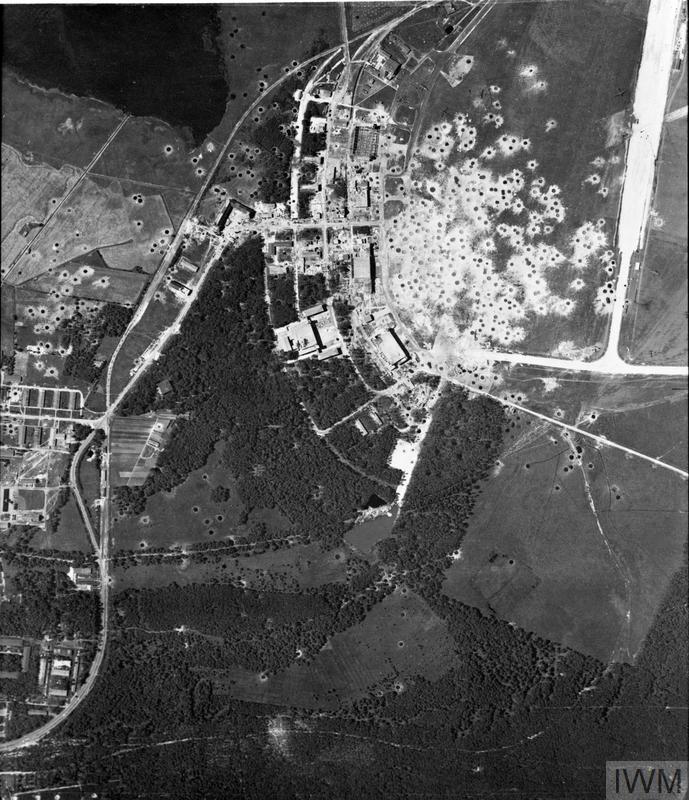
ROYAL AIR FORCE: OPERATIONS BY THE PHOTOGRAPHIC RECONNAISSANCE UNITS, 1939-1945.
Aerial reconnaissance photograph of the Rocket Research Establishment at Peenemunde, Usedom Island, Germany, taken by a De Havilland Mosquito PR Mark IX of No.www.iwm.org.uk
Imagine that image with one-third less focal length on the lens...or worse. Spitfires were flying to Peenemunde from the UK in May 1942. Your comment about Mustangs flying longer-range PR missions than Spitfires has to be compared against the Peenemunde missions. There's no way even a Mustang was flying those types of distances at low level where its oblique camera could actually collect useful IMINT.
You correctly surmised that here would be issues with deep vertical mount of the F.52. Aft of pilot's seat is the location of the glycol/aftercooler radiator matrix, and aft of that system, exiting 100C heated air into plenum. Above the radiator matrix are batteries, radios and fuel tank. There is sufficient volume and depth aft of fuel ank - but an insulated mount intruding into the plenum where the Meridith 'magic' occurs can't be a great idea. Above the radiator matrix are batteries, radios and fuel tank.I'd still like to know the depth of the F-6 fuselage to understand what size of camera and lens combination could be installed.
You didn't need to state it at all. The question posed was whch airframe was best suited to manfacturing efficiency.There are no combinations of explanations that will enable you to state that the Spitfire design, and production attributes, were comparable to NAA Mustang. I suggested that you take Castle Bromwich as the flagship and just use that as best case for unit production.I'll state this one more time....Spitfire production was distributed across dozens of sites (28 in the area of Southampton to Salisbury alone), not 3 or 4 big factories. That comes at a financial, logisitical and efficiency cost compared to having one or two really huge factories that do everything. Here's an article that gives a high-level indication of how it was made to work. Note the comments about a garage making Spitfire fuselages or one small company making all the leading edge fuel tanks.
So pick Castle Bromwich, where by accounts the majority of Spitfires were produced? And by inference the least labor intensive example of the Spitfire production airframe, including wings, were produced. By accounts, it was not particularly bound by the 'shadow' concept of dispursed job shops.
The decision to distribute manufacturing happened after the Supermarine factory was destroyed in 1940. However, once you've implemented such a complex distributed manufacturing system, it's hard to close it down and re-centralize it all.
Again, comparing the US experience to that in the UK needs to be done with consideration of the differing factors at play. You may claim that they are irrelevant but that does not make them so.
Everyone always talks about the elliptical wing being the whole issue but if you read the files it clearly wasn't exclusively the cause of Spitfire problems. The Air Ministry wrote memos criticising Supermarine for withholding in house manufacturing advice from sub contractors and shadow plants.For the sake of your argument - the ONLY definition for strategic recon is 'high altitude/long range'. It the mission not practical, wth higher risk, when performed at 35,000 feet at same or better speed and range? More threats, yes, and certainly relevant to B-17 discussion if theatre moved from Pacific to ETO. .
And yet the F-9 did perform strategic missions in Pacific and did survive. So did F-4 and F-5, so did F-6 (all types). The discusson isn't whether the Mustang was equal or better than Spitfire XIV for Strategic Recon. It clearly was not with K-24 platform (s) versus the F52 - and would not install practically in a -51D. That said your insistance that the Spitfire as a strategic recon platform at 40,000 feet may only be only mission profile used to define 'strategic recon', seems silly to me for the resons I stated above. Arguably, without debate, flying at 40000 feet with higher grade optics offers higher quality and more survivability - all threats considered for WWII. But that is only a mission profile for higher survivability - not a definition of the mission itself.
Not with F-52, but could perform high altitude (35K+ at same or higher speed) and range, with armament for enhanced survivability, with lesser optics for presumably lower quality results. But you can Not say it could not perform the 'role'. Otherwise using the same logic, I remind you the the Mustang was an infinitely better fighter than the Spitfire - OVER Berlin. The distinction is made solely on performance envelope, not on capability.
So, what were the mission profiles for Spit recon in 1942? Wasn't first F.52 equipped Spit, the Mk XI which didn't really go eprational until early 1943? If so,, what camera inst'l in earlier Spit PR - F.24? Were those missions considered strategic even if not flown at 40,000 feet?IIRC F4/F5 used K-17 and K-24 cameras - were they considered tactical recon platforms?
Actually the Mustang I with the 54 gal (bay mounted 27gal each) auxilliary tanks provided as kits, had a range of 1724 mi with reserve of 15min at 10,000 feet - and delivered with first production article Mustang in 1941. I have no clue regarding the application of the extra capability but BPC paid NAA $125 each for the kits. Delivered to all RAF for all NA-73/83.
You correctly surmised that here would be issues with deep vertical mount of the F.52. Aft of pilot's seat is the location of the glycol/aftercooler radiator matrix, and aft of that system, exiting 100C heated air into plenum. Above the radiator matrix are batteries, radios and fuel tank. There is sufficient volume and depth aft of fuel ank - but an insulated mount intruding into the plenum where the Meridith 'magic' occurs can't be a great idea. Above the radiator matrix are batteries, radios and fuel tank.
So, if 'strategic recon' is defined by F.52 mounted vertically and zipping along in pressurized cabin at 40,000 feet - then he Spitfire must have the unique and singular reputation as the only strategic recon' platform - and the sole example of such during WWII?
Nope. That said, it demonstrated an excellence at the mission, that the P-51D did not perform. I do not concede however that identifying strategic information via airborne recon flying from say 3000 eet to 30,000 feet was not achieved with P-51C/D/K and K-24 system, particularly in Pacific and CBI.
You didn't need to state it at all. The question posed was whch airframe was best suited to manfacturing efficiency.There are no combinations of explanations that will enable you to state that the Spitfire design, and production attributes, were comparable to NAA Mustang. I suggested that you take Castle Bromwich as the flagship and just use that as best case for unit production.
So pick Castle Bromwich, where by accounts the majority of Spitfires were produced? And by inference the least labor intensive example of the Spitfire production airframe, including wings, were produced. By accounts, it was not particularly bound by the 'shadow' concept of dispursed job shops.
Let's summarize
Strategic Recon
A lot of words and arms waving - but your arguments net out as follows:
Only F52 camera provided technology for strategic recon. No other optic platform could perform the precision optical acquisition deemed minimum std for strategic recon.
Ergo as the Spitfire was modified to install a F.52 camera, it entered the class of suitable LR strategic recon platforms with Mosquito in 1943.
Conversely, those aiframes that did not have F.52 installed could not perform strategic recon.
Conclusion, no strategic recon was performed by any other nation that did not operate with the F52.
Ar 234 for example, or B-17/B-24/B-29 fail by your yardstick - despite floating in 25-35K range which is an easy envelope for and F-6B/C/D
In your heart you know that is not true. The Mustang could perform strategic recon - but I concede not to same level of quality. IIRC it was also the highest population airframe dedicated to recon in context of primary purpose of recon As a Mustang I, through F-6 airframe series, flying at low to intermediate altitude it gathered intel considered both tactical and strategic. Nobody discared strategic images because they werent acquired by F.52 at 40,000 feet.
But - Agreed- Not able to fly 40 K recon runs with F.52. Not Agreed - that P-51B/D in F-6 could Not fly strategic recon at say 35K with K-24 and deliver less quality images.
Manufacturing
Both Spitfire and Mustang produced in distributed scheme - Mustang two points, Spitfire many.
Each NAA Plant building Mustang also produced large volume of AT-6, while managing multiple models under one roof. Additionally NAA Inglewood was building B-25 and performing centralized airframe design, R&D, Experimental builds - in parallel with production at Inglewood (A-36, XP-51B, P-51D-1, XP-51F/G/J and XP-82) from 11-42 through EOW
Each plant was 1200 mi from the other. While Dallas actually a satellite plant, it stood alone as a single point production site - not dependent on Inglewood for production resources.
Philosophically, NAA completed the airframe in each single location. Bespoke operations perormed following completion, as kits produced at either Inglewood or Dallas were dispatched amd installed via intermediate depot contractor. No Mustang returned to complete it. No other subcontractor built the kits.
If you want to reduce to comparison of just any One Spitfire plant to Inglewood, fire away.
AFAIK, no Spitfire major plants were interrupted by LW after 1940. Same for NAA. Both Inglewood and Woolston suffered Worker's strikes (I suspect common Communist agitation - until Germany invaded Russia). By accounts the loss of Woolston triggered the shadow factory scheme, but Castle Bromwich soldiered on as single point. The key metric IMO was labor hours (perhaps worth higher scrutiny) in which the NAA's unit direct labor total per P-51D was 2000 hours in 1945. FWIIW all models of P-51/A-36 were delivered, pre GFE, between 38-35K. The XP-51B were priced at $41K.NAA made profit based on constantly improving production process approaching battery processes applied at Ford and GM, versus job shop/bespoke. BTW I understand that the average Price/cost associated with average Spit was far lower - but the disparity in labor hours is more revealing for comparisons.
I simply asked you to compare after November 1942 when NAA delivering to AAF in addtion to RAF - with any one or two or all Spitfire facilities delivering Spitfire. Didn't even ask for labor hours/parts/overhead comparisons per airframe.
I'm not talking about 'American' superiority - just NAA over Supermarine wrt to combined Design to Manufacturaility scheme - of the Mustang over Spitfire.
There was nothing "wrong" with the P-47 but Greg indulges in a wild conspiracy theory dating back to April 1939. The P-47 needed more internal fuel as well as fully functioning drop tanks in UK. The P-47 started to arrive in UK in 1942, it commenced operations in March April 1943. All of this time B-17 were being escorted by Spitfires. To me it was obvious that P-47 would escort B-17s and have to escort them as far as they wanted to go. It wasnt until June 1943 that this decision was taken. There is no doubt there were mistakes made but the conspiracy accusations are grossly unfair. What were the manufacturers doing, what were they thinking. The P-47 started in pole position and finished third in a three horse race, beaten by a horse that was asleep in the stable and getting a new saddle made when the starting gun went off.
What was included and/ or excluded in Arnolds categrory "tactical airplane"?Dating back to May 1939 was the statement from "Hap" Arnold prohibiting AAC funding of drop tanks.
See screen shot from Greg's video @4.16
View attachment 715175
Some manufacturers went ahead anyway, as did the USN.
Republic, possibly as a way around the directive, developed a 200 gallon "conformal" type tank, which was not a "drop" tank as such, but was fixed.
See @5.54 of the video.
There was nothing "wrong" with the P-47 but Greg indulges in a wild conspiracy theory dating back to April 1939. The P-47 needed more internal fuel as well as fully functioning drop tanks in UK. The P-47 started to arrive in UK in 1942, it commenced operations in March April 1943. All of this time B-17 were being escorted by Spitfires. To me it was obvious that P-47 would escort B-17s and have to escort them as far as they wanted to go. It wasnt until June 1943 that this decision was taken. There is no doubt there were mistakes made but the conspiracy accusations are grossly unfair. What were the manufacturers doing, what were they thinking. The P-47 started in pole position and finished third in a three horse race, beaten by a horse that was asleep in the stable and getting a new saddle made when the starting gun went off.
Quoting Greg directly from the video @ 4.16 "no fighters would have drop tanks".What was included and/ or excluded in Arnolds categrory "tactical airplane"?
That's not what the document saysQuoting Greg directly from the video @ 4.16 "no fighters would have drop tanks".
THIS IS GETTING INCREDIBLY EXASPERATING - I WAS ONLY RESPONDING TO JUST SCHMIDT, AND A POST BY PBEN IS ALSO QUOTED
But what I wrote, in reply to your earlier post, is exactly what Greg said - verbatim.That's not what the document says


