
Navigation
Install the app
How to install the app on iOS
Follow along with the video below to see how to install our site as a web app on your home screen.
Note: This feature may not be available in some browsers.
More options
You are using an out of date browser. It may not display this or other websites correctly.
You should upgrade or use an alternative browser.
You should upgrade or use an alternative browser.
"The case for the P-47 Thunderbolt being the greatest fighter of the Second World War "
- Thread starter NVSMITH
- Start date
Ad: This forum contains affiliate links to products on Amazon and eBay. More information in Terms and rules
More options
Who Replied?
SaparotRob
Unter Gemeine Geschwader Murmeltier XIII
That's great!
Just Schmidt
Senior Airman
Very nice chart, one thing surprized me.View attachment 715046
Always loved this comparision.
The Mustang fills the shoes of the Thunderbolt relatively well, I guess it's too easy to think of it as a rather flimsy thing. Not in this comparizon.
Here is its history. Delivered to an MU in Sept 1945. First squadron service in 1949 with 611 (West Lancashire) Squadron Royal Auxiliary Air Force which flew the type between Feb 1949 and Nov 1951 based out of RAF Woodvale in Lancashire, England. The CO at that time was the then test pilot Roland Beaumont.A museum in my home town of Perth has a Mk22 Spitfire that served in the RAF in 1945 and standing next to it it's surprising how small it is, but looking at the comparison above the Me109 is even smaller.

drgondog
Major
Fat girl at the Prom.A catfight is over when a Thunder girl comes out of the bathroom and towers over those pretty girls.
View attachment 715025
Just Schmidt
Senior Airman
But still feeling abowe everybody else...Fat girl at the Prom.

GrauGeist
Generalfeldmarschall zur Luftschiff Abteilung
The KI-43 was actually just a bit smaller than the A6M both in length and wingspan.
That is the Prom mafia to blame.Fat girl at the Prom.
Thanks a lot mate, appreciate the informationHere is its history. Delivered to an MU in Sept 1945. First squadron service in 1949 with 611 (West Lancashire) Squadron Royal Auxiliary Air Force which flew the type between Feb 1949 and Nov 1951 based out of RAF Woodvale in Lancashire, England. The CO at that time was the then test pilot Roland Beaumont.

buffnut453
Captain
Generous, but the first Mustang Is and P-51-NA were modified for F24 and operational in 1942. They were dispatched by RAF to perform image gathering missions of important German assets far beyond range of Spitfires, some strategic, some tactical.
To your points - as a refresher. The Spitfire XIV was superior as a platform than any P-51 system I can contemplate, absent requested and delivered optic system installable aft of exit scoop. Even then a vertical installation would be subject to heated exhaust distortion - hence side mount. I did not argue that point - I argued the mission requirement and definition of strategic recon - namely a platform to gather images of important enemy assets at long range and return. You have been arguing that even an F-6B/C/D/K with verically or oblique mounted cameras could not be a platform to gather precision images of strategic assets suitable for interpretation.
Absent the disqualifier of 'can't capture a plant location, a radar array, an assembly or staging of assets in Rail center deep n German territory, bomb damage assessment' at medium altitudes with K-24', then your only discussion points have to be 'not the same quality' - which case even the Mustang I and then F-6 series Mustangs were already gathering strategic and tactical images from 1942 forward. The choice of high altitude is all about risk management not mission capability. A stripped down F-6B/C/D/K is equal in general performance at 25-40,000 feet, save lack of pressurization.
Hmm, you are reaching into the threat world of SAMs which dictated conditions the Mk XIV could not survive.
I suggest that strategic reconnaissance mission includes but not limited to: ground based intelligence gathering, low level photo recon, high level recon and SIGINT of opponent's important asset details. I suggest that B-17s, Ju 88s, Bf 109, Mosquito, P-38/F-5 are examples of platforms from which strategic recon missions were performed.
The Mission profile and vehicle in case of airframes are dictated by the objective of a.) gathering reliable and informative images for interpretation, b. availability of a suitable airframe equipped with quality camera, and c.) returning to base with said images.
Do you disagree?
In a word...yes. There's a lot of obfuscation in your post (I never said the Spit could survive against SAMs; my point was that strategic reconnaissance has traditionally been viewed as high-altitude, long-range). Yes, there were multiple platforms capable of performing strat PR...although the F-9 (B-17 PR variant) was deemed unsurvivable. None of that changes the relative merits of the Spitfire and P-51.
I go back to your statement "There is no role that the Spitfire accomplished that was not 'easily' accommodated by the P-51B/D airframe." The P-51B/D airframe could NOT perform high-altitude, long-range PR.
Here's an image from an F52 camera with 36in focal length lens showing Peenemunde. The collection platform was a Mosquito but the same camera installation was in the Spitfire PR MkXI:
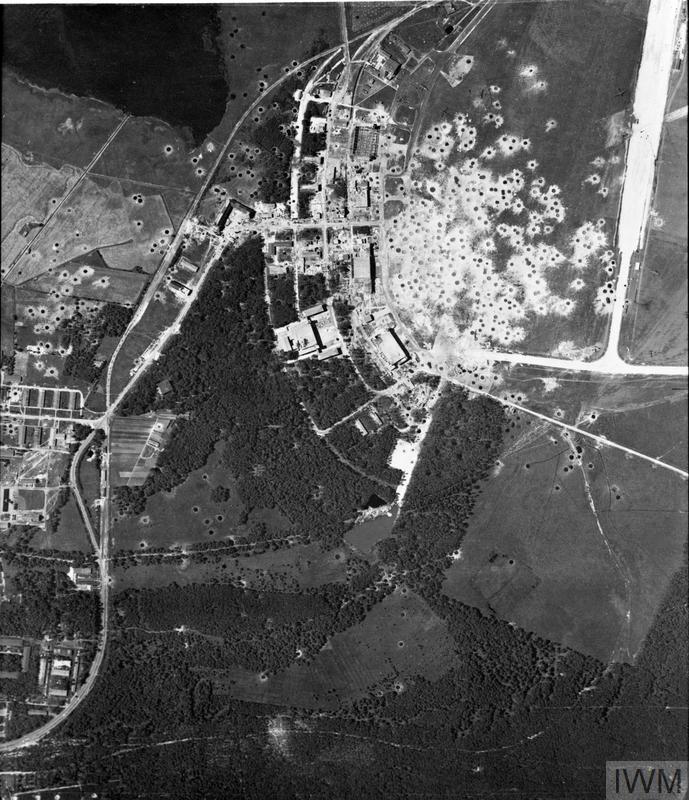
ROYAL AIR FORCE: OPERATIONS BY THE PHOTOGRAPHIC RECONNAISSANCE UNITS, 1939-1945.
Aerial reconnaissance photograph of the Rocket Research Establishment at Peenemunde, Usedom Island, Germany, taken by a De Havilland Mosquito PR Mark IX of No.
Imagine that image with one-third less focal length on the lens...or worse. Spitfires were flying to Peenemunde from the UK in May 1942. Your comment about Mustangs flying longer-range PR missions than Spitfires has to be compared against the Peenemunde missions. There's no way even a Mustang was flying those types of distances at low level where its oblique camera could actually collect useful IMINT.
I'd still like to know the depth of the F-6 fuselage to understand what size of camera and lens combination could be installed.
My arguments lack substance if a.) the wing with mods were not built separately from the plant assembling the airframe, and b) did not materially change the jigs and tooling from one design to the next.
In the comparison to the Mustang using the NA-97 A-36 as an example of the most prolific and substantive change until P-51H. 1.) Modified from NA-83 Wing in which all lines and dimensions remained intact but
Pitot tube and plumbing changed internally
Bomb rack and internal fuel plumbing introduced.
Gun bay dimensions and local rib placement (slight jig change issue)
Dive brakes installed w/controls and strengthened main spar (cap sizing) plus sheet thickness in several wing panels increased, primarily for bomb load.
Various design for both 20mm cannon (including slanted mounts) and 50 caliber mount and feed chutes. Same bay dimensions and gun mount design as NA-91 (Mustang IA)
No change except pitot tube, removal dive brakes, and landing light arrangement (LE mod - local) for P-51A
Strenghen aileron hinge/spar for P-51B/C-1 (no dimensional change) for 15 degree throw.
Change from 2 hing to 3hinge aileron on P-51B-5, C-5
Change LE from WS 30 to 65 to accomodate wheel bay door change, Change LE locally to provide for three gun battery, change gun bay mount scheme to 3 un upright, change ammo chute and ejection port.
In February, at Inglewod, three individual lines were supported - A-36, P-51A, P-51B-1 along with B-25 and AT-6 production. The contributions for improvement to Production by GM consultants in 1942 can not be overestimated.
When the D wing design began, the B Lines and jigs and tooling were modified to co-reside with B-5 wing assy, to implement production immediately with no prototype. It was installed on the two B-1 airframe spares set aside for the Cockpit enclosure, sliding" modifications as P-51D-NA. The tooliing and jigs remained unchangedfor the remainder of the P-51D production save for rocket mount scheme. The D wing could have been retrofitted to the B/C airframes. The B/C wing could have been installed on the D-K.
The sole major departure from Mustangwing of 1941 was the XP-51F/G/J leading to P-51H. Completely Different in all respects and not retro capable to any previous Mustang.
If the many changes to Spitfire wing were of similar complexity and impact to production, I stand corrected for the comparisons to production and field maintenance.
Nope. Only that the reasons for plant dispersal - and NAA choice of separate plants 1200 miles apart - are irrelevant. The comparison of poulation is irrelevant, the land mass available is irrelevant. What is relevant is the unit of production comparisons based on a.) the strategic choice for dispersal, and b.) the resulting design to production cycles based on matching training labor pool, Tooling, Jigs, assembly and plant layouts - built around several existing airframes of different complexity.
Comparing the most productive Spitfire factory, given the very high war board piorities to each airframe by respective authorities, to NAA Factory is precisely what the comparisons should be. Given that no material disruption to Spitfire production by LW from late 1942 through EOW, particulary at Castle Bromwich
I'll state this one more time....Spitfire production was distributed across dozens of sites (28 in the area of Southampton to Salisbury alone), not 3 or 4 big factories. That comes at a financial, logisitical and efficiency cost compared to having one or two really huge factories that do everything. Here's an article that gives a high-level indication of how it was made to work. Note the comments about a garage making Spitfire fuselages or one small company making all the leading edge fuel tanks.
The decision to distribute manufacturing happened after the Supermarine factory was destroyed in 1940. However, once you've implemented such a complex distributed manufacturing system, it's hard to close it down and re-centralize it all.
Again, comparing the US experience to that in the UK needs to be done with consideration of the differing factors at play. You may claim that they are irrelevant but that does not make them so.
SaparotRob
Unter Gemeine Geschwader Murmeltier XIII
That is an interesting report. The P-47C was far nimbler than I thought.Back to the OP.... I haven't yet bothered to read the hushkit article. The last few I've read have been irritatingly 'clickbaity', and I suspect that the title of this latest piece is likely to reflect that same editorial desire.
That said, The P47 is undoubtedly a great aircraft. But the claim 'greatest' doesn't seem to stand any objective scrutiny to my mind.
I found the following interesting reading. P-47 Tactical Trials

Since the discussion switched to reconnaissance, I wonder if could P-47 become a good recon platform. High speed at high altitudes and large fuselage (probably) allow to fit several cameras in... I noticed that RP-47B was mentioned in some articles, but without many details.
buffnut453
Captain
Since the discussion switched to reconnaissance, I wonder if could P-47 become a good recon platform. High speed at high altitudes and large fuselage (probably) allow to fit several cameras in... I noticed that RP-47B was mentioned in some articles, but without many details.
Not really. The turbosupercharger under the fuselage prevented carriage of vertical cameras. Installing oblique cameras ought to have been straightforward.
Cameras could be installed in the dance hall, on the left hand side as you near the rear wheel.Not really. The turbosupercharger under the fuselage prevented carriage of vertical cameras. Installing oblique cameras ought to have been straightforward.
buffnut453
Captain
Cameras could be installed in the dance hall, on the left hand side as you near the rear wheel.
That's the room opposite the swimming pool, right? Just aft of the bowling alley?

Thumpalumpacus
Colonel
Since the discussion switched to reconnaissance, I wonder if could P-47 become a good recon platform. High speed at high altitudes and large fuselage (probably) allow to fit several cameras in... I noticed that RP-47B was mentioned in some articles, but without many details.
Short range, perhaps, long range, probably not before the -N.
GrauGeist
Generalfeldmarschall zur Luftschiff Abteilung
There were some photo recon P-47Bs, with the camera situated by the intercooler vent, but that's all.
Interestingly enough, the few photo recon Jugs had the "RP" designation instead of the "F" prefix and all of the P-47Bs ended up being designated RP (restricted from combat) by early 1944.
Interestingly enough, the few photo recon Jugs had the "RP" designation instead of the "F" prefix and all of the P-47Bs ended up being designated RP (restricted from combat) by early 1944.
buffnut453
Captain
There were some photo recon P-47Bs, with the camera situated by the intercooler vent, but that's all.
Interestingly enough, the few photo recon Jugs had the "RP" designation instead of the "F" prefix and all of the P-47Bs ended up being designated RP (restricted from combat) by early 1944.
Yeah, I forgot there were a few RP-47Bs. Seems like a similar set up to the vertical camera installed in a small number of P-43s. It clearly wasn't worth continuing given that no other such conversions were made.
Users who are viewing this thread
Total: 1 (members: 0, guests: 1)


