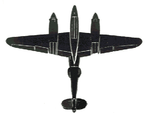
Stich, I think it could have worked, but the nacelles would have had to be long to have space (and proper positioning) for the landing gear. (or switch to a taildragger) The radiator could have gone under the foreward part of the nacelle, like the one on the P-40's nose.
However, with the large nacelles (probably weighing almost as much as the previous booms) and the added weight of the fuselage, the aircraft would probably have been somewhat heavier.
The push-pull twin boom configuration is interesting as it eliminates the extra drag and rotational inertia (though the small booms will still add some) of outboard placed engines, and is significantly simpler than the Do 335's arrangement. (however, only a small armament would be able to be sone mounted, and -except for an engine cannon- would have to be synchronized)
And, Bill, most of what you discussed was common to all twin engined aircraft. I think the question was what was the advantages of the twin boom configuration compared to wing mounted nacelles with a central fuselage. (though, as I introduced, there are many other possibilities for the twin boom arrangement)