
UK & US discover Japan's plans in detail October 1941

Ad: This forum contains affiliate links to products on Amazon and eBay. More information in Terms and rules

I know Manila didn't have a drydock sufficient to hoist even a Standard American BB of the era, and it lacked the fuel storage for ongoing operations. I can't speak with any authority about Singapore's facilities. I do know that both hypothetical bases were in Japanese air range, and both lacked adequate air defenses. Not a good place to park valuable naval assets. So yes, damaged American ships would likely return to PH, holing up in Manila only to make them seaworthy for the voyage, but no permanent repairs.
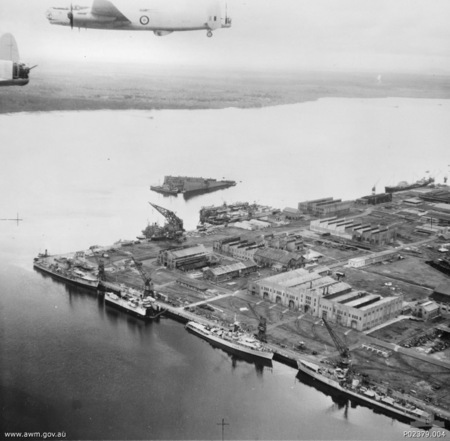
Britain built a new naval dockyard at Singapore between the wars to support a large fleet to be sent East in the event of war with Japan. It opened in 1938 but construction went on into 1941. It had the world's largest dry dock (King George VI dock) plus AFD9 (55,000 ton lift) plus another smaller cruiser sized AFD


It had oil fuel storage for about 1.3 million tons of oil fuel for ships and extensive warehousing for naval stores. There were extensive defensive gun batteries up to 15" and also anti-aircraft guns including c40 3.7" AHA weapons placed strategically around the island. There were also 4 airfields on the island. Unfortunately most of the aircraft allocated to the theatre were mostly less than modern (Buffalo fighters, Blenheim bombers, Vildebeest biplane torpedo bombers).

The Cavite yard in the Philippines on the other hand only had access to a cruiser sized floating dock and other dry docks for destroyers and submarines. The Asiatic Fleet had two fleet oilers to haul oil from refineries in the DEI (Balikpapan) to keep whatever storage existed at Cavite topped up.

The differences between the two bases is one reason for Britain trying to persuade the US Pacific Fleet to move part of its available ships in early 1941.
 
Britain built a new naval dockyard at Singapore between the wars to support a large fleet to be sent East in the event of war with Japan. It opened in 1938 but construction went on into 1941. It had the world's largest dry dock (King George VI dock) plus AFD9 (55,000 ton lift) plus another smaller cruiser sized AFD


It had oil fuel storage for about 1.3 million tons of oil fuel for ships and extensive warehousing for naval stores. There were extensive defensive gun batteries up to 15" and also anti-aircraft guns including c40 3.7" AHA weapons placed strategically around the island. There were also 4 airfields on the island. Unfortunately most of the aircraft allocated to the theatre were mostly less than modern (Buffalo fighters, Blenheim bombers, Vildebeest biplane torpedo bombers).

The Cavite yard in the Philippines on the other hand only had access to a cruiser sized floating dock and other dry docks for destroyers and submarines. The Asiatic Fleet had two fleet oilers to haul oil from refineries in the DEI (Balikpapan) to keep whatever storage existed at Cavite topped up.

The differences between the two bases is one reason for Britain trying to persuade the US Pacific Fleet to move part of its available ships in early 1941.

Thanks for broadening my info blank on this score. Had the US known Pearl wasn't to be attacked (per the thread's hypothetical) by autumn 1941, it seems possible that they could have arrived by 8 Dec, were the political will there. But without the attack on Pearl Harbor, would that political will be there? I don't think so.
 
Thanks for broadening my info blank on this score. Had the US known Pearl wasn't to be attacked (per the thread's hypothetical) by autumn 1941, it seems possible that they could have arrived by 8 Dec, were the political will there. But without the attack on Pearl Harbor, would that political will be there? I don't think so.

Without a DoW or formal alliance can FDR pull this off?

I really don't see there being the political will either. How would FDR sell such a move to the isolationists, even if their influence was waning? And also how to sell it as something not to be seen as propping up nations like Britain, France and the Netherlands with their extensive colonies in the region?

So the US Pacific Fleet is not moving further forward than PH especially given its lack of logistic support (tankers, supply ships etc) beyond that point. This article highlights the USN oil problem in the aftermath of PH.
 
I would like to suggest you look up the combat record of the Japanese cruiser Mogami while escorting the Imperial Japanese Army's navy. I'm thinking Battle of Sunda Strait.
The Japanese Army had its own navy. (Thanks GrauGeist!)
What does the cruiser Mogami have to do with a "supposed" IJA running it's own fleet? as for the latter I have run across such rumors but never come across any substantially backed
information - maybe you can kindly highlight this to me?

As for the Mogami - it was part of the first Fleet and assigned mostly to the 7th Cruiser Division (IJN)
As for Malaya, the Mogami was assigned to cover the invasion of Malaya as part of 7th Cruiser Division under Vice Admiral Jiaburo Ozawa's First Southern Expeditionary Fleet, providing close support for landings of Japanese troops at Singora, Pattani and Kota Bharu - where as the land operation were part and under command of the Southern Expeditionary Army under Gensui (Marshal) Terauchi Hisaichi - who had devised the plans for the Pacific war together with his IJN counterpart Admiral Yamamoto Isoroku.
 
What does the cruiser Mogami have to do with a "supposed" IJA running it's own fleet? as for the latter I have run across such rumors but never come across any substantially backed
information - maybe you can kindly highlight this to me?

As for the Mogami - it was part of the first Fleet and assigned mostly to the 7th Cruiser Division (IJN)
As for Malaya, the Mogami was assigned to cover the invasion of Malaya as part of 7th Cruiser Division under Vice Admiral Jiaburo Ozawa's First Southern Expeditionary Fleet, providing close support for landings of Japanese troops at Singora, Pattani and Kota Bharu - where as the land operation were part and under command of the Southern Expeditionary Army under Gensui (Marshal) Terauchi Hisaichi - who had devised the plans for the Pacific war together with his IJN counterpart Admiral Yamamoto Isoroku.
The Mogami torpedoed 5 Imperial Japanese Army transport ships. It's one of my favorite combat exploits.
 
What does the cruiser Mogami have to do with a "supposed" IJA running it's own fleet? as for the latter I have run across such rumors but never come across any substantially backed
information - maybe you can kindly highlight this to me?

As for the Mogami - it was part of the first Fleet and assigned mostly to the 7th Cruiser Division (IJN)
As for Malaya, the Mogami was assigned to cover the invasion of Malaya as part of 7th Cruiser Division under Vice Admiral Jiaburo Ozawa's First Southern Expeditionary Fleet, providing close support for landings of Japanese troops at Singora, Pattani and Kota Bharu - where as the land operation were part and under command of the Southern Expeditionary Army under Gensui (Marshal) Terauchi Hisaichi - who had devised the plans for the Pacific war together with his IJN counterpart Admiral Yamamoto Isoroku.

The best resource for the detailed histories of all Japanese warships, including those of the Imperial Japanese Army, is the Combined Fleet site.

The IJA ships are much more than "rumors". You will find detailed histories here

Detailed history of Mogami here, including the incident on 28th Feb 1942 when, along with the destroyer Fubuki, it is believed she was responsible for sinking Japanese ships.
 
I would like to suggest you look up the combat record of the Japanese cruiser Mogami while escorting the Imperial Japanese Army's navy. I'm thinking Battle of Sunda Strait.
The Japanese Army had its own navy. (Thanks GrauGeist!)
What does the cruiser Mogami have to do with a "supposed" IJA running it's own combat fleet? as for the latter I have run across such rumors but never come across any substantially backed information - maybe you can kindly highlight this to me?

As for the Mogami - it was part of the first Fleet and assigned mostly to the 7th Cruiser Division (IJN)
As for Malaya, the Mogami was assigned to cover the invasion of Malaya as part of 7th Cruiser Division under Vice Admiral Jiaburo Ozawa's First Southern Expeditionary Fleet, providing close support for landings of Japanese troops at Singora, Pattani and Kota Bharu - where as the land operation were part and under command of the Southern Expeditionary Army under Gensui (Marshal) Terauchi Hisaichi - who had devised the plans for the Pacific war together with his IJN counterpart Admiral Yamamoto Isoroku.

As for Sunda Strait, I assume that you are referring to the Shinshu Maru - which wasn't a IJN combat asset - but an "assigned" troop carrier or nowadays refered to as an amphibious assault ship to the 16th IJA. (belonging to the IJA and sometimes using cover names such as Fuso Maru, and Ryujo Maru). That the IJA had it's own merchant vessels and troop carriers
is known but to my knowledge never naval combat vessels. as such I don't see the statement that the IJA had it's own fleet to be valid other then having had transport ships.

But as I said, if you have more information I would be very interested to know/learn about.
 
Last edited:
The Americans were beefing up the defenses of the Philippines all during 1941.
The Naval base at Cavite dated to before the Spanish-American war and was the only repair facility in the Western Pacific for the US.
It had been allowed to stagnate or even be weakened during the period of the peace treaties when the nations weren't supposed to be fortifying /reinforcing their forward bases.
The US was shipping aircraft and materials into the Philippines including tanks, SP guns and artillery for the Philippine army.

The Japanese could NOT bypass the Philippines and move on to Malaya, Burma, Indonesia and expect to get their booty back to Japan.
I agree with your statements. Japan wanted to conquer the Philippines (US territory) thereby getting into a war with the USA. The military threat did not come from the Philippines
but from the USN based at the time in Pearl. So logically if you want to attack the Philippines, you need to (or be well advised) to take out the USN at Pearl first or simultaneously.

The Japanese could have taken on the Brits independently in Malaya and the Dutch in Indonesia. taking into account that the USA will not go to war. Therefore my statement that the Malayan/Dutch East Indies campaign was an independent issue within a general war plan.

Since however the Japanese had included the Philippines in their "Southern drive" - all three operations can be seen as one overall strategy, especially since all three operations were conducted simultaneously.
But since the Malayan/Dutch operation was conducted by an independently organized task-forces - the attack onto the Philippines could have been stopped due to "bad" reports coming in from "climb mount ...."

The Malayan/Dutch operations could and IMO would have still been conducted - and IJN assets freed from the Philippine operation (after landing troops) plus other IJN assets could and would have been deployed towards a US Naval advance. Meaning that despite the loss of the IJN Pearl task-force - (to what ever extend) the operation Malaya or both Malaya and Philippines would could still be conducted. -
Even if the overall strategy failed (which it historically, partially did) it has no major imminent effect on the other two simultaniously running operations, That's all I was trying to say.
 
What does the cruiser Mogami have to do with a "supposed" IJA running it's own combat fleet? as for the latter I have run across such rumors but never come across any substantially backed information - maybe you can kindly highlight this to me?

As for the Mogami - it was part of the first Fleet and assigned mostly to the 7th Cruiser Division (IJN)
As for Malaya, the Mogami was assigned to cover the invasion of Malaya as part of 7th Cruiser Division under Vice Admiral Jiaburo Ozawa's First Southern Expeditionary Fleet, providing close support for landings of Japanese troops at Singora, Pattani and Kota Bharu - where as the land operation were part and under command of the Southern Expeditionary Army under Gensui (Marshal) Terauchi Hisaichi - who had devised the plans for the Pacific war together with his IJN counterpart Admiral Yamamoto Isoroku.

As for Sunda Strait, I assume that you are referring to the Shinshu Maru - which wasn't a IJN combat asset - but an "assigned" troop carrier or nowadays refered to as an amphibious assault ship to the 16th IJA. (belonging to the IJA and sometimes using cover names such as Fuso Maru, and Ryujo Maru). That the IJA had it's own merchant vessels and troop carriers
is known but to my knowledge never naval combat vessels. as such I don't see the statement that the IJA had it's own fleet to be valid other then having had transport ships.

But as I said, if you have more information I would be very interested to know/learn about.
I just thought it might be as amusing to you as it is to me, given the animosity between the IJA and the IJN.
 
From Hyperwar, this is from the USSBS and based upon interviews with the Japanese officers listed below the quote:

The purposes of the surprise attack on Pearl Harbor were:
To render impotent the United States Pacific Fleet in order to gain time and to insure freedom of action in the South Seas Operation, (including invasion of the Philippine Islands), and to facilitate the defense of the mandated islands. The attack was conceived and proposed by Admiral Isoroku Yamamoto, CinC of the Japanese Combined Fleet. In January 1941, Rear Admiral Tokijiro Onishi, Chief of Staff of the 11th Air Fleet was ordered to make a preliminary study of the operation, and in the first part of September 1941 members of the Operations Section of the Naval General Staff and selected members of the Staffs of the Combined Fleet and the First Air Fleet commenced work on the details of the actual plan.


The information contained in this narrative was supplied from memory by the Japanese officers listed below and, although considered accurate in general, may be subject to minor corrections in detail after examination of translated documents.
  • Admiral Nagano, Osami -- Chief of the Naval General Staff.
    Rear Admiral Mito, Highashi -- Chief of Staff, Sixth Fleet (Submarines).
    Captain Tomioka, Sadatoshi -- Chief Operations Section, Naval General Staff.
    Commander Miyo, Tatsukichi -- Member Operations Section, Naval General Staff.
    Captain Kuroshia, Kameto,
    Captain Watanabe, Yajuji -- Members Staff Combined Fleet.
    Captain Fuchida, Mitsuo -- Leader of First Attack on Pearl Harbor.
 
From Hyperwar, this is from the USSBS and based upon interviews with the Japanese officers listed below the quote:

The purposes of the surprise attack on Pearl Harbor were:
To render impotent the United States Pacific Fleet in order to gain time and to insure freedom of action in the South Seas Operation, (including invasion of the Philippine Islands), and to facilitate the defense of the mandated islands. The attack was conceived and proposed by Admiral Isoroku Yamamoto, CinC of the Japanese Combined Fleet. In January 1941, Rear Admiral Tokijiro Onishi, Chief of Staff of the 11th Air Fleet was ordered to make a preliminary study of the operation, and in the first part of September 1941 members of the Operations Section of the Naval General Staff and selected members of the Staffs of the Combined Fleet and the First Air Fleet commenced work on the details of the actual plan.


The information contained in this narrative was supplied from memory by the Japanese officers listed below and, although considered accurate in general, may be subject to minor corrections in detail after examination of translated documents.
  • Admiral Nagano, Osami -- Chief of the Naval General Staff.
    Rear Admiral Mito, Highashi -- Chief of Staff, Sixth Fleet (Submarines).
    Captain Tomioka, Sadatoshi -- Chief Operations Section, Naval General Staff.
    Commander Miyo, Tatsukichi -- Member Operations Section, Naval General Staff.
    Captain Kuroshia, Kameto,
    Captain Watanabe, Yajuji -- Members Staff Combined Fleet.
    Captain Fuchida, Mitsuo -- Leader of First Attack on Pearl Harbor.
Thanks for the informative article.

....sank HMS Prince of Wales and HMS Repulse with the loss of only four planes. This action not only removed the only threat to the Malaya invasion forces but also.....

That is why I initially forwarded that the Malayan/Dutch campaign was an independent issue for the Japanese - regardless of attacking Pearl and the Philippines.
But it belonged into an overall strategy encompassing three main operations.

The article also mentions:
1. If discovered prior to "X"-minus-2-day, the Task Force (Pearl) was to return to Japan without executing the attack.
2. If at any time during the approach to Pearl Harbor the negotiations with the United States had been successful the attack would have been cancelled.

So would the attack onto Malaya and Dutch East-Indies been called off too?

4. If, at any time during the approach to Pearl Harbor the American Fleet attempted to intercept the Japanese Task Force, the Japanese planned to counterattack. If the American Fleet advanced into Japanese home waters in pursuit of the Task Force it was planned to commit the Main Body of the Japanese Fleet as a support force.
So would the attack onto Malaya, Dutch East-Indies and the Philippines been called off too?
 
Thanks for the informative article.

....sank HMS Prince of Wales and HMS Repulse with the loss of only four planes. This action not only removed the only threat to the Malaya invasion forces but also.....

That is why I initially forwarded that the Malayan/Dutch campaign was an independent issue for the Japanese - regardless of attacking Pearl and the Philippines.
But it belonged into an overall strategy encompassing three main operations.

The article also mentions:
1. If discovered prior to "X"-minus-2-day, the Task Force (Pearl) was to return to Japan without executing the attack.
2. If at any time during the approach to Pearl Harbor the negotiations with the United States had been successful the attack would have been cancelled.

So would the attack onto Malaya and Dutch East-Indies been called off too?

Probably. The Japanese wanted a free hand in Southeast Asia, and if they could get that without going to war with America they probably would have seized the opportunity.

4. If, at any time during the approach to Pearl Harbor the American Fleet attempted to intercept the Japanese Task Force, the Japanese planned to counterattack. If the American Fleet advanced into Japanese home waters in pursuit of the Task Force it was planned to commit the Main Body of the Japanese Fleet as a support force.
So would the attack onto Malaya, Dutch East-Indies and the Philippines been called off too?

Called off? No. The entire purpose of their launching the war was to seize the oil and rubber resources in the region. Delayed? Probably. You go after the enemy attempting to forestall your objectives before seizing your objectives, generally.
 
Map of the South West pacific area.
swpa-map-1942-l.jpg


If the Japanese try to by pass the Philippines to leave the US out of the conflict how much of a risk are they taking?
If the US gets several hundred bombers into the Philippines and expands the naval forces by very much at all (another 6 Subs ?) and the US decides to enter the one, two or 3 months after the Japanese attack Singapore and the Dutch East Indies what do the Japanese do to secure their supply lines?
Do they they think the US would only join the war at 30% chance, or 10% chance or 50% chance?
How much trouble could a US force in Philippines cause the Japanese if left alone for several months (and forget the US battleships sailing across the Pacific) before they started sinking Japanese merchant ships?
Remember that the Japanese have no idea that the US torpedoes were as bad as they turned out to be.
Between the Iron embargo and the oil embargo the US cannot be seen as anything less than hostile.

The Philippines simply pose too great a risk to communications (sea traffic) to anything west of New Guinea to the China coast for Japan to gamble on leaving them alone.
 
Map of the South West pacific area.
View attachment 667294

If the Japanese try to by pass the Philippines to leave the US out of the conflict how much of a risk are they taking?
If the US gets several hundred bombers into the Philippines and expands the naval forces by very much at all (another 6 Subs ?) and the US decides to enter the one, two or 3 months after the Japanese attack Singapore and the Dutch East Indies what do the Japanese do to secure their supply lines?
Do they they think the US would only join the war at 30% chance, or 10% chance or 50% chance?
How much trouble could a US force in Philippines cause the Japanese if left alone for several months (and forget the US battleships sailing across the Pacific) before they started sinking Japanese merchant ships?
Remember that the Japanese have no idea that the US torpedoes were as bad as they turned out to be.
Between the Iron embargo and the oil embargo the US cannot be seen as anything less than hostile.

The Philippines simply pose too great a risk to communications (sea traffic) to anything west of New Guinea to the China coast for Japan to gamble on leaving them alone.
That is why I had posted previously:

The Malayan/Dutch operations could and IMO would have still been conducted - and IJN assets freed from the Philippine operation (after landing troops) plus other IJN assets could and would have been deployed towards a US Naval advance. Meaning that despite the loss of the IJN Pearl task-force - (to what ever extend) the operation Malaya or both Malaya and Philippines would could still be conducted. -
Even if the overall strategy failed (which it historically, partially did) it has no major imminent effect on the other two simultaniously running operations, That's all I was trying to say.


My question towards Thumpalumpacus had arisen out of the Japanese plan described in his forwarded article:

1. If discovered prior to "X"-minus-2-day, the Task Force (Pearl) was to return to Japan without executing the attack.
2. If at any time during the approach to Pearl Harbor the negotiations with the United States had been successful the attack would have been cancelled.


So point 1. would need to be taken into account in regards to this "hypothetical scenario/thread". just "discovered" not even being attacked, would already result in cancellation.

As such - back to the thread's original idea - what action would/could the US have planed in regards to stopping the attack onto all, or only the US concerning attacks.
 

Users who are viewing this thread

Back