FLYBOYJ
"THE GREAT GAZOO"
OK, first it needs to be a four-engined plane. Since the B-29 was only a paper dream in 1940, I can't just make things easy and build it.
I thought we were talking 1942?

Follow along with the video below to see how to install our site as a web app on your home screen.
Note: This feature may not be available in some browsers.
OK, first it needs to be a four-engined plane. Since the B-29 was only a paper dream in 1940, I can't just make things easy and build it.

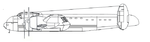
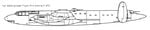
Four engine Mosquio, built from metal...
Initial production (1942-1943): RR Griffon III/IV
Late production (1944 onwards): Two options: 2,050 hp RR Griffon 65 for high altitude bomber, or 2,450/2,585 hp Bristol Centaurus for a medium altitude version
Metal allows the aircraft to be lighter and/or stronger than the original 'Wooden wonder'
Expand the wingspan and lengthen the fuselage to accommodate at least 2 x 4,000 MC or HC bombs.
Non 'cookie' loads would be somewhat limited, probably to 4,000-6,000 lbs (typically 9 x 500 lbs/6x 1,000 lbs. 3 x 2,000 lbs).
Top speed would be in the order of 425-430 mph, possibly higher. Cruising speed would be in excess of 350 mph at 30,000 ft, higher (both in terms of speed and altiude) for Griffon 65 engine versions.
No defensive armament.

I would attempt to hybrid a CH-47 with a B-26 or B-25.
Bill

I would attempt to hybrid a CH-47 with a B-26 or B-25.
The end result would probably end up being smaller than either, but it would retain two engines in the wings. The idea would be to allow the bomber to land and take off from a stationary position and climb to altitude using the helicopter blades, and then gain speed using the engines.
As the speed builds up the rotary blades could shut down and aline themselves with the fuselage, similarly to how a helicopter is actually stored. The purpose would be to protect the blades from damage in a combat zone, while the plane flies as normal bomber would using its radial engines.
The question is could 1942 technology achieve this?
Bill


What does Fortress I has to do with night bombing? Did they scored any kills vs. night fighters?No armament is risky for a number of reasons IMHO. 'Nothing will be able to catch me' is a fallacy - the RAF thought that about the Fortress I, and the Germans did catch and kill a number of them, even though they were armed.
I would also argue that armament gives a morale boost to crews, especially in a large and relatively slow aircraft like a heavy bomber.
The guns may not score any kills, but they can boost crew morale, and may force some attackers to hold back or even abort an attack altogether.

I know most folks will quote the Mossie against both of these arguments, but that was an awful lot faster and more agile than a Lanc, so had a better chance to begin with. If you're going to send an unarmed, radial engined Lanc in to combat zone, you might as well scrap it altogether and use the C-54 instead...
The hortons didn´t matured their powered wing designs in 1942 but they did later.
The Ju-288 can fill the following roles almost superbly:
[+]strategic patrol plane with long range
[+]high altitude level bomber
[+]medium range, medium altitude, heavy bomber
[+]dive bomber (not sure, though- probably only shallow attack)
[+]maritime patrol/attack aircraft
[+]high speed, long range, high altitude reconnaissance
[+]high speed, medium altitude raids
[+]night bomber
[+]high speed, low level attack bomber
Why is that a problem? Even today we cannot bomb accurately from 30,000 feet using iron bombs. A WWII era level bomber should be operating at 15 to 20,000 feet. Just high enough to get above the accurate range of medium flak like the Bofors 40mm.high altitude performance of the Ju 288 was pretty poor
The idea follows a CH-47, but it does not need to be the equivalent. The finished design may actually be much smaller as i suggested.