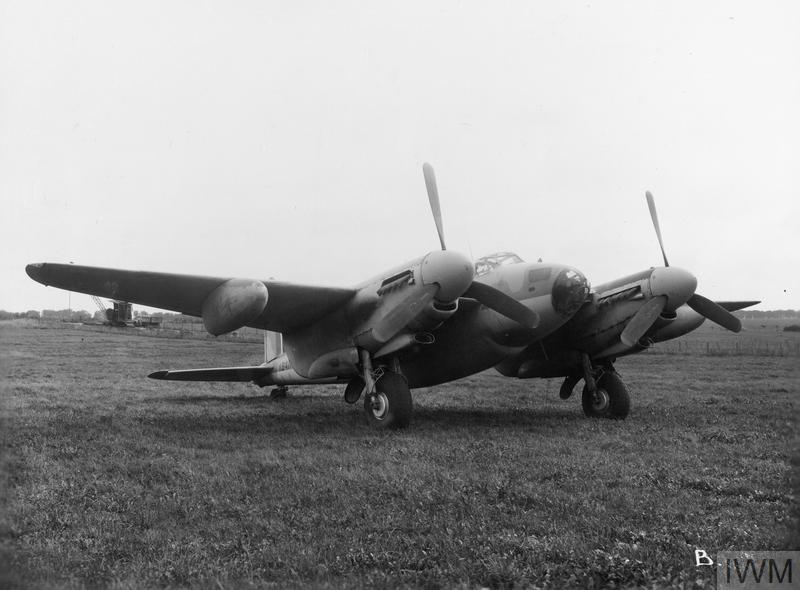
Wait a minute. Woah. Hold on padnuh. IIRC the Mosquito bomber wasn't flying in any numbers until 1942.
By then, you have thousands of Soviet aircraft made of wood, many of them with speeds of ~ 350 mph, and in mid 1942 they introduced the 400 mph La 5. All of these made of wood. The Soviets made tens of thousands of aircraft made of laminated plywood and resin during WW2.
If the Soviets could make ~20,000 Yak series fighters, and 9,000 La 5s I am certain the US could make at least that many Mosquitos if they really wanted to.
What USSR produced is otally irrelevant to his debate. The key questions are a.) When is the earliest possible recognition that the Special Mosquito is a plausible alternative to B-17/24 for long range strategic bombing, b.) when can design/configuration be decided - leading to GFE procurement of specific engine variant of Packard Merlin, and c.) how early could a decision be made to prioritize production. If Merlin 61 series is the engine selected, then the A1 Priority for NAA P-51B must be the loser for Super Mosquito to procede. Alternative would be to seek and fund separate source for both.
Time is not your friend. Single point decision is not practical. AAF, War Production Board, stakeholders in Packard Production (by international agreement with BAM/RAF) must all agree on path forward.
You seem to pass and wave at serious milestones for both available technology (Merlin 61 or equivilant for combined high/low altitude options) and priority production allocations - for engines, raw material sourcing, labor training, tooling and critical materials. It is boring when you declare victory and state with zippo that some persuasive alien parasite infects AAF top command, R-R and DeHaviland senior officers, with a compulsion to forecast the specifications for a wooden two engine/zero defensive armament bomber as the highest probability successful daylight strategic bomber to go to War against Germany -
In or before 1940.
That would be about right block of time to drain funding for wartime expansion, from investment capital to be unleashed in the US and build the production facility, and hire and tain labor force, develop sourcing for balsa supply, engage with DeHaviland for rights to license intellecual property for Mosquito, engage with R-R for parallel production license other than Packard, build prototype with Merlin XX, with full knowledge that R-R has the 2S/2S Merlin 61 emerging from R&D in 1941 and so perform design study and plans for upgraded cooling system requirements to minimize transition to new, high performance engine.
The second point you overlook is that extremely early foresight and recognition that a Special Mosquito, undefended, without escort, was a better solution for AWPD-2 than heavily defended B-17s/B-24s attacking long range strategic targets. To the hard nosed advocates of Strategic Airpower I mentioned earlier, how do you a.) identify the recently introduced Mosquito as the basis for Super Mosquito which will Clearly be able to strike targets at very long range, undefended, when ONLY heavily defended bomber were considered feasible - and long range escorts were not considered 'possible' by AAF, and b.) excite them and the War Production Board to assign the highest priority to your Special Mosquito project?
From a technology perspective the Merlin 61 (IMO) was on critical path, leading to best possible earliest delivery of Special Mosquito as mid 1943 for early (and few Packard 1650-3 engines @2 each per ship). For that to happen the P-51B must be delayed for a significant length of time for the 'new' Packard plant to build 1650-3 for Mustangs. The decision to produce the Merlin by license must go to a US based, bigger Packard type company. This project was never going to be high enough priority in Britain for R-R to produce for American Mosquito, as the demand for Spitfire and Lancaster exceeded supply.
With the chain of earliest possible start in 1940 for 100% buy in on Special Mosquito, the elapsed time to complete the design changes to initial Mosquito airframe for Special Mosquitio, execute technolgy (enginering/production Processes/QA) transfer from DeHaviland, execute technolgy transfer from R-R to new engine company for parallel operations to Packard, it is not conceivable that first flight of American built Special Mosquito is any earlier than for XP-51B November 30, 1942. Same critical path for ironing out cooling issues of Merlin 61 for the XP-51B drives production solution to say March 1943. That said, not even Packard had producton 1650-3 delivered to NAA until late April, 1943 and NAA had as many as 40 completed, save engines, P-51Bs in June 1943. ThwT The Packard union was on strike in June, causing delay to approximately 1000 engines by more than 30 more days. Project Training Command ramp up to allocate training centers, organize syllabus and trainers for Flight Ops, Maintainers, pilots and begin training for the projected mission profile. As a parallel comparison, recognize that the Allison Mustang (P-51-NA) had been in AAF inventory in summer 1942 - but organized and trained and start of operation required a year for 30+ to see action in MTO in June 1943.
Question - how in hell does USSR experience in building with wood assist in speeding up American made Special Mosquito to improve the above project initiation to delivery cycle?
This is all based on crystal ball concept of seeding the ultimate plan for attack operations in Group force strength by January 1944, into presuming that all the key figures required to make it happen in 1940 would be infected with the Special Mosquito religious fervor, far earlier than AAF-HQ Planning could be convinced that a Special Mosquito attack vehicle could improve target destruction efficiency over large formations of B-17/B-24. Even under the rosiest circumstances the initial dribble of Mosquitos would be equivalent to perhaps the same for P-51B and C, but Mosquito only 1/2 the airframes based on 2 engine delivery requirements compared to P-51B.
So, the Special Mosquito could never start ops until early 1944 - based on impssible assumptions.
Now, how about experience based disgruntlement on part of AAF-HQ and 8th/12th AF in combat from summer/fall 1942.
Remember specifically that the results expected for precision were very high for B-17/Norden bombsight through 1942, although results varied from 'good to abysmal'. The doctrine of "The bomber will always get through' was irrefutable from start of 8th AF ops through Blitz Week at end of July 1943. So, no possibility of convincing AAF High Command that a change was remotely feasible until after August 17th raid to Regensburg and Schweinfurt. No ' aha moment yet for 4-engine mission.
Further - There was zero inclination by RAF for placing a large force of Mosquitos to join RAF BC attacking Berlin and other deep targets to achieve pin point target destruction. Why not? RAF had very clever planners and leaders. Just because they got their nose bloodied by LW in 1940 performing daylight bombing, would not preclude RAF from capitalizing on a Mosquito Plan and try it out - Before 8th started deep penetrations in July 1943. The 'why not' is that in-theatre leaders with operational experience of Mosquito caability for long range strategic strikes were Silent on the subject.
So, historically and factually, the Mosquito was not projected into the Strategic Bombing Plan as the long range precsion bomber - day or night.
Note: To this critical point, not even the very knowledgable contrbutors on this forum have presented a clear aircraft model, mission profile (presumably by daylight given precision delivery requirements, presumably low level at point of attack) that actual combat results demonstrate before 1943 - point to a solid plan for USAAF to duplicate for 8th AF. But to your constant 'we could do this, we could do that - your words are meaningless until the 'why and how and when' can be nailed down as a basis for review, you can not expect folks to take your dream seriously. It might just be me, but if you can't present logic and facts to support how USAAF leaders could see - and agree- your vision, then you can't baffle them with a blizzard of non correlated examples such as 'what the USSR did'
To Continue: It is at this moment ('aha' perhaps after October 1943 Schweinfurt bloody nose), super salesman must begin Convincing AAF/War Production Board) that a.) you must quickly obtain RAF/BAM and DeHaviland agreement to license Super Mosquito, b.) otain agreement to override R-R, Packard/RF/AAF agreement for Merlin production allocations to 'other Mosquitos, Hurricanes, Lancasters, etc and re-direct to Super Mosquito. Equally urgent is obtaining agreement for technology transfer to obtain all raw material procurement, engineering and production support persnnel, training processes etc.
Then, at this moment, when the performance envelope of the P-51B is more widely shared, and deliveries have commenced before Schweinfurt, you must argue for future priority of Packard 1650-3 and -7 engines at expense of slowing or closing P-51B/C/D to all operational AAF theatres (as well as RAF).
Pause here. One last point regarding earlier possible decision in 1943.
What possible proof points, even given foreknowledge of potential large force 1945 Super Mosquito capabilities, can you propose to Generals Arnold, Spaaz and Eaker (and Churchill and Portal) at Casablanca to compel the 'aha' to take back to US and state 'forget about long range strategic airpower conducted during daylight' - then give highest Priority to Special Mosquito.
Recall that POINTBLANK was all about destroying German industrial capability and render Germany incapable of resisting invasion projected for spring 1944 - and that the 'Bomb them by Day and Night' theme by Eaker to Churchill was said to be the turning point after which Churchill no loger actively resisted US notion that Germany could be successfully attacked in daylight.
The Priority decision to commit to Mosquito 'bomber' could only follow several time based milestones, the first and most important being a recognition that the Mosquito would serve the POINTBANK objectives for RAF and USAAF crafted at Casablanca - spring 1943.
But if RAF recognized that the proposed strategic capability of the Super Mosquito was better for daylight role- and deemed suitable to attack power grids, refineries, ball bearings, etc. with low losses - why would RAF not take the mission as its own? There would be no replacement of 8th AF B-17s, just a change in RAF doctrine.
Last point, arguably introduction of P-51B and resultant destruction of LW Day Fighter ability to resist Overlord - was more important than improving daylight bombing target destruction efficiency. There is no scenario (realistic, fact based) that projects Super Mosquito as more important than P-51B and thus unrealistic that Mosquito could divert NAA committed Merlin 61 based engines from Packard to achieve eary 1944 delivery.