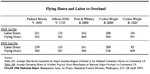
Just for completeness, here are the data from Table 115 for the Statistical Journal of the USAAF:
These are, as Joe said above, all Continental USA numbers and are somewhat unrelated to engines being operated on the front lines. I'd expect front-line engines to be overhauled either slightly sooner or about the same time since any Merlin or Allison that was running at overhaul hours was running pretty decently. If the engine was being operated on, say, Malta, where Coral dust was so prevalent, it wouldn't make TBO and would be overhaul based on condition rather than overhaul hours.
The Merlins were great engines for high-altitude, long-range flying,and the Allison was developed into one, but wasn't quite there when it was needed. Right when Allison started building the G-series engine and they really made decent power, they started cancelling pistons for jets, and Allison never did get the G-series engines as reliable as earlier Allisons were. For my money a -100 series E-series or F-series engine was the best Allison for the money.
As for the Merlin, it was there, could do the job well if not superbly, was reliable in service, and usually lasted some 35 - 50 mission before needing to be swapped out. That isn't all that bad. Many Merlins were found to be "in spec" when received for overhaul, and the "overhaul" consisted mostly of new bearings, perhaps a valve or two, cleanup of parts, and possibly new supercharger impellers, with possibly a gear or two, depending on inspection. Rods were probably changed on the second or third overhaul regardless of condition. I seriously doubt they wore out many cams or crankshafts. They are stout units. Typical of British engines, they gave some serious attention to ignition systems at overhaul.
But in service, the Merlins were as reliable as any aero engine of the day, and moreso than some.
I can say this. I've worked 8 Planes of Fame airshows. We usually have 30 - 35 WWII aircraft there with a mixed bag of Allisons, Merlins, Wrights, Prats, and a smattering of others. The planes fly for 3 days with about 50 - 65 sorties per day. That's 1200 - 1400 sorties in my airshow years there. We've had maybe 5 - 6 mission aborts in that time with one being a flat tire, one being hydraulic-related (A Corsair could get the wings to come down), and 2 of the aborts were radials. That leaves 1 or 2 aborts for the V-12s, and, as I recall, a P-51D had a run-down battery on one, and the other was a Curtiss-Electric prop on a P-40E that needed brushes.
In my book, that ain't bad considering we have probably about half Merlins there in a typical year.
Above, I'm calling an "abort" a plane that is scheduled to take off and the pilot goes out to it to fly the show and then discovers something wrong. There were a few others that never tried to fly because something was discovered before the scheduled flight. Most of those are not engine-related.
We did have one B-17 have an emergency in flight when he hit a BIG bird. The damage was a hole in the leading edge inboard of the #1 engine, and was not engine-related. He landed safely and flew home on schedule. Who knew a bird had that much blood or that many feathers?
By the way. The Merlin was done in typical British craftsman fashion and the Allison was optimized for production. Consequently the Allison has about 7,000 parts including nuts and bolts and the Merlin has about 11,000 parts. A significant amount of the Merlin labor is dealing with another 2,000+ fasteners, many with pal-nuts! The actual overhaul labor is very similar, but taking a Merlin apart and putting one back together again means handling probably 5,000 more fasteners than for an Allison (apart and back together, both tasks). These are aircraft nuts and don't "spin" off by hand. You use a wrench all the way (no, not a ratchet wrench!), and that takes awhile.
For clarity, it is not really 2,500 more fasteners, it is 2,500 more parts. A fastener was a bolt, a washer, a nut and pal nut or a bolt, a washer, a lock washer, and a nut ... depending on application. Sometimes there were two washers. Then there is the safety wire and/or cotter pins to consider. None are hard to work with, but all take time to place and tighten to spec.





 EKB raised the whole "Merlin is so-o-o unreliable vs the Allison" schtick; it's up to EKB to support his own convictions with more than just meaningless, bald statements. In the meantime I suggest EKB read Harvey-Bailey carefully to find out for himself how Rolls-Royce resolved various component failures.

