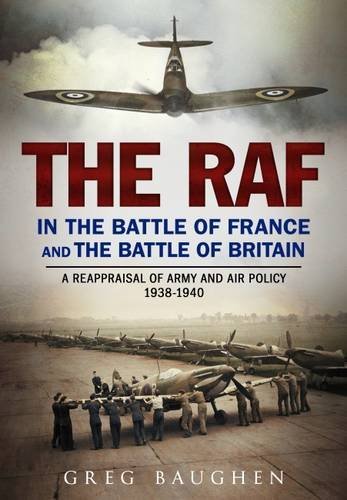
I am reading few books that are rather critical of the RAF in the late 30s and early 40s
What are their titles?
When trying to predict the future there are always those who argue with absolute certainty based on absolute ignorance of what is to come while afterwards there are the writers looking back wanting to show how obviously incompetent the ancestors were. Those Romans had basic steam engines as toys, good control of landscape, straight Roman roads, a wide trade economy, advanced engineering with all those aqueducts, metal working, surely it was the dire impacts steam power would have on a slave based economy that stopped the rail revolution of the 1st century BCE or earlier. Ask yourself what did the Romans ever do for you?
The USN war plan against Japan ended in a negotiated peace, since the planners knew the US could never produce enough stuff to mount an invasion of a Japanese main island. The 1920's USAAF discussions at Maxwell about the future had things like 100 division armies in the field, but debated about fights and squadrons as that was all they actually had, not the groups and wings a 100 division army would need.
In peace time the Defence Department tends to defend the department, while going to war amongst itself. Strategic Bombing and its counterpoint Strategic Defence were close to "pure" air only operations, anything "tactical" and the issue of who was finally in command came into play. World War I had seen little air/ground or air/naval operations and in any case for most of the war the army and navy had their own air power. The pre 1918 fighting had shown the benefits of reconnaissance and air spotting. The 1918 offensives had shown the costs and benefits of airpower combat intervention on the front line. In the 1930's it was understood air power could intervene much further away with more effect, on land it could actually hurt the rail system and so isolate the battlefield. The idea of joint plans under a supreme commander was a utopian theory and to be fair, required real experience about what worked. Also of course the big driver of WWII combined operations was large scale amphibious attacks, not required for a repeat WWI. Probably somewhere in the background some people were pointing out France could choose to stay neutral and the British were not going to be able to create an army as big as Germany's so go air force.
In the 1920's the RN was almost back to the 2 power standard, if France, Italy and Germany declared war all at the same time the RN had a nice measure of superiority. France and Germany could not come by sea and Germany had to go through France by land, that left air power.
Pre WWI the British air force effectively did not exist, then the ramp up during WWI was very end weighted, 60 odd squadrons passed in 1917, peaking at 204 in November 1918, back to 29 in 1920, or about 1915 levels, rising to 65 in early 1935, up to 158 in September 1939, peaking at over 500 squadrons in WWII, back to 150 in the late 1940's.
On 1 January 1935 the RAF had 14 fighter squadrons in Britain, the Auxiliary Air Force Squadrons were light bomber and army co-operation units, 14 reserve squadrons were formed or redesignated fighter between March 1935 and August 1939, another 11 regular squadrons formed, giving 39 fighter squadrons nominally available in September 1939, another 18 squadrons formed in October 1939.
In 1935 there was the heavy weight Heyford at 9,200 pounds, with what we consider the simple trainer Anson arriving at 5,375 pounds, and on the horizon what we consider the light weight Battle at 6,647 pounds and Blenheim at 8,100 pounds. The Whitley at 15,475 pounds and Wellington 18,000 pounds, these were the RAF heavy bombers of the mid 1930's. Then came the 4 engine types.
Whatever individual officers wanted the actual schemes approved were A in July 1934 for completion in March 1939 for 127.5 squadrons (16.5 FAA) including 13 reserve squadrons there were 28 fighter and 8 heavy bomber based in Britain. Scheme C in May 1935 upped that to 166.5 including 13 reserve and FAA, with 35 fighter and 20 Heavy Bomber based in Britain by March 1937, both A and C had 5 Army Co-operation squadrons, C increased some squadron strengths. Scheme F was November 1935 for completion March 1939, had 187 squadrons including 20 reserve, again upped some squadron strengths, light bomber units abolished, 30 fighter, 20 heavy bomber and 11 Army Co-Operation in Britain.
Scheme H was withdrawn, Scheme J (38 fighter 64 heavy bomber) was cut down to become K in January 1938, completion in March 1941, 38 fighter, 58 heavy bomber, 11 army co-operation in Britain, but it was overtaken by events. J for the first time added Japan as an issue. Scheme L in April 1938 for completion in March 1940 had 38 fighter, 47 heavy bomber and 11 army co-operation in Britain, all up 180 squadrons without the FAA.
Finally came scheme M in October 1938 for completion in March 1942, 50 fighter, 85 heavy bomber, 9 army co-operation squadrons in Britain, 212 squadrons all up, no more medium bomber squadrons. Apart from the RAF desire for bombing the distances from Britain to Germany mandated heavy bombers to obtain the necessary range and bomb loads. Scheme A had based in Britain a 500 aircraft striking force, 336 fighters, 64 coastal and 60 army co-operation, scheme M had 1,360 striking force, 800 fighters, 281 coastal, 108 army co-operation.
Scheme M fighters were Typhoon, Tornado and Whirlwind, bombers Halifax, Manchester and Stirling.
The British tend to dislike large armies and the trauma of WWI intensified that, meaning in early 1938 the army was not thinking in terms of sending any force onto the continent, later they upgraded the expeditionary force to 2 divisions. In mid 1939 came the idea of sending an army sized unit, but the British Army preparedness then went backwards as conscription was introduced.
The next problem is the definition of army support, for the army it included them having control of a large bombing force that hit the front line positions. The RAF at the time thought reconnaissance and some strategic interdiction, key rail centres at key times sort of thing, with any reconnaissance aircraft carrying a few bombs for targets of opportunity. Neither side of the debate was understanding the other, neither had the right doctrine. The RAF certainly was not interested in the tactical support of armies as defined in 1944, but neither was the army, and given the army was not talking about expeditionary forces until near the start of WWII the RAF actually had quite a sizeable Army Co-operation Command.
In September 1939 the command came to 13 squadrons, Bomber Command had 39 squadrons, Fighter Command 36 squadrons and Coastal Command 19 squadrons. The 13 Army Co-Operation squadrons were, 1, 73, 85, 87 Hurricane, 2, 4, 13, 16, 26, 614, Lysander, 613 Hind/Hector, 53, 59 Blenheim. Obviously 613 squadron was not front line. The Blenheims were meant as longer range reconnaissance. 2 squadron received Lysanders in July 1938, 4 squadron went to Lysanders in December 1938, 13 squadron received Lysanders in January 1939, 16 squadron received Lysanders in May 1938, 26 squadron, Lysanders in February 1939, and 614 squadron Lysanders in July 1939. So essentially the RAF was actually ahead of the army in providing basic reconnaissance airpower, but well behind in terms of firepower.
Number 1 group Bomber Command had 10 Fairey Battle squadrons, they went to France in September 1939, to either bring them within range of Germany (strategic) or to support the army (tactical) depending on how you read the relevant documents. By May 1940 it was understood the Battles would do tactical bombing. A new number 1 group was being formed in Bomber Command on the assumption the Battle squadrons would not be returning. The then current thinking was the majority of the Blenheim bomber squadrons, number 2 group, would move to France in the foreseeable future and the Battle squadrons would convert to more modern aircraft. Things like the airfield construction program had been delayed by the bad weather. In the period September 1939 to April 1940 very little effective work was done on figuring out how to combine air and ground forces.
When the fighting started in May 1940 the RAF had in France, under the Air Component, so meant to directly support the army, 4 fighter, 5 short range reconnaissance (Lysander), 2 long range bomber reconnaissance and another 2 bomber squadrons with Blenheims. The striking force had 2 fighter, 1 strategic reconnaissance and 10 bomber squadrons (8 Battle and 2 Blenheim). The 6 fighter squadrons were reinforced by another 4 once the Germans attacked. The ground force they were supporting had 10 front line divisions plus another 3 in training, and plans were to expand to something like 15 or more divisions when you add the armour and Canadians.
In June 1944, with a much better doctrine 2nd TAF had 12 bomber squadrons (6 Mosquito fighter bomber, 2 Boston, 4 Mitchell), as well as 8 tactical reconnaissance squadrons (Spitfires, Mustangs) and 9 Auster squadrons. The latter effectively army units. The big difference of course is fighter squadrons, there were something like 66 fighter squadrons in 2nd TAF in June 1944, including 6 night fighter. This to support the 1944 army of around 17 divisions, so a larger size to that in May 1940. Of course there were other air assets available in both 1940 and 1944 with lots more in 1944, but the above is essentially the airpower which was supposed to give priority to army support.
So in 1940 there were 7 reconnaissance squadrons, in 1944 there were 8, with another 9 very short range reconnaissance squadrons who have a main purpose of artillery fire control, but clearly are useful observers. In 1940 and 1944 there were 12 bomber squadrons. Of course the role of front line support had been moved from bomber to fighter aircraft so there really should be more bomber squadrons in 1940 to match the 1944 force mix.
The support assets were there in 1940 and in remarkably accurate numbers relative to the army they were supporting given the lack of experience and planning. In the end the lack of fighters in 1940 meant the support aircraft were not going to be very effective even if they had good doctrine. And the doctrine required all parties to work together, something that really took until Montgomery took control of 8th Army.
Essentially the RAF actually provided a reasonable army support force in 1940 but made a big contribution to ensuring it would be ineffective thanks to poor doctrine. The RAF did not provide a reasonable defence force. The army also hurt development of doctrine. The Lysander was a more survivable aircraft than the Auster. In 1940 lots of Lysanders did not survive, in 1944 lots of Austers did. The miscellaneous types require air superiority to function well with minimal losses.